Stitching Stories
Preaching
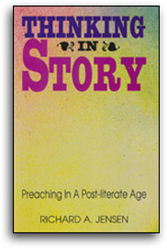
THINKING IN STORY
Preaching In A Post-literate Age
I have sought to lay out for you the kind of paradigm shift that I think is necessary for preaching in this post-literate age. That paradigm shift is a shift from "thinking in ideas" in terms of sermon preparation to "thinking in story." Now we must put the nuts and bolts together. How are sermons constructed when we think in story? How are sermons conducted when we understand that many of the characteristics of preaching in an oral culture might be relevant in today's electronic environment? The task of this chapter is to examine these questions.

I want to begin by reviewing the characteristics that I proposed for preaching in an oral culture and making specific comments on each item in terms of sermon preparation.
1. Stitching Stories Together
When I was a student in seminary in the late '50s I was taught homiletics as a "thinking in idea" discipline. I learned to study the text in order to find the ideas. Once I had the idea or ideas of the text clearly in mind the sermon took shape rather quickly. My three points were my three ideas. I then figured out the best way possible to deliver these points/ideas in a way that would help my listener understand what this biblical text was all about. My homiletical instruction, that is, taught me to think in ideas. What ideas are in this text? What ideas can I share with the congregation?
In chapter three I explored some basic starting points for a theology of preaching. I have sought to make it crystal clear that I do not believe that the Bible is primarily a book of ideas. Martin Luther has urged upon us that the Bible should be seen as a means of grace; a means through which Jesus Christ comes to touch and shape our lives. When I now study texts in broader context I look for the realities of the gospel that take hold of my life. When I pause before a text to let it do me good I am looking for a sense of participation in the gospel which I may pass along to my hearers. I have simply found that this is oftentimes best done through stories. Once I have a sense of participation in the gospel message of a text of scripture I look for stories to tell in order that my hearers might also participate in the reality of God's grace.
What stories can I tell? That is the fundamental question that people who "think in story" ask themselves about the text each week. What stories can I tell to enable the gospel reality of the text to become a reality in the lives of the congregation? What stories can I tell? That's where "thinking in story" begins each week on the road from text to sermon. As I have indicated earlier, I first ask: What biblical stories can I tell? What stories can I tell? And how can I tell them? How shall I stitch them together? You will remember that oral storytellers functioned by stitching stories together. They stitched together bits and pieces and whole stories as they rhapsodized their stories for the life of the people. The "authors" of much of our biblical material also stitched together stories in recording the acts of God in human history. Stitching stories together is the structural component of sermon preparation under the heading of "thinking in story." I will, therefore, leave this structural component to the last. We will first look at the other characteristics of preaching in an oral culture and conclude by looking at structural issues in sermon building.
2. Use Of Repetition
Repetition was necessary in an oral culture because people had only their memories to rely on in retelling the story at a later date. Preaching is oral communication. Unless we put an outline of our sermon in the bulletin or on a slide or overhead projector our listeners also have only their memory to rely on. It is very important, therefore, that the central image of our sermon be repeated several times. It may be just a sentence or a paragraph that we repeat. At any rate, the living center of our sermon needs to be a recurring event of sound.
There is a very practical benefit from the use of repetition. When we can decide what phrase, sentence or paragraph will need repetition in our sermon we will assure ourselves that our sermon has a living center. Many sermons falter at just this point. They do not have a center! We are sometimes quite self-conscious about such repetition. Is it really necessary? This is a "literate" question. Repetition is not as necessary in written communication. The reader has eyes which can recover the center of the message. We must constantly remember that preaching is oral, not literate communication. In oral communication repetition of the living center is vital.
When preaching is guided by "thinking in story" it will not be able to cover many realities! I have indicated this by speaking of the living center of the sermon. Literate sermons typically have three points. "Oral" sermons normally stitch stories together around a single living center. As I indicated in chapter three it will be best if this living center takes the form of proclamation! The living center ought most often to be first or second person, present tense language that enables Jesus to speak words of proclamation through us.
3. Situational Vs. Abstraction
Oral communication typically moves from the particular to the universal. It does not begin with a universal statement and then illustrate the universal with particular examples. Oral communication tells particular stories as the way toward a general or universal reality.
Once we have isolated the living center of the text at hand for our sermon we ask: What stories can I tell? What stories can I tell in order that people can participate in this living center? We are not seeking to explain the idea of the text. The gospel is never an idea! The gospel is an event through which God enters our lives in Jesus Christ. We tell stories in order that people can participate in this gospel reality.
4. A Tone Of Conflict
Conflict was an essential part of oral storytelling. The stories of our group were told over and against the stories of their group. Biblical stories relate the ways in which God won the conflict with chaos, with the Egyptians, with the nations that led them into exile, with Rome, with the principalities and powers of this present world to name just a few. God in Jesus Christ joins the conflict with all the powers that suppress life; with all the powers that deal in death. One of the church's pictures of Christ's atoning work is the picture of Christ the Victor! Preaching does not intend to explain what Christ the Victor means! Preaching intends, rather, to tell stories of Christ's victorious work in such a way that those who hear these stories participate in the victory for themselves!
Eugene Lowry deals with this tone of conflict in a different way in his early work, The Homiletical Plot: The Sermon as Narrative Art Form.1 As the title suggests, Lowry is not so much interested in the flow of ideas as in the plot of a story. He particularly likes stories that function the way most television stories work. Television stories typically begin with a felt discrepancy which then moves to a known conclusion. What we don't know as viewers is how the conclusion, where the heroes of the weekly series will win out after all, is to come about. Lowry believes this kind of plot is amendable for preaching purposes. This is so because those who listen to a sermon also know that the dilemma in a sermon will get worked out in the end. That's why they come to church! They listen intently to the sermon, however, to discover again how it is that God resolves the issue at hand.
Lowry works for tension in the sermon structure. I believe that his understanding of tension is similar to the "tone of conflict" I suggest. According to Lowry, sermons should begin with an upsetting of the equilibrium of the listener. "The central task of any sermon, therefore, is the resolution of that particular central ambiguity."2 Good things will happen in a sermon where people identify with stories which upset equilibrium and then participate in God's resolution of the imbalance in life.
5. Right Brain Communication
Literate training teaches us to organize our sermon in a logical series of ideas. The sermon outline with its points 1, 2 and 3 and perhaps its a, b, c subpoints is a left-brain way of organizing ideas. By that I don't mean to imply that such organization is bad. Identifying such organization as "literate" simply helps us to see that we could structure our sermon in quite different ways.
The metaphor that comes to my mind for right-brain sermon organization is the stitching together of a quilt. Individual pieces and stories are put together to form a whole. And the whole is more than the sum of the individual stories. The whole has a pattern of its own. I would urge you in your story stitching to imagine your sermon as a whole. What kind of pattern are you creating?
6. Metaphors Of Participation
It is absolutely vital for dynamic preaching that we can come to a clear understanding of the difference between metaphors of participation and metaphors of illustration. We begin our task of sermon construction by asking what stories we can tell. We seek to tell stories in which people will participate. The story works by involving people in its reality. At times we will say a few words about the story after we have told it. Our own explanatory words come after the story. Hopefully we won't need to say much. Sometimes we may need to say nothing in terms of application. We simply let the story do its work.
We let the story work because the reality we are seeking to bring alive is something more than idea. Through the stories we tell we are seeking to make the gospel happen in human lives. This is a very different goal from one that seeks to explain the gospel. When we explain we usually begin with the idea and then give an illustration to help people grasp the idea. This is metaphor as illustration. I am convinced that metaphors of illustration do not serve the living gospel of our Lord Jesus Christ as well as metaphors of participation. We ought to seek to tell stories through which the realities of the text become the realities of the hearer.
7. Thinking In Story
Our task is to learn a new way of thinking. Please note that storytelling is a way of thinking. It is not that we tell stories in order to do something other than think. Literate culture taught Western Civilization a narrow way of thought. Literate culture taught us to think in ideas as the highest form of human thought. There is certainly nothing wrong with thinking in ideas. But there are other ways to think. One can also think in story. That takes thinking, too, but it works in a different way. I would like to invite you to seek to learn this new way of thinking as one of the ways in which you put sermons together.
The Sermon Is The Story
Having been reminded of the characteristics of preaching in an oral era that may inform our preaching today, let us take a look at the practical ways in which we can stitch stories together. I want to remind you of a related approach to preaching. In Telling The Story, I advocated a kind of storytelling where the story is the sermon itself.3 The sermon, that is, consists of one story with no explanation given. I compared story preaching to the work of the artist. At the end of a novel or movie or play the author does not come out and tell us what it meant! These words of art are open-ended. This open-endedness invites the audience to participate in the completion of the work of art in their own lives.
Preaching can be like that as well. We tell one story that is in a living relationship to the text at hand. The approach that works best is probably a telling of the story in such a way that it lands you in the text in a new way. The story invites you into the text from a different perspective. Our participation in the story leads us to a new form of participation in the text itself. Hopefully the Holy Spirit will be at work in this participation leading the listener to his or her own way of appropriating this text of scripture.
The most powerful possibility of this approach is that the listener makes the connection between the story, the text and his or her own life story. The listener makes the connection! That is much more powerful in the long run than the connections we might make for them.
The down side of story preaching is that the listener might get nothing at all out of the juxtaposition between story and text. That's a real possibility. Hopefully the listener who doesn't get it will talk with others after the service about the sermon. The listener may want to talk with the pastor directly to get it ironed out. I don't see this as a problem. I preached a sermon in a seminary community where the story was the preaching itself. It was truly open-ended. It was a story about a pastor who did not know what he was going to preach on for the next Sunday. The text didn't speak to him. In telling the context of the pastor's life that week I suddenly said that the pastor now knew just what she would say. "Amen," I said and sat down.
Two days later a very bright student came to my office to tell me that this form of preaching didn't work. He and another excellent student, he told me, had discussed the text for two hours the day before and could not agree on what my open-endedness meant. "Let me get this straight," I said. "I preached a sermon on this text which led you and your friend to have a two-hour discussion of the text and I failed?"
In story preaching the preacher is not in total control of the meaning of the text for the congregation. Is that bad? I don't think so! If we have faithfully made the biblical story live we expect that the Holy Spirit will work with this word! The Holy Spirit can enable people to see things through our story that speak to them far more relevantly than we could ever speak. I've experienced this in my own preaching many times. It is important, however, in story preaching that the congregation knows that it might need to discuss the sermon with others later in the day. Story preaching needs that kind of context. I do not consider it a failure when our story preaching triggers extended conversations between parishioners on the text for the day. I have not used this form of preaching very often on my radio broadcasts, however, precisely because I cannot presume that my hearers have a context in which the sermon can receive further discussion.
Before moving on to the matter of sermon construction I am including an example of a "story" sermon that I have used in my radio ministry. It is titled: "Mr. North's Surprise" and is based on Mark 2:15-17. The text appears only at the close of the sermon.
Mr. North's Surprise:A Story Sermon
(A sermon preached on Lutheran Vespers on February 12, 1989.)
"The meeting will please come to order," Justin North called out in a strong voice. Justin North was the chair of the church council at Trinity Church. He had held that position longer than anyone in the history of Trinity. Justin North was what you might regard as a pillar of the congregation. Everyone who knew him sensed that he was a devout and dedicated Christian gentleman. His religious convictions ran very deep.
The meeting did come to order. Justin North, as was his custom, led the meeting with prayer. His prayers were usually pretty long. He knew the members of the council quite well. He prayed for several of them by name for specific needs. He asked God's guidance on their deliberations. "Thy will be done," he finally concluded. That was the signature of a Justin North prayer. "Thy will be done."
The first item for discussion that evening was the proposed budget for the next year. The budget committee made their presentation. They had obviously studied the needs of the congregation very thoroughly. They had listened to the membership. Their attention to the concerns of people had caused them to raise spending in a number of the congregation's programs. They intended to make up for that by slashing the mission budget of the congregation. After listening to the discussion for a while Justin North blew his top. "Show me somewhere in the Bible," he shouted, "where we are commanded to take care of ourselves first! It's nowhere! It can't be found. If we need to spend money at home then let's put on a good stewardship campaign to raise the level of giving. But we can't cut our mission. Mission is who we are!"
The council members were swayed by Mr. North's speech. The mission budget was not cut. Justin heaved a sign of relief and went on to the next item on the agenda. There was a vacancy on the council that had to be filled. The nominating committee recommended Taylor Martin for the vacancy. "Any discussion?" Justin North asked. There was none. "Well, I've got something to say," he continued. "I'm strongly opposed to this nomination. I can't believe you would nominate Taylor Martin for this position. I mean, I can't believe it. He's an alcoholic, folks. An alcoholic! I know he's been dry for a while now. I know he's going to AA. But that doesn't erase the past. What kind of example do we hold up before our members, especially the young people, if we put someone like him on the council. It's as if we approve of his past behavior. We can't do that. His behavior can't be approved. We can't send that kind of message to our members. As church council members we are called upon to live exemplary lives; to set an example for our people. Taylor Martin is not qualified for membership on the council. Putting him on our church council is surely not the way to do God's will. If you approve of this nomination than I will seriously consider resigning from the council in protest." Justin North was a powerful man at Trinity Church. The council voted not to accept the recommendation of the nominating committee.
It was not just on the church council that Justin North demanded excellence. Justin expressed similar views on the school board of which he had been a member for the last eight years. The school board was presently locked in controversy over the high school principal: Phyllis Scribner. Some board members were convinced that she had been using school funds for her own personal use. The evidence seemed pretty conclusive. The complaint of the teachers was that Ms. Scribner didn't deal straight with them. You couldn't trust her word. One day she'd say one thing. The next day she'd say something else. Phyllis Scribner seemed to lack a sense of basic integrity.
The school board decided that one of their members should confront Ms. Scribner personally with the allegations that were piling up against her. Justin North was selected as the board's emissary. So it was that Mr. North came to the high school on Tuesday afternoon. He was ushered in to Ms. Scribner's office. They exchanged small talk for a few minutes and then Justin North launched into the matter at hand. Mr. North had a way of getting to a subject directly. "Now, Ms. Scribner," he began, "I'm sure you are aware of the allegations that have come before the school board. Let's look at the fiscal matter first. We've got some pretty solid evidence that you have been spending school board dollars for your own personal use. Tom Briggs, our treasurer, has the specifics. His most direct allegation is that you bought a new car this past year using money from the transportation budget. His evidence is rather overwhelming. What do you have to say for yourself in this matter?"
"I have nothing to say for myself," Ms. Scribner replied in an aloof tone. "I can't believe these allegations. I won't dignify them with a reply. The burden of proof in this matter rests squarely on your shoulders."
"Oh, that won't do for an answer, Ms. Scribner," Justin North responded, "That just won't do. You're the principal of this school. You hold a position of public trust in this community. You've got to establish to this board and to this school district that your behavior is beyond reproach. What about the allegations made by many of the teachers. They, too, challenge your integrity. They say that you are not a trustworthy person. We've got a whole stack of complaints to that effect. What about it? Do you have anything to say on this subject?"
"No," Phyllis Scribner said testily. "I have nothing to say about that either. You have their word against mine. I tell you it's nothing but a pack of lies."
Justin North left his meeting with Phyllis Scribner more convinced than ever that she had to go. He was sure she was guilty -- guilty and hiding behind a smokescreen of silence. He dutifully reported his conversation with her to the school board. Additional evidence pointing to Ms. Scribner's lack of integrity was presented. Justin North just sat there getting more and more angry. He couldn't tolerate people like Phyllis Scribner. Finally he spoke. "I think it's high time we ask for Ms. Scribner's resignation," he said forcefully. "The evidence against her is overwhelming. She has no business in our system. She has no business in our community for that matter. A person like that simply poisons the environment for all of us. The time to act is now."
The school board entertained Justin North's motion but tabled it until the next meeting. The evidence they had needed to be thoroughly checked out before they took final action. The day after the school board meeting Justin North stopped to see his pastor at Trinity Church. He was still fuming over the Phyllis Scribner affair. He was to read the gospel lesson at the Sunday Service and he needed to get information on the reading from Pastor Boyle. "Can I see Pastor Boyle?" he inquired of the church secretary.
"Just a minute," she replied, "he's got someone with him. I'll see how long he'll be. She picked up the phone. In a minute she was back to Mr. North. "Pastor Boyle is about finished with his visitor. He said you could come right in."
Justin North did just that -- he went right in. He'd been in Pastor Boyle's office many times before. "Good afternoon, Pastor," he said as he entered the office.
The pastor sat at his desk facing the door. A woman sat opposite the pastor with her back to the entrance. "Well, hi, Justin," Pastor Boyle said. "What brings you here?"
"Oh, I just stopped by to get the gospel reading for Sunday," Mr. North replied. "I didn't mean to interrupt or anything. The secretary said I should come in."
"No, no," Pastor Boyle answered, "you're not interrupting. Here, I've got the reading all ready and printed out for you." Pastor Boyle handed the paper over to Mr. North. "Mark 2:15-17" it said in bold script across the top of the page. "Say," Pastor Boyle continued, "do you know Phyllis Scribner here? She's the principal of the high school. Oh, that's right, you're on the board aren't you. Well, anyway, we've been talking a little about her church membership. She might join us here at Trinity."
Justin North just about passed out. What on earth was this woman doing at his church, talking with his pastor? She had no business being there he thought to himself. Doesn't Pastor Boyle know about her he wondered in silence. Justin North greeted Ms. Scribner hurriedly, then turned and beat it for the door. "I'll just wait for you out in the hall if it's okay with you," he said to Pastor Boyle. He couldn't wait to get out of that office. He bolted for the door. He sat down out in the hall in a chair that was provided. Justin North just sat there staring into space. He was dumbstruck at the turn of events. He was angry. How could that woman ever think of joining Trinity? And Pastor Boyle? Didn't he know? Hadn't he heard the charges and suspicions regarding Ms. Scribner? What was he doing even letting her into his office?
As he sat in the hall fuming, Justin North noticed the wadded up piece of paper in his hand. It was the paper that Pastor Boyle had given to him. He looked at it all crumpled in his hand. Slowly he uncrumpled it. "Mark 2:15-17" it said across the top. It was next Sunday's gospel reading, of course. Justin North proceeded to read the words before him. With great surprise he read these words:
And as Jesus sat at table in Levi's house, many tax collectors and sinners were sitting with Jesus and his disciples for there were many who followed him. And the scribes of the Pharisees, when they saw that Jesus was eating with sinners and tax collectors, said to Jesus' disciples, "Why does he eat with tax collectors and sinners?"
And when Jesus heard it, he said to them, "Those who are well have no need of a physician, but those who are sick; I came not to call the righteous, but sinners. Amen.
Sermon Construction
1. Stitching Stories
I have indicated that the art of sermon construction, the art of creating the whole, the quilt of the sermon, begins with the question: What stories can I tell? Our first task, of course, is to study the biblical text using all the tools of exegesis available to us. We need to pay particular attention to the story character of the text when the text is narrative in nature. How does this story function within the larger whole of this book of the Bible? Why is this story told here? How does it connect with the stories around it?
In seeking to answer such questions we should first of all see our text in light of the context and the book from which it comes. Scripture is its own best interpreter. We should move out of this particular book of the Bible for additional insight only when such a move is absolutely necessary. And we move out of the biblical material to theological material from our tradition with the least frequency of all! I remember so well the preaching I did in my first years of ministry. I could convert any text of scripture into a premise of Lutheran theology in no time flat! Needless to say, that is not biblical preaching.
There are many ways of stitching stories together once we have been engaged with the central event of the text. I will give you some practical suggestions for the beginning of this process. Let us suppose that our text is Mark 2:1-11. This is the story of the healing of the paralytic. Jesus speaks two eventful gospel words in this story. When the paralytic is laid at his feet Jesus surprises everyone by saying: "Son, your sins are forgiven." The scribes shouted blasphemy. "Who can forgive sins but God alone?" Jesus' reply was: "Which is easier, to say to the paralytic, 'Your sins are forgiven,' or to say,
'Stand up and take your mat and walk?' But so that you may know that the Son of Man has authority on earth to forgive sins -- he said to the paralytic -- 'I say to you stand up, take your mat and go to your home.' "
Let us suppose that we decide that the central event of this text is Jesus' proclamation of the forgiveness of sins. There are many texts in the gospels where Jesus makes such first person proclamations. Whenever such proclamations appear in the text I believe we should construct our sermon in such a way that we can enable our congregation to hear Jesus' word of promise addressed to them.
What stories can we tell to enable our listeners to participate in the living center of this text? Let me propose two simple ways to accomplish this reality. First of all, we might retell the gospel story reaching a climax with Jesus' words to the paralytic: "Son, your sins are forgiven."
Next we might tell two or three brief stories of people in need of forgiveness in their life. We tell stories, let us say, of Harold and Harriet and their search in life for a word of forgiveness. Then we bring Harold and Harriet to hear the word of Jesus in this text. "Son, daughter, your sins are forgiven." This word of Jesus is spoken to Harold and Harriet.
After we have enabled Harold and Harriet to hear Jesus' word of forgiveness we can do one of two things. On the one hand, we can invite our hearers as people who need forgiveness, to hear this same word from Jesus. We speak Jesus' word to them. "Son, daughter, your sins are forgiven." On the other hand, we might think that our hearers will have participated in the stories of Harold and Harriet in such a way that they have overheard this word as a word addressed to their own life situation.
These same stories of people in need for forgiveness can be stitched together in a different way. We can tell the stories of Harold and Harriet at the outset of the sermon. We can tell them as open-ended stories of people in need. The stories are not resolved. The tension builds. The equilibrium is upset. In conclusion we tell the biblical story where Jesus' word of forgiveness is heard as a word spoken to the paralytic and to the needy persons in the stories we have just told. In this arrangement we have the same dual possibility of concluding our sermon that I discussed in the preceding paragraph. "How To Preach A Parable"
Eugene Lowry has written a widely used book suggesting four different ways to stitch stories together. The book is titled: How To Preach A Parable: Designs for Narrative Sermons.4 One purpose of his book is to show ways in which sermons might be designed for texts of scripture that are parabolic or narrative in nature. He suggests four designs. For each design possibility a sermon is included which follows the model. The sermons are by noted preachers of our time. Lowry analyzes these sermons step by step to show how the design is carried out.
I choose not to re-invent the wheel at this point! Lowry's suggestions are fine models of ways to stitch stories together. There is no point for me to try to invent categories of my own when his categories are so useful. I will briefly describe each model and refer you to Lowry's book for further detail. In some cases I will include a sermon of my own to illustrate Lowry's models.
1. Running The Story
This is the simplest design. In each design Lowry uses the word "story" as a reference to the biblical story on which the sermon is based. In "running the story" we simply tell the story from the Bible with our own elaborations, amplifications and flourishes. At the end of the story we make whatever application we feel needs to be made. It is possible, of course, to tell the story in such a way that very little application needs to be made at the end of the story. The living center of this type of sermon comes at the end.
I would urge a living center which turns the story into first person announcement of God and or God's Son to the congregation. We might say something like, "What Jesus is saying to you and me this morning through this story is: 'Son, daughter, your sins are forgiven.' " I use this ending as a reference back to the Mark 2:1-11 text which we discussed earlier. The living center of proclamation of most texts can be rephrased in such first person announcements!
As an example of "running the story" I refer you again to the sermon based on Daniel 4 at the end of Chapter Three titled: "The Most High Sovereign." In this sermon I set the context and then re-tell the story of Daniel 4. At the conclusion of the running of the story I seek to apply the story to our contemporary situation.
2. Delaying The Story
In this story stitching form we begin with stories other than the biblical story in order to set the context for the biblical story. This type of story stitching might be thought of as following a law/gospel structure. We begin with a story or stories that portray the human need for God. We then tell the biblical story as a response to this human need. This is a form of Paul Tillich's "method of correlation" which we discussed earlier.
I include for you now a sermon based on Luke 18:18-27 which is an example of delaying the story. Telling the textual story is delayed while I first tell a story about Burt Reynolds. I then briefly tell the story of the rich ruler as a response to the issues raised by the Burt Reynolds interview. The sermon closes with words of proclamation told in a repetitive manner.
Burt Reynolds And TheQuestion of Identity -- Luke 18:18-30
(A sermon preached on Lutheran Vespers on Sunday, September 1, 1991.)
I never thought I would preach a sermon featuring the Hollywood actor Burt Reynolds. But here it is. Sometime back I read an article in the Chicago Tribune by Howard Reich on Reynolds' new stage show. It's a one-man show titled: "An Evening With Burt Reynolds: The Laughs, the Loves, the Lies, the Legends, (Not Necessarily in That Order)." Reynolds has been traveling the country with this show and receiving warm reviews. Burt Reynolds has quite a story to tell. I call it a story of identity. It's a story that leads us into vital questions about ourselves. Who are we anyway? Where does our identity come from?
For a good share of his life Burt Reynolds got his identity from his fame. From 1977 to 1982 he was the No. 1 box office draw in the world. That's fame all right. "It was an incredible, extraordinary experience," Reynolds is quoted as saying. "It's almost impossible to explain what it feels like to be that big in the first place. When you're No. 1 in the world (it means) you go to China and Bali, and you get off a plane, and they know you. And they not only know you ... you're like a god to them."
"You're like a god!" Interesting statement isn't it? But being like a god is not easy, says Reynolds. "You're going to find yourself so unhappy because, after you're No. 1, there's only one way to go. You can't stay there, so you're going to drop eventually, and you have to prepare yourself for that." But Reynolds found it impossible to prepare for the fall.
"You're like a god." That statement might have a biblical ring in your ears. That was the temptation that the serpent in the Garden of Eden put before Eve. The serpent tried to convince Eve to eat of the forbidden tree. Eve wouldn't do it. "God said we would die if we ate of that tree," Eve scolded. But the tempter wouldn't give up. "You will not die," the tempter said, "For God knows that when you eat of it your eyes will be opened, and you will be like God." Genesis 3:5. You will be like God! That's the most fundamental temptation that faces us as human beings. The 19th century German philosopher Friedrich Nietschze put it this way: "There can not be a god," he said, "for if there were a god I could not stand not to be that god. Therefore god is dead."
Burt Reynolds, like Nietschze, wanted to be "god." He found out, however, that being "god" was hard on his body. His body virtually gave out on him. "I was tired, depressed, hyperventilating, fainting all the time," he said. It took a while but his health eventually came back to him. The trouble was, by that time he was out of the loop! Nobody remembered him. When the gods fall, they really fall. No one called him with work. No one stopped to see him. "When you're dropped by everyone the way I was," Reynolds said, "you need an enormous faith in God or Zen or Buddha or whatever. If you don't have something, you're going to go directly to whatever puts you out of this world, whatever pill, whatever you smoke, whatever you can stick in your arm, whatever you can drink."
In the article I read Reynolds does not identify the face of the god he turned to. His description of the fall of the gods, however, is priceless. When the gods fall and there is no other god you do turn to whatever puts you out of this world. Our society is filled to overflowing with such people: people who can't stand themselves any more. People who can't stand who they are. People who are bereft of an identity.
One more word from Burt Reynolds. "There's a saying in the South," he says, "that no man is a man until his father tells him he is .... Well, my father unfortunately didn't tell me until I was 46. So for 46 years I was a little crazy." And listen to this next line. Reynolds says: "I was looking for an adult to put his arms around me and say ... 'You're a grownup; you can start acting differently now.' "
Reynolds' perception is really on target. Identity is something we cannot achieve. Reynolds achieved a famous identity, of course. He was No. 1. He was the best. He was like a god. But he couldn't sustain his achievement. What do you do after you're No. 1? Reynolds put it well, "There's only one way to go." And that's down.
That's true for any sense of identity we achieve. Please note the important word here. That's the word "achieve." Any identity we have to achieve is an identity we cannot sustain.
Burt Reynolds could not sustain his achievement of being No. 1. No one can. No one can sustain an achieved identity as a great preacher, a marvelous cook, a top salesman, a super executive, a top notch homemaker, a great teacher -- you fill in the identity that best fits you. What identity have you achieved that you must forever sustain in order to be someone? I can tell you this. You can't sustain it. The day will come when you can no longer be what you have achieved. Then who are you? If you're like Burt Reynolds, you fall to the bottom of the pack.
Newsweek magazine once ran an article that makes exactly this point. It was titled: "Overstressed by Success." The article talked of how terrifying it is to be at the top. The top in this case referred to top executives, chief executive officers of large corporations. In many ways these are the great heroes of a society like ours where great achievement in business is one of the most common goals. Some make it. We envy them. We shouldn't! At least not according to this Newsweek article. The article begins by chronicling the fall of a very successful businessman by the name of Rick Chollet. He was a handsome man, happily married and loved by his colleagues. He had turned a small business into a large and very successful business. Rick Chollet had it all. He was at the top. And he committed suicide. He left a note that said: "Please forgive me, but the thought of going through the torture of living is just too much to bear." Rick Chollet had attained great achievements. But he couldn't sustain these achievements. He couldn't sustain his perceived identity as a captain of industry.
People who work with these successful types speak of their "encore anxiety." They fear, that is, that they won't be able to sustain their earlier achievements. They live in dread of exposure. They are afraid they will be found out. So they drive themselves all the more. Achieve and then achieve some more. They are on a treadmill that never stops. That's just about always the way it is when we set out to achieve an identity. I will say it again. There is no identity that we achieve, that we can earn and carve out for ourselves, that can not be taken away from us in an instant when we can no longer sustain our achievement. "Encore anxiety" is the affliction of the whole human race. "Encore anxiety" is the affliction of human beings this side of the fall who think that by our efforts and determination we can "be like god." "Encore anxiety" is the affliction of the human race when we try to create our own identity. That's really what Burt Reynolds had. He had encore anxiety.
One day an overachiever came to see Jesus. He was a ruler. He knew something about achievement. "Good Teacher," he said to Jesus, "what must I do (there's that word!) to inherit eternal life?" The ruler was willing to do anything he had to do to really accomplish something in life. He wanted to accomplish eternal life! He's a very ambitious ruler.
Jesus tested the ruler. "You know the commandments," Jesus said. "Do not commit adultery, Do not kill, Do not steal, Do not bear false witness, Honor your father and mother." The ruler was elated with Jesus' test. "I have kept all these since my youth," he shouted. An overachiever indeed!
Jesus looked at the ruler. "There's just one more thing you have to achieve," Jesus said in effect. That's always the way it is with achievement. There's always one more thing to do. The thing Jesus had in mind for the ruler had to do with his money. "Sell all that you own and distribute the money to the poor, and you will have treasure in heaven; then come, follow me (Luke 18:22)."
At these words the ruler became very sad. He was very rich. He couldn't do what Jesus asked him to do. He couldn't achieve his identity after all. He walked away! Jesus' disciples observed this scene. They were stunned. This ruler was a wonderful man. He had achieved much. He kept the commandments. He was a man of distinction and character. How could Jesus possibly send this man away? "If this man can't be saved," they said to Jesus, "then who can be saved?" Jesus answered: "What is impossible for mortals is possible for God (Luke 18:26-27)."
What is impossible for mortals is possible for God. Here is the answer to the question of human identity. The ruler could not do what he had to do. He couldn't achieve salvation. He couldn't achieve his identity before God. Neither can we. Identity is something that human beings cannot achieve. But it can be given to us. We can receive it. God wants to give us the gift of our identity. It's not possible for us to achieve a secure identity. But God can give it to us. With God all things are possible. God can give us what we cannot achieve. We can receive our identity from God.
My friend Fran Burnford told me a wonderful story about her grandson. His name is Adam. He's now six years old. One day Adam and his mother were driving to church. As they were driving Adam said: "I was baptized five years ago in 1985. My Grandma Fran and I think about that a lot." One of the things Grandma Fran does when she sees Adam is to mark the sign of the cross on his forehead to remind him of who he is. The sign of the cross was made on Adam's forehead when he was baptized. "Adam, child of God, you have been sealed by the Holy Spirit and marked with the cross of Christ forever." That's what the pastor said when Adam was baptized. Adam knows that. When he draws pictures of himself to send to Grandma Fran he puts a cross on his forehead. Adam knows who he is. He knows himself to be a child of God. He has received his identity from God. He has an identity that no power in heaven or hell can take away from him.
Adam knows who he is. Hopefully he will remember who he is when he grows up. If he does he will be spared from having to build an identity for himself. Adam doesn't have to achieve an identity for himself. God gave him an identity as a child of God through the ministry of Jesus Christ.
Burt Reynolds himself hinted at the solution to the identity question when he talked about his father. "There's a saying in the South," Reynolds said, "that no man is a man until his father tells him he is .... I was looking for an adult to put his arms around me." What a wonderful metaphor for baptism. Baptism is one of the places in life where we experience God putting God's arms around us and saying; "You're my son; you're my daughter."
God in Jesus Christ gives us the best identity we could ever ask for. We are God's sons. We are God's daughters. We belong to God. We receive from God an identity that is eternal. And it's all free. Nothing to achieve here. Nothing that can be taken away. Jesus simply says to us from God: "You are my son. You are my daughter."
There is no identity on earth that we can achieve and sustain. The only identity that lasts is the identity we receive from God as a gift.
Jesus says to each of us today: "Don't be like Burt Reynolds or the rich young ruler. Don't count on what you can do to achieve your status in life. It's impossible for you to create your own status. With mortals this is impossible. But what is impossible for you is possible for me. I call you son of God. I call you daughter of God. I invite you to receive from me an identity that lasts forever." Amen.
3. Suspending The Story
This form begins just as the "running the story" model with the retelling of the biblical story. In telling the biblical story, however, we encounter a difficulty. Using the Mark 2:1-11 text again let's suppose that as we retell the story we realize that something more needs to be said about blasphemy. Why did the scribes think Jesus was blaspheming God? We feel this need of further clarification so we "suspend" the story of the text for a moment in order to "explain" the nature of blasphemy in its biblical context. Usually such explanation can also be done in story form.
This form, therefore, begins with the biblical story; suspends that story in order to tell another story or stories to help the story along; returns to the biblical story and finally makes an application to life. This form is similar enough to "delaying" the story that I have chosen to give no sermonic example of the model.
Alternating the Story
This form is designed to move back and forth from the biblical story to our contemporary world. One hears this form often used by preachers in the African-American tradition. One can either begin with the biblical story or with contemporary reality. If, for example, we begin with the biblical story we will suspend this story as we pause to apply the reality of the story to our lives. We return to the biblical story, pause again for application and so on.
My initial reaction to this form was that it would be very difficult to manage. When I look at this form from the perspective of an audience that is electronically massaged by television, however, I see real possibilities. Television programs that are stories may be said to "alternate" the story. We watch a few minutes of one part of the story line, switch to another story, then to a third story, back to the first story and so on. This kind of story alternation is very much part of the experience of our listeners. Alternating the story, therefore, may be a very relevant way of dealing with biblical stories.
I would urge you to consider this form of stitching stories together when you give talks beyond the confines of Sunday morning. I am thinking here of talks you may give in the community, at the school, at a father-son or mother-daughter dinner and so forth. Set as your goal that you are going to tell one bible story that you wish them to know and remember. In the telling of the biblical story you can alternate with real life and say those things you wish to say to this particular audience. Tuck your points inside the story rather than telling stories to illustrate your points. I have experimented with this form in talks to groups of women and men. I used the Book of Ruth for the women's talk and the story of Cain for the talk to men. The response was very favorable.
These are a few suggestions for stitching your stories together. There are many more ways that this can be done. You will discover them as you go. I hope these suggestions, however, can help you begin the process of "thinking in story."
I close this chapter with a Pentecost sermon in which the textual story is told as the frame of the sermon. In the course of the Pentecost story I pause ("alternate") in order to make some more didactic points about the nature and work of the
Holy Spirit. The sermon closes with a series of paragraphs with a repetitive structure that seeks to bring the work of the Holy Spirit to the life of the hearer in a proclamatory fashion.
I Promise Pentecost For You
Acts 2:1-42
(A sermon preached on Lutheran Vespers on January 19, 1992.)
"We need to feel the presence of the Lord, so blow, Spirit, blow." That's the chorus of a marvelous hymn to the Spirit written by Lutheran composer John Ylvisaker. In the Bible the Spirit of God is often associated with the wind or breath of God. In the beginning of time, when all was darkness and void, God's Spirit blew over the creation to bring life in its wake. We read that in Genesis chapter 1. In Genesis 2 we hear that our first parents were fashioned by God from the dust and brought to life by God's breath. We should not be surprised, therefore, when we realize again that the day of Pentecost, the day God poured out the Holy Spirit through Jesus Christ upon all peoples, begins with the rush of a mighty wind. "Blow, Spirit, blow!"
Jesus' disciples did as he had commanded them. They waited in Jerusalem. They waited for God to baptize them with the Holy Spirit and energize them for God's mission to the ends of the earth. On the Jewish festival of Pentecost the disciples were all together in Jerusalem ... waiting. Their waiting was not in vain. "Suddenly from heaven there came a sound like the rush of a violent wind ... (Acts 2:2)." The disciples knew that sound. They knew the sound of the Spirit. Wind was the sound of God's Spirit. The wind, the sound of God, filled the whole room. As they looked around the room they could see tongues as of fire dancing over each one's head. "All of them were filled with the Holy Spirit and began to speak in other languages, as the Spirit gave them ability (Acts 2:4)."
This is the most important story in all of the Bible, perhaps, in helping us to grasp and be grasped by the Holy Spirit. Note first where the Spirit comes from. The Holy Spirit comes from outside the room in which the disciples gathered. The Holy Spirit comes from outside of themselves. The Holy Spirit comes from the outside, the Holy Spirit comes from God. It's very important to grasp this reality. There have been times in the life of the Christian church when people have talked as if the Holy Spirit was something inside ourselves. This is not so. When we long for the presence of the Holy Spirit in our life we are not directed to look inside ourselves. We are directed, rather, to look outside ourselves. As we shall see in this Pentecost story, to receive the Holy Spirit into our lives, we are to look outside of ourselves; we are to look to Jesus Christ.
The first manifestation of the Holy Spirit in the lives of the disciples was a Spirit that empowered them to bear witness to Jesus Christ. Since it was the Jewish festival of Pentecost there were Jewish people gathered in Jerusalem from all parts of the world. These Jewish pilgrims spoke all kinds of different languages. These Jews from all over the world also heard the sound of God. They heard the sound of the wind. They traced its origin. And what did they find? They found some unlettered disciples from Galilee speaking to each one of them, in their own language, and telling about God's deeds of power. You can imagine their shock. "How do you know my language?" they might have asked. The fact was that the disciples did know their language and did proclaim to them the deeds of God made manifest in God's son, Jesus.
The Holy Spirit enabled the disciples to proclaim the name of Jesus to all who were in Jerusalem on that long ago Pentecost day. This event is unique. It is unrepeatable. It only happened once. Never again in the New Testament do we hear of Christian people inspired by the Spirit to speak in the languages of other people. There are several places in the Book of Acts where the Holy Spirit enables people to speak in tongues. Speaking in tongues, however, is understood to be an unintelligible language. The Holy Spirit enabled the disciples on the first Pentecost to bear witness to Jesus in intelligible languages. In the book of Acts the Holy Spirit will enable Christians in other cities to speak in unintelligible languages as a sign of God's Spirit in their lives. Likewise, the gift of speaking in tongues that is manifest so often among us today is almost always speaking in unintelligible sounds. Such tongue speaking is a valid gift of the Holy Spirit. It is not, however, the same experience that the disciples had on Pentecost day. What happened to the disciples that day is unrepeatable.
The Jewish people in Jerusalem on Pentecost day couldn't believe their ears. They witnessed a miracle, but they didn't believe it. Miracles do not necessarily have the power to convert people to faith! That's a reality worth remembering. Indeed, some in the crowd mocked the disciples. They accused them of being drunk.
Peter had had enough of the crowd's derision. He got up to speak. He got up to try to explain what had just occurred among them. He assured the crowd that these men weren't drunk. It was too early in the day for that, he declared. Peter went on to make his first point. Peter's first point was that this whole event they had witnessed was the fulfillment of Old Testament prophecy. The prophet Joel, in the Old Testament, had prophesied that in the last days God would, indeed, pour out the Spirit upon all humankind. "Your sons and your daughters shall prophesy," Joel had said, "Your young men shall see visions, and your old men shall dream dreams. Even upon my slaves, both men and women, in those days I will pour out my Spirit and they shall prophesy (Acts 2:17-18)."
Joel's prophesy has come true! That's Peter's point. In the Old Testament the Spirit of God rested on special people and for a limited period of time. Not so in the days after Jesus Christ. In these days the Spirit of God will be poured out on everyone.
Peter then turns to a second explanation for the Pentecost event. First, it is a fulfillment of prophesy. Second, it is caused by Jesus Christ. I always try to make this point abundantly clear. The day of Pentecost is about the Holy Spirit. But when Peter preaches in explanation of the events of this day his address is not centered on the Holy Spirit. His address, rather, is centered in Jesus. Jesus is the author of Pentecost. That's Peter's message.
Peter addresses the Israelites gathered in Jerusalem on that first Pentecost day and tells them about Jesus. Jesus of Nazareth was attested before you by God with power, wonders and signs. And yet, you crucified and killed this man. But God has raised Jesus from the dead, Peter continues. "This Jesus God raised up, and of that all of us are witnesses. Being therefore exalted at the right hand of God, and having received from the Father the promise of the Spirit, he has poured out this that you both see and hear (Acts 2:32-33)." Do you follow that? The language is a little complicated but the point is simple. Peter is explicitly making the point that Jesus is the author of Pentecost. He, Jesus, has poured out this that you both see and hear. Jesus is the One who pours out the Spirit.
Peter's point is as true now as it has ever been. Christian people know that they are supposed to have the Holy Spirit in some way. The New Testament promises the Holy Spirit to believers. But we do not receive the Holy Spirit by talking to, or praying to, or devoting ourselves to the Holy Spirit. The Holy Spirit cannot give you the Holy Spirit! Only Jesus can give you the Holy Spirit. Jesus is the author of Pentecost. Jesus is the one who pours out the Spirit on all believers. If you want to have the Holy Spirit in your life, do what the disciples did. Wait. They waited in Jerusalem. We wait wherever Jesus' story is told among us. When we hear the story of Jesus, or read the story of Jesus, or celebrate the story of Jesus in baptism and the Lord's supper, we are just where we need to be in order to receive the Holy Spirit.
The story of the first Pentecost ends with the response of the crowd to Peter's sermon. I said earlier that what happened to the disciples on the day of Pentecost was an unrepeatable event. What happened to the disciples on the day of Pentecost is different from what happens to us. Our entry into the Pentecost experience is with the crowd. What happens with the crowd is most definitely a repeatable event. The crowd was cut to the heart when they heard that they were responsible for Jesus' death. That's not just true for some Jewish people in New Testament days, however. We are also responsible for Jesus' death. He died for us, remember! And so the crowd asked, and so we might ask, "What should we do (Acts 2:37)?"
And Peter said to them, and Peter says to us: "Repent, and be baptized every one of you in the name of Jesus Christ so that your sins may be forgiven; and you will receive the gift of the Holy Spirit (Acts 2:38)."
On that first Pentecost day 3,000 persons were baptized into the name of Jesus in order that they might receive the Holy Spirit. This event marks the birthday of the Christian church. The Christian church was born on Pentecost.
We rightfully call the Christian church a Pentecost church. By Pentecost church I mean a church whose members come from every corner of the known world. My own church, the Evangelical Lutheran Church in America, says this in the language of inclusivity. The ELCA, that is, wants to be an inclusive church. It shares this vision with most Christian denominations. Most Christian churches want to encompass Jew and Gentile, slave and free, women and men, people of every conceivable ethnic origin. That's really the only kind of church that the church of Jesus Christ can be. But I've decided that I'm not going to use the word "inclusive" any longer to describe this kind of church. I'm going to use the word Pentecost. The Christian church, the Evangelical Lutheran Church in America and every other Christian body, are called to be a Pentecost church. We are called by the Spirit of Pentecost to be a body of people who proclaim the message of God's deeds of power in Christ Jesus to every person on the face of this earth. We are called by the Spirit of Pentecost to welcome into our membership any person of any race or color whose life has been touched by Christ Jesus. We are called by the Spirit of Pentecost to be a Pentecost church.
Peter answered the cry of people in every age. When we are confronted with the reality of our own sinfulness, when
we are confronted with the reality that we helped put Jesus to death, we wonder what we can do. "What shall we do?" the crowd demanded of Peter. "What shall we do?" we demand of this chief of the disciples. And Peter tells us that we ought to repent and be baptized in the name of the Lord Jesus so that we, too, might receive the gift of the Holy Spirit.
We long to feel the presence of the Lord in our lives. Peter tells us to repent of the directions we are headed with our life and wait upon the story of Jesus. So we wait upon Jesus in our baptism. And Jesus says to us through the water: "I promise Pentecost to you. I promise to come to live in your body so that you might be a new and different person."
We long to feel the presence of the Lord in our lives. We long to experience the gifts of the Holy Spirit that our lives might be directed by God. So we repent and wait upon Jesus at the Lord's supper. And Jesus says to us through the bread and wine: "I promise Pentecost to you. I promise to give you the gifts you need to carry out my ministry in the world."
We long to feel the presence of the Lord in our lives. We long to experience the fruit of the Holy Spirit that our lives might be directed by God. So we repent and wait upon Jesus in the Word of God spoken and read. And Jesus says to us through God's Word: "I promise Pentecost to you. I promise to give you the fruit of the Spirit so that you may love your neighbor as yourself."
"We long to feel the presence of the Lord, so blow, Spirit, blow." Amen.
1. Eugene L. Lowry, The Homiletical Plot: The Sermon As Narrative Art Form, (Atlanta, John Knox Press, 1980).2. Ibid., p. 31.3. Richard A. Jensen, Telling the Story: Variety and Imagination in Preaching (Minneapolis, Augsburg Publishing, 1980) Chapter 5 and 6.4. Eugene L. Lowry, How To Preach A Parable: Designs For Narrative Sermons (Nashville, Abingdon Press, 1989).
I want to begin by reviewing the characteristics that I proposed for preaching in an oral culture and making specific comments on each item in terms of sermon preparation.
1. Stitching Stories Together
When I was a student in seminary in the late '50s I was taught homiletics as a "thinking in idea" discipline. I learned to study the text in order to find the ideas. Once I had the idea or ideas of the text clearly in mind the sermon took shape rather quickly. My three points were my three ideas. I then figured out the best way possible to deliver these points/ideas in a way that would help my listener understand what this biblical text was all about. My homiletical instruction, that is, taught me to think in ideas. What ideas are in this text? What ideas can I share with the congregation?
In chapter three I explored some basic starting points for a theology of preaching. I have sought to make it crystal clear that I do not believe that the Bible is primarily a book of ideas. Martin Luther has urged upon us that the Bible should be seen as a means of grace; a means through which Jesus Christ comes to touch and shape our lives. When I now study texts in broader context I look for the realities of the gospel that take hold of my life. When I pause before a text to let it do me good I am looking for a sense of participation in the gospel which I may pass along to my hearers. I have simply found that this is oftentimes best done through stories. Once I have a sense of participation in the gospel message of a text of scripture I look for stories to tell in order that my hearers might also participate in the reality of God's grace.
What stories can I tell? That is the fundamental question that people who "think in story" ask themselves about the text each week. What stories can I tell to enable the gospel reality of the text to become a reality in the lives of the congregation? What stories can I tell? That's where "thinking in story" begins each week on the road from text to sermon. As I have indicated earlier, I first ask: What biblical stories can I tell? What stories can I tell? And how can I tell them? How shall I stitch them together? You will remember that oral storytellers functioned by stitching stories together. They stitched together bits and pieces and whole stories as they rhapsodized their stories for the life of the people. The "authors" of much of our biblical material also stitched together stories in recording the acts of God in human history. Stitching stories together is the structural component of sermon preparation under the heading of "thinking in story." I will, therefore, leave this structural component to the last. We will first look at the other characteristics of preaching in an oral culture and conclude by looking at structural issues in sermon building.
2. Use Of Repetition
Repetition was necessary in an oral culture because people had only their memories to rely on in retelling the story at a later date. Preaching is oral communication. Unless we put an outline of our sermon in the bulletin or on a slide or overhead projector our listeners also have only their memory to rely on. It is very important, therefore, that the central image of our sermon be repeated several times. It may be just a sentence or a paragraph that we repeat. At any rate, the living center of our sermon needs to be a recurring event of sound.
There is a very practical benefit from the use of repetition. When we can decide what phrase, sentence or paragraph will need repetition in our sermon we will assure ourselves that our sermon has a living center. Many sermons falter at just this point. They do not have a center! We are sometimes quite self-conscious about such repetition. Is it really necessary? This is a "literate" question. Repetition is not as necessary in written communication. The reader has eyes which can recover the center of the message. We must constantly remember that preaching is oral, not literate communication. In oral communication repetition of the living center is vital.
When preaching is guided by "thinking in story" it will not be able to cover many realities! I have indicated this by speaking of the living center of the sermon. Literate sermons typically have three points. "Oral" sermons normally stitch stories together around a single living center. As I indicated in chapter three it will be best if this living center takes the form of proclamation! The living center ought most often to be first or second person, present tense language that enables Jesus to speak words of proclamation through us.
3. Situational Vs. Abstraction
Oral communication typically moves from the particular to the universal. It does not begin with a universal statement and then illustrate the universal with particular examples. Oral communication tells particular stories as the way toward a general or universal reality.
Once we have isolated the living center of the text at hand for our sermon we ask: What stories can I tell? What stories can I tell in order that people can participate in this living center? We are not seeking to explain the idea of the text. The gospel is never an idea! The gospel is an event through which God enters our lives in Jesus Christ. We tell stories in order that people can participate in this gospel reality.
4. A Tone Of Conflict
Conflict was an essential part of oral storytelling. The stories of our group were told over and against the stories of their group. Biblical stories relate the ways in which God won the conflict with chaos, with the Egyptians, with the nations that led them into exile, with Rome, with the principalities and powers of this present world to name just a few. God in Jesus Christ joins the conflict with all the powers that suppress life; with all the powers that deal in death. One of the church's pictures of Christ's atoning work is the picture of Christ the Victor! Preaching does not intend to explain what Christ the Victor means! Preaching intends, rather, to tell stories of Christ's victorious work in such a way that those who hear these stories participate in the victory for themselves!
Eugene Lowry deals with this tone of conflict in a different way in his early work, The Homiletical Plot: The Sermon as Narrative Art Form.1 As the title suggests, Lowry is not so much interested in the flow of ideas as in the plot of a story. He particularly likes stories that function the way most television stories work. Television stories typically begin with a felt discrepancy which then moves to a known conclusion. What we don't know as viewers is how the conclusion, where the heroes of the weekly series will win out after all, is to come about. Lowry believes this kind of plot is amendable for preaching purposes. This is so because those who listen to a sermon also know that the dilemma in a sermon will get worked out in the end. That's why they come to church! They listen intently to the sermon, however, to discover again how it is that God resolves the issue at hand.
Lowry works for tension in the sermon structure. I believe that his understanding of tension is similar to the "tone of conflict" I suggest. According to Lowry, sermons should begin with an upsetting of the equilibrium of the listener. "The central task of any sermon, therefore, is the resolution of that particular central ambiguity."2 Good things will happen in a sermon where people identify with stories which upset equilibrium and then participate in God's resolution of the imbalance in life.
5. Right Brain Communication
Literate training teaches us to organize our sermon in a logical series of ideas. The sermon outline with its points 1, 2 and 3 and perhaps its a, b, c subpoints is a left-brain way of organizing ideas. By that I don't mean to imply that such organization is bad. Identifying such organization as "literate" simply helps us to see that we could structure our sermon in quite different ways.
The metaphor that comes to my mind for right-brain sermon organization is the stitching together of a quilt. Individual pieces and stories are put together to form a whole. And the whole is more than the sum of the individual stories. The whole has a pattern of its own. I would urge you in your story stitching to imagine your sermon as a whole. What kind of pattern are you creating?
6. Metaphors Of Participation
It is absolutely vital for dynamic preaching that we can come to a clear understanding of the difference between metaphors of participation and metaphors of illustration. We begin our task of sermon construction by asking what stories we can tell. We seek to tell stories in which people will participate. The story works by involving people in its reality. At times we will say a few words about the story after we have told it. Our own explanatory words come after the story. Hopefully we won't need to say much. Sometimes we may need to say nothing in terms of application. We simply let the story do its work.
We let the story work because the reality we are seeking to bring alive is something more than idea. Through the stories we tell we are seeking to make the gospel happen in human lives. This is a very different goal from one that seeks to explain the gospel. When we explain we usually begin with the idea and then give an illustration to help people grasp the idea. This is metaphor as illustration. I am convinced that metaphors of illustration do not serve the living gospel of our Lord Jesus Christ as well as metaphors of participation. We ought to seek to tell stories through which the realities of the text become the realities of the hearer.
7. Thinking In Story
Our task is to learn a new way of thinking. Please note that storytelling is a way of thinking. It is not that we tell stories in order to do something other than think. Literate culture taught Western Civilization a narrow way of thought. Literate culture taught us to think in ideas as the highest form of human thought. There is certainly nothing wrong with thinking in ideas. But there are other ways to think. One can also think in story. That takes thinking, too, but it works in a different way. I would like to invite you to seek to learn this new way of thinking as one of the ways in which you put sermons together.
The Sermon Is The Story
Having been reminded of the characteristics of preaching in an oral era that may inform our preaching today, let us take a look at the practical ways in which we can stitch stories together. I want to remind you of a related approach to preaching. In Telling The Story, I advocated a kind of storytelling where the story is the sermon itself.3 The sermon, that is, consists of one story with no explanation given. I compared story preaching to the work of the artist. At the end of a novel or movie or play the author does not come out and tell us what it meant! These words of art are open-ended. This open-endedness invites the audience to participate in the completion of the work of art in their own lives.
Preaching can be like that as well. We tell one story that is in a living relationship to the text at hand. The approach that works best is probably a telling of the story in such a way that it lands you in the text in a new way. The story invites you into the text from a different perspective. Our participation in the story leads us to a new form of participation in the text itself. Hopefully the Holy Spirit will be at work in this participation leading the listener to his or her own way of appropriating this text of scripture.
The most powerful possibility of this approach is that the listener makes the connection between the story, the text and his or her own life story. The listener makes the connection! That is much more powerful in the long run than the connections we might make for them.
The down side of story preaching is that the listener might get nothing at all out of the juxtaposition between story and text. That's a real possibility. Hopefully the listener who doesn't get it will talk with others after the service about the sermon. The listener may want to talk with the pastor directly to get it ironed out. I don't see this as a problem. I preached a sermon in a seminary community where the story was the preaching itself. It was truly open-ended. It was a story about a pastor who did not know what he was going to preach on for the next Sunday. The text didn't speak to him. In telling the context of the pastor's life that week I suddenly said that the pastor now knew just what she would say. "Amen," I said and sat down.
Two days later a very bright student came to my office to tell me that this form of preaching didn't work. He and another excellent student, he told me, had discussed the text for two hours the day before and could not agree on what my open-endedness meant. "Let me get this straight," I said. "I preached a sermon on this text which led you and your friend to have a two-hour discussion of the text and I failed?"
In story preaching the preacher is not in total control of the meaning of the text for the congregation. Is that bad? I don't think so! If we have faithfully made the biblical story live we expect that the Holy Spirit will work with this word! The Holy Spirit can enable people to see things through our story that speak to them far more relevantly than we could ever speak. I've experienced this in my own preaching many times. It is important, however, in story preaching that the congregation knows that it might need to discuss the sermon with others later in the day. Story preaching needs that kind of context. I do not consider it a failure when our story preaching triggers extended conversations between parishioners on the text for the day. I have not used this form of preaching very often on my radio broadcasts, however, precisely because I cannot presume that my hearers have a context in which the sermon can receive further discussion.
Before moving on to the matter of sermon construction I am including an example of a "story" sermon that I have used in my radio ministry. It is titled: "Mr. North's Surprise" and is based on Mark 2:15-17. The text appears only at the close of the sermon.
Mr. North's Surprise:A Story Sermon
(A sermon preached on Lutheran Vespers on February 12, 1989.)
"The meeting will please come to order," Justin North called out in a strong voice. Justin North was the chair of the church council at Trinity Church. He had held that position longer than anyone in the history of Trinity. Justin North was what you might regard as a pillar of the congregation. Everyone who knew him sensed that he was a devout and dedicated Christian gentleman. His religious convictions ran very deep.
The meeting did come to order. Justin North, as was his custom, led the meeting with prayer. His prayers were usually pretty long. He knew the members of the council quite well. He prayed for several of them by name for specific needs. He asked God's guidance on their deliberations. "Thy will be done," he finally concluded. That was the signature of a Justin North prayer. "Thy will be done."
The first item for discussion that evening was the proposed budget for the next year. The budget committee made their presentation. They had obviously studied the needs of the congregation very thoroughly. They had listened to the membership. Their attention to the concerns of people had caused them to raise spending in a number of the congregation's programs. They intended to make up for that by slashing the mission budget of the congregation. After listening to the discussion for a while Justin North blew his top. "Show me somewhere in the Bible," he shouted, "where we are commanded to take care of ourselves first! It's nowhere! It can't be found. If we need to spend money at home then let's put on a good stewardship campaign to raise the level of giving. But we can't cut our mission. Mission is who we are!"
The council members were swayed by Mr. North's speech. The mission budget was not cut. Justin heaved a sign of relief and went on to the next item on the agenda. There was a vacancy on the council that had to be filled. The nominating committee recommended Taylor Martin for the vacancy. "Any discussion?" Justin North asked. There was none. "Well, I've got something to say," he continued. "I'm strongly opposed to this nomination. I can't believe you would nominate Taylor Martin for this position. I mean, I can't believe it. He's an alcoholic, folks. An alcoholic! I know he's been dry for a while now. I know he's going to AA. But that doesn't erase the past. What kind of example do we hold up before our members, especially the young people, if we put someone like him on the council. It's as if we approve of his past behavior. We can't do that. His behavior can't be approved. We can't send that kind of message to our members. As church council members we are called upon to live exemplary lives; to set an example for our people. Taylor Martin is not qualified for membership on the council. Putting him on our church council is surely not the way to do God's will. If you approve of this nomination than I will seriously consider resigning from the council in protest." Justin North was a powerful man at Trinity Church. The council voted not to accept the recommendation of the nominating committee.
It was not just on the church council that Justin North demanded excellence. Justin expressed similar views on the school board of which he had been a member for the last eight years. The school board was presently locked in controversy over the high school principal: Phyllis Scribner. Some board members were convinced that she had been using school funds for her own personal use. The evidence seemed pretty conclusive. The complaint of the teachers was that Ms. Scribner didn't deal straight with them. You couldn't trust her word. One day she'd say one thing. The next day she'd say something else. Phyllis Scribner seemed to lack a sense of basic integrity.
The school board decided that one of their members should confront Ms. Scribner personally with the allegations that were piling up against her. Justin North was selected as the board's emissary. So it was that Mr. North came to the high school on Tuesday afternoon. He was ushered in to Ms. Scribner's office. They exchanged small talk for a few minutes and then Justin North launched into the matter at hand. Mr. North had a way of getting to a subject directly. "Now, Ms. Scribner," he began, "I'm sure you are aware of the allegations that have come before the school board. Let's look at the fiscal matter first. We've got some pretty solid evidence that you have been spending school board dollars for your own personal use. Tom Briggs, our treasurer, has the specifics. His most direct allegation is that you bought a new car this past year using money from the transportation budget. His evidence is rather overwhelming. What do you have to say for yourself in this matter?"
"I have nothing to say for myself," Ms. Scribner replied in an aloof tone. "I can't believe these allegations. I won't dignify them with a reply. The burden of proof in this matter rests squarely on your shoulders."
"Oh, that won't do for an answer, Ms. Scribner," Justin North responded, "That just won't do. You're the principal of this school. You hold a position of public trust in this community. You've got to establish to this board and to this school district that your behavior is beyond reproach. What about the allegations made by many of the teachers. They, too, challenge your integrity. They say that you are not a trustworthy person. We've got a whole stack of complaints to that effect. What about it? Do you have anything to say on this subject?"
"No," Phyllis Scribner said testily. "I have nothing to say about that either. You have their word against mine. I tell you it's nothing but a pack of lies."
Justin North left his meeting with Phyllis Scribner more convinced than ever that she had to go. He was sure she was guilty -- guilty and hiding behind a smokescreen of silence. He dutifully reported his conversation with her to the school board. Additional evidence pointing to Ms. Scribner's lack of integrity was presented. Justin North just sat there getting more and more angry. He couldn't tolerate people like Phyllis Scribner. Finally he spoke. "I think it's high time we ask for Ms. Scribner's resignation," he said forcefully. "The evidence against her is overwhelming. She has no business in our system. She has no business in our community for that matter. A person like that simply poisons the environment for all of us. The time to act is now."
The school board entertained Justin North's motion but tabled it until the next meeting. The evidence they had needed to be thoroughly checked out before they took final action. The day after the school board meeting Justin North stopped to see his pastor at Trinity Church. He was still fuming over the Phyllis Scribner affair. He was to read the gospel lesson at the Sunday Service and he needed to get information on the reading from Pastor Boyle. "Can I see Pastor Boyle?" he inquired of the church secretary.
"Just a minute," she replied, "he's got someone with him. I'll see how long he'll be. She picked up the phone. In a minute she was back to Mr. North. "Pastor Boyle is about finished with his visitor. He said you could come right in."
Justin North did just that -- he went right in. He'd been in Pastor Boyle's office many times before. "Good afternoon, Pastor," he said as he entered the office.
The pastor sat at his desk facing the door. A woman sat opposite the pastor with her back to the entrance. "Well, hi, Justin," Pastor Boyle said. "What brings you here?"
"Oh, I just stopped by to get the gospel reading for Sunday," Mr. North replied. "I didn't mean to interrupt or anything. The secretary said I should come in."
"No, no," Pastor Boyle answered, "you're not interrupting. Here, I've got the reading all ready and printed out for you." Pastor Boyle handed the paper over to Mr. North. "Mark 2:15-17" it said in bold script across the top of the page. "Say," Pastor Boyle continued, "do you know Phyllis Scribner here? She's the principal of the high school. Oh, that's right, you're on the board aren't you. Well, anyway, we've been talking a little about her church membership. She might join us here at Trinity."
Justin North just about passed out. What on earth was this woman doing at his church, talking with his pastor? She had no business being there he thought to himself. Doesn't Pastor Boyle know about her he wondered in silence. Justin North greeted Ms. Scribner hurriedly, then turned and beat it for the door. "I'll just wait for you out in the hall if it's okay with you," he said to Pastor Boyle. He couldn't wait to get out of that office. He bolted for the door. He sat down out in the hall in a chair that was provided. Justin North just sat there staring into space. He was dumbstruck at the turn of events. He was angry. How could that woman ever think of joining Trinity? And Pastor Boyle? Didn't he know? Hadn't he heard the charges and suspicions regarding Ms. Scribner? What was he doing even letting her into his office?
As he sat in the hall fuming, Justin North noticed the wadded up piece of paper in his hand. It was the paper that Pastor Boyle had given to him. He looked at it all crumpled in his hand. Slowly he uncrumpled it. "Mark 2:15-17" it said across the top. It was next Sunday's gospel reading, of course. Justin North proceeded to read the words before him. With great surprise he read these words:
And as Jesus sat at table in Levi's house, many tax collectors and sinners were sitting with Jesus and his disciples for there were many who followed him. And the scribes of the Pharisees, when they saw that Jesus was eating with sinners and tax collectors, said to Jesus' disciples, "Why does he eat with tax collectors and sinners?"
And when Jesus heard it, he said to them, "Those who are well have no need of a physician, but those who are sick; I came not to call the righteous, but sinners. Amen.
Sermon Construction
1. Stitching Stories
I have indicated that the art of sermon construction, the art of creating the whole, the quilt of the sermon, begins with the question: What stories can I tell? Our first task, of course, is to study the biblical text using all the tools of exegesis available to us. We need to pay particular attention to the story character of the text when the text is narrative in nature. How does this story function within the larger whole of this book of the Bible? Why is this story told here? How does it connect with the stories around it?
In seeking to answer such questions we should first of all see our text in light of the context and the book from which it comes. Scripture is its own best interpreter. We should move out of this particular book of the Bible for additional insight only when such a move is absolutely necessary. And we move out of the biblical material to theological material from our tradition with the least frequency of all! I remember so well the preaching I did in my first years of ministry. I could convert any text of scripture into a premise of Lutheran theology in no time flat! Needless to say, that is not biblical preaching.
There are many ways of stitching stories together once we have been engaged with the central event of the text. I will give you some practical suggestions for the beginning of this process. Let us suppose that our text is Mark 2:1-11. This is the story of the healing of the paralytic. Jesus speaks two eventful gospel words in this story. When the paralytic is laid at his feet Jesus surprises everyone by saying: "Son, your sins are forgiven." The scribes shouted blasphemy. "Who can forgive sins but God alone?" Jesus' reply was: "Which is easier, to say to the paralytic, 'Your sins are forgiven,' or to say,
'Stand up and take your mat and walk?' But so that you may know that the Son of Man has authority on earth to forgive sins -- he said to the paralytic -- 'I say to you stand up, take your mat and go to your home.' "
Let us suppose that we decide that the central event of this text is Jesus' proclamation of the forgiveness of sins. There are many texts in the gospels where Jesus makes such first person proclamations. Whenever such proclamations appear in the text I believe we should construct our sermon in such a way that we can enable our congregation to hear Jesus' word of promise addressed to them.
What stories can we tell to enable our listeners to participate in the living center of this text? Let me propose two simple ways to accomplish this reality. First of all, we might retell the gospel story reaching a climax with Jesus' words to the paralytic: "Son, your sins are forgiven."
Next we might tell two or three brief stories of people in need of forgiveness in their life. We tell stories, let us say, of Harold and Harriet and their search in life for a word of forgiveness. Then we bring Harold and Harriet to hear the word of Jesus in this text. "Son, daughter, your sins are forgiven." This word of Jesus is spoken to Harold and Harriet.
After we have enabled Harold and Harriet to hear Jesus' word of forgiveness we can do one of two things. On the one hand, we can invite our hearers as people who need forgiveness, to hear this same word from Jesus. We speak Jesus' word to them. "Son, daughter, your sins are forgiven." On the other hand, we might think that our hearers will have participated in the stories of Harold and Harriet in such a way that they have overheard this word as a word addressed to their own life situation.
These same stories of people in need for forgiveness can be stitched together in a different way. We can tell the stories of Harold and Harriet at the outset of the sermon. We can tell them as open-ended stories of people in need. The stories are not resolved. The tension builds. The equilibrium is upset. In conclusion we tell the biblical story where Jesus' word of forgiveness is heard as a word spoken to the paralytic and to the needy persons in the stories we have just told. In this arrangement we have the same dual possibility of concluding our sermon that I discussed in the preceding paragraph. "How To Preach A Parable"
Eugene Lowry has written a widely used book suggesting four different ways to stitch stories together. The book is titled: How To Preach A Parable: Designs for Narrative Sermons.4 One purpose of his book is to show ways in which sermons might be designed for texts of scripture that are parabolic or narrative in nature. He suggests four designs. For each design possibility a sermon is included which follows the model. The sermons are by noted preachers of our time. Lowry analyzes these sermons step by step to show how the design is carried out.
I choose not to re-invent the wheel at this point! Lowry's suggestions are fine models of ways to stitch stories together. There is no point for me to try to invent categories of my own when his categories are so useful. I will briefly describe each model and refer you to Lowry's book for further detail. In some cases I will include a sermon of my own to illustrate Lowry's models.
1. Running The Story
This is the simplest design. In each design Lowry uses the word "story" as a reference to the biblical story on which the sermon is based. In "running the story" we simply tell the story from the Bible with our own elaborations, amplifications and flourishes. At the end of the story we make whatever application we feel needs to be made. It is possible, of course, to tell the story in such a way that very little application needs to be made at the end of the story. The living center of this type of sermon comes at the end.
I would urge a living center which turns the story into first person announcement of God and or God's Son to the congregation. We might say something like, "What Jesus is saying to you and me this morning through this story is: 'Son, daughter, your sins are forgiven.' " I use this ending as a reference back to the Mark 2:1-11 text which we discussed earlier. The living center of proclamation of most texts can be rephrased in such first person announcements!
As an example of "running the story" I refer you again to the sermon based on Daniel 4 at the end of Chapter Three titled: "The Most High Sovereign." In this sermon I set the context and then re-tell the story of Daniel 4. At the conclusion of the running of the story I seek to apply the story to our contemporary situation.
2. Delaying The Story
In this story stitching form we begin with stories other than the biblical story in order to set the context for the biblical story. This type of story stitching might be thought of as following a law/gospel structure. We begin with a story or stories that portray the human need for God. We then tell the biblical story as a response to this human need. This is a form of Paul Tillich's "method of correlation" which we discussed earlier.
I include for you now a sermon based on Luke 18:18-27 which is an example of delaying the story. Telling the textual story is delayed while I first tell a story about Burt Reynolds. I then briefly tell the story of the rich ruler as a response to the issues raised by the Burt Reynolds interview. The sermon closes with words of proclamation told in a repetitive manner.
Burt Reynolds And TheQuestion of Identity -- Luke 18:18-30
(A sermon preached on Lutheran Vespers on Sunday, September 1, 1991.)
I never thought I would preach a sermon featuring the Hollywood actor Burt Reynolds. But here it is. Sometime back I read an article in the Chicago Tribune by Howard Reich on Reynolds' new stage show. It's a one-man show titled: "An Evening With Burt Reynolds: The Laughs, the Loves, the Lies, the Legends, (Not Necessarily in That Order)." Reynolds has been traveling the country with this show and receiving warm reviews. Burt Reynolds has quite a story to tell. I call it a story of identity. It's a story that leads us into vital questions about ourselves. Who are we anyway? Where does our identity come from?
For a good share of his life Burt Reynolds got his identity from his fame. From 1977 to 1982 he was the No. 1 box office draw in the world. That's fame all right. "It was an incredible, extraordinary experience," Reynolds is quoted as saying. "It's almost impossible to explain what it feels like to be that big in the first place. When you're No. 1 in the world (it means) you go to China and Bali, and you get off a plane, and they know you. And they not only know you ... you're like a god to them."
"You're like a god!" Interesting statement isn't it? But being like a god is not easy, says Reynolds. "You're going to find yourself so unhappy because, after you're No. 1, there's only one way to go. You can't stay there, so you're going to drop eventually, and you have to prepare yourself for that." But Reynolds found it impossible to prepare for the fall.
"You're like a god." That statement might have a biblical ring in your ears. That was the temptation that the serpent in the Garden of Eden put before Eve. The serpent tried to convince Eve to eat of the forbidden tree. Eve wouldn't do it. "God said we would die if we ate of that tree," Eve scolded. But the tempter wouldn't give up. "You will not die," the tempter said, "For God knows that when you eat of it your eyes will be opened, and you will be like God." Genesis 3:5. You will be like God! That's the most fundamental temptation that faces us as human beings. The 19th century German philosopher Friedrich Nietschze put it this way: "There can not be a god," he said, "for if there were a god I could not stand not to be that god. Therefore god is dead."
Burt Reynolds, like Nietschze, wanted to be "god." He found out, however, that being "god" was hard on his body. His body virtually gave out on him. "I was tired, depressed, hyperventilating, fainting all the time," he said. It took a while but his health eventually came back to him. The trouble was, by that time he was out of the loop! Nobody remembered him. When the gods fall, they really fall. No one called him with work. No one stopped to see him. "When you're dropped by everyone the way I was," Reynolds said, "you need an enormous faith in God or Zen or Buddha or whatever. If you don't have something, you're going to go directly to whatever puts you out of this world, whatever pill, whatever you smoke, whatever you can stick in your arm, whatever you can drink."
In the article I read Reynolds does not identify the face of the god he turned to. His description of the fall of the gods, however, is priceless. When the gods fall and there is no other god you do turn to whatever puts you out of this world. Our society is filled to overflowing with such people: people who can't stand themselves any more. People who can't stand who they are. People who are bereft of an identity.
One more word from Burt Reynolds. "There's a saying in the South," he says, "that no man is a man until his father tells him he is .... Well, my father unfortunately didn't tell me until I was 46. So for 46 years I was a little crazy." And listen to this next line. Reynolds says: "I was looking for an adult to put his arms around me and say ... 'You're a grownup; you can start acting differently now.' "
Reynolds' perception is really on target. Identity is something we cannot achieve. Reynolds achieved a famous identity, of course. He was No. 1. He was the best. He was like a god. But he couldn't sustain his achievement. What do you do after you're No. 1? Reynolds put it well, "There's only one way to go." And that's down.
That's true for any sense of identity we achieve. Please note the important word here. That's the word "achieve." Any identity we have to achieve is an identity we cannot sustain.
Burt Reynolds could not sustain his achievement of being No. 1. No one can. No one can sustain an achieved identity as a great preacher, a marvelous cook, a top salesman, a super executive, a top notch homemaker, a great teacher -- you fill in the identity that best fits you. What identity have you achieved that you must forever sustain in order to be someone? I can tell you this. You can't sustain it. The day will come when you can no longer be what you have achieved. Then who are you? If you're like Burt Reynolds, you fall to the bottom of the pack.
Newsweek magazine once ran an article that makes exactly this point. It was titled: "Overstressed by Success." The article talked of how terrifying it is to be at the top. The top in this case referred to top executives, chief executive officers of large corporations. In many ways these are the great heroes of a society like ours where great achievement in business is one of the most common goals. Some make it. We envy them. We shouldn't! At least not according to this Newsweek article. The article begins by chronicling the fall of a very successful businessman by the name of Rick Chollet. He was a handsome man, happily married and loved by his colleagues. He had turned a small business into a large and very successful business. Rick Chollet had it all. He was at the top. And he committed suicide. He left a note that said: "Please forgive me, but the thought of going through the torture of living is just too much to bear." Rick Chollet had attained great achievements. But he couldn't sustain these achievements. He couldn't sustain his perceived identity as a captain of industry.
People who work with these successful types speak of their "encore anxiety." They fear, that is, that they won't be able to sustain their earlier achievements. They live in dread of exposure. They are afraid they will be found out. So they drive themselves all the more. Achieve and then achieve some more. They are on a treadmill that never stops. That's just about always the way it is when we set out to achieve an identity. I will say it again. There is no identity that we achieve, that we can earn and carve out for ourselves, that can not be taken away from us in an instant when we can no longer sustain our achievement. "Encore anxiety" is the affliction of the whole human race. "Encore anxiety" is the affliction of human beings this side of the fall who think that by our efforts and determination we can "be like god." "Encore anxiety" is the affliction of the human race when we try to create our own identity. That's really what Burt Reynolds had. He had encore anxiety.
One day an overachiever came to see Jesus. He was a ruler. He knew something about achievement. "Good Teacher," he said to Jesus, "what must I do (there's that word!) to inherit eternal life?" The ruler was willing to do anything he had to do to really accomplish something in life. He wanted to accomplish eternal life! He's a very ambitious ruler.
Jesus tested the ruler. "You know the commandments," Jesus said. "Do not commit adultery, Do not kill, Do not steal, Do not bear false witness, Honor your father and mother." The ruler was elated with Jesus' test. "I have kept all these since my youth," he shouted. An overachiever indeed!
Jesus looked at the ruler. "There's just one more thing you have to achieve," Jesus said in effect. That's always the way it is with achievement. There's always one more thing to do. The thing Jesus had in mind for the ruler had to do with his money. "Sell all that you own and distribute the money to the poor, and you will have treasure in heaven; then come, follow me (Luke 18:22)."
At these words the ruler became very sad. He was very rich. He couldn't do what Jesus asked him to do. He couldn't achieve his identity after all. He walked away! Jesus' disciples observed this scene. They were stunned. This ruler was a wonderful man. He had achieved much. He kept the commandments. He was a man of distinction and character. How could Jesus possibly send this man away? "If this man can't be saved," they said to Jesus, "then who can be saved?" Jesus answered: "What is impossible for mortals is possible for God (Luke 18:26-27)."
What is impossible for mortals is possible for God. Here is the answer to the question of human identity. The ruler could not do what he had to do. He couldn't achieve salvation. He couldn't achieve his identity before God. Neither can we. Identity is something that human beings cannot achieve. But it can be given to us. We can receive it. God wants to give us the gift of our identity. It's not possible for us to achieve a secure identity. But God can give it to us. With God all things are possible. God can give us what we cannot achieve. We can receive our identity from God.
My friend Fran Burnford told me a wonderful story about her grandson. His name is Adam. He's now six years old. One day Adam and his mother were driving to church. As they were driving Adam said: "I was baptized five years ago in 1985. My Grandma Fran and I think about that a lot." One of the things Grandma Fran does when she sees Adam is to mark the sign of the cross on his forehead to remind him of who he is. The sign of the cross was made on Adam's forehead when he was baptized. "Adam, child of God, you have been sealed by the Holy Spirit and marked with the cross of Christ forever." That's what the pastor said when Adam was baptized. Adam knows that. When he draws pictures of himself to send to Grandma Fran he puts a cross on his forehead. Adam knows who he is. He knows himself to be a child of God. He has received his identity from God. He has an identity that no power in heaven or hell can take away from him.
Adam knows who he is. Hopefully he will remember who he is when he grows up. If he does he will be spared from having to build an identity for himself. Adam doesn't have to achieve an identity for himself. God gave him an identity as a child of God through the ministry of Jesus Christ.
Burt Reynolds himself hinted at the solution to the identity question when he talked about his father. "There's a saying in the South," Reynolds said, "that no man is a man until his father tells him he is .... I was looking for an adult to put his arms around me." What a wonderful metaphor for baptism. Baptism is one of the places in life where we experience God putting God's arms around us and saying; "You're my son; you're my daughter."
God in Jesus Christ gives us the best identity we could ever ask for. We are God's sons. We are God's daughters. We belong to God. We receive from God an identity that is eternal. And it's all free. Nothing to achieve here. Nothing that can be taken away. Jesus simply says to us from God: "You are my son. You are my daughter."
There is no identity on earth that we can achieve and sustain. The only identity that lasts is the identity we receive from God as a gift.
Jesus says to each of us today: "Don't be like Burt Reynolds or the rich young ruler. Don't count on what you can do to achieve your status in life. It's impossible for you to create your own status. With mortals this is impossible. But what is impossible for you is possible for me. I call you son of God. I call you daughter of God. I invite you to receive from me an identity that lasts forever." Amen.
3. Suspending The Story
This form begins just as the "running the story" model with the retelling of the biblical story. In telling the biblical story, however, we encounter a difficulty. Using the Mark 2:1-11 text again let's suppose that as we retell the story we realize that something more needs to be said about blasphemy. Why did the scribes think Jesus was blaspheming God? We feel this need of further clarification so we "suspend" the story of the text for a moment in order to "explain" the nature of blasphemy in its biblical context. Usually such explanation can also be done in story form.
This form, therefore, begins with the biblical story; suspends that story in order to tell another story or stories to help the story along; returns to the biblical story and finally makes an application to life. This form is similar enough to "delaying" the story that I have chosen to give no sermonic example of the model.
Alternating the Story
This form is designed to move back and forth from the biblical story to our contemporary world. One hears this form often used by preachers in the African-American tradition. One can either begin with the biblical story or with contemporary reality. If, for example, we begin with the biblical story we will suspend this story as we pause to apply the reality of the story to our lives. We return to the biblical story, pause again for application and so on.
My initial reaction to this form was that it would be very difficult to manage. When I look at this form from the perspective of an audience that is electronically massaged by television, however, I see real possibilities. Television programs that are stories may be said to "alternate" the story. We watch a few minutes of one part of the story line, switch to another story, then to a third story, back to the first story and so on. This kind of story alternation is very much part of the experience of our listeners. Alternating the story, therefore, may be a very relevant way of dealing with biblical stories.
I would urge you to consider this form of stitching stories together when you give talks beyond the confines of Sunday morning. I am thinking here of talks you may give in the community, at the school, at a father-son or mother-daughter dinner and so forth. Set as your goal that you are going to tell one bible story that you wish them to know and remember. In the telling of the biblical story you can alternate with real life and say those things you wish to say to this particular audience. Tuck your points inside the story rather than telling stories to illustrate your points. I have experimented with this form in talks to groups of women and men. I used the Book of Ruth for the women's talk and the story of Cain for the talk to men. The response was very favorable.
These are a few suggestions for stitching your stories together. There are many more ways that this can be done. You will discover them as you go. I hope these suggestions, however, can help you begin the process of "thinking in story."
I close this chapter with a Pentecost sermon in which the textual story is told as the frame of the sermon. In the course of the Pentecost story I pause ("alternate") in order to make some more didactic points about the nature and work of the
Holy Spirit. The sermon closes with a series of paragraphs with a repetitive structure that seeks to bring the work of the Holy Spirit to the life of the hearer in a proclamatory fashion.
I Promise Pentecost For You
Acts 2:1-42
(A sermon preached on Lutheran Vespers on January 19, 1992.)
"We need to feel the presence of the Lord, so blow, Spirit, blow." That's the chorus of a marvelous hymn to the Spirit written by Lutheran composer John Ylvisaker. In the Bible the Spirit of God is often associated with the wind or breath of God. In the beginning of time, when all was darkness and void, God's Spirit blew over the creation to bring life in its wake. We read that in Genesis chapter 1. In Genesis 2 we hear that our first parents were fashioned by God from the dust and brought to life by God's breath. We should not be surprised, therefore, when we realize again that the day of Pentecost, the day God poured out the Holy Spirit through Jesus Christ upon all peoples, begins with the rush of a mighty wind. "Blow, Spirit, blow!"
Jesus' disciples did as he had commanded them. They waited in Jerusalem. They waited for God to baptize them with the Holy Spirit and energize them for God's mission to the ends of the earth. On the Jewish festival of Pentecost the disciples were all together in Jerusalem ... waiting. Their waiting was not in vain. "Suddenly from heaven there came a sound like the rush of a violent wind ... (Acts 2:2)." The disciples knew that sound. They knew the sound of the Spirit. Wind was the sound of God's Spirit. The wind, the sound of God, filled the whole room. As they looked around the room they could see tongues as of fire dancing over each one's head. "All of them were filled with the Holy Spirit and began to speak in other languages, as the Spirit gave them ability (Acts 2:4)."
This is the most important story in all of the Bible, perhaps, in helping us to grasp and be grasped by the Holy Spirit. Note first where the Spirit comes from. The Holy Spirit comes from outside the room in which the disciples gathered. The Holy Spirit comes from outside of themselves. The Holy Spirit comes from the outside, the Holy Spirit comes from God. It's very important to grasp this reality. There have been times in the life of the Christian church when people have talked as if the Holy Spirit was something inside ourselves. This is not so. When we long for the presence of the Holy Spirit in our life we are not directed to look inside ourselves. We are directed, rather, to look outside ourselves. As we shall see in this Pentecost story, to receive the Holy Spirit into our lives, we are to look outside of ourselves; we are to look to Jesus Christ.
The first manifestation of the Holy Spirit in the lives of the disciples was a Spirit that empowered them to bear witness to Jesus Christ. Since it was the Jewish festival of Pentecost there were Jewish people gathered in Jerusalem from all parts of the world. These Jewish pilgrims spoke all kinds of different languages. These Jews from all over the world also heard the sound of God. They heard the sound of the wind. They traced its origin. And what did they find? They found some unlettered disciples from Galilee speaking to each one of them, in their own language, and telling about God's deeds of power. You can imagine their shock. "How do you know my language?" they might have asked. The fact was that the disciples did know their language and did proclaim to them the deeds of God made manifest in God's son, Jesus.
The Holy Spirit enabled the disciples to proclaim the name of Jesus to all who were in Jerusalem on that long ago Pentecost day. This event is unique. It is unrepeatable. It only happened once. Never again in the New Testament do we hear of Christian people inspired by the Spirit to speak in the languages of other people. There are several places in the Book of Acts where the Holy Spirit enables people to speak in tongues. Speaking in tongues, however, is understood to be an unintelligible language. The Holy Spirit enabled the disciples on the first Pentecost to bear witness to Jesus in intelligible languages. In the book of Acts the Holy Spirit will enable Christians in other cities to speak in unintelligible languages as a sign of God's Spirit in their lives. Likewise, the gift of speaking in tongues that is manifest so often among us today is almost always speaking in unintelligible sounds. Such tongue speaking is a valid gift of the Holy Spirit. It is not, however, the same experience that the disciples had on Pentecost day. What happened to the disciples that day is unrepeatable.
The Jewish people in Jerusalem on Pentecost day couldn't believe their ears. They witnessed a miracle, but they didn't believe it. Miracles do not necessarily have the power to convert people to faith! That's a reality worth remembering. Indeed, some in the crowd mocked the disciples. They accused them of being drunk.
Peter had had enough of the crowd's derision. He got up to speak. He got up to try to explain what had just occurred among them. He assured the crowd that these men weren't drunk. It was too early in the day for that, he declared. Peter went on to make his first point. Peter's first point was that this whole event they had witnessed was the fulfillment of Old Testament prophecy. The prophet Joel, in the Old Testament, had prophesied that in the last days God would, indeed, pour out the Spirit upon all humankind. "Your sons and your daughters shall prophesy," Joel had said, "Your young men shall see visions, and your old men shall dream dreams. Even upon my slaves, both men and women, in those days I will pour out my Spirit and they shall prophesy (Acts 2:17-18)."
Joel's prophesy has come true! That's Peter's point. In the Old Testament the Spirit of God rested on special people and for a limited period of time. Not so in the days after Jesus Christ. In these days the Spirit of God will be poured out on everyone.
Peter then turns to a second explanation for the Pentecost event. First, it is a fulfillment of prophesy. Second, it is caused by Jesus Christ. I always try to make this point abundantly clear. The day of Pentecost is about the Holy Spirit. But when Peter preaches in explanation of the events of this day his address is not centered on the Holy Spirit. His address, rather, is centered in Jesus. Jesus is the author of Pentecost. That's Peter's message.
Peter addresses the Israelites gathered in Jerusalem on that first Pentecost day and tells them about Jesus. Jesus of Nazareth was attested before you by God with power, wonders and signs. And yet, you crucified and killed this man. But God has raised Jesus from the dead, Peter continues. "This Jesus God raised up, and of that all of us are witnesses. Being therefore exalted at the right hand of God, and having received from the Father the promise of the Spirit, he has poured out this that you both see and hear (Acts 2:32-33)." Do you follow that? The language is a little complicated but the point is simple. Peter is explicitly making the point that Jesus is the author of Pentecost. He, Jesus, has poured out this that you both see and hear. Jesus is the One who pours out the Spirit.
Peter's point is as true now as it has ever been. Christian people know that they are supposed to have the Holy Spirit in some way. The New Testament promises the Holy Spirit to believers. But we do not receive the Holy Spirit by talking to, or praying to, or devoting ourselves to the Holy Spirit. The Holy Spirit cannot give you the Holy Spirit! Only Jesus can give you the Holy Spirit. Jesus is the author of Pentecost. Jesus is the one who pours out the Spirit on all believers. If you want to have the Holy Spirit in your life, do what the disciples did. Wait. They waited in Jerusalem. We wait wherever Jesus' story is told among us. When we hear the story of Jesus, or read the story of Jesus, or celebrate the story of Jesus in baptism and the Lord's supper, we are just where we need to be in order to receive the Holy Spirit.
The story of the first Pentecost ends with the response of the crowd to Peter's sermon. I said earlier that what happened to the disciples on the day of Pentecost was an unrepeatable event. What happened to the disciples on the day of Pentecost is different from what happens to us. Our entry into the Pentecost experience is with the crowd. What happens with the crowd is most definitely a repeatable event. The crowd was cut to the heart when they heard that they were responsible for Jesus' death. That's not just true for some Jewish people in New Testament days, however. We are also responsible for Jesus' death. He died for us, remember! And so the crowd asked, and so we might ask, "What should we do (Acts 2:37)?"
And Peter said to them, and Peter says to us: "Repent, and be baptized every one of you in the name of Jesus Christ so that your sins may be forgiven; and you will receive the gift of the Holy Spirit (Acts 2:38)."
On that first Pentecost day 3,000 persons were baptized into the name of Jesus in order that they might receive the Holy Spirit. This event marks the birthday of the Christian church. The Christian church was born on Pentecost.
We rightfully call the Christian church a Pentecost church. By Pentecost church I mean a church whose members come from every corner of the known world. My own church, the Evangelical Lutheran Church in America, says this in the language of inclusivity. The ELCA, that is, wants to be an inclusive church. It shares this vision with most Christian denominations. Most Christian churches want to encompass Jew and Gentile, slave and free, women and men, people of every conceivable ethnic origin. That's really the only kind of church that the church of Jesus Christ can be. But I've decided that I'm not going to use the word "inclusive" any longer to describe this kind of church. I'm going to use the word Pentecost. The Christian church, the Evangelical Lutheran Church in America and every other Christian body, are called to be a Pentecost church. We are called by the Spirit of Pentecost to be a body of people who proclaim the message of God's deeds of power in Christ Jesus to every person on the face of this earth. We are called by the Spirit of Pentecost to welcome into our membership any person of any race or color whose life has been touched by Christ Jesus. We are called by the Spirit of Pentecost to be a Pentecost church.
Peter answered the cry of people in every age. When we are confronted with the reality of our own sinfulness, when
we are confronted with the reality that we helped put Jesus to death, we wonder what we can do. "What shall we do?" the crowd demanded of Peter. "What shall we do?" we demand of this chief of the disciples. And Peter tells us that we ought to repent and be baptized in the name of the Lord Jesus so that we, too, might receive the gift of the Holy Spirit.
We long to feel the presence of the Lord in our lives. Peter tells us to repent of the directions we are headed with our life and wait upon the story of Jesus. So we wait upon Jesus in our baptism. And Jesus says to us through the water: "I promise Pentecost to you. I promise to come to live in your body so that you might be a new and different person."
We long to feel the presence of the Lord in our lives. We long to experience the gifts of the Holy Spirit that our lives might be directed by God. So we repent and wait upon Jesus at the Lord's supper. And Jesus says to us through the bread and wine: "I promise Pentecost to you. I promise to give you the gifts you need to carry out my ministry in the world."
We long to feel the presence of the Lord in our lives. We long to experience the fruit of the Holy Spirit that our lives might be directed by God. So we repent and wait upon Jesus in the Word of God spoken and read. And Jesus says to us through God's Word: "I promise Pentecost to you. I promise to give you the fruit of the Spirit so that you may love your neighbor as yourself."
"We long to feel the presence of the Lord, so blow, Spirit, blow." Amen.
1. Eugene L. Lowry, The Homiletical Plot: The Sermon As Narrative Art Form, (Atlanta, John Knox Press, 1980).2. Ibid., p. 31.3. Richard A. Jensen, Telling the Story: Variety and Imagination in Preaching (Minneapolis, Augsburg Publishing, 1980) Chapter 5 and 6.4. Eugene L. Lowry, How To Preach A Parable: Designs For Narrative Sermons (Nashville, Abingdon Press, 1989).