
Proper 25, Pentecost 23, Ordinary Time 30
Worship
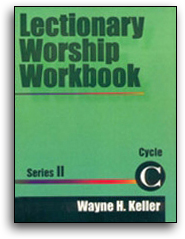
Lectionary Worship Workbook
Series II, Cycle C Gospel Texts
Liturgical Color: Green
Gospel: Luke 18:9-14
Theme: The Posture of Prayer: Who Got It Right, the Pharisee or the Tax Collector?
Recognizing Who God Is
Music for Preparation
"A Psalm Prelude," Howells.
Choral Invitation
(Adult Choir) "Psalm 34:9-22," para. Helen L. Wright, 1984; psalm tone: St. Meinrad VIII; refrain: Robert E. Kreutz.
Pastoral Invitation
Pastor and Ministers

Well, Lord, here we are again, ready or not to meet you face to face. Thank you for all of your mercies this past week. Thank you for calling us together again as your family in this place. Some of us have "prodigaled" away the whole week again, expending our lives only for material security and fleeting satisfactions. Some of us have stood by you, Lord, and dutifully minded our spiritual chores, growing proud in our self-righteousness. That's why we're glad to return here again -- together -- and to zero in on what you call us to be and to do (Frank D. Medsker, slightly revised).
P: Make joyful sounds, verbal and music, to God. If you can't sing, hum, whistle, or tap your feet as we praise the God of Creation.
M: Okay, pastor, that's what we'll do, in worship and beyond worship.
Hymn of Praise
"Rejoice, the Lord is King." (See Epiphany 2.)
Prayer of Praise
Include a hint of what's coming in regard to the Pharisee and tax collector and how those attitudes affect our daily living. Point out that God is in charge, even when it seems that God is not in charge.
Invitation To Discover Who We Are And Who We Can Become
Introduction to the Act of Recognizing Our Humanity
Lucy (from Peanuts) sits behind her psychiatrist's booth. Charlie Brown stands before her. She says, "The whole trouble with you is that you're wishy-washy." Charlie, puzzled, asks, "What's the difference between being wishy-washy and being humble?" Lucy informs him, as only Lucy can do, "You are wishy-washy ... I am humble." Do any of us have trouble with humility and self-righteousness? How? Anyone willing to respond? (Wait. If no response, offer a couple of your own struggles.) For example, do we think our form of worship, theology, or behavior, superior to others? Do we rejoice when others fail? Do we act more "religious" than others because we follow the rules better? (Thirty seconds of silence.) Offer this story for the people's meditation: Socrates once was asked by one of his disciples, "Why is it, sir, that you tell everyone who wants to become your disciple to look into this pool, and tell you what he sees?" "That's very simple, my friend. I am ready to accept all those who tell me that they see fish swimming around. But those who see only their own image mirrored in the water are in love with their ego. I have no use for them." (Two minutes of silence; ask the people to write down their insights ... about themselves, not others.)
Response
"O Savior, in This Quiet Place," Fred Pratt Green, 1974; William Jones, 1789.
Introduction to the Act of Receiving New Life
Be careful around our confession. Humility is a quality we often question in others, but assume in ourselves. There is some truth to Robert Southey's observation that the Devil's "favorite sin is pride that apes humility." At the same time, we cannot "make" ourselves humble. We can, however, be honest enough to recognize that our only justifiable source of pride is not in ourselves, but in God. I invite us to take two minutes in silence to thank God for our ability to change through the work of the Holy Spirit; God makes us able to put humility and self-righteousness in the proper perspective.
Response
Invite the congregation to sing Psalm 34:9-22.
Hearing The Truth Of The Good News
Message with the Children of All Ages
Combine this with the Gospel presentation. In advance, have your "Pharisee" seated among the people; and have your "tax collector" seated in the corner of the sanctuary. The Pharisee, sitting in the middle of the pew, crawls over several people to get to the aisle, and makes quite a commotion walking to the front of the sanctuary; he then makes his flowery prayer. The tax collector sits where he is and offers his prayer. After the drama, ask the children what they thought about the way the two men responded. Build the message around their responses.
Dramatizing the Scripture
See Message with the Children of All Ages.
Proclamation of the Good News
Consider these ideas, suggested by Ernest Trice Thompson, in Presbyterian Outlook (2/20/67): The Pharisee thanked God for two things: (1) For his own personal righteousness. There is no suggestion that he was wrong in his estimate of himself. He does, however, compare himself with people and not with God; and he couches his righteousness in negative, rather than positive, terms. (2) For his own personal devotion; that is, he does more than the law requires. He glances at God, but contemplates himself. The tax collector refused even to look to heaven, but smote on his breast and cried out, "God, be merciful to me, a sinner." His prayer comes right to the point. Two points stand out: his sense of sin and his cry for mercy. One prayer was real; the other was not.
Responding To What We Say We Believe
Stewardship Challenge
What does the stewardship of your prayer life look like? A fervent evangelist once said, "I would rather teach one person to pray that ten people to preach." Dr. Norman W. Paulline has said, "The Christian's greatest privilege is prayer. The Christian's greatest responsibility is helping God answer prayer."
Response
"Praise God From Whom All Blessings Flow," Jim Strathdee, from New Wine. (See Appendix I for address.)
Hymn of Obedience
"Fight the Good Fight," John Samuel Bewley Monsell, 1863; alt.; John Hatton (d. 1793).
Charge to the Congregation
Paul Tournier, the Swiss psychiatrist, said, "I have noticed more and more how dangerous it is for us to be right." We see this danger in self-righteous politicians and religious leaders. Do we see it in ourselves? How do we avoid self-righteousness and false humility? Is conceit nature's compensation for inferiority? Take the stance of the tax collector.
Meditation
"... of the thousands of prayers and praises and promises that the average person makes to God ... God in mercy disregards almost all of them. Why is that merciful? Because most of our praying is for the wrong thing ..." (Meher Baba). The essence of prayer is not, "My will be done ... but thy will be done." And if we want to develop a growing prayer life, I suggest that when we pray, we pray verbally, even when praying by ourself. We may be amazed by what we actually say, which we may never hear if we pray silently only.
Music Possibilities In Addition To Those Already Suggested
Music for Preparation: "Pastorale," Purvis.
Hymn of Praise: "I Sing the Mighty Power of God." (See Epiphany 7.)
Response to the Pardon: "Lord, Have Mercy," John Michael Talbot, Birdwing Records, Chatsworth, California 91311, produced by John Talbot and Phil Perkins.
Offertory: "Chorale," Dupr .
Hymn of Obedience: "Open My Eyes That I May See," Clara H. Scott, 1895.
Gospel: Luke 18:9-14
Theme: The Posture of Prayer: Who Got It Right, the Pharisee or the Tax Collector?
Recognizing Who God Is
Music for Preparation
"A Psalm Prelude," Howells.
Choral Invitation
(Adult Choir) "Psalm 34:9-22," para. Helen L. Wright, 1984; psalm tone: St. Meinrad VIII; refrain: Robert E. Kreutz.
Pastoral Invitation
Pastor and Ministers
Well, Lord, here we are again, ready or not to meet you face to face. Thank you for all of your mercies this past week. Thank you for calling us together again as your family in this place. Some of us have "prodigaled" away the whole week again, expending our lives only for material security and fleeting satisfactions. Some of us have stood by you, Lord, and dutifully minded our spiritual chores, growing proud in our self-righteousness. That's why we're glad to return here again -- together -- and to zero in on what you call us to be and to do (Frank D. Medsker, slightly revised).
P: Make joyful sounds, verbal and music, to God. If you can't sing, hum, whistle, or tap your feet as we praise the God of Creation.
M: Okay, pastor, that's what we'll do, in worship and beyond worship.
Hymn of Praise
"Rejoice, the Lord is King." (See Epiphany 2.)
Prayer of Praise
Include a hint of what's coming in regard to the Pharisee and tax collector and how those attitudes affect our daily living. Point out that God is in charge, even when it seems that God is not in charge.
Invitation To Discover Who We Are And Who We Can Become
Introduction to the Act of Recognizing Our Humanity
Lucy (from Peanuts) sits behind her psychiatrist's booth. Charlie Brown stands before her. She says, "The whole trouble with you is that you're wishy-washy." Charlie, puzzled, asks, "What's the difference between being wishy-washy and being humble?" Lucy informs him, as only Lucy can do, "You are wishy-washy ... I am humble." Do any of us have trouble with humility and self-righteousness? How? Anyone willing to respond? (Wait. If no response, offer a couple of your own struggles.) For example, do we think our form of worship, theology, or behavior, superior to others? Do we rejoice when others fail? Do we act more "religious" than others because we follow the rules better? (Thirty seconds of silence.) Offer this story for the people's meditation: Socrates once was asked by one of his disciples, "Why is it, sir, that you tell everyone who wants to become your disciple to look into this pool, and tell you what he sees?" "That's very simple, my friend. I am ready to accept all those who tell me that they see fish swimming around. But those who see only their own image mirrored in the water are in love with their ego. I have no use for them." (Two minutes of silence; ask the people to write down their insights ... about themselves, not others.)
Response
"O Savior, in This Quiet Place," Fred Pratt Green, 1974; William Jones, 1789.
Introduction to the Act of Receiving New Life
Be careful around our confession. Humility is a quality we often question in others, but assume in ourselves. There is some truth to Robert Southey's observation that the Devil's "favorite sin is pride that apes humility." At the same time, we cannot "make" ourselves humble. We can, however, be honest enough to recognize that our only justifiable source of pride is not in ourselves, but in God. I invite us to take two minutes in silence to thank God for our ability to change through the work of the Holy Spirit; God makes us able to put humility and self-righteousness in the proper perspective.
Response
Invite the congregation to sing Psalm 34:9-22.
Hearing The Truth Of The Good News
Message with the Children of All Ages
Combine this with the Gospel presentation. In advance, have your "Pharisee" seated among the people; and have your "tax collector" seated in the corner of the sanctuary. The Pharisee, sitting in the middle of the pew, crawls over several people to get to the aisle, and makes quite a commotion walking to the front of the sanctuary; he then makes his flowery prayer. The tax collector sits where he is and offers his prayer. After the drama, ask the children what they thought about the way the two men responded. Build the message around their responses.
Dramatizing the Scripture
See Message with the Children of All Ages.
Proclamation of the Good News
Consider these ideas, suggested by Ernest Trice Thompson, in Presbyterian Outlook (2/20/67): The Pharisee thanked God for two things: (1) For his own personal righteousness. There is no suggestion that he was wrong in his estimate of himself. He does, however, compare himself with people and not with God; and he couches his righteousness in negative, rather than positive, terms. (2) For his own personal devotion; that is, he does more than the law requires. He glances at God, but contemplates himself. The tax collector refused even to look to heaven, but smote on his breast and cried out, "God, be merciful to me, a sinner." His prayer comes right to the point. Two points stand out: his sense of sin and his cry for mercy. One prayer was real; the other was not.
Responding To What We Say We Believe
Stewardship Challenge
What does the stewardship of your prayer life look like? A fervent evangelist once said, "I would rather teach one person to pray that ten people to preach." Dr. Norman W. Paulline has said, "The Christian's greatest privilege is prayer. The Christian's greatest responsibility is helping God answer prayer."
Response
"Praise God From Whom All Blessings Flow," Jim Strathdee, from New Wine. (See Appendix I for address.)
Hymn of Obedience
"Fight the Good Fight," John Samuel Bewley Monsell, 1863; alt.; John Hatton (d. 1793).
Charge to the Congregation
Paul Tournier, the Swiss psychiatrist, said, "I have noticed more and more how dangerous it is for us to be right." We see this danger in self-righteous politicians and religious leaders. Do we see it in ourselves? How do we avoid self-righteousness and false humility? Is conceit nature's compensation for inferiority? Take the stance of the tax collector.
Meditation
"... of the thousands of prayers and praises and promises that the average person makes to God ... God in mercy disregards almost all of them. Why is that merciful? Because most of our praying is for the wrong thing ..." (Meher Baba). The essence of prayer is not, "My will be done ... but thy will be done." And if we want to develop a growing prayer life, I suggest that when we pray, we pray verbally, even when praying by ourself. We may be amazed by what we actually say, which we may never hear if we pray silently only.
Music Possibilities In Addition To Those Already Suggested
Music for Preparation: "Pastorale," Purvis.
Hymn of Praise: "I Sing the Mighty Power of God." (See Epiphany 7.)
Response to the Pardon: "Lord, Have Mercy," John Michael Talbot, Birdwing Records, Chatsworth, California 91311, produced by John Talbot and Phil Perkins.
Offertory: "Chorale," Dupr .
Hymn of Obedience: "Open My Eyes That I May See," Clara H. Scott, 1895.

