Advent 1
Preaching
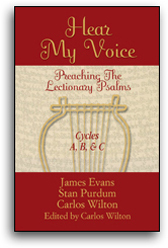
Hear My Voice
Preaching The Lectionary Psalms for Cycles A, B, C
Object:
(See Advent 4, Cycle A, and Proper 15/Pentecost 13/Ordinary Time 20, Cycle C, for an alternative approach.)
This psalm with this exact selection of verses is used two different years during the Advent season: here in Cycle B for Advent 1, and in Cycle A for Advent 4. Obviously, the lectionary committee wants us to find an Advent theme in it.

Certainly, one may be found in verse 4. "O Lord of hosts, how long will you be angry with your people's prayers?" That "how long" is the cry of Advent. The Jews of the Old Testament and the inter-testamental period were living in that "how long" time, a prolonged wait for the promised Messiah. To paraphrase, the psalmist is saying, "We've been waiting long enough. Come down here and straighten out this mess, so we can gain control of our own lives."
That is the tone of Advent. Hymns like "O Come, O Come, Emmanuel" emphasize the sense of waiting for something that has not yet happened, something that will eventually bring so dramatic a change that people will gain mastery over their conditions and control of their own destinies -- or, at least, so they hope.
The irony is that, although Advent points us backward to the time before Jesus came, and we live in the time after he came, we often still find ourselves swamped by Advent-like moods. We live after the event to which the people of the Old Testament looked forward, the coming of the Messiah. But we still don't have mastery of our conditions. So in many ways, the Advent mood still seems to fit even though the Christmas event has happened. The difference is now, instead of struggling to believe that a Messiah is really coming, we are working to keep faith alive that the final victory will be God's.
And so we may look at the hopefulness of Advent with jaded eyes and minimal expectations. Perhaps we come with a kind of resignation that leads us to just "go with the flow" and not really expect things to get much better.
Yet, waiting can release a kind of creative energy in us. Paul Tournier, a Christian author and psychiatrist, had a happy marriage to a woman he fully loved. When she died young, he was heartbroken and become painfully aware of what it meant not to have a companion to grow old with. He missed the rich conversations they'd had and the warmth of her presence. He did believe, however, that her absence was not forever, that there would be a reunion someday in God's kingdom. Nonetheless, in the meantime, he discovered that while waiting for that day, his energies could be redirected, and he found a rebirth of his creative urge. He went on to write some of his most helpful books after the death of his wife.
Waiting can be creative.
-- S. P.
This psalm with this exact selection of verses is used two different years during the Advent season: here in Cycle B for Advent 1, and in Cycle A for Advent 4. Obviously, the lectionary committee wants us to find an Advent theme in it.
Certainly, one may be found in verse 4. "O Lord of hosts, how long will you be angry with your people's prayers?" That "how long" is the cry of Advent. The Jews of the Old Testament and the inter-testamental period were living in that "how long" time, a prolonged wait for the promised Messiah. To paraphrase, the psalmist is saying, "We've been waiting long enough. Come down here and straighten out this mess, so we can gain control of our own lives."
That is the tone of Advent. Hymns like "O Come, O Come, Emmanuel" emphasize the sense of waiting for something that has not yet happened, something that will eventually bring so dramatic a change that people will gain mastery over their conditions and control of their own destinies -- or, at least, so they hope.
The irony is that, although Advent points us backward to the time before Jesus came, and we live in the time after he came, we often still find ourselves swamped by Advent-like moods. We live after the event to which the people of the Old Testament looked forward, the coming of the Messiah. But we still don't have mastery of our conditions. So in many ways, the Advent mood still seems to fit even though the Christmas event has happened. The difference is now, instead of struggling to believe that a Messiah is really coming, we are working to keep faith alive that the final victory will be God's.
And so we may look at the hopefulness of Advent with jaded eyes and minimal expectations. Perhaps we come with a kind of resignation that leads us to just "go with the flow" and not really expect things to get much better.
Yet, waiting can release a kind of creative energy in us. Paul Tournier, a Christian author and psychiatrist, had a happy marriage to a woman he fully loved. When she died young, he was heartbroken and become painfully aware of what it meant not to have a companion to grow old with. He missed the rich conversations they'd had and the warmth of her presence. He did believe, however, that her absence was not forever, that there would be a reunion someday in God's kingdom. Nonetheless, in the meantime, he discovered that while waiting for that day, his energies could be redirected, and he found a rebirth of his creative urge. He went on to write some of his most helpful books after the death of his wife.
Waiting can be creative.
-- S. P.