Proper 22
Preaching
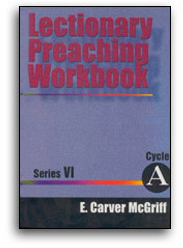
Lectionary Preaching Workbook
Series VI, Cycle A
COMMENTARY ON THE LESSONS
Lesson 1: Exodus 20:1-4, 7-9, 12-20 (C)
The Ten Commandments. Of course we will immediately think of ten sermon ideas. Or we can focus on the need for laws even though Jesus taught that they could be supplanted by the twofold commandment of love. Clearly, as we view the state of things in our world, we are not nearly at a point where we can dispense with laws. Furthermore, laws will always be necessary as a guide. A hundred loving people may be driving down Main Street, each at a speed which seems loving to him or her, the teenagers using 50 miles per hour as a guide, the type "B" personality adults a more sedate 30 mph, and us type "A" people trying to pass both of them -- all in love. So, we put a sign up which says "30 Speed Limit" and now we all drive the same.
If we can avoid being too preachy, I think the one about honoring your father and your mother would be a good sermon idea. What does that mean exactly? Unquestioning obedience? Probably not. Then what? Or "Thou shalt not steal" is relevant today in a time when a surprising number of people seem to think stealing is normal conduct. A preacher could do worse than to schedule a ten-sermon series on this passage, looking at each commandment in terms of today's world.
Lesson 1: Isaiah 5:1-7 (RC, E)
Isaiah expresses what he conceives (or feels given) as God's displeasure at the conduct of the people of Israel. He uses the analogy of a vineyard which produces bad grapes as being like those people and threatens their total destruction. We, of course, know that God would not do that. If God were into destroying the unfaithful, there'd be very few folks around these days. However, this rather beautiful passage must have gotten everyone's attention. As to preaching possibilities, it probably wouldn't hurt to lay it on a little thick, that God does get tired of persistent disloyalty on the part of the unfaithful. He may not literally destroy people, but we certainly live in a world in which a life lived counter to the teachings of the Bible ensures unhappiness, emotional turmoil, and the absence of a peaceful mind. I have always believed that God has arranged this creation in such a way as to ensure that virtue is rewarded in the long run, and wrongful conduct is always paid back, one way or another. Face it, God is smarter than we are.
Lesson 2: Philippians 3:4b-14 (C); Philippians 3:14-21 (E)
Paul is a zealous Christian, valuing nothing in his worldly life dedicated solely to a pursuit of the Christian life, almost gladly suffering, urgently desiring resurrection after death. He pledges to devote all his energies to this, completely setting aside any pride in his worthy pedigree. I find myself badly outclassed by Saint Paul. I fear I'm part of that generation of people, and of clergy, who have always been glad we went to the right seminary, received this or that recognition, served that particular church, know certain people. We aspire (there are, I'm sure exceptions) to have nice parsonages or manses, or whatever your denomination calls a home. We scan our denominational journal to see how many members a friend's church received, where we stand on the salary scale, who was invited to speak at the conference. Most of us have a long way to go, and my experience is that similar concerns occupy people in all the other vocations of the earth. It's probably only when one becomes very old or very sick that the sentiments Paul expresses here become ours. At best, we have here an exalted example of the very finest attitude to which we might look. It is almost certainly unreasonable to expect any listener to assume Paul's attitude when we clergy find it so difficult ourselves. Perhaps a bit of confession to our people is in order. And maybe the word is that in the midst of this self-interested life we live, we are to work at practicing the teachings of Jesus. Either Luther or someone said we can't keep the crows from flying overhead, but we can keep them from making a nest in our hair. What I can do is (1) be honest about my condition, (2) pray for forgiveness and a better attitude, and (3) earnestly try to practice the works of love.
Lesson 2: Philippians 4:6-9 (RC)
(See Proper 23)
Gospel: Matthew 21:33-46 (C); Matthew 21:33-43 (RC, E)
Jesus here reminds us that we are tenants of this world, not its owners. We have obligations to return part of what it provides, and to respect its resources. Also, we are to respect the demands of the One who does own the earth, to honor him, to obey the orders delivered to us. He warns the Pharisees that those who cast out the owner's son must expect drastic consequences. They themselves predict this before realizing that they themselves are the villains in the story. He concludes by quoting from the 118th Psalm: "The stone which the builders rejected has become the chief cornerstone ..." The vineyards along with equipment, wine press, and so forth, are the earth. And Jesus, "the cornerstone," is the owner's son.
SERMON SUGGESTIONS
Title: "Our Other Gods"
Text: Exodus 20:1-4, 7-9, 12-20
Theme: This text opens with the warning that we are not to have any other gods but God. We earlier observed an old legend that Abraham, as a young boy, worked in his father's shop where the old man made idols according to customer specifications. Since various religions abounded, and gods were believed to have kingdoms which were geographically limited, many people believed an idol depicting their god would bring good luck. Or that at least they could thereby appease their god if he became angry. Abraham, however, didn't believe in all of this and questioned his dad, who explained that the boy was wrong, each god had certain powers. Then one day the old man went out of town. When he returned, every idol in the shop was destroyed by a hammer except for one, against which the hammer was leaning. Furious, the old man called his son, Abraham, and charged him with the damage. But the boy said, no, it was that one idol which you told me had great powers. He was greater than the others and destroyed them. The old man had no answer.
We all have idols. Wasn't it Tillich who said whatever occupies your mind, and determines your actions, is your god? I confess I spend at least an hour, more often two hours each day, exercising. Even at an admittedly advanced age, I hate to see a day end without having at least done an hour of aerobics. How much time do I spend in prayer, meditation, devotional reading? Less, I fear. I must beware my own worship of the wrong god (this doesn't mean we shouldn't try to stay in good physical condition). I know people who are always thinking about money, who head straight for the stock reports. Scott Peck, in his book In Search of Stones, admitted that in his younger years, sexual conquest was a preoccupation of his. He later found Christ. I know clergy who give a lot more thought to their career success than they do to the spiritual welfare of their members, and, I fear, themselves. Today's paper discloses that the head of a major Christian denomination has been buying Mercedes and expensive waterfront property since achieving wide influence as a religious leader.
Regarding God's patience, I think there is room for some of this. Exercise, economic endeavor, interest in the stock market, morally appropriate interpersonal relationships -- these are okay. But they become gods when we become guilty of two things: one, breaking any of the moral laws set before us, and two, allowing these interests to preclude any sincere worship of God.
Title: "The Upward Call"
Text: Philippians 3:4-14
Theme: My main focus would be on the 12th verse. "I press on to make it my own," Paul said, "Not that I have already attained this." His total devotion exceeds that of most of us, certainly my own. I cannot claim that my home, or my savings, or my family, or my automobile are of little consequence in my life. Frankly, although I'm grateful for a Paul whose zeal preserved the holy Word for me, I don't even think it healthy for the average person to be this committed. I know one or two individuals who are so "into" religion it's all they want to talk about. Bluntly said, I find them boring. I prefer friends with a wide range of interests. I can't imagine socializing with people who don't give a hoot about sports, or politics, or the stock market, or recent movies, or at least something which can afford mutual interest. Yet, Paul has here commended pressing on to make the benefits of the faith one's own.
1. Healthy interests and involvement in life are worthy and important. Paul doesn't say that here, but the thrust of the gospel confirms this to me.
2. I err, though, if I allow these interests to prevent me from including worship and a healthy amount of introspection by which to be aware of any excesses or wrongful attitudes or conduct on my part.
3. High moral standards premised on love are the means by which I am to "press on," including a sharing of concern, resources, and time with those in need.
Title: "Working In The Vineyard"
Text: Matthew 21:38
Theme: Jesus has warned his listeners that the earth as symbolized by the vineyard is the possession of God. Those who reside and work there, we ourselves, are tenants. We have stewardship responsibilities to respect what we find there, and to return a portion of it to the owner, to God. This brings to mind the troubling issue of our own use of the earth's natural resources. Put here by God, we are to use them, but also we must respect them and restore what we use. Our forests, our wildlife, our fuel resources, the food we are able to grow from rich ground, all of this is a temporary loan from God, if you will. But many people forget this, think we own what we find around us. Elsewhere, Jesus tells of the man who had such a large store of grain that he had larger barns built in order to keep it all. There were hungry people about, poor people who had little. He could easily have shared his wealth and still possessed more than enough for himself. But he wanted it all. Shortly after, he died. We will too. Nothing in our possession, including our homes and lands, can be ours on any more than a temporary basis. Collectively, we can destroy ourselves, or more reprehensible, destroy our grandchildren, by irresponsible use of the earth's riches. The owner has sent his son, speaking the very words of our text, to tell us of our responsibilities.
1. We are to live in harmony, sharing. I live in a prosperous community in the heartland of America. Compared to most major cities, we have hardly any crime, virtually no poverty. It would be easy to protect all that, blind ourselves to the tortured lives of so many other people. We may not do this if we think to follow Christ. We are to recognize that all of this belongs to God and we are custodians for a time. We have an obligation to do what we can to see that others have happy lives also. Giving a share to God is done by giving a share to others of God's children.
2. We are to be careful in the use of the earth's resources. We ebb and flow in worrying about energy crises and other wasteful uses of resources. We love to quarrel about the issue, preservationists versus developers and investors. This doesn't mean we are not to use what we have. Those people operating the vineyard were welcome to enjoy its benefits, had they been willing to return a just portion to the owner. But it does mean we are to realize that after we're gone, that "vineyard" will still remain, available then to other occupants. We are its stewards.
3. The owner of the vineyard (God) was patient. He did not immediately punish the miscreant occupants. He gave them another chance. But there was a stopping point beyond which he was not willing to go. That point was the rejection of his son.
4. We are to acknowledge the true owner of the land and return a portion to him as well. Tragically, our country suffers from the fact that somewhere around half of America's population is never exposed to the word of God. Sunday is a day to read the paper, work in the yard, go to the park or the lake. So the saving word is not being heard, and the consequence of this is unhappy, empty lives. There is hope, though, in the Church, the custodian of the saving word. I refer to all churches which base their teachings on the Bible. In them, collectively, lies our corporate hope. In them also lies the hope for each of us as we contemplate that which lies beyond our residence in this vineyard. But there is more than one way to reject the son. One very effective way is to ignore him.
ADDITIONAL ILLUSTRATIONS
One bishop told of the man living in the African bush country who somehow received possession of an old automobile. He drove it down a jungle path and soon had car trouble. The man then went to a witch doctor for advice, and was told that the car was possessed by an evil spirit. He said the way to get rid of it was to build a fire underneath. They did this and the car exploded, thereby convincing the car's owner that the witch doctor had been correct. (We get wrong ideas about the nature of things without hearing the biblical word).
____________
Sarah Ban Breathnach, in her splendid Simple Abundance, wrote about M.F.K. Fisher, a successful but not very prosperous writer Nonetheless, Fisher had a happy life. Breathnach wrote this: "Poverty is always experienced in the soul before it is felt in the pocketbook. It seems incredible to think of M.F.K. Fisher lacking for money, because she never lacked a simply abundant life. Perhaps she enjoyed the good life because she received it with a grateful heart. She traveled, lived in France and Italy, wrote many magnificent books, knew passionate love, enjoyed a wide circle of friends and admirers, and always savored the everyday epiphanies of eating and drinking well. M.F.K. Fisher's authentic self found outward expression in exuberance."
____________
Psalm Of The Day
Psalm 19 (C) --Ê"The heavens are telling the glory of God."
Psalm 80:7-14 (RC, E) -- "Let your face shine, that we may be saved."
Prayer Of The Day
Grant us integrity, O Lord, and the wisdom to order our values in everyday living, that we may lead abundant lives as Jesus wished for us, yet be faithful to him in accepting those privations and sufferings by which we are thereby faithful to his call. Amen.
Lesson 1: Exodus 20:1-4, 7-9, 12-20 (C)
The Ten Commandments. Of course we will immediately think of ten sermon ideas. Or we can focus on the need for laws even though Jesus taught that they could be supplanted by the twofold commandment of love. Clearly, as we view the state of things in our world, we are not nearly at a point where we can dispense with laws. Furthermore, laws will always be necessary as a guide. A hundred loving people may be driving down Main Street, each at a speed which seems loving to him or her, the teenagers using 50 miles per hour as a guide, the type "B" personality adults a more sedate 30 mph, and us type "A" people trying to pass both of them -- all in love. So, we put a sign up which says "30 Speed Limit" and now we all drive the same.
If we can avoid being too preachy, I think the one about honoring your father and your mother would be a good sermon idea. What does that mean exactly? Unquestioning obedience? Probably not. Then what? Or "Thou shalt not steal" is relevant today in a time when a surprising number of people seem to think stealing is normal conduct. A preacher could do worse than to schedule a ten-sermon series on this passage, looking at each commandment in terms of today's world.
Lesson 1: Isaiah 5:1-7 (RC, E)
Isaiah expresses what he conceives (or feels given) as God's displeasure at the conduct of the people of Israel. He uses the analogy of a vineyard which produces bad grapes as being like those people and threatens their total destruction. We, of course, know that God would not do that. If God were into destroying the unfaithful, there'd be very few folks around these days. However, this rather beautiful passage must have gotten everyone's attention. As to preaching possibilities, it probably wouldn't hurt to lay it on a little thick, that God does get tired of persistent disloyalty on the part of the unfaithful. He may not literally destroy people, but we certainly live in a world in which a life lived counter to the teachings of the Bible ensures unhappiness, emotional turmoil, and the absence of a peaceful mind. I have always believed that God has arranged this creation in such a way as to ensure that virtue is rewarded in the long run, and wrongful conduct is always paid back, one way or another. Face it, God is smarter than we are.
Lesson 2: Philippians 3:4b-14 (C); Philippians 3:14-21 (E)
Paul is a zealous Christian, valuing nothing in his worldly life dedicated solely to a pursuit of the Christian life, almost gladly suffering, urgently desiring resurrection after death. He pledges to devote all his energies to this, completely setting aside any pride in his worthy pedigree. I find myself badly outclassed by Saint Paul. I fear I'm part of that generation of people, and of clergy, who have always been glad we went to the right seminary, received this or that recognition, served that particular church, know certain people. We aspire (there are, I'm sure exceptions) to have nice parsonages or manses, or whatever your denomination calls a home. We scan our denominational journal to see how many members a friend's church received, where we stand on the salary scale, who was invited to speak at the conference. Most of us have a long way to go, and my experience is that similar concerns occupy people in all the other vocations of the earth. It's probably only when one becomes very old or very sick that the sentiments Paul expresses here become ours. At best, we have here an exalted example of the very finest attitude to which we might look. It is almost certainly unreasonable to expect any listener to assume Paul's attitude when we clergy find it so difficult ourselves. Perhaps a bit of confession to our people is in order. And maybe the word is that in the midst of this self-interested life we live, we are to work at practicing the teachings of Jesus. Either Luther or someone said we can't keep the crows from flying overhead, but we can keep them from making a nest in our hair. What I can do is (1) be honest about my condition, (2) pray for forgiveness and a better attitude, and (3) earnestly try to practice the works of love.
Lesson 2: Philippians 4:6-9 (RC)
(See Proper 23)
Gospel: Matthew 21:33-46 (C); Matthew 21:33-43 (RC, E)
Jesus here reminds us that we are tenants of this world, not its owners. We have obligations to return part of what it provides, and to respect its resources. Also, we are to respect the demands of the One who does own the earth, to honor him, to obey the orders delivered to us. He warns the Pharisees that those who cast out the owner's son must expect drastic consequences. They themselves predict this before realizing that they themselves are the villains in the story. He concludes by quoting from the 118th Psalm: "The stone which the builders rejected has become the chief cornerstone ..." The vineyards along with equipment, wine press, and so forth, are the earth. And Jesus, "the cornerstone," is the owner's son.
SERMON SUGGESTIONS
Title: "Our Other Gods"
Text: Exodus 20:1-4, 7-9, 12-20
Theme: This text opens with the warning that we are not to have any other gods but God. We earlier observed an old legend that Abraham, as a young boy, worked in his father's shop where the old man made idols according to customer specifications. Since various religions abounded, and gods were believed to have kingdoms which were geographically limited, many people believed an idol depicting their god would bring good luck. Or that at least they could thereby appease their god if he became angry. Abraham, however, didn't believe in all of this and questioned his dad, who explained that the boy was wrong, each god had certain powers. Then one day the old man went out of town. When he returned, every idol in the shop was destroyed by a hammer except for one, against which the hammer was leaning. Furious, the old man called his son, Abraham, and charged him with the damage. But the boy said, no, it was that one idol which you told me had great powers. He was greater than the others and destroyed them. The old man had no answer.
We all have idols. Wasn't it Tillich who said whatever occupies your mind, and determines your actions, is your god? I confess I spend at least an hour, more often two hours each day, exercising. Even at an admittedly advanced age, I hate to see a day end without having at least done an hour of aerobics. How much time do I spend in prayer, meditation, devotional reading? Less, I fear. I must beware my own worship of the wrong god (this doesn't mean we shouldn't try to stay in good physical condition). I know people who are always thinking about money, who head straight for the stock reports. Scott Peck, in his book In Search of Stones, admitted that in his younger years, sexual conquest was a preoccupation of his. He later found Christ. I know clergy who give a lot more thought to their career success than they do to the spiritual welfare of their members, and, I fear, themselves. Today's paper discloses that the head of a major Christian denomination has been buying Mercedes and expensive waterfront property since achieving wide influence as a religious leader.
Regarding God's patience, I think there is room for some of this. Exercise, economic endeavor, interest in the stock market, morally appropriate interpersonal relationships -- these are okay. But they become gods when we become guilty of two things: one, breaking any of the moral laws set before us, and two, allowing these interests to preclude any sincere worship of God.
Title: "The Upward Call"
Text: Philippians 3:4-14
Theme: My main focus would be on the 12th verse. "I press on to make it my own," Paul said, "Not that I have already attained this." His total devotion exceeds that of most of us, certainly my own. I cannot claim that my home, or my savings, or my family, or my automobile are of little consequence in my life. Frankly, although I'm grateful for a Paul whose zeal preserved the holy Word for me, I don't even think it healthy for the average person to be this committed. I know one or two individuals who are so "into" religion it's all they want to talk about. Bluntly said, I find them boring. I prefer friends with a wide range of interests. I can't imagine socializing with people who don't give a hoot about sports, or politics, or the stock market, or recent movies, or at least something which can afford mutual interest. Yet, Paul has here commended pressing on to make the benefits of the faith one's own.
1. Healthy interests and involvement in life are worthy and important. Paul doesn't say that here, but the thrust of the gospel confirms this to me.
2. I err, though, if I allow these interests to prevent me from including worship and a healthy amount of introspection by which to be aware of any excesses or wrongful attitudes or conduct on my part.
3. High moral standards premised on love are the means by which I am to "press on," including a sharing of concern, resources, and time with those in need.
Title: "Working In The Vineyard"
Text: Matthew 21:38
Theme: Jesus has warned his listeners that the earth as symbolized by the vineyard is the possession of God. Those who reside and work there, we ourselves, are tenants. We have stewardship responsibilities to respect what we find there, and to return a portion of it to the owner, to God. This brings to mind the troubling issue of our own use of the earth's natural resources. Put here by God, we are to use them, but also we must respect them and restore what we use. Our forests, our wildlife, our fuel resources, the food we are able to grow from rich ground, all of this is a temporary loan from God, if you will. But many people forget this, think we own what we find around us. Elsewhere, Jesus tells of the man who had such a large store of grain that he had larger barns built in order to keep it all. There were hungry people about, poor people who had little. He could easily have shared his wealth and still possessed more than enough for himself. But he wanted it all. Shortly after, he died. We will too. Nothing in our possession, including our homes and lands, can be ours on any more than a temporary basis. Collectively, we can destroy ourselves, or more reprehensible, destroy our grandchildren, by irresponsible use of the earth's riches. The owner has sent his son, speaking the very words of our text, to tell us of our responsibilities.
1. We are to live in harmony, sharing. I live in a prosperous community in the heartland of America. Compared to most major cities, we have hardly any crime, virtually no poverty. It would be easy to protect all that, blind ourselves to the tortured lives of so many other people. We may not do this if we think to follow Christ. We are to recognize that all of this belongs to God and we are custodians for a time. We have an obligation to do what we can to see that others have happy lives also. Giving a share to God is done by giving a share to others of God's children.
2. We are to be careful in the use of the earth's resources. We ebb and flow in worrying about energy crises and other wasteful uses of resources. We love to quarrel about the issue, preservationists versus developers and investors. This doesn't mean we are not to use what we have. Those people operating the vineyard were welcome to enjoy its benefits, had they been willing to return a just portion to the owner. But it does mean we are to realize that after we're gone, that "vineyard" will still remain, available then to other occupants. We are its stewards.
3. The owner of the vineyard (God) was patient. He did not immediately punish the miscreant occupants. He gave them another chance. But there was a stopping point beyond which he was not willing to go. That point was the rejection of his son.
4. We are to acknowledge the true owner of the land and return a portion to him as well. Tragically, our country suffers from the fact that somewhere around half of America's population is never exposed to the word of God. Sunday is a day to read the paper, work in the yard, go to the park or the lake. So the saving word is not being heard, and the consequence of this is unhappy, empty lives. There is hope, though, in the Church, the custodian of the saving word. I refer to all churches which base their teachings on the Bible. In them, collectively, lies our corporate hope. In them also lies the hope for each of us as we contemplate that which lies beyond our residence in this vineyard. But there is more than one way to reject the son. One very effective way is to ignore him.
ADDITIONAL ILLUSTRATIONS
One bishop told of the man living in the African bush country who somehow received possession of an old automobile. He drove it down a jungle path and soon had car trouble. The man then went to a witch doctor for advice, and was told that the car was possessed by an evil spirit. He said the way to get rid of it was to build a fire underneath. They did this and the car exploded, thereby convincing the car's owner that the witch doctor had been correct. (We get wrong ideas about the nature of things without hearing the biblical word).
____________
Sarah Ban Breathnach, in her splendid Simple Abundance, wrote about M.F.K. Fisher, a successful but not very prosperous writer Nonetheless, Fisher had a happy life. Breathnach wrote this: "Poverty is always experienced in the soul before it is felt in the pocketbook. It seems incredible to think of M.F.K. Fisher lacking for money, because she never lacked a simply abundant life. Perhaps she enjoyed the good life because she received it with a grateful heart. She traveled, lived in France and Italy, wrote many magnificent books, knew passionate love, enjoyed a wide circle of friends and admirers, and always savored the everyday epiphanies of eating and drinking well. M.F.K. Fisher's authentic self found outward expression in exuberance."
____________
Psalm Of The Day
Psalm 19 (C) --Ê"The heavens are telling the glory of God."
Psalm 80:7-14 (RC, E) -- "Let your face shine, that we may be saved."
Prayer Of The Day
Grant us integrity, O Lord, and the wisdom to order our values in everyday living, that we may lead abundant lives as Jesus wished for us, yet be faithful to him in accepting those privations and sufferings by which we are thereby faithful to his call. Amen.