Proper 15
Devotional
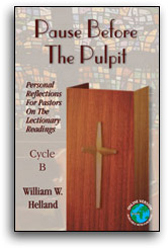
Pause Before The Pulpit
Personal Reflections For Pastors On The Lectionary Readings
John 6:51-58
This week's lesson picks up where last week's left off, and is the conclusion to Jesus' discourse on the Bread of Life. His audience that day couldn't figure out what he was talking about, for it didn't make sense to them. How could he be the Bread of Life and how could he come down from heaven? These are, no doubt, difficult truths to comprehend, but our ability or inability to comprehend them doesn't make them any less true. It's similar to me and my computer; I'm amazed at the technology, but I don't understand how it works. Does my inability to comprehend it make it any less true or real? No. And so it is with the teachings of Christ. This is very important for us to grasp and to pass on to our parishioners.
Jesus wasn't done confusing them though. He also told them that they were to eat him. What? That didn't make sense at all! If they were to take him literally, it would be cannibalism!
When attempting to understand this text, I tend to agree with those who believe this is not in reference to the sacrament or Eucharist, for that would not be instituted until sometime later. So what did he mean? It seems most consistent with what Jesus said before this: to understand this eating and drinking as referring to believing.
Jesus contrasted himself to the bread that their ancestors ate while wandering in the wilderness in the days of Moses. All who ate that bread died. Not that the bread killed them, but it was unable to give them enduring and eternal life. It sustained life while in the wilderness, but it didn't extend their life beyond normal years.
However, whoever eats of this bread (or believes in Jesus Christ) will live forever. Jesus was offering them something far superior to anything their ancestors had ever eaten. Let us not forget we have something far superior to offer people than anything they can buy or do to extend life here on earth. People today are chasing after anything and everything they can get their hands on to try to stay young and add years to their lives. Why? Because this life is all they've got. If professing Christians are doing this, it means they have not thought enough about heaven nor the life that Christ has given them through faith in him.
I'm not suggesting that we neglect our bodies, or that it is wrong to keep ourselves physically fit and looking good. What I am saying is to be obsessed with this is wrong. Obsessions often grow out of a fear. When professing Christians are afraid to die and dread the future that God is preparing for them, there is something wrong. They don't seem to understand how real life from Jesus is. For when we understand his words and receive them by faith we begin to clearly understand that this life on earth is nothing compared to heaven!
We cannot overemphasize from our pulpits and when ministering one on one with people, the importance of sincere belief in Jesus Christ. Jesus was not requesting a superficial relationship with people whereby they identify themselves with a Christian church and confess the Apostles' Creed each time they worship. He was requesting and inviting people to an intimate relationship whereby those who eat my flesh and drink my blood abide in me, and I in them.
This term, abide, has come to mean a lot to me; as it suggests quality time, quantity of time, listening, loving, nurturing, security, friendship, empathy, comfort, and perhaps so much more. That is the relationship Jesus desires with us and the people we minister to. However, we cannot describe that kind of a relationship to others and teach them how to have it, if we don't have it ourselves.
I urge you today to "eat the flesh" and "drink the blood" of Jesus. In other words, get in him and let him get in you. Once you are there, stay there and abide with him and he will abide with you. It's a wonderful relationship that will greatly impact your ministry.
A Pastor's Prayer:
Dear Lord,
Thank you for initiating this intimate relationship with me. Help me to abide in you and allow you to abide in me. Please help me to not only model this relationship for others to see, but to know how to preach and teach it so others can enjoy it, too. Amen.
Ephesians 5:15-20
The Apostle Paul's advice to the church in Ephesus, as found in this text, could come right out of a pastor's handbook on ministry. It is sound, timeless advice; and not surprisingly so, as it is God's Word to the church.
The opening statement is strong and unmistakable: Be careful then how you live, not as unwise people but as wise. Oh, how much easier our ministries would be if we and our parishioners would follow this rule for Christian living! The problem is, we are not always careful how we live. We are too easily swept up by the momentum and values of the world around us. The fact that the divorce rate in the church is about the same as that of the unchurched is very telling. The fact that you can't tell much difference in the lifestyles of many Christians from that of the unbelieving world around them is reason to pause as well. Far too many Christians don't want to be told what to do, and use God's grace as an excuse to sin. Certainly God's grace does cover our sin, but what is the advantage of bringing all this pain upon ourselves and others in the name of "freedom"? This is unwise living, and makes a mockery out of grace and the one who has extended this grace to us.
If you and your parishioners want to live like wise people, then I urge you to read Proverbs, the words of Jesus, and the Apostle's letters. These are rich resources containing the best wisdom the world has ever known.
Our text then urges us to make the most of the time, because the days are evil. It wasn't then, nor is it now, the time to be lazy. There is much work for the church to do, starting with itself and reaching out into the community. I had a volunteer jail chaplaincy ministry for a couple years and was shocked at the number of men who had never read the Bible. Some didn't know anything about the name of Jesus, other than as a swear word. We have a huge mission field right around us.
Now, the first two statements we've looked at, if not taken seriously, lead to only one thing -- foolishness. So we are warned: do not be foolish, but understand what the will of the Lord is. Do you know what the will of the Lord is for you and your ministry? Do the people in your church know what the will of the Lord is for them and their church? Many times we think we know, but if the truth be known, what we call the will of the Lord is really the pastor's agenda or the selfish and proud plans of a congregation.
It takes time, prayer, Bible reading, earnest discussion amongst sincere Christians, and more prayer to determine the will of God. One of the mistakes that many Christians and churches make (including pastors) is that we are impatient. We don't want to go through the hard work of determining the will of the Lord. I pity the pastor who wants to take time to determine the will of the Lord, but the congregation won't. If they want to press ahead without sufficient time for the aforementioned steps, move on and find a church that does want to understand the will of the Lord and leave the foolish church behind.
Last of all, we are encouraged to worship intentionally and diligently. I like how Paul introduced this, as he used the illustration of getting drunk. When a person is filled with alcohol, it takes over their mind, mouth, and motion. So, too, when we are filled with the Spirit of God, he will take over our mind, mouth, and motion in worship. He guides us into singing psalms and hymns and spiritual songs among ourselves, singing and making melody to the Lord in our hearts, giving thanks to God the Father at all times and for everything in the name of our Lord Jesus Christ. May we allow this pattern for private and public worship to guide us in the future. And may our worship come out of thankful hearts, for God has given us so much in the person of his Son, Jesus Christ.
A Pastor's Prayer:
Dear Lord,
Thank you for this set of rules on how to live my life, both in and out of the church. Help me to preach and teach these rules in a law/grace balance, that people might see the advantage of following these rules in their personal lives and in the ministry of their church. May they, and I, always remember that the motivation to live out these rules is the fact that you died for our inability to do it perfectly. Thank you. Amen.
This week's lesson picks up where last week's left off, and is the conclusion to Jesus' discourse on the Bread of Life. His audience that day couldn't figure out what he was talking about, for it didn't make sense to them. How could he be the Bread of Life and how could he come down from heaven? These are, no doubt, difficult truths to comprehend, but our ability or inability to comprehend them doesn't make them any less true. It's similar to me and my computer; I'm amazed at the technology, but I don't understand how it works. Does my inability to comprehend it make it any less true or real? No. And so it is with the teachings of Christ. This is very important for us to grasp and to pass on to our parishioners.
Jesus wasn't done confusing them though. He also told them that they were to eat him. What? That didn't make sense at all! If they were to take him literally, it would be cannibalism!
When attempting to understand this text, I tend to agree with those who believe this is not in reference to the sacrament or Eucharist, for that would not be instituted until sometime later. So what did he mean? It seems most consistent with what Jesus said before this: to understand this eating and drinking as referring to believing.
Jesus contrasted himself to the bread that their ancestors ate while wandering in the wilderness in the days of Moses. All who ate that bread died. Not that the bread killed them, but it was unable to give them enduring and eternal life. It sustained life while in the wilderness, but it didn't extend their life beyond normal years.
However, whoever eats of this bread (or believes in Jesus Christ) will live forever. Jesus was offering them something far superior to anything their ancestors had ever eaten. Let us not forget we have something far superior to offer people than anything they can buy or do to extend life here on earth. People today are chasing after anything and everything they can get their hands on to try to stay young and add years to their lives. Why? Because this life is all they've got. If professing Christians are doing this, it means they have not thought enough about heaven nor the life that Christ has given them through faith in him.
I'm not suggesting that we neglect our bodies, or that it is wrong to keep ourselves physically fit and looking good. What I am saying is to be obsessed with this is wrong. Obsessions often grow out of a fear. When professing Christians are afraid to die and dread the future that God is preparing for them, there is something wrong. They don't seem to understand how real life from Jesus is. For when we understand his words and receive them by faith we begin to clearly understand that this life on earth is nothing compared to heaven!
We cannot overemphasize from our pulpits and when ministering one on one with people, the importance of sincere belief in Jesus Christ. Jesus was not requesting a superficial relationship with people whereby they identify themselves with a Christian church and confess the Apostles' Creed each time they worship. He was requesting and inviting people to an intimate relationship whereby those who eat my flesh and drink my blood abide in me, and I in them.
This term, abide, has come to mean a lot to me; as it suggests quality time, quantity of time, listening, loving, nurturing, security, friendship, empathy, comfort, and perhaps so much more. That is the relationship Jesus desires with us and the people we minister to. However, we cannot describe that kind of a relationship to others and teach them how to have it, if we don't have it ourselves.
I urge you today to "eat the flesh" and "drink the blood" of Jesus. In other words, get in him and let him get in you. Once you are there, stay there and abide with him and he will abide with you. It's a wonderful relationship that will greatly impact your ministry.
A Pastor's Prayer:
Dear Lord,
Thank you for initiating this intimate relationship with me. Help me to abide in you and allow you to abide in me. Please help me to not only model this relationship for others to see, but to know how to preach and teach it so others can enjoy it, too. Amen.
Ephesians 5:15-20
The Apostle Paul's advice to the church in Ephesus, as found in this text, could come right out of a pastor's handbook on ministry. It is sound, timeless advice; and not surprisingly so, as it is God's Word to the church.
The opening statement is strong and unmistakable: Be careful then how you live, not as unwise people but as wise. Oh, how much easier our ministries would be if we and our parishioners would follow this rule for Christian living! The problem is, we are not always careful how we live. We are too easily swept up by the momentum and values of the world around us. The fact that the divorce rate in the church is about the same as that of the unchurched is very telling. The fact that you can't tell much difference in the lifestyles of many Christians from that of the unbelieving world around them is reason to pause as well. Far too many Christians don't want to be told what to do, and use God's grace as an excuse to sin. Certainly God's grace does cover our sin, but what is the advantage of bringing all this pain upon ourselves and others in the name of "freedom"? This is unwise living, and makes a mockery out of grace and the one who has extended this grace to us.
If you and your parishioners want to live like wise people, then I urge you to read Proverbs, the words of Jesus, and the Apostle's letters. These are rich resources containing the best wisdom the world has ever known.
Our text then urges us to make the most of the time, because the days are evil. It wasn't then, nor is it now, the time to be lazy. There is much work for the church to do, starting with itself and reaching out into the community. I had a volunteer jail chaplaincy ministry for a couple years and was shocked at the number of men who had never read the Bible. Some didn't know anything about the name of Jesus, other than as a swear word. We have a huge mission field right around us.
Now, the first two statements we've looked at, if not taken seriously, lead to only one thing -- foolishness. So we are warned: do not be foolish, but understand what the will of the Lord is. Do you know what the will of the Lord is for you and your ministry? Do the people in your church know what the will of the Lord is for them and their church? Many times we think we know, but if the truth be known, what we call the will of the Lord is really the pastor's agenda or the selfish and proud plans of a congregation.
It takes time, prayer, Bible reading, earnest discussion amongst sincere Christians, and more prayer to determine the will of God. One of the mistakes that many Christians and churches make (including pastors) is that we are impatient. We don't want to go through the hard work of determining the will of the Lord. I pity the pastor who wants to take time to determine the will of the Lord, but the congregation won't. If they want to press ahead without sufficient time for the aforementioned steps, move on and find a church that does want to understand the will of the Lord and leave the foolish church behind.
Last of all, we are encouraged to worship intentionally and diligently. I like how Paul introduced this, as he used the illustration of getting drunk. When a person is filled with alcohol, it takes over their mind, mouth, and motion. So, too, when we are filled with the Spirit of God, he will take over our mind, mouth, and motion in worship. He guides us into singing psalms and hymns and spiritual songs among ourselves, singing and making melody to the Lord in our hearts, giving thanks to God the Father at all times and for everything in the name of our Lord Jesus Christ. May we allow this pattern for private and public worship to guide us in the future. And may our worship come out of thankful hearts, for God has given us so much in the person of his Son, Jesus Christ.
A Pastor's Prayer:
Dear Lord,
Thank you for this set of rules on how to live my life, both in and out of the church. Help me to preach and teach these rules in a law/grace balance, that people might see the advantage of following these rules in their personal lives and in the ministry of their church. May they, and I, always remember that the motivation to live out these rules is the fact that you died for our inability to do it perfectly. Thank you. Amen.