

Marked In An Empty Tomb -- The Cross Is Still Ther
Sermon
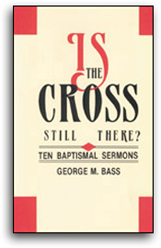
Is The Cross Still There?
Nine baptismal sermons
Yes, the cross is still there upon our foreheads and in our hearts. Easter, more than anything else, assures us of that. Because we believe in both Jesus' death and resurrection, we declare: "Christ is risen! He is risen indeed!" Our Lord's resurrection is at the heart of the Christian faith. Without the reality of the resurrection, the cross would be nonsense, Jesus would be a well-intentioned martyr, and the Christian church simply would not exist. He died, but he is alive forever! We have been marked by the cross at Easter for time and eternity.

On that first Easter Day, when the women told the disciples what had happened at the tomb of Jesus, their story was too incredible for the disciples to believe. They knew that Jesus was dead, and that people just don't rise from the grave, especially after someone had been dead for most of three days; such things don't even occur in our time when miracles of resuscitation commonly take place. The news was preposterous; it was just too much to believe. Like most people who had lived before them, and many people who have lived since the first century A.D., the thought of a person overcoming death -- resurrection -- was "an idle tale," pure nonsense.
Toward the end of the third week after Easter a couple of years ago, local newspaper headlines announced: "Come hell or high water, atheists set for conclave." The national convention of American Atheists was held in Minneapolis, Minnesota, a state wherein 95 percent of the people claim to believe in some sort of god and more than half of the population is supposed to attend church every week. It seemed ludicrous that the atheists would meet in this city but, apparently, they wanted to make known their "beliefs" to the people who worship the God of the Jews and Christians; they simply can't accept the biblical account of creation or the other stories of how God deals with people here on earth.
One woman, Cora Wheeler, was interviewed, apparently because she was a rather typical atheist. She told the reporter that her father was an atheist, but that he never used the term. Her mother sent her to Sunday School, but "her father would always point out the ‘fantasies' in the various Bible stories in those Sunday sessions." She didn't realize that she was an atheist until she was an adult: "I was sorting mail at my job at the post office and saw a copy of the magazine, American Atheist, and I said, ‘So that's what I am.' " She believes that if she would ever wind up before the judgment seat of God, she'll have two questions: "I'll ask how come (this deity) gave me a brain to think with and why has he or she been so hidden. Nobody asks you to believe in trees. They don't require belief. They can be seen…. Religion came from primitive times. For early Christians, God was a man sitting up in the clouds. Then they learned about space. So the church, to save the faith, made it a spiritual God, invisible. It's obviously made up."18 For her and the others, the resurrection of the Son of God can be nothing else except pure and unadulterated nonsense.
So much for the resurrection of Jesus if we stop reading the story at the point where the disciples regard it as "an idle tale." But Peter, at least, was curious and ran out to the tomb to see if it really was empty; the two angels were gone but the cloths in which Jesus had been wrapped so hurriedly on the day he died were there. He was amazed, but he still didn't believe the story. Nor did Cleopas and the "other disciple" accept the possibility of Jesus' rising from the dead as they walked toward Emmaus that same evening; they were still wondering why he had to die on a cross, why he had to die at all. Christ joined them and said to them, when he heard what they were talking about, "You foolish men! So slow to believe the full message of the prophets! Was it not ordained that the Christ should suffer and so enter into his glory?" He had to review the prophecies about himself with them, but it was only when he broke the bread at dinner that they recognized him, "and he vanished out of their sight."
In the case of Peter and the others, it wasn't until Jesus appeared to them in a locked room that the issue of his resurrection was addressed and settled once and for all time, at least, for them. Jesus spoke, "Peace be with you!" Luke tells us that they thought they were seeing a ghost, but the Lord asked, "Why are you so agitated, and why are these doubts rising in your hearts? Look at my hands and feet; yes, it is I indeed. Touch me and see for yourselves; a ghost has no flesh and bones as you can see I have." Even when he showed them his hands and feet, Luke tells us, "their joy was so great that they still could not believe it, and they stood there dumbfounded." To prove he was real and no ghost, Jesus took some fish and ate it "before their eyes." At last, they believed that the Lord had risen as he said he would, and they soon were ready to go out into all the world with the good news, "He is risen, as he said. He is risen indeed!"
Easter assures us that Jesus did not die in vain upon the cross at Calvary; his death served God's purpose, which was to reconcile the world to himself through the death of Jesus Christ. His resurrection reminds us that God accomplished his intention, despite the unfathomable mystery that will always surround his death and resurrection. The cross remains both a visible and invisible symbol of the faith. The resurrection holds it up for the world to see and to know that this is the sign of God's love for humanity. The cross declares to the world, "God loves the world so much that he has done everything he can to save those whom he has created in his image." The "empty" cross announces to the world that God is not only alive, but he has an active interest in the affairs of his people and does all he can to assure them that he, God the Father, is still God and has ultimate control over heaven and earth. The Lord is still alive!
When a colleague, Dr. James Limburg, was in East Germany several years ago, he met the pastor of a church in a small town near Dresden. He discovered that the man was a musician (Jim is too; he plays a trombone), plays a trumpet; he has played it in the brass band of his church for more than 50 years. Jim asked him, "Do you have your trumpet with you?" Indeed he did; he brought out a battered old horn and they went out into the garden behind the home where they had met, and he played a couple of hymns, as he does at home in his parish. He told Jim that no public religous activities were permitted in his town, and that his parsonage was right across the street from the city hall. Every morning, promptly at 8 a.m., as the government workers begin their day, he opens a window facing that building and plays two hymns appointed for the day. It is probably an illegal act, but he has done it for years and no one has bothered him. Prof. Limburg asks, "Why does he do it? Simply this: to keep the memory of God alive in that little town." That's really what the cross does in our world, isn't it? But it really does more than that; it reminds us that God is not only alive but that, in due time, our living and ever-present Lord will actually return to usher in the fullness of the kingdom of God and the era when he will rule "forever and ever."
As for us, we have the opportunity to meet that risen Lord, especially when we receive the Body and Blood in that holy supper which he prepared for us. And he comes to us and allows us to "touch" him by taking the elements in our hands and eating and drinking what he gives us. And when we do that, the invisible, indelible, and illuminated mark of the cross that was traced on our foreheads in baptism assures us that he is alive, that his death has delivered us from sin and death, and that through our baptism we participate, not only in his death but also in the benefits of his resurrection.
A couple of days after Easter a few years ago, an 18-year-old woman who had been baptized as a baby in our church was beaten and murdered by several young men; her name was Mollie Larson. In his sermon at her funeral, Pastor Paul K. Peterson said: "We are gathered in this room where some of you have been before. In our vault back in the office there is a book that tells us that on January 31, 1971, Mollie Michelle was here in this room, and in this room she was baptized in the name of the Father and of the Son and of the Holy Spirit. In that simple washing and those few words God made a promise to Mollie. God established a no-strings covenant with Mollie that was contingent not on Mollie, not on Mollie's parents or family or friends. It was not a two-way promise to which she was bound to conform with some established pattern of behavior. God simply said to Mollie, ‘I am going to be your God. I am going to hold you close to my heart, and nothing, nothing will ever change that.' God is not into going back on his promises. He makes them and they stick. The apostle says it so well in this lesson (Romans 8:31-39), ‘I am sure… that neither death, nor life, nor angels, nor principalities , nor things present, nor things to come, nor powers, nor height, nor depth, nor anything else in all creation, will be able to separate us from the love of God in Christ Jesus our Lord.' "
Pastor Peterson added: "If we get that promise straight and riveted in our head and heart, then we might find ourselves with more questions than we had before. Chief among them might be, Then where was God on that dark night, on that godforsaken highway? Clearly God wasn't around to throw a protective shield around Mollie when she needed it. That's true…. The only answer that can satisfy our longing for understanding is to say once again, I am sure… I am sure that God was where the world needs him to be, on the cross at work for our redemption. And at the moment the blows fell that destroyed this young life, the man on the cross was the first to weep, just as he has wept for all of us who stray, who are overwhelmed by circumstances that defy understanding, and he weeps with us for all our losses, too. God's good purpose, God's will, is not for death. That's what Easter really means. God's purpose is to give us life, and give it to us abundantly. And we are here to say today, even through our tears, this is God's will for Mollie." And he adds, "That's the promise God made to Mollie back those few years ago in this room… (and) that life is God's gift now fulfilled in ways that pass our understanding today."19 For Mollie -- for all of us who have been baptized in the name of the Father and of the Son and of the Holy Spirit -- Easter declares, "The cross is still there."
Outside of the downtown hotels during the convention of American Atheists, I saw a car with special Minnesota license plates upon it. There were no numbers, only letters which spelled out "ATHEIST." The owner of the car wanted the world to know that he or she could not believe in God; it was a way of announcing to the world that as far as this person was concerned, God is dead. But we believe that God is very much alive. And we believe that God not only exists, but that he loves us and has given us proof of that love in the death and resurrection of our Lord, Jesus Christ. So we take our God-given faith into the world, proclaiming to all, "Christ is risen. He is risen indeed." And we believe that the cross, the sign of God's incomprehensible and immeasurable love, is still there and always will be on our foreheads. Yes, the cross is still there because the crucified Christ is alive forever!
On that first Easter Day, when the women told the disciples what had happened at the tomb of Jesus, their story was too incredible for the disciples to believe. They knew that Jesus was dead, and that people just don't rise from the grave, especially after someone had been dead for most of three days; such things don't even occur in our time when miracles of resuscitation commonly take place. The news was preposterous; it was just too much to believe. Like most people who had lived before them, and many people who have lived since the first century A.D., the thought of a person overcoming death -- resurrection -- was "an idle tale," pure nonsense.
Toward the end of the third week after Easter a couple of years ago, local newspaper headlines announced: "Come hell or high water, atheists set for conclave." The national convention of American Atheists was held in Minneapolis, Minnesota, a state wherein 95 percent of the people claim to believe in some sort of god and more than half of the population is supposed to attend church every week. It seemed ludicrous that the atheists would meet in this city but, apparently, they wanted to make known their "beliefs" to the people who worship the God of the Jews and Christians; they simply can't accept the biblical account of creation or the other stories of how God deals with people here on earth.
One woman, Cora Wheeler, was interviewed, apparently because she was a rather typical atheist. She told the reporter that her father was an atheist, but that he never used the term. Her mother sent her to Sunday School, but "her father would always point out the ‘fantasies' in the various Bible stories in those Sunday sessions." She didn't realize that she was an atheist until she was an adult: "I was sorting mail at my job at the post office and saw a copy of the magazine, American Atheist, and I said, ‘So that's what I am.' " She believes that if she would ever wind up before the judgment seat of God, she'll have two questions: "I'll ask how come (this deity) gave me a brain to think with and why has he or she been so hidden. Nobody asks you to believe in trees. They don't require belief. They can be seen…. Religion came from primitive times. For early Christians, God was a man sitting up in the clouds. Then they learned about space. So the church, to save the faith, made it a spiritual God, invisible. It's obviously made up."18 For her and the others, the resurrection of the Son of God can be nothing else except pure and unadulterated nonsense.
So much for the resurrection of Jesus if we stop reading the story at the point where the disciples regard it as "an idle tale." But Peter, at least, was curious and ran out to the tomb to see if it really was empty; the two angels were gone but the cloths in which Jesus had been wrapped so hurriedly on the day he died were there. He was amazed, but he still didn't believe the story. Nor did Cleopas and the "other disciple" accept the possibility of Jesus' rising from the dead as they walked toward Emmaus that same evening; they were still wondering why he had to die on a cross, why he had to die at all. Christ joined them and said to them, when he heard what they were talking about, "You foolish men! So slow to believe the full message of the prophets! Was it not ordained that the Christ should suffer and so enter into his glory?" He had to review the prophecies about himself with them, but it was only when he broke the bread at dinner that they recognized him, "and he vanished out of their sight."
In the case of Peter and the others, it wasn't until Jesus appeared to them in a locked room that the issue of his resurrection was addressed and settled once and for all time, at least, for them. Jesus spoke, "Peace be with you!" Luke tells us that they thought they were seeing a ghost, but the Lord asked, "Why are you so agitated, and why are these doubts rising in your hearts? Look at my hands and feet; yes, it is I indeed. Touch me and see for yourselves; a ghost has no flesh and bones as you can see I have." Even when he showed them his hands and feet, Luke tells us, "their joy was so great that they still could not believe it, and they stood there dumbfounded." To prove he was real and no ghost, Jesus took some fish and ate it "before their eyes." At last, they believed that the Lord had risen as he said he would, and they soon were ready to go out into all the world with the good news, "He is risen, as he said. He is risen indeed!"
Easter assures us that Jesus did not die in vain upon the cross at Calvary; his death served God's purpose, which was to reconcile the world to himself through the death of Jesus Christ. His resurrection reminds us that God accomplished his intention, despite the unfathomable mystery that will always surround his death and resurrection. The cross remains both a visible and invisible symbol of the faith. The resurrection holds it up for the world to see and to know that this is the sign of God's love for humanity. The cross declares to the world, "God loves the world so much that he has done everything he can to save those whom he has created in his image." The "empty" cross announces to the world that God is not only alive, but he has an active interest in the affairs of his people and does all he can to assure them that he, God the Father, is still God and has ultimate control over heaven and earth. The Lord is still alive!
When a colleague, Dr. James Limburg, was in East Germany several years ago, he met the pastor of a church in a small town near Dresden. He discovered that the man was a musician (Jim is too; he plays a trombone), plays a trumpet; he has played it in the brass band of his church for more than 50 years. Jim asked him, "Do you have your trumpet with you?" Indeed he did; he brought out a battered old horn and they went out into the garden behind the home where they had met, and he played a couple of hymns, as he does at home in his parish. He told Jim that no public religous activities were permitted in his town, and that his parsonage was right across the street from the city hall. Every morning, promptly at 8 a.m., as the government workers begin their day, he opens a window facing that building and plays two hymns appointed for the day. It is probably an illegal act, but he has done it for years and no one has bothered him. Prof. Limburg asks, "Why does he do it? Simply this: to keep the memory of God alive in that little town." That's really what the cross does in our world, isn't it? But it really does more than that; it reminds us that God is not only alive but that, in due time, our living and ever-present Lord will actually return to usher in the fullness of the kingdom of God and the era when he will rule "forever and ever."
As for us, we have the opportunity to meet that risen Lord, especially when we receive the Body and Blood in that holy supper which he prepared for us. And he comes to us and allows us to "touch" him by taking the elements in our hands and eating and drinking what he gives us. And when we do that, the invisible, indelible, and illuminated mark of the cross that was traced on our foreheads in baptism assures us that he is alive, that his death has delivered us from sin and death, and that through our baptism we participate, not only in his death but also in the benefits of his resurrection.
A couple of days after Easter a few years ago, an 18-year-old woman who had been baptized as a baby in our church was beaten and murdered by several young men; her name was Mollie Larson. In his sermon at her funeral, Pastor Paul K. Peterson said: "We are gathered in this room where some of you have been before. In our vault back in the office there is a book that tells us that on January 31, 1971, Mollie Michelle was here in this room, and in this room she was baptized in the name of the Father and of the Son and of the Holy Spirit. In that simple washing and those few words God made a promise to Mollie. God established a no-strings covenant with Mollie that was contingent not on Mollie, not on Mollie's parents or family or friends. It was not a two-way promise to which she was bound to conform with some established pattern of behavior. God simply said to Mollie, ‘I am going to be your God. I am going to hold you close to my heart, and nothing, nothing will ever change that.' God is not into going back on his promises. He makes them and they stick. The apostle says it so well in this lesson (Romans 8:31-39), ‘I am sure… that neither death, nor life, nor angels, nor principalities , nor things present, nor things to come, nor powers, nor height, nor depth, nor anything else in all creation, will be able to separate us from the love of God in Christ Jesus our Lord.' "
Pastor Peterson added: "If we get that promise straight and riveted in our head and heart, then we might find ourselves with more questions than we had before. Chief among them might be, Then where was God on that dark night, on that godforsaken highway? Clearly God wasn't around to throw a protective shield around Mollie when she needed it. That's true…. The only answer that can satisfy our longing for understanding is to say once again, I am sure… I am sure that God was where the world needs him to be, on the cross at work for our redemption. And at the moment the blows fell that destroyed this young life, the man on the cross was the first to weep, just as he has wept for all of us who stray, who are overwhelmed by circumstances that defy understanding, and he weeps with us for all our losses, too. God's good purpose, God's will, is not for death. That's what Easter really means. God's purpose is to give us life, and give it to us abundantly. And we are here to say today, even through our tears, this is God's will for Mollie." And he adds, "That's the promise God made to Mollie back those few years ago in this room… (and) that life is God's gift now fulfilled in ways that pass our understanding today."19 For Mollie -- for all of us who have been baptized in the name of the Father and of the Son and of the Holy Spirit -- Easter declares, "The cross is still there."
Outside of the downtown hotels during the convention of American Atheists, I saw a car with special Minnesota license plates upon it. There were no numbers, only letters which spelled out "ATHEIST." The owner of the car wanted the world to know that he or she could not believe in God; it was a way of announcing to the world that as far as this person was concerned, God is dead. But we believe that God is very much alive. And we believe that God not only exists, but that he loves us and has given us proof of that love in the death and resurrection of our Lord, Jesus Christ. So we take our God-given faith into the world, proclaiming to all, "Christ is risen. He is risen indeed." And we believe that the cross, the sign of God's incomprehensible and immeasurable love, is still there and always will be on our foreheads. Yes, the cross is still there because the crucified Christ is alive forever!

