The Eternal God Is Thy Refuge
Sermon
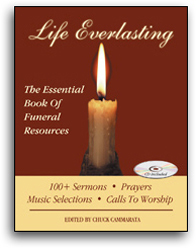
Life Everlasting
The Essential Book of Funeral Resources
Object:
For a person who had endured much pain
The Eternal God Is Thy Refuge
Deuteronomy; Psalm 23; Psalm 84; Hebrews 12:12-13; Revelation

About four years ago this month, I met Nancy as I sat down at a table in a restaurant down there in southern New Jersey. I was meeting some members of the pastor nominating committee after they had come to worship in my former congregation. Nancy asked me the first question before I had even settled in directly on the other side of the table from her piercing mind, her comforting smile, her dancing eyes, and her warmth of spirit. While I can't remember that first question, the occasion has become somewhat symbolic for me in my own memory of Nancy. Our conversations were always dominated by questions; from Nancy to me. Whether in a Bible study class one summer, with her willingness to just take on a text and wrestle with it, or whether at her hospital bed with the newspaper so neatly piled, though you knew it had been read, the question there at the bedside was of current events, politics, or international relations. I always felt like I could never know enough when it came to one of Nancy's questions, but she made me feel so good in not knowing enough! My favorite questions came when Nancy would inquire about my children, about how they had settled in, how they liked school, had they made friends, and for my daughter as she moved into the middle school years. Nancy spoke with me for a long time about nurturing the mind and maturation and the strength and the identity of young girls.
Those questions are somewhat symbolic for me, because I soon realized how difficult it was to get Nancy to tell me about herself. Certainly, she would never talk of her struggle for health or her constant pain, but neither could I get her to say much about her incredible experience in life and family and faith. That is partly why the celebration of Nancy's life today is such a gift to all of us, to listen, to learn, and to give thanks to God. In terms of my own training, Nancy was a pastoral care challenge, because she was so disciplined in trying to get me as the caregiver to talk more about myself. The lines of caregiver and care-receiver were always blurred, even in these last weeks. It was as if, in those questions, she was artfully and respectfully saying, "So enough about me, let's talk about you." Even as Nancy's last hospital stay became longer and longer, she wouldn't let the volunteers at the hospital inform the church. Those who knew Nancy so well could rightly conclude that had to do with her pride and dignity and strength. That's all true, but what was also true, is that she didn't want to bother me as I wrestled with my own mother's death early in January. The lines between caregiver and care-receiver were always blurred.
You can imagine, I would think, that Nancy gave input into our service of worship this afternoon. She chose the hymn setting of Psalm 23:
When I walk through the shades of death,
thy presence is my stay;
a word of thy supporting breath drives all my fears away.
Thy hand, in sight of all my foes, doth still my table spread
my cup with blessings overflows
thine oil anoints my head.
And this text from the Old Testament, the book of Deuteronomy was important to Nancy as well: "The eternal God is thy dwelling place and underneath are the everlasting arms."
In terms of Nancy's own faith, this process of death was the eternal God drawing her in. That is how she described it. God's mighty Spirit, drawing near unto her, bringing her back, forever in God's presence.
"How lovely is your dwelling place, O Lord of hosts! My soul longs, indeed it faints for the courts of the Lord" (Psalm 84). Or the words of Jesus in the Gospel of John, "In my Father's house, there are many mansions, if it were not so I would have told you." Or the Apocalypse of John, the book of Revelation: "God will dwell with them, and they will be God's people, and God will be with them; God will wipe every tear from their eyes. Death will be no more; mourning and crying and pain will be no more, for the first things have passed away" (Revelation 21:13-14). Or in Nancy's imagination, in her dying days, "God is out there, and bringing me in, closer in to be with God."
Even in her death, Nancy forbids me to talk about her faith. Because her faith was the church's faith. Her faith was a gift from God. And I stand before you to proclaim our faith that death shall not have the last word, that the sense of relief can now be mixed with thanksgiving, even joy, for Nancy's long journey of illness is finished, but her life in God has just begun. The strength and dignity with which Nancy lived life, is exactly how she lived up to and through her own death. We believe in the resurrection power of God, that the eternal God has offered Nancy that resting place underneath the everlasting arms.
We gather to proclaim the church's faith, our faith in resurrection hope, that our hope might provide an exclamation point to Nancy's life. We shall sing of that faith, and part of what it means to be the church, is that when you can't sing for yourself, we will sing for you. Part of Nancy's place in this community of faith, was her willingness to sing and to pray for others. Our celebration and thanksgiving for her life means we will stand and proclaim and sing, not her faith, but the church's faith, our faith, for it is a gift of God. And, when your doubts bring silence, or questions, when your own illnesses cause absence, when you find you are distant from this community, we will continue to sing for you, and with that great cloud of witnesses, and for all the saints.
"Therefore lift your drooping hands and strengthen your weak knees, and make straight paths for your feet, so that what is lame may not be put out of joint, but rather healed" (Hebrews 12:12-13).
Strength and dignity in life and in death and in life eternal. For the eternal God is thy dwelling place, and underneath are the everlasting arms. Amen.
The Eternal God Is Thy Refuge
Deuteronomy; Psalm 23; Psalm 84; Hebrews 12:12-13; Revelation
About four years ago this month, I met Nancy as I sat down at a table in a restaurant down there in southern New Jersey. I was meeting some members of the pastor nominating committee after they had come to worship in my former congregation. Nancy asked me the first question before I had even settled in directly on the other side of the table from her piercing mind, her comforting smile, her dancing eyes, and her warmth of spirit. While I can't remember that first question, the occasion has become somewhat symbolic for me in my own memory of Nancy. Our conversations were always dominated by questions; from Nancy to me. Whether in a Bible study class one summer, with her willingness to just take on a text and wrestle with it, or whether at her hospital bed with the newspaper so neatly piled, though you knew it had been read, the question there at the bedside was of current events, politics, or international relations. I always felt like I could never know enough when it came to one of Nancy's questions, but she made me feel so good in not knowing enough! My favorite questions came when Nancy would inquire about my children, about how they had settled in, how they liked school, had they made friends, and for my daughter as she moved into the middle school years. Nancy spoke with me for a long time about nurturing the mind and maturation and the strength and the identity of young girls.
Those questions are somewhat symbolic for me, because I soon realized how difficult it was to get Nancy to tell me about herself. Certainly, she would never talk of her struggle for health or her constant pain, but neither could I get her to say much about her incredible experience in life and family and faith. That is partly why the celebration of Nancy's life today is such a gift to all of us, to listen, to learn, and to give thanks to God. In terms of my own training, Nancy was a pastoral care challenge, because she was so disciplined in trying to get me as the caregiver to talk more about myself. The lines of caregiver and care-receiver were always blurred, even in these last weeks. It was as if, in those questions, she was artfully and respectfully saying, "So enough about me, let's talk about you." Even as Nancy's last hospital stay became longer and longer, she wouldn't let the volunteers at the hospital inform the church. Those who knew Nancy so well could rightly conclude that had to do with her pride and dignity and strength. That's all true, but what was also true, is that she didn't want to bother me as I wrestled with my own mother's death early in January. The lines between caregiver and care-receiver were always blurred.
You can imagine, I would think, that Nancy gave input into our service of worship this afternoon. She chose the hymn setting of Psalm 23:
When I walk through the shades of death,
thy presence is my stay;
a word of thy supporting breath drives all my fears away.
Thy hand, in sight of all my foes, doth still my table spread
my cup with blessings overflows
thine oil anoints my head.
And this text from the Old Testament, the book of Deuteronomy was important to Nancy as well: "The eternal God is thy dwelling place and underneath are the everlasting arms."
In terms of Nancy's own faith, this process of death was the eternal God drawing her in. That is how she described it. God's mighty Spirit, drawing near unto her, bringing her back, forever in God's presence.
"How lovely is your dwelling place, O Lord of hosts! My soul longs, indeed it faints for the courts of the Lord" (Psalm 84). Or the words of Jesus in the Gospel of John, "In my Father's house, there are many mansions, if it were not so I would have told you." Or the Apocalypse of John, the book of Revelation: "God will dwell with them, and they will be God's people, and God will be with them; God will wipe every tear from their eyes. Death will be no more; mourning and crying and pain will be no more, for the first things have passed away" (Revelation 21:13-14). Or in Nancy's imagination, in her dying days, "God is out there, and bringing me in, closer in to be with God."
Even in her death, Nancy forbids me to talk about her faith. Because her faith was the church's faith. Her faith was a gift from God. And I stand before you to proclaim our faith that death shall not have the last word, that the sense of relief can now be mixed with thanksgiving, even joy, for Nancy's long journey of illness is finished, but her life in God has just begun. The strength and dignity with which Nancy lived life, is exactly how she lived up to and through her own death. We believe in the resurrection power of God, that the eternal God has offered Nancy that resting place underneath the everlasting arms.
We gather to proclaim the church's faith, our faith in resurrection hope, that our hope might provide an exclamation point to Nancy's life. We shall sing of that faith, and part of what it means to be the church, is that when you can't sing for yourself, we will sing for you. Part of Nancy's place in this community of faith, was her willingness to sing and to pray for others. Our celebration and thanksgiving for her life means we will stand and proclaim and sing, not her faith, but the church's faith, our faith, for it is a gift of God. And, when your doubts bring silence, or questions, when your own illnesses cause absence, when you find you are distant from this community, we will continue to sing for you, and with that great cloud of witnesses, and for all the saints.
"Therefore lift your drooping hands and strengthen your weak knees, and make straight paths for your feet, so that what is lame may not be put out of joint, but rather healed" (Hebrews 12:12-13).
Strength and dignity in life and in death and in life eternal. For the eternal God is thy dwelling place, and underneath are the everlasting arms. Amen.