Economic Justice, Facing The Issue
Sermon
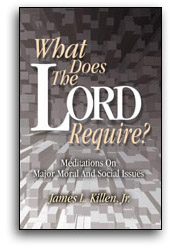
WHAT DOES THE LORD REQUIRE?
Meditations On Major Moral And Social Issues
For years, they had all been hearing that our world's economic system is working in a way that makes the rich richer and the poor poorer and that it is reducing the disadvantaged people of the world, especially of the "developing nations," to deep, oppressive poverty. They had all heard the prophetic messages of the Latin American "theologians of liberation" saying that God is partial to the poor and that Christian people ought to join with the poor to work to eliminate the causes of their poverty. But, for many of the 3,000 delegates who came to Rio de Janeiro, Brazil, for the 1996 World Methodist Conference, these things had not yet become real.1 In Rio, they could look around and see what the prophets had been talking about. They saw the squatter's villages, they call them "favellas," filling every empty space and climbing up the steep mountainsides in view of the fine homes of the affluent and of the luxury hotels where the lunch buffet costs 25 American dollars. Thousands of people live as well as they can in these favellas. Two hundred thousand people live in one favella alone, the favella called "Prosthemia." These people are in poverty, not because of any failure of their own, but as a result of economic conditions beyond their control. The conference was especially concerned about the thousands of children who come, or are sent, down from those squatters' villages to live on the streets of Rio to get money by working, by begging, and sometimes by stealing. These street children represent a major problem that impacts every country in the world. Furthermore, more and more people are realizing that the problem of economic inequity is not just "someone else's problem." There is reason to believe that the conditions that caused the widespread poverty in Latin America are spreading to other countries - including our own.
Today, we are going to talk about the knotty issue of economic justice. We are going to ask questions about what kind of a response Christian people ought to make to the suffering of the poor people of the earth.
Right now, many of you are probably thinking, "Why do we have to think about that? Economics is a complex subject. Economic justice is a disturbing issue that asks uncomfortable questions about our way of life and that do not allow for any simple or clear cut solutions. Why do we have to think about that, especially in church? Why can't we stick to the spiritual things?"
The answer is that we have to think about economic justice because God wants us to. The Bible makes that clear. People who read the Bible through for the first time are often surprised at what they find there. A certain affluent American professional man participated in a nine--month comprehensive Bible study that caused him to read and study most of the Bible for the first time. He had an unexpected experience. He was surprised at how much the Bible says about money and about economic justice. He was deeply disturbed by the fact that he heard the Bible contradicting some of the things our culture had taught him. He had grown accustomed to being encouraged to "get all you can for yourself and leave others to look out for themselves." He had always believed that was the American way of life and that the Christian faith supports the American way. But he heard the Bible saying, "God wants everyone to have enough, and God wants us to want that, too." In genuine anguish, the man asked his pastor, "Does the Bible condemn capitalism?"
Actually, the Bible does not condemn capitalism as such. It seems that most of the Bible is set in social systems that functioned according to a sort of primitive agrarian capitalism. Some people think that they see the development of a kind of socialism in the early church in Jerusalem. The book of Acts tells us that "all who believed were together and had all things in common; they would sell their possessions and goods and distribute the proceeds to all, as any had need" (Acts 2:44--45). But, if you read that passage carefully and in context, it will be apparent that it is an example of Christian stewardship and of sharing rather than of socialism. The biblical people practiced capitalism. Yet they knew that, left to itself, economics will work to the advantage of the rich. It can move toward a kind of feudalism in which a few rich and powerful people have all of the resources and the rest of the population is reduced to servitude and desperation. They had seen that happen in Egypt and in the cities of Canaan. They knew that God wants something better than that for God's people.
This commitment to the well--being of all people is apparent in many parts of the Bible. The Old Testament books of the law (Torah), which shaped the life of the Jewish nation, required farmers to leave some of their crops to be gleaned by the poor, the widows and orphans, and the disadvantaged. They were reminded again and again that their ancestors had been poor sojourners in Egypt (Deuteronomy 24:19--22). Limits were set on what the rich could do to exploit the poor. Later, the prophets thundered God's condemnation upon those who violated these commandments. Amos cried out against those who would sell the needy for a pair of shoes and trample the heads of the poor into the dust of the earth and push the afflicted out of the way (Amos 2:6--7). Isaiah condemned those who increase their holdings, adding house to house and field to field until there is no room left for anyone else (Isaiah 5:8). Jesus called his followers to be responsive to the needs of the poor saying, "I was hungry and you gave me food ... Truly I tell you, just as you did it to one of the least of these, who are members of my family, you did it to me" (Matthew 25:31--45).
You just can't read the Bible without knowing that God wants all people to have enough and that there is something wrong with any situation that reduces some people to desperate poverty.
When we look around at our world with that in mind, it becomes apparent that there is something wrong.
The delegates to the World Methodist Conference could travel around in the city that was once thought to be a very glamorous place and see not only the poverty of the poor but the impact of that poverty upon the quality of life in the whole city. They knew that they were meeting in Rio because economic and political conditions in neighboring Argentina were so volatile that it seemed unsafe for the meeting to be held in Buenos Aires. In fact, the economic conditions we have been describing were the reasons for the revolutionary movements that had broken out in places like Bolivia, Nicaragua, and El Salvador.
In Mexico, our near neighbor, nearly half of all of the children who die before the age of five die of malnutrition - while one of our biggest problems continues to be overeating. There is a lot of suffering in our world.
And here is something that really spells the problem out. Several years ago, the basketball star, Michael Jordan, was awarded a contract for twenty million dollars a year to endorse Nike tennis shoes. That is more than the entire payroll of the factory in Indonesia that makes Nike tennis shoes. There is something wrong with that, isn't there?
To our embarrassment, even though the vast majority of American people would never intentionally exploit or oppress anyone, the systems that tend to impoverish the disadvantaged people of the world work to our advantage.
But now another dimension of this problem is developing. The same tendency for the rich to get richer and for everyone else to get poorer is present in our own country.
Early in the preparations for the 1997 presidential campaign, candidates for the nominations of both parties finally said out loud what many of us had been knowing for a long time. Most average Americans are less prosperous today than they were twenty years ago. We are moving down the ladder of affluence, not up. And for many people, this is devastating. (Somehow that issue got lost as the campaigns developed. It has not emerged again since. Politicians don't like to talk about this.)
In part, this is a result of the globalization of the economy. When the average daily wage of workers in Asia and Latin America is three dollars and the average daily wage of workers in the United States is 85 dollars, the shrinking of the world is bound to have a negative effect on American prosperity. We have all heard the frequent news reports of the closing of American manufacturing industries and the relocation of those operations to other countries where labor costs are lower. In a competitive business situation, that may seem the expedient thing to do. But its impact on the families of the American workers who were displaced can be destructive.
There are evidently some other forces at work to make the rich richer and the rest poorer. The companies call it "getting lean and mean" to stay competitive. It involves reducing staff as much as possible and requiring those who are retained to work more for what they get. It also involves replacing highly paid employees with employees who can be paid much less. You have seen it happening. Recently, a man standing in line at the grocery store told a friend about the second job he had taken to make ends meet. He ended by saying, "Even at that, I don't make as much as I made before I was laid off from the plant." Where is this leading?
On November 6, 1995, Lester Thurow published an article in the New York Times Magazine that gave a statistical analysis of what is happening to us. He said that, in the past 25 years, the difference between the incomes of the top twenty percent of the wage earning men and the bottom twenty percent has doubled. In a time when gross domestic production rose by 29 percent, the real earning of working men fell by eleven percent. The share of the wealth held by the top one percent of our population is double what it was in the mid--1970s. One percent of the country's population now owns close to forty percent of the country's resources. Thurow ends by asking the question, "Can democracy survive that much inequity?"2
The trend has evidently continued. On May 17, 2002, Bill Moyers hosted a television documentary that dealt with the widening gap between the rich and the poor in America. He said that so much money is being sucked up into the pockets of the richest one percent of the American population that America has now become the most unequal of the industrialized nations. The very rich get richer, but the workers are impoverished. His program had several sections. In the first, there was a report on the growing income gap in Hartford, Connecticut, where, since 1990, the average income of the top fifth of the population has increased by 21 percent and that of the lowest fifth has declined by nineteen percent. In the second segment of the program, he interviewed Kevin Phillips, author of Money and Democracy, who asserted that big money has been able virtually to buy control of both of the major political parties in our government. Then there was a brief segment on the lavish lifestyle of the very wealthy followed by a report on the spiraling cost of medical care. We have come to a place where forty million Americans can no longer afford health insurance. Moyers ended his program by saying that "the rich have declared class war and spent what it took to win ... All that is left now is for the politicians to divide up the spoils."3
When we put all of these things together and think about where they may be leading us, we catch a vision that is so frightening that most of us don't want to look at it. But we must look at it. And, we must ask where it is going.
In 1996, Jose Miguez Boninos, who is a theologian and a pastor in Argentina, said that economic conditions in his own country have gotten so bad that those who once thought of themselves as the affluent are finding their own fortunes impacted. Doctors and lawyers are finding their waiting rooms empty because people cannot afford their services. He said they are responding differently. Some are becoming bitter and dropping into despair. Others are finally seeing things more clearly and joining the poor in a search for solutions. Since that time, conditions have gotten worse. (At the time of this writing, Argentina is bankrupt and in a state of dangerous political turmoil.)
Unfortunately, some respond in violent ways. We have experienced the results of the fanaticism that was born out of desperation in Afghanistan. And some don't know any way to respond to a threat but through repression. Some people who arrived early for the World Methodist Conference in Rio employed a guide to take them to see some of the work that the churches were doing with the street children. The guide took them first to a place near a Catholic cathedral where someone, possibly the police, had recently found seven young girls sleeping on the sidewalk and shot them as they slept. The places where they lay were outlined in yellow paint and above them on the cathedral wall was written the word, "unrequited," because as yet no one has been punished. That story should fill us all with anguish. We wonder, "Is that where the history of the world is going, toward a time when we just get all we can for ourselves, oblivious to the effect of our getting on others, and when the children of the poor will be regarded as rubbish to be disposed of?"
Then what should Christian people do about these conditions? Let us hasten to say that there are no simple solutions. The problems are too complex. But there are three things that we can do that will be steps in the right direction.
The first thing we are most naturally inclined to do is one right thing to do. Americans, and especially Christians, just naturally want to respond to human need in compassion. While some treat the poor like rubbish to be disposed of, the Christian churches in Brazil see them as precious children of God and are committing massive efforts toward rescuing them and helping them break the cycle of poverty. Thousands of street children are fed and involved in school programs every day through the efforts of the churches in Brazil. The first letter of John asks, "How does God's love abide in anyone who has the world's goods and sees a brother or sister in need and yet refuses to help?" (1 John 3:17). Giving help is one right thing to do. But there are others.
One that we may not have thought of is that we need to prepare ourselves to be spiritual survivors in this world of changing economic conditions. You see, many of us have gotten addicted to upward mobility. It would not be so bad if we had just made a game of seeing how much we can accumulate. The problem is that we have made a religion of it. It is where we find the meaning of our lives. It is where we get our sense of basic well--being. Consequently, an end to easy upward mobility can be really devastating. It has been for many people.
We need to discover a new way of putting our lives together, a new center around which to organize them. Jesus gave us the key when he said, "... do not worry about your life, what you will eat or what you will drink ... But strive first for the kingdom of God and his righteousness and all of these things will be given to you as well" (Matthew 6:25--33). These familiar words were never more relevant than they are now. If we take them seriously, they will enable us to live full, good lives under any economic conditions. We will be able to survive downward mobility as whole persons and to show others how to do that, too. We may actually be set free to make sacrifices if we have to in the quest for economic justice.
Then we must participate as best we can in the search for solutions to the economic problems of our world. The way to economic justice has not yet been found. And we can suppose that, when it is found, it will not be something easy or simplistic. Bishop Peter Storey of the Methodist Church in South Africa made a profound brief statement. He said, "We can assume these issues are complex, but the principles of Jesus are not." If those who work among the complexities of economic life will work with a loving commitment to the well--being of all people, the solutions will eventually emerge. If the leaders of business and government - and the rest of us, too - learn to ask, "How can we see that the needs of all people are met?" instead of just asking, "How can we maximize our own profit and that of those we represent?" the solutions will eventually emerge. It will take a conversion of culture to lead the decision makers to think in those terms. But God may be working through conditions in the world to lead us to be open to that kind of conversion. Let us pray that it comes in time.
From the private dining room on the fourteenth story of the Intercontinental Hotel in Rio, one can catch a very meaningful vision. A broad street runs between the high--rise apartment buildings where the affluent live. Their tennis courts and swimming pools and manicured lawns are surrounded by walls with guarded gates to keep intruders out. Then the street crosses a freeway and gets lost among the makeshift dwellings of the favella where several thousand people live in oppressive poverty. The houses climb the steep banks of a mountain. But beyond that mountain, in the distance, one can see the top of another mountain and on top of that the massive statue of Christ the Redeemer with arms outstretched that dominates the city of Rio de Janeiro. Christians must wonder, "What does Christ want for all of the people of that city, and for all of the people of a world that is looking more and more like it?" We must ask. And when we think we know, we must want that, too, and do all we can to bring it to be, because what Christ wants for us is what is really best for us all.4
____________
1. Joe Hale, Editor, Proceedings of the Seventeenth World Methodist Conference (Lake Junaluska, North Carolina: World Methodist Council, 1997).
2. Lester Thurow, "Their World Might Crumble," New York Times Magazine, November 6, 1995.
3. Bill Moyers, Now with Bill Moyers (PBS Home Video) May 17, 2002.
4. A version of this sermon was originally published in Pulpit Digest, September--October, 1998, David Albert Farmer, Editor (Inver Grove Heights, Minnesota: Logos Productions Inc.).
Today, we are going to talk about the knotty issue of economic justice. We are going to ask questions about what kind of a response Christian people ought to make to the suffering of the poor people of the earth.
Right now, many of you are probably thinking, "Why do we have to think about that? Economics is a complex subject. Economic justice is a disturbing issue that asks uncomfortable questions about our way of life and that do not allow for any simple or clear cut solutions. Why do we have to think about that, especially in church? Why can't we stick to the spiritual things?"
The answer is that we have to think about economic justice because God wants us to. The Bible makes that clear. People who read the Bible through for the first time are often surprised at what they find there. A certain affluent American professional man participated in a nine--month comprehensive Bible study that caused him to read and study most of the Bible for the first time. He had an unexpected experience. He was surprised at how much the Bible says about money and about economic justice. He was deeply disturbed by the fact that he heard the Bible contradicting some of the things our culture had taught him. He had grown accustomed to being encouraged to "get all you can for yourself and leave others to look out for themselves." He had always believed that was the American way of life and that the Christian faith supports the American way. But he heard the Bible saying, "God wants everyone to have enough, and God wants us to want that, too." In genuine anguish, the man asked his pastor, "Does the Bible condemn capitalism?"
Actually, the Bible does not condemn capitalism as such. It seems that most of the Bible is set in social systems that functioned according to a sort of primitive agrarian capitalism. Some people think that they see the development of a kind of socialism in the early church in Jerusalem. The book of Acts tells us that "all who believed were together and had all things in common; they would sell their possessions and goods and distribute the proceeds to all, as any had need" (Acts 2:44--45). But, if you read that passage carefully and in context, it will be apparent that it is an example of Christian stewardship and of sharing rather than of socialism. The biblical people practiced capitalism. Yet they knew that, left to itself, economics will work to the advantage of the rich. It can move toward a kind of feudalism in which a few rich and powerful people have all of the resources and the rest of the population is reduced to servitude and desperation. They had seen that happen in Egypt and in the cities of Canaan. They knew that God wants something better than that for God's people.
This commitment to the well--being of all people is apparent in many parts of the Bible. The Old Testament books of the law (Torah), which shaped the life of the Jewish nation, required farmers to leave some of their crops to be gleaned by the poor, the widows and orphans, and the disadvantaged. They were reminded again and again that their ancestors had been poor sojourners in Egypt (Deuteronomy 24:19--22). Limits were set on what the rich could do to exploit the poor. Later, the prophets thundered God's condemnation upon those who violated these commandments. Amos cried out against those who would sell the needy for a pair of shoes and trample the heads of the poor into the dust of the earth and push the afflicted out of the way (Amos 2:6--7). Isaiah condemned those who increase their holdings, adding house to house and field to field until there is no room left for anyone else (Isaiah 5:8). Jesus called his followers to be responsive to the needs of the poor saying, "I was hungry and you gave me food ... Truly I tell you, just as you did it to one of the least of these, who are members of my family, you did it to me" (Matthew 25:31--45).
You just can't read the Bible without knowing that God wants all people to have enough and that there is something wrong with any situation that reduces some people to desperate poverty.
When we look around at our world with that in mind, it becomes apparent that there is something wrong.
The delegates to the World Methodist Conference could travel around in the city that was once thought to be a very glamorous place and see not only the poverty of the poor but the impact of that poverty upon the quality of life in the whole city. They knew that they were meeting in Rio because economic and political conditions in neighboring Argentina were so volatile that it seemed unsafe for the meeting to be held in Buenos Aires. In fact, the economic conditions we have been describing were the reasons for the revolutionary movements that had broken out in places like Bolivia, Nicaragua, and El Salvador.
In Mexico, our near neighbor, nearly half of all of the children who die before the age of five die of malnutrition - while one of our biggest problems continues to be overeating. There is a lot of suffering in our world.
And here is something that really spells the problem out. Several years ago, the basketball star, Michael Jordan, was awarded a contract for twenty million dollars a year to endorse Nike tennis shoes. That is more than the entire payroll of the factory in Indonesia that makes Nike tennis shoes. There is something wrong with that, isn't there?
To our embarrassment, even though the vast majority of American people would never intentionally exploit or oppress anyone, the systems that tend to impoverish the disadvantaged people of the world work to our advantage.
But now another dimension of this problem is developing. The same tendency for the rich to get richer and for everyone else to get poorer is present in our own country.
Early in the preparations for the 1997 presidential campaign, candidates for the nominations of both parties finally said out loud what many of us had been knowing for a long time. Most average Americans are less prosperous today than they were twenty years ago. We are moving down the ladder of affluence, not up. And for many people, this is devastating. (Somehow that issue got lost as the campaigns developed. It has not emerged again since. Politicians don't like to talk about this.)
In part, this is a result of the globalization of the economy. When the average daily wage of workers in Asia and Latin America is three dollars and the average daily wage of workers in the United States is 85 dollars, the shrinking of the world is bound to have a negative effect on American prosperity. We have all heard the frequent news reports of the closing of American manufacturing industries and the relocation of those operations to other countries where labor costs are lower. In a competitive business situation, that may seem the expedient thing to do. But its impact on the families of the American workers who were displaced can be destructive.
There are evidently some other forces at work to make the rich richer and the rest poorer. The companies call it "getting lean and mean" to stay competitive. It involves reducing staff as much as possible and requiring those who are retained to work more for what they get. It also involves replacing highly paid employees with employees who can be paid much less. You have seen it happening. Recently, a man standing in line at the grocery store told a friend about the second job he had taken to make ends meet. He ended by saying, "Even at that, I don't make as much as I made before I was laid off from the plant." Where is this leading?
On November 6, 1995, Lester Thurow published an article in the New York Times Magazine that gave a statistical analysis of what is happening to us. He said that, in the past 25 years, the difference between the incomes of the top twenty percent of the wage earning men and the bottom twenty percent has doubled. In a time when gross domestic production rose by 29 percent, the real earning of working men fell by eleven percent. The share of the wealth held by the top one percent of our population is double what it was in the mid--1970s. One percent of the country's population now owns close to forty percent of the country's resources. Thurow ends by asking the question, "Can democracy survive that much inequity?"2
The trend has evidently continued. On May 17, 2002, Bill Moyers hosted a television documentary that dealt with the widening gap between the rich and the poor in America. He said that so much money is being sucked up into the pockets of the richest one percent of the American population that America has now become the most unequal of the industrialized nations. The very rich get richer, but the workers are impoverished. His program had several sections. In the first, there was a report on the growing income gap in Hartford, Connecticut, where, since 1990, the average income of the top fifth of the population has increased by 21 percent and that of the lowest fifth has declined by nineteen percent. In the second segment of the program, he interviewed Kevin Phillips, author of Money and Democracy, who asserted that big money has been able virtually to buy control of both of the major political parties in our government. Then there was a brief segment on the lavish lifestyle of the very wealthy followed by a report on the spiraling cost of medical care. We have come to a place where forty million Americans can no longer afford health insurance. Moyers ended his program by saying that "the rich have declared class war and spent what it took to win ... All that is left now is for the politicians to divide up the spoils."3
When we put all of these things together and think about where they may be leading us, we catch a vision that is so frightening that most of us don't want to look at it. But we must look at it. And, we must ask where it is going.
In 1996, Jose Miguez Boninos, who is a theologian and a pastor in Argentina, said that economic conditions in his own country have gotten so bad that those who once thought of themselves as the affluent are finding their own fortunes impacted. Doctors and lawyers are finding their waiting rooms empty because people cannot afford their services. He said they are responding differently. Some are becoming bitter and dropping into despair. Others are finally seeing things more clearly and joining the poor in a search for solutions. Since that time, conditions have gotten worse. (At the time of this writing, Argentina is bankrupt and in a state of dangerous political turmoil.)
Unfortunately, some respond in violent ways. We have experienced the results of the fanaticism that was born out of desperation in Afghanistan. And some don't know any way to respond to a threat but through repression. Some people who arrived early for the World Methodist Conference in Rio employed a guide to take them to see some of the work that the churches were doing with the street children. The guide took them first to a place near a Catholic cathedral where someone, possibly the police, had recently found seven young girls sleeping on the sidewalk and shot them as they slept. The places where they lay were outlined in yellow paint and above them on the cathedral wall was written the word, "unrequited," because as yet no one has been punished. That story should fill us all with anguish. We wonder, "Is that where the history of the world is going, toward a time when we just get all we can for ourselves, oblivious to the effect of our getting on others, and when the children of the poor will be regarded as rubbish to be disposed of?"
Then what should Christian people do about these conditions? Let us hasten to say that there are no simple solutions. The problems are too complex. But there are three things that we can do that will be steps in the right direction.
The first thing we are most naturally inclined to do is one right thing to do. Americans, and especially Christians, just naturally want to respond to human need in compassion. While some treat the poor like rubbish to be disposed of, the Christian churches in Brazil see them as precious children of God and are committing massive efforts toward rescuing them and helping them break the cycle of poverty. Thousands of street children are fed and involved in school programs every day through the efforts of the churches in Brazil. The first letter of John asks, "How does God's love abide in anyone who has the world's goods and sees a brother or sister in need and yet refuses to help?" (1 John 3:17). Giving help is one right thing to do. But there are others.
One that we may not have thought of is that we need to prepare ourselves to be spiritual survivors in this world of changing economic conditions. You see, many of us have gotten addicted to upward mobility. It would not be so bad if we had just made a game of seeing how much we can accumulate. The problem is that we have made a religion of it. It is where we find the meaning of our lives. It is where we get our sense of basic well--being. Consequently, an end to easy upward mobility can be really devastating. It has been for many people.
We need to discover a new way of putting our lives together, a new center around which to organize them. Jesus gave us the key when he said, "... do not worry about your life, what you will eat or what you will drink ... But strive first for the kingdom of God and his righteousness and all of these things will be given to you as well" (Matthew 6:25--33). These familiar words were never more relevant than they are now. If we take them seriously, they will enable us to live full, good lives under any economic conditions. We will be able to survive downward mobility as whole persons and to show others how to do that, too. We may actually be set free to make sacrifices if we have to in the quest for economic justice.
Then we must participate as best we can in the search for solutions to the economic problems of our world. The way to economic justice has not yet been found. And we can suppose that, when it is found, it will not be something easy or simplistic. Bishop Peter Storey of the Methodist Church in South Africa made a profound brief statement. He said, "We can assume these issues are complex, but the principles of Jesus are not." If those who work among the complexities of economic life will work with a loving commitment to the well--being of all people, the solutions will eventually emerge. If the leaders of business and government - and the rest of us, too - learn to ask, "How can we see that the needs of all people are met?" instead of just asking, "How can we maximize our own profit and that of those we represent?" the solutions will eventually emerge. It will take a conversion of culture to lead the decision makers to think in those terms. But God may be working through conditions in the world to lead us to be open to that kind of conversion. Let us pray that it comes in time.
From the private dining room on the fourteenth story of the Intercontinental Hotel in Rio, one can catch a very meaningful vision. A broad street runs between the high--rise apartment buildings where the affluent live. Their tennis courts and swimming pools and manicured lawns are surrounded by walls with guarded gates to keep intruders out. Then the street crosses a freeway and gets lost among the makeshift dwellings of the favella where several thousand people live in oppressive poverty. The houses climb the steep banks of a mountain. But beyond that mountain, in the distance, one can see the top of another mountain and on top of that the massive statue of Christ the Redeemer with arms outstretched that dominates the city of Rio de Janeiro. Christians must wonder, "What does Christ want for all of the people of that city, and for all of the people of a world that is looking more and more like it?" We must ask. And when we think we know, we must want that, too, and do all we can to bring it to be, because what Christ wants for us is what is really best for us all.4
____________
1. Joe Hale, Editor, Proceedings of the Seventeenth World Methodist Conference (Lake Junaluska, North Carolina: World Methodist Council, 1997).
2. Lester Thurow, "Their World Might Crumble," New York Times Magazine, November 6, 1995.
3. Bill Moyers, Now with Bill Moyers (PBS Home Video) May 17, 2002.
4. A version of this sermon was originally published in Pulpit Digest, September--October, 1998, David Albert Farmer, Editor (Inver Grove Heights, Minnesota: Logos Productions Inc.).