Lent To Life
Sermon
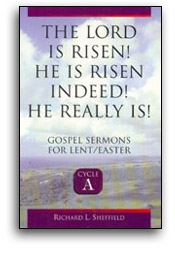
The Lord Is Risen! He Is Risen Indeed! He Really Is!
Gospel Sermons For Lent/Easter
Ash Wednesday is the first day of Lent. A Sunday school teacher asked her class if anyone could tell her what Lent is. One especially precocious little boy piped up, "Sure. It's what you get when you clean your bellybutton."
So, it's in BIG letters on your bulletin: L-E-N-T, Lent.
And today is the first day of Lent. We call it "Ash Wednesday," even though few, if any of us, have ever actually done as our Catholic friends do on this day and been marked with the ashes of repentance in the form of a cross on our foreheads.

We Protestants aren't too big on that sort of stuff. But I thought for moment earlier that that was about to change. (I looked around. Some of you did too!) John Wurster spoke thoughtfully and seriously about ashes and their representation of our creation from the earth and our eventual return to it.
He brought to mind the words spoken at grave side, "Ashes to ashes, dust to dust," ALL THE WHILE standing right there in the center aisle holding a plate of ashes that I now know he got from his fireplace. I questioned John about that, and John said, "Well, you know, ashes are hard to come by." It's true. Especially in a Presbyterian church. Marking ourselves for all to see as less than we should be and not nearly what we could be isn't one of our favorite things. Is it?
Even though the truth be known we know the truth about ourselves, the truth about our lives -- we just wait 'til death to say it: earth to earth, ashes to ashes, dust to dust.
I read recently of a funeral director who signs all his correspondence, "Eventually yours." Eventually, he's right. And whether we show it or mark it on Ash Wednesday, we know it.
Many of us may have the same question as little Johnny. The story goes that:
On their way home from attending an Ash Wednesday service, little Johnny asked his mother, "Is it true, Mommy, like the minister said? We come from dust?"
"Yes, darling," his mother answered, probably hoping he wouldn't ask any more questions about where he came from!
"But is it true, Mommy, that we go back to dust again when we die?" (That's the question none of us want to ask.) "Yes, dear," his mother replied.
"Well, Mommy, when I said my prayers last night and looked under the bed, I saw someone who is either coming or going."1
Life's like that, isn't it? We're caught, coming and going. Like dust -- under a bed. Blown about by every breeze. That's why we laughed. That's also why we have Lent. A time of reflecting on life, reorganizing the priorities of life, recognizing the path our life is on, reconnoitering the possibilities of the life that's still before us. A life full of lint -- and this once-a-year cleaning season we call Lent.
Lent means literally, "lengthening days," and points us toward spring. I don't know if you've noticed but the days are getting longer. Today is two minutes longer by the sun than yesterday. But have you also noticed that in those same small increments, life is getting shorter, for you and me? The "end of the world," a matter of much speculation (and much nonsense) as we approach the turn of the millennium, whether it comes with the explosion of a meteor crossing our orbit, or with a whimper in two or three billion years, will come for you and me within our life-time. The end of the world will come all right. But not in some God-caused catastrophic event. God is about re-creation not wrecking creation. The end of the world will come -- when you die. Because life only gets shorter and because death only gets nearer, we have Lent. A time of disciplined reflection on our often undisciplined lives.
But contrary to popular piety the disciplines of Lent are not meant to make us wish that this time in our life would be quickly over, so we can get on to something else. Rather, a disciplined Lent is meant to make all the times of our lives, the time of our life, time we pray will last forever.
In the lesson from Matthew that the lectionary assigns for Ash Wednesday, the disciplines of Lent are laid out by Jesus himself. Not as a matter of "liturgy" but as a way to live. Actually those are the same thing. "Liturgy," in its original meaning, simply means "the work of the people." What people do. How people live. Worship reflects the rhythms of life. Life should be worshipful. Jesus lays out a way of life worth living.
The lesson from Matthew describes a life worth living in terms of giving, praying, and fasting. Giving to others in a way that gives glory to God and not just credit to you. Praying so that God can hear you, not just so others can. And fasting, a spiritual discipline unfamiliar to most of us that simply means learning by experience what you can live without. But doing it in such a way that it isn't intended to gain the sympathy of others for poor, deprived you. The bottom line of such a life is that it is God- serving, not self-serving.
In such a life, giving becomes more than another way of getting. (Though those I know who give this way get more than you can imagine in return.) Praying becomes listening to God, instead of just expecting God to listen to us while we list things for him to do. Fasting becomes a way of keeping things simple and avoiding being drowned in life's trivialities.
There are worse ways to live. Like the way a lot of us live. What Lent is about is learning to live a life worth living forever.
So this Lent let's look at our life and how we live it; our time and how we tend it. This Lent, let's look for better ways to live better.
This Lent, let's give up giving up, and learn to give to others and to each other what God has given to us. Let's make the best of our life. Let's learn to live -- like Lent leads to life. Like Lent really does lead to Easter.
____________
1. Holy Humor: A Book of Inspirational Wit and Cartoons, eds. Cal Samra and Rose Samra (Thomas Nelson, 1997), p. 36.
So, it's in BIG letters on your bulletin: L-E-N-T, Lent.
And today is the first day of Lent. We call it "Ash Wednesday," even though few, if any of us, have ever actually done as our Catholic friends do on this day and been marked with the ashes of repentance in the form of a cross on our foreheads.
We Protestants aren't too big on that sort of stuff. But I thought for moment earlier that that was about to change. (I looked around. Some of you did too!) John Wurster spoke thoughtfully and seriously about ashes and their representation of our creation from the earth and our eventual return to it.
He brought to mind the words spoken at grave side, "Ashes to ashes, dust to dust," ALL THE WHILE standing right there in the center aisle holding a plate of ashes that I now know he got from his fireplace. I questioned John about that, and John said, "Well, you know, ashes are hard to come by." It's true. Especially in a Presbyterian church. Marking ourselves for all to see as less than we should be and not nearly what we could be isn't one of our favorite things. Is it?
Even though the truth be known we know the truth about ourselves, the truth about our lives -- we just wait 'til death to say it: earth to earth, ashes to ashes, dust to dust.
I read recently of a funeral director who signs all his correspondence, "Eventually yours." Eventually, he's right. And whether we show it or mark it on Ash Wednesday, we know it.
Many of us may have the same question as little Johnny. The story goes that:
On their way home from attending an Ash Wednesday service, little Johnny asked his mother, "Is it true, Mommy, like the minister said? We come from dust?"
"Yes, darling," his mother answered, probably hoping he wouldn't ask any more questions about where he came from!
"But is it true, Mommy, that we go back to dust again when we die?" (That's the question none of us want to ask.) "Yes, dear," his mother replied.
"Well, Mommy, when I said my prayers last night and looked under the bed, I saw someone who is either coming or going."1
Life's like that, isn't it? We're caught, coming and going. Like dust -- under a bed. Blown about by every breeze. That's why we laughed. That's also why we have Lent. A time of reflecting on life, reorganizing the priorities of life, recognizing the path our life is on, reconnoitering the possibilities of the life that's still before us. A life full of lint -- and this once-a-year cleaning season we call Lent.
Lent means literally, "lengthening days," and points us toward spring. I don't know if you've noticed but the days are getting longer. Today is two minutes longer by the sun than yesterday. But have you also noticed that in those same small increments, life is getting shorter, for you and me? The "end of the world," a matter of much speculation (and much nonsense) as we approach the turn of the millennium, whether it comes with the explosion of a meteor crossing our orbit, or with a whimper in two or three billion years, will come for you and me within our life-time. The end of the world will come all right. But not in some God-caused catastrophic event. God is about re-creation not wrecking creation. The end of the world will come -- when you die. Because life only gets shorter and because death only gets nearer, we have Lent. A time of disciplined reflection on our often undisciplined lives.
But contrary to popular piety the disciplines of Lent are not meant to make us wish that this time in our life would be quickly over, so we can get on to something else. Rather, a disciplined Lent is meant to make all the times of our lives, the time of our life, time we pray will last forever.
In the lesson from Matthew that the lectionary assigns for Ash Wednesday, the disciplines of Lent are laid out by Jesus himself. Not as a matter of "liturgy" but as a way to live. Actually those are the same thing. "Liturgy," in its original meaning, simply means "the work of the people." What people do. How people live. Worship reflects the rhythms of life. Life should be worshipful. Jesus lays out a way of life worth living.
The lesson from Matthew describes a life worth living in terms of giving, praying, and fasting. Giving to others in a way that gives glory to God and not just credit to you. Praying so that God can hear you, not just so others can. And fasting, a spiritual discipline unfamiliar to most of us that simply means learning by experience what you can live without. But doing it in such a way that it isn't intended to gain the sympathy of others for poor, deprived you. The bottom line of such a life is that it is God- serving, not self-serving.
In such a life, giving becomes more than another way of getting. (Though those I know who give this way get more than you can imagine in return.) Praying becomes listening to God, instead of just expecting God to listen to us while we list things for him to do. Fasting becomes a way of keeping things simple and avoiding being drowned in life's trivialities.
There are worse ways to live. Like the way a lot of us live. What Lent is about is learning to live a life worth living forever.
So this Lent let's look at our life and how we live it; our time and how we tend it. This Lent, let's look for better ways to live better.
This Lent, let's give up giving up, and learn to give to others and to each other what God has given to us. Let's make the best of our life. Let's learn to live -- like Lent leads to life. Like Lent really does lead to Easter.
____________
1. Holy Humor: A Book of Inspirational Wit and Cartoons, eds. Cal Samra and Rose Samra (Thomas Nelson, 1997), p. 36.