Good Friday
Preaching
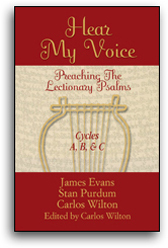
Hear My Voice
Preaching The Lectionary Psalms for Cycles A, B, C
Object:
(Occurs in all three cycles of the lectionary; see Good Friday, Cycle B; Lent 2, Cycle B; and Proper 23/Pentecost 21/Ordinary Time 28, Cycle C, for alternative approaches.)

Jesus spoke the opening words of Psalm 22 from the cross (Matthew 27:46), making it an obvious choice for the Good Friday responsorial psalm. But the larger psalm served the early Christian community as well, for it describes the suffering of a righteous one in terms that fit the crucifixion of Jesus, including verse 17, "they have pierced my hands and feet" (RSV) and verse 18, "for my clothing they cast lots." And beyond that, the psalm testifies to the vindication of those who suffer for righteousness (vv. 22-23). In all, five quotations from or allusions to Psalm 22 appear in the gospel passion narratives.
1. While the primary focus of this day is the suffering and death of Jesus, there is room to speak to all who suffer through no wrongdoing of their own. It will be the rare sufferer who cannot personally appropriate the words of verses 14 and 15. The preacher could delve into each of the metaphors of those two verses. What is the equivalent of being poured out like water? Of having one's heart melt like wax? Of having one's tongue stick to one's jaws? Those in the congregation who are suffering -- physically, mentally, emotionally, socially, spiritually, or otherwise -- can speak eloquently to their experience, informing the word of gospel that is spoken from the pulpit.
2. Take a look at the last phrase of verse 29. The NRSV translates it "and I shall live for him," but the footnote in that version gives it as "he who cannot keep himself alive," which is also how the RSV renders it. The difference between the two is important. The first assumes that the sufferer will survive long enough to serve God with his existence; the second alludes to faithful dying, which, of course, is exactly what Jesus was doing that dark Friday. For anyone to be able to praise God and pray while dying, as Jesus did, "My God," is to declare that even death is ultimately under the umbrella of the kingdom of God, and to give testimony that physical death, for the faithful, is a doorway to eternity. We need to remind people of that from time to time.
-- S. P.
Jesus spoke the opening words of Psalm 22 from the cross (Matthew 27:46), making it an obvious choice for the Good Friday responsorial psalm. But the larger psalm served the early Christian community as well, for it describes the suffering of a righteous one in terms that fit the crucifixion of Jesus, including verse 17, "they have pierced my hands and feet" (RSV) and verse 18, "for my clothing they cast lots." And beyond that, the psalm testifies to the vindication of those who suffer for righteousness (vv. 22-23). In all, five quotations from or allusions to Psalm 22 appear in the gospel passion narratives.
1. While the primary focus of this day is the suffering and death of Jesus, there is room to speak to all who suffer through no wrongdoing of their own. It will be the rare sufferer who cannot personally appropriate the words of verses 14 and 15. The preacher could delve into each of the metaphors of those two verses. What is the equivalent of being poured out like water? Of having one's heart melt like wax? Of having one's tongue stick to one's jaws? Those in the congregation who are suffering -- physically, mentally, emotionally, socially, spiritually, or otherwise -- can speak eloquently to their experience, informing the word of gospel that is spoken from the pulpit.
2. Take a look at the last phrase of verse 29. The NRSV translates it "and I shall live for him," but the footnote in that version gives it as "he who cannot keep himself alive," which is also how the RSV renders it. The difference between the two is important. The first assumes that the sufferer will survive long enough to serve God with his existence; the second alludes to faithful dying, which, of course, is exactly what Jesus was doing that dark Friday. For anyone to be able to praise God and pray while dying, as Jesus did, "My God," is to declare that even death is ultimately under the umbrella of the kingdom of God, and to give testimony that physical death, for the faithful, is a doorway to eternity. We need to remind people of that from time to time.
-- S. P.