God Is Faithful To Godself
Stories
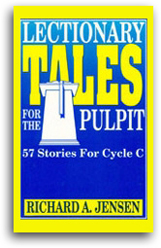
Lectionary Tales For The Pulpit
57 Stories For Cycle C
His hands were surely trembling as he lifted his hammer to nail his theses to the door of the Castle Church in Wittenberg, Germany. The year was 1517. The man was Martin Luther. Luther had lived through many a crisis in his personal relationship to God. Out of his struggles he came to believe that much of what his church had taught him was simply wrong. It was wrong teaching that had caused his faith crisis.

Luther decided to go on the offensive. The topic for his offensive was the matter of "indulgences." The Christian church at the time of Luther believed that sins committed after one was baptized that were not specifically forgiven would have to be paid off in purgatory. Purgatory was understood to be the place where souls lived after their death and before their resurrection. An indulgence from the church freed one from punishment in purgatory for a prescribed number of sins. Luther accepted some of this belief but he was enraged when he discovered that the church was actually selling "full indulgences" to people while asking nothing from them in terms of repentance and new life. This Luther protested. He nailed his 95 Theses for debate on the matter to the Castle Church door.
Think about this! One man. One man stands up to challenge a fundamental teaching of his church. Who did he think he was anyway? What gave him the courage to carry out his convictions in this way?
Thanks to the new media of print, Luther's 95 Theses were spread all over Europe. The church was not pleased. They tried to curb Luther in a variety of ways. They even declared him to be excommunicated from the church. The matter came to a head several years later in a meeting held in the city of Worms, Germany. The meeting was called a "Diet." It was a meeting of none other than the Holy Roman Empire which governed most of Europe in those days. It was presided over by the Emperor, Charles V, himself. Before this incredible display of political and churchly power Luther was asked two questions. All of his writings were placed on a table in the center of the room. "Did you write these books?" he was asked. And a second question: "Would he recant any of what he had written?"
Luther was forced into a corner. The answer he gave is perhaps the best known words he ever spoke. He would not recant. "Here I stand," he said finally. "I can do no other. God help me! Amen."
And again we ask: how could one man have the courage of convictions so that he might stand against the Holy Catholic Church and the Holy Roman Empire? Luther, himself, gives us an answer to our question. A year later he preached a series of sermons in his home church in Wittenberg. To the question, "How did you do this?" Luther replies, "I did nothing." Here are his words: "I simply taught, preached, and wrote God's Word; otherwise I did nothing. And while I slept, or drank Wittenberg beer with my friends Philip and Amsdorf, the Word so greatly weakened the papacy that no prince or emperor ever inflicted such losses upon it. I did nothing; the Word did everything!"
What gave Luther his courage? His confidence was in the Word and promises of God. He simply believed that God is always faithful to God's promises. God cannot deny Godself. Even though we be faithless, God will be faithful. That's where Luther stood!
Luther decided to go on the offensive. The topic for his offensive was the matter of "indulgences." The Christian church at the time of Luther believed that sins committed after one was baptized that were not specifically forgiven would have to be paid off in purgatory. Purgatory was understood to be the place where souls lived after their death and before their resurrection. An indulgence from the church freed one from punishment in purgatory for a prescribed number of sins. Luther accepted some of this belief but he was enraged when he discovered that the church was actually selling "full indulgences" to people while asking nothing from them in terms of repentance and new life. This Luther protested. He nailed his 95 Theses for debate on the matter to the Castle Church door.
Think about this! One man. One man stands up to challenge a fundamental teaching of his church. Who did he think he was anyway? What gave him the courage to carry out his convictions in this way?
Thanks to the new media of print, Luther's 95 Theses were spread all over Europe. The church was not pleased. They tried to curb Luther in a variety of ways. They even declared him to be excommunicated from the church. The matter came to a head several years later in a meeting held in the city of Worms, Germany. The meeting was called a "Diet." It was a meeting of none other than the Holy Roman Empire which governed most of Europe in those days. It was presided over by the Emperor, Charles V, himself. Before this incredible display of political and churchly power Luther was asked two questions. All of his writings were placed on a table in the center of the room. "Did you write these books?" he was asked. And a second question: "Would he recant any of what he had written?"
Luther was forced into a corner. The answer he gave is perhaps the best known words he ever spoke. He would not recant. "Here I stand," he said finally. "I can do no other. God help me! Amen."
And again we ask: how could one man have the courage of convictions so that he might stand against the Holy Catholic Church and the Holy Roman Empire? Luther, himself, gives us an answer to our question. A year later he preached a series of sermons in his home church in Wittenberg. To the question, "How did you do this?" Luther replies, "I did nothing." Here are his words: "I simply taught, preached, and wrote God's Word; otherwise I did nothing. And while I slept, or drank Wittenberg beer with my friends Philip and Amsdorf, the Word so greatly weakened the papacy that no prince or emperor ever inflicted such losses upon it. I did nothing; the Word did everything!"
What gave Luther his courage? His confidence was in the Word and promises of God. He simply believed that God is always faithful to God's promises. God cannot deny Godself. Even though we be faithless, God will be faithful. That's where Luther stood!