Epiphany 5/Ordinary Time 5
Preaching
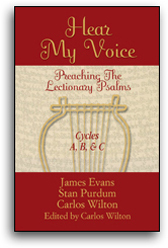
Hear My Voice
Preaching The Lectionary Psalms for Cycles A, B, C
Object:
This is a dangerous psalm -- dangerous, because it is so open to misinterpretation.
"Happy are those who fear the Lord...." Well, who could quarrel with that? Yet this psalm goes on to describe, in concrete terms, exactly what form that happiness takes: "Their descendants will be mighty in the land.... Wealth and riches are in their houses" (vv. 2a, 3a).
Power? Wealth? Are these the fruits of a godly life? The psalmist seems to think so.

At least it seems that way, at first glance. There are plenty of shallow preachers, these days, who would jump at the opportunity to skim these out-of-context verses off the top and use them as grist for the gospel-of-prosperity mill. ("Turn to the Lord, and God will bless you in this life, beyond your wildest dreams: with health, wealth and recreational vehicles. Call our 800-number now to buy our new book. Only $29.95: MasterCard and Visa accepted.")
But read on. Psalm 112 is about a lot more than wealth and power. It lists other characteristics of godly people. Such individuals are "a light for the upright." They are gracious, merciful, generous, and fair. They are immovable in their ethical resolve. They are, in every respect, admirable and well-rounded individuals (vv. 4-8).
This psalm is in some ways reminiscent of the description of "a capable wife" in Proverbs 31. That wise woman, with her daunting daily to-do list, seems to be doing an amazing job of being all things to all people -- but it quickly becomes apparent that the only reason she is able to do so is because God is her all-in-all.
Wisdom, in the Hebrew Scriptures, is not a matter of intellectual erudition. It is an eminently practical concept, closely linked to an idea that has fallen into disfavor in our cynical, modern age: the idea of virtue. The truly wise, according to the biblical model, are expert practitioners of common sense. They know how to live well -- and that sort of "living well" has nothing to do with expensive luxuries. If wealth does accrue to them, it's because they are successful, holistic practitioners of the art of living.
Our second president, John Adams, wrote these words in a letter to his grandson, John, then in his twenties:
Oh, that I may always be able to say to my grandsons, "You have earned much and behave well, my lads. Go on and improve in everything worthy." Have you considered the meaning of the word 'worthy'? Weigh it well.... I had rather you should be worthy possessors of one thousand pounds honestly acquired by your own labor and industry, than of ten millions by banks and tricks. I should rather you be worthy shoemakers than secretaries of states or treasury acquired by libels in newspapers. I had rather you should be worthy makers of brooms and baskets than unworthy presidents of the United States procured by intrigue, factious slander and corruption. (From a letter quoted by David McCullough in John Adams [New York: Simon & Schuster, 2001], pp. 608-609.)
Adams -- who was also a deeply religious man -- would have intuitively understood the message of Psalm 112.
-- C. W.
"Happy are those who fear the Lord...." Well, who could quarrel with that? Yet this psalm goes on to describe, in concrete terms, exactly what form that happiness takes: "Their descendants will be mighty in the land.... Wealth and riches are in their houses" (vv. 2a, 3a).
Power? Wealth? Are these the fruits of a godly life? The psalmist seems to think so.
At least it seems that way, at first glance. There are plenty of shallow preachers, these days, who would jump at the opportunity to skim these out-of-context verses off the top and use them as grist for the gospel-of-prosperity mill. ("Turn to the Lord, and God will bless you in this life, beyond your wildest dreams: with health, wealth and recreational vehicles. Call our 800-number now to buy our new book. Only $29.95: MasterCard and Visa accepted.")
But read on. Psalm 112 is about a lot more than wealth and power. It lists other characteristics of godly people. Such individuals are "a light for the upright." They are gracious, merciful, generous, and fair. They are immovable in their ethical resolve. They are, in every respect, admirable and well-rounded individuals (vv. 4-8).
This psalm is in some ways reminiscent of the description of "a capable wife" in Proverbs 31. That wise woman, with her daunting daily to-do list, seems to be doing an amazing job of being all things to all people -- but it quickly becomes apparent that the only reason she is able to do so is because God is her all-in-all.
Wisdom, in the Hebrew Scriptures, is not a matter of intellectual erudition. It is an eminently practical concept, closely linked to an idea that has fallen into disfavor in our cynical, modern age: the idea of virtue. The truly wise, according to the biblical model, are expert practitioners of common sense. They know how to live well -- and that sort of "living well" has nothing to do with expensive luxuries. If wealth does accrue to them, it's because they are successful, holistic practitioners of the art of living.
Our second president, John Adams, wrote these words in a letter to his grandson, John, then in his twenties:
Oh, that I may always be able to say to my grandsons, "You have earned much and behave well, my lads. Go on and improve in everything worthy." Have you considered the meaning of the word 'worthy'? Weigh it well.... I had rather you should be worthy possessors of one thousand pounds honestly acquired by your own labor and industry, than of ten millions by banks and tricks. I should rather you be worthy shoemakers than secretaries of states or treasury acquired by libels in newspapers. I had rather you should be worthy makers of brooms and baskets than unworthy presidents of the United States procured by intrigue, factious slander and corruption. (From a letter quoted by David McCullough in John Adams [New York: Simon & Schuster, 2001], pp. 608-609.)
Adams -- who was also a deeply religious man -- would have intuitively understood the message of Psalm 112.
-- C. W.