Enlightened Eyes
Sermon
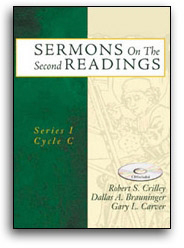
Sermons On The Second Readings
Series I, Cycle C
It is a matter of perspective. It is a matter of how we choose to look at things. "Two men looked through prison bars. One saw mud; the other saw stars." It is a matter of perspective. It is a matter of how we choose to look at things.
Some see a glass as one-half empty. Some see the glass as one-half full. Some see a situation as a problem, while others will see the same situation as an opportunity.

It is a matter of perspective. It is a matter of how we choose to look at things. In fact, it can go beyond perspective, attitude, or outlook. It can touch on discernment.
Years ago, in the days of the horse and buggy, an old man would sit and whittle on the front porch of his house that sat at the entrance to the small village in which he lived. He served as an unofficial greeter to any and all who might happen to pass by. On one such occasion, he was approached by a wagon-load of travelers who inquired, "Pardon us, sir, but what kind of folks live here?"
The old man hit a lick or two with his knife on the whittling stick and asked, "Well, what kind of folks did you find in the place from which you came?"
"Wonderful people! Kind and friendly. Maybe the best people we've ever known. We hated to leave."
"Well, I guess that's the kind of folks you are going to find here."
Several hours later another wagon-load approached the front porch sitter. "Pardon us, sir, but what kind of folks live here?"
The old man hit another lick or two with his knife on his whittling stick and asked, "Well, what kind of folks did you find in the place from which you came?"
"An ornery lot! Hard to live with. Self-centered! Are we glad we won't have to see them again!"
"Well, I guess that's the kind of folks you are going to find here."
It is a matter of perspective. It is a matter of how we choose to look at things. In fact, we may just find what we are looking for.
In our text today, Paul challenges the Ephesians and us to look at things in a different way. In his prayer for the church, he petitions that they might have the "eyes of their hearts enlightened" (v. 18). He prays that they might see things from the perspective of the heart. He prays that they would have a new vision and outlook that they would see beyond their outward circumstances and see with the eyes of the heart.
Seventeenth-century mathematician Blaise Pascal said, "The heart has reasons the mind knows not of." Through the eyes of the heart, Paul desires that the recipients of the letter would see into the awesomeness of God and into the mystery of life. He wants them to see beyond the ordinary, to see reality as God sees it, and thusly, to see God at work.
Paul's prayer is that through the eyes of the heart they "would know the hope to which God has called them" (v. 18). As you know, the letter of Ephesians was a circular letter. It was not so much written to a particular church at a particular time as it was written to all churches at all times. Ephesians was written to people in the first century and to people in the twenty-first century who have seen the pain of sickness and suffering, the agony of loss and death. Through the enlightened eyes of the heart, Paul wants us to see beyond the grave, to what can be, to see that that for which we have longed and desired most for our loved ones is, in fact, true! Ephesians was written to those who have experienced frustration over the brevity and incompleteness of life. We go through the long and painful process to get enough sense to live life and then, too quickly, it is over. Ephesians is written to those who despair over the unfortunate who never had a chance in life, the children born into disease, neglect, poverty, and war. It is written to comfort and console those who cry, "There must be more. There has to be more!"
In 1956 our family bought a '56 Chevy, complete with a 283 engine, four-barrel carburetor, and dual exhaust power pack, and we set sail on vacation for the sunny shores of Panama City, Florida. Because he wanted to see the ocean before he died, Grandpa Carver went with us. He and I sat in the back seat as we traveled through small towns before the days of the rapid traffic of the interstate highways. He and I had a silly little routine as we passed through the little towns. Every time he would see a cemetery, he would proclaim, "I don't want to live here." Taking my cue, I would respond, "Why is that, Grandpa?" True to form, he would laugh and say, "People die here!" Yes, Grandpa, people died there and people die in Chattanooga, Tennessee. Grandpa died in 1964. I still would give almost anything to spend one more day with him. There must be -- there has to be more. That wonderful spirit of a man has to live on! It is the same feeling we have on All Saints' Sunday as we honor those who have outstripped us in the race. There must be more!
It is in this same spirit that Paul wants us to know the hope to which God has called us. We cannot live without hope. It is said that a small town settled near the base of a huge dam. For some reason, repairs or something, the town was to be flooded at some future unspecified time. How did the townspeople respond? How do you guess? There were no repairs made, no painting, no maintenance, much less improvements, because there was no future. There was no hope! Without hope we neglect, crumble, and dry up like a prune. Without hope we die from the inside before we die on the outside. We cannot live without hope.
But when we have hope, life takes on the texture that everything is good, the future is bright, anything is possible. Philip Yancey reminds us that pharmaceuticals are tested today by the double-blind method. This means that the doctors themselves do not know which is the real drug and which is the control substance or placebo. Before the double-blind method, it was impossible to assess correctly the effectiveness of the drugs because almost everyone would display amazing results and spectacular success. It seems that by the doctor's demeanor, smile, voice, or attitude, he or she would convey confidence and hope. Thus, almost everyone would get better no matter which drug they received. Such is the power of human hope!
Paul is interested that we see through enlightened eyes that God's hope is all real stuff -- no placebo! Death for God's child is not an end but only a beginning. Death for the Christian is not an exit but an entrance! "... the gift of God is eternal life through Jesus Christ our Lord" (Romans 6:23).
A pastor took his small daughter to see a matinee performance of Snow White. The audience was full of little children and everyone was happy until the evil witch appeared. She seemed to be having her way, and the children began to get disturbed. Some children began to cry. Finally the pastor's little girl got up on the edge of her seat and exclaimed, "Wait a minute! Wait a minute! I know this story -- my mommy has read me this story many times. It comes out okay in the end. You don't have to be afraid."
Through the enlightened eyes of hope we are alive to see beyond the external circumstances and discern that God is in control. Everything will be okay. In that we can have confidence and hope.
The essence and evidence of this hope is the "riches of his glorious inheritance among the saints" (v. 18). Now, let's see; an inheritance is something that we did not earn, right? Is it not usually something that someone else made or earned and chose to give to us? It is a gift? I am looking forward to my inheritance from my parents. It is the only thing for which I have asked. They have even said I could have it now, if I wished, but that would not be right. In fact, it is sitting in their bedroom now. It is a cedar chest that was made by Grandpa Carver. It not only was his; he made it with his own two hands. Every time I look at it, I will remember his contribution to my life and look forward to the time when we can talk more about it. Such is the inheritance of the saints.
And they are everywhere! I think of Mother Teresa and her 600 homes run by the Sisters of Charity. I think of Jean Vanier and his L'Arche Community, which devotes its time and energy to taking care of those who cannot take care of themselves. I think of Dorothy Day, who is not only one of the finest theologians of the last century, but who also fed hundreds of thousands through the Catholic Worker Movement. I think of Millard Fuller, who has provided housing for tens of thousands through Habitat for Humanity. I think of Dr. and Mrs. Bill Magee, who have given beaming faces to 36,000 cranially disfigured Third World children through Operation Smile. I think of police persons, fire persons, and other rescue persons who gave their lives on September 11. I think of the Jewish man who stayed with his crippled friend and they both perished with the collapse of the Twin Towers. Saints are everywhere.
And these everyday saints are here. In a few moments we will read aloud the list of everyday saints in our fellowship who have gone on this past year. As the list is read, think of how they influenced your life. Think of what they passed on to you. These everyday saints have set the pattern, provided the example for us to follow. Such is the glorious inheritance of the saints.
Not only does the Apostle Paul desire that we should envision this glorious inheritance of the saints through enlightened eyes, but also that we should realize his "incomparably great power" (v. 19). This is nothing less than the same mighty power that raised Jesus from the dead (v. 20). Now, if God can raise up Jesus who had been stone cold dead for three days, he has power sufficient for any problem that we may face in our days.
My good friend Scott Walker tells the story of the Herolds, a family he met while serving in the Philippines. Years ago, Mr. Herold sought to build a highroad across the rugged terrain of the northern island of Luzon. It was a challenge. The primitive conditions and lack of modern machinery made the task difficult for Mr. Herold and the hard-working men and women of the Igorot Tribe who helped him. Once, when Mr. Herold rode his horse down the mountain trail to a city port to buy supplies, by chance he happened upon the opportunity to buy a crate of bright, shiny wheelbarrows from the United States. He borrowed an old truck and hastily bumped and banged his way up the rutted new roadbed as the night descended. He had to return the truck the next day, so it was almost three days before he was able to return to the work site.
When he arrived, he almost fell off his horse with laughter. The Igorots were already energetically using the wheelbarrows. With shovels they would fill each with rock and dirt, and then four men would groan and grunt as they lifted and carried the wheelbarrow on their shoulders. For them, it was simply a large metal container to carry. The wheel was useless.1
Scott's story is so symbolic of our stories. How many of us leave unused and untapped the mighty power of God? In most situations, I underestimate the power of evil, overestimate my own power, and totally ignore the power of God. God's power works, even in a graveyard. And his power is available to us every day.
Too, this power has a desired purpose. It is not as a sermon title I once saw: "Plenty of Power for Whatever!" God's power has a direction and purpose. Martin Luther King, Jr., said, "Power without love is reckless and allusive. Power at its best is love implementing the demands of justice." This is God's power in us at work through us to help bring about God's justice and will. As Robert Mullholland says, "The goal of spiritual formation is Christlikeness, for the sake of others." God's power in us is never to be used for self-centered self-aggrandizement but always is to be used to cooperate with God in bringing about his kingdom in our heart and in our world.
How do we find such power? Many have sought such power in various ways. Some have not found it through money or brute force. Such power for God's purposes is found when we give back to God our own power. It is found when we give ourselves, our families, our will, and all we possess back to God who gave it to us in the first place and trust God for the results. That is what Jesus did when he surrendered to the cross and trusted that God would raise him up. We must admit that we are puny and powerless and allow his power to work in us -- the very power that raised Jesus from the dead. The very same power that will raise us from the dead and, in the meantime, will carry us through.
It is a matter of perspective. It is a matter of how we choose to look at things. Through enlightened eyes we can see the power of God's hope and our glorious inheritance as evidenced by the pattern set by God's everyday saints. We can have the perspective, outlook, and discernment to see as God does. We can look at things through the eyes of the heart and smile in the dark.
G. W. Target tells the following story: There were once two men, both seriously ill, in the same small room of a great hospital. Quite a small room, just large enough for the pair of them -- two beds, two bedside lockers, a door opening on the hall, and one window looking out on the world.
One of the men, as part of his treatment, was allowed to sit up in bed for an hour in the afternoon (something to do with draining the fluid from his lungs), and his bed was next to the window.
But the other man had to spend all his time flat on his back -- and both of them had to be kept quiet and still. This was the reason they were in the small room by themselves, and they were grateful for peace and privacy -- none of the bustle and clatter and prying eyes of the general ward for them.
Of course, one of the disadvantages of their condition was that they weren't allowed to do much: no reading, no radio, certainly no television -- they just had to keep quiet and still, just the two of them. Well, they used to talk for hours and hours -- about their wives, their children, their homes, their jobs, their hobbies, their childhood, what they did during the war, where they'd been on vacations -- all that sort of thing. Every afternoon, when the man in the bed next to the window was propped up for his hour, he would pass the time by describing what he could see outside. And the other man began to live for those hours.
The window apparently overlooked a park with a lake, where there were ducks and swans, children throwing them bread and sailing model boats, and young lovers walking hand in hand beneath the trees, and there were flowers and stretches of grass, games of softball, people taking their ease in the sunshine, and right at the back, behind the fringe of trees, a fine view of the city skyline.
The man on his back would listen to all of this, enjoying every minute -- how a child nearly fell into the lake, how beautiful the girls were in their summer dresses, then an exciting ballgame, or a boy playing with his puppy. It got to the place that he could almost see what was happening outside.
Then one fine afternoon, when there was some sort of parade, the thought struck him: Why should the man next to the window have all the pleasure of seeing what was going on? Why shouldn't he get the chance?
He felt ashamed, and tried not to think like that, but the more he tried, the worse he wanted a change. He'd do anything!
In a few days, he had turned sour. He should be by the window. And he brooded and couldn't sleep, and grew even more seriously ill -- which none of the doctors understood.
One night as he stared at the ceiling, the other man suddenly woke up, coughing and choking, the fluid congesting in his lungs, his hands groping for the button that would bring the night nurse running. But the other man watched without moving.
The coughing racked the darkness -- on and on -- choked off -- then stopped -- the sound of breathing stopped -- the man continued to stare at the ceiling.
In the morning the day nurse came in with water for their baths and found the other man dead. They took away his body, quietly, no fuss.
As soon as it seemed decent, the man asked if he could be moved to the bed next to the window. And they moved him, tucked him in, and made him quite comfortable, and left him alone to be quiet and still.
The minute they'd gone, he propped himself up on one elbow, painfully and laboriously, and looked out the window.
It faced a blank wall.2
It's a matter of perspective!
____________
1. Scott Walker, Glimpses of God (Minneapolis: Augsburg Press, 1997), p. 17.
2. Tim Hansel, You Gotta Keep Dancin' (Elgin, Illinois: David C. Cook Publishing Co., 1985), p. 56.
Some see a glass as one-half empty. Some see the glass as one-half full. Some see a situation as a problem, while others will see the same situation as an opportunity.
It is a matter of perspective. It is a matter of how we choose to look at things. In fact, it can go beyond perspective, attitude, or outlook. It can touch on discernment.
Years ago, in the days of the horse and buggy, an old man would sit and whittle on the front porch of his house that sat at the entrance to the small village in which he lived. He served as an unofficial greeter to any and all who might happen to pass by. On one such occasion, he was approached by a wagon-load of travelers who inquired, "Pardon us, sir, but what kind of folks live here?"
The old man hit a lick or two with his knife on the whittling stick and asked, "Well, what kind of folks did you find in the place from which you came?"
"Wonderful people! Kind and friendly. Maybe the best people we've ever known. We hated to leave."
"Well, I guess that's the kind of folks you are going to find here."
Several hours later another wagon-load approached the front porch sitter. "Pardon us, sir, but what kind of folks live here?"
The old man hit another lick or two with his knife on his whittling stick and asked, "Well, what kind of folks did you find in the place from which you came?"
"An ornery lot! Hard to live with. Self-centered! Are we glad we won't have to see them again!"
"Well, I guess that's the kind of folks you are going to find here."
It is a matter of perspective. It is a matter of how we choose to look at things. In fact, we may just find what we are looking for.
In our text today, Paul challenges the Ephesians and us to look at things in a different way. In his prayer for the church, he petitions that they might have the "eyes of their hearts enlightened" (v. 18). He prays that they might see things from the perspective of the heart. He prays that they would have a new vision and outlook that they would see beyond their outward circumstances and see with the eyes of the heart.
Seventeenth-century mathematician Blaise Pascal said, "The heart has reasons the mind knows not of." Through the eyes of the heart, Paul desires that the recipients of the letter would see into the awesomeness of God and into the mystery of life. He wants them to see beyond the ordinary, to see reality as God sees it, and thusly, to see God at work.
Paul's prayer is that through the eyes of the heart they "would know the hope to which God has called them" (v. 18). As you know, the letter of Ephesians was a circular letter. It was not so much written to a particular church at a particular time as it was written to all churches at all times. Ephesians was written to people in the first century and to people in the twenty-first century who have seen the pain of sickness and suffering, the agony of loss and death. Through the enlightened eyes of the heart, Paul wants us to see beyond the grave, to what can be, to see that that for which we have longed and desired most for our loved ones is, in fact, true! Ephesians was written to those who have experienced frustration over the brevity and incompleteness of life. We go through the long and painful process to get enough sense to live life and then, too quickly, it is over. Ephesians is written to those who despair over the unfortunate who never had a chance in life, the children born into disease, neglect, poverty, and war. It is written to comfort and console those who cry, "There must be more. There has to be more!"
In 1956 our family bought a '56 Chevy, complete with a 283 engine, four-barrel carburetor, and dual exhaust power pack, and we set sail on vacation for the sunny shores of Panama City, Florida. Because he wanted to see the ocean before he died, Grandpa Carver went with us. He and I sat in the back seat as we traveled through small towns before the days of the rapid traffic of the interstate highways. He and I had a silly little routine as we passed through the little towns. Every time he would see a cemetery, he would proclaim, "I don't want to live here." Taking my cue, I would respond, "Why is that, Grandpa?" True to form, he would laugh and say, "People die here!" Yes, Grandpa, people died there and people die in Chattanooga, Tennessee. Grandpa died in 1964. I still would give almost anything to spend one more day with him. There must be -- there has to be more. That wonderful spirit of a man has to live on! It is the same feeling we have on All Saints' Sunday as we honor those who have outstripped us in the race. There must be more!
It is in this same spirit that Paul wants us to know the hope to which God has called us. We cannot live without hope. It is said that a small town settled near the base of a huge dam. For some reason, repairs or something, the town was to be flooded at some future unspecified time. How did the townspeople respond? How do you guess? There were no repairs made, no painting, no maintenance, much less improvements, because there was no future. There was no hope! Without hope we neglect, crumble, and dry up like a prune. Without hope we die from the inside before we die on the outside. We cannot live without hope.
But when we have hope, life takes on the texture that everything is good, the future is bright, anything is possible. Philip Yancey reminds us that pharmaceuticals are tested today by the double-blind method. This means that the doctors themselves do not know which is the real drug and which is the control substance or placebo. Before the double-blind method, it was impossible to assess correctly the effectiveness of the drugs because almost everyone would display amazing results and spectacular success. It seems that by the doctor's demeanor, smile, voice, or attitude, he or she would convey confidence and hope. Thus, almost everyone would get better no matter which drug they received. Such is the power of human hope!
Paul is interested that we see through enlightened eyes that God's hope is all real stuff -- no placebo! Death for God's child is not an end but only a beginning. Death for the Christian is not an exit but an entrance! "... the gift of God is eternal life through Jesus Christ our Lord" (Romans 6:23).
A pastor took his small daughter to see a matinee performance of Snow White. The audience was full of little children and everyone was happy until the evil witch appeared. She seemed to be having her way, and the children began to get disturbed. Some children began to cry. Finally the pastor's little girl got up on the edge of her seat and exclaimed, "Wait a minute! Wait a minute! I know this story -- my mommy has read me this story many times. It comes out okay in the end. You don't have to be afraid."
Through the enlightened eyes of hope we are alive to see beyond the external circumstances and discern that God is in control. Everything will be okay. In that we can have confidence and hope.
The essence and evidence of this hope is the "riches of his glorious inheritance among the saints" (v. 18). Now, let's see; an inheritance is something that we did not earn, right? Is it not usually something that someone else made or earned and chose to give to us? It is a gift? I am looking forward to my inheritance from my parents. It is the only thing for which I have asked. They have even said I could have it now, if I wished, but that would not be right. In fact, it is sitting in their bedroom now. It is a cedar chest that was made by Grandpa Carver. It not only was his; he made it with his own two hands. Every time I look at it, I will remember his contribution to my life and look forward to the time when we can talk more about it. Such is the inheritance of the saints.
And they are everywhere! I think of Mother Teresa and her 600 homes run by the Sisters of Charity. I think of Jean Vanier and his L'Arche Community, which devotes its time and energy to taking care of those who cannot take care of themselves. I think of Dorothy Day, who is not only one of the finest theologians of the last century, but who also fed hundreds of thousands through the Catholic Worker Movement. I think of Millard Fuller, who has provided housing for tens of thousands through Habitat for Humanity. I think of Dr. and Mrs. Bill Magee, who have given beaming faces to 36,000 cranially disfigured Third World children through Operation Smile. I think of police persons, fire persons, and other rescue persons who gave their lives on September 11. I think of the Jewish man who stayed with his crippled friend and they both perished with the collapse of the Twin Towers. Saints are everywhere.
And these everyday saints are here. In a few moments we will read aloud the list of everyday saints in our fellowship who have gone on this past year. As the list is read, think of how they influenced your life. Think of what they passed on to you. These everyday saints have set the pattern, provided the example for us to follow. Such is the glorious inheritance of the saints.
Not only does the Apostle Paul desire that we should envision this glorious inheritance of the saints through enlightened eyes, but also that we should realize his "incomparably great power" (v. 19). This is nothing less than the same mighty power that raised Jesus from the dead (v. 20). Now, if God can raise up Jesus who had been stone cold dead for three days, he has power sufficient for any problem that we may face in our days.
My good friend Scott Walker tells the story of the Herolds, a family he met while serving in the Philippines. Years ago, Mr. Herold sought to build a highroad across the rugged terrain of the northern island of Luzon. It was a challenge. The primitive conditions and lack of modern machinery made the task difficult for Mr. Herold and the hard-working men and women of the Igorot Tribe who helped him. Once, when Mr. Herold rode his horse down the mountain trail to a city port to buy supplies, by chance he happened upon the opportunity to buy a crate of bright, shiny wheelbarrows from the United States. He borrowed an old truck and hastily bumped and banged his way up the rutted new roadbed as the night descended. He had to return the truck the next day, so it was almost three days before he was able to return to the work site.
When he arrived, he almost fell off his horse with laughter. The Igorots were already energetically using the wheelbarrows. With shovels they would fill each with rock and dirt, and then four men would groan and grunt as they lifted and carried the wheelbarrow on their shoulders. For them, it was simply a large metal container to carry. The wheel was useless.1
Scott's story is so symbolic of our stories. How many of us leave unused and untapped the mighty power of God? In most situations, I underestimate the power of evil, overestimate my own power, and totally ignore the power of God. God's power works, even in a graveyard. And his power is available to us every day.
Too, this power has a desired purpose. It is not as a sermon title I once saw: "Plenty of Power for Whatever!" God's power has a direction and purpose. Martin Luther King, Jr., said, "Power without love is reckless and allusive. Power at its best is love implementing the demands of justice." This is God's power in us at work through us to help bring about God's justice and will. As Robert Mullholland says, "The goal of spiritual formation is Christlikeness, for the sake of others." God's power in us is never to be used for self-centered self-aggrandizement but always is to be used to cooperate with God in bringing about his kingdom in our heart and in our world.
How do we find such power? Many have sought such power in various ways. Some have not found it through money or brute force. Such power for God's purposes is found when we give back to God our own power. It is found when we give ourselves, our families, our will, and all we possess back to God who gave it to us in the first place and trust God for the results. That is what Jesus did when he surrendered to the cross and trusted that God would raise him up. We must admit that we are puny and powerless and allow his power to work in us -- the very power that raised Jesus from the dead. The very same power that will raise us from the dead and, in the meantime, will carry us through.
It is a matter of perspective. It is a matter of how we choose to look at things. Through enlightened eyes we can see the power of God's hope and our glorious inheritance as evidenced by the pattern set by God's everyday saints. We can have the perspective, outlook, and discernment to see as God does. We can look at things through the eyes of the heart and smile in the dark.
G. W. Target tells the following story: There were once two men, both seriously ill, in the same small room of a great hospital. Quite a small room, just large enough for the pair of them -- two beds, two bedside lockers, a door opening on the hall, and one window looking out on the world.
One of the men, as part of his treatment, was allowed to sit up in bed for an hour in the afternoon (something to do with draining the fluid from his lungs), and his bed was next to the window.
But the other man had to spend all his time flat on his back -- and both of them had to be kept quiet and still. This was the reason they were in the small room by themselves, and they were grateful for peace and privacy -- none of the bustle and clatter and prying eyes of the general ward for them.
Of course, one of the disadvantages of their condition was that they weren't allowed to do much: no reading, no radio, certainly no television -- they just had to keep quiet and still, just the two of them. Well, they used to talk for hours and hours -- about their wives, their children, their homes, their jobs, their hobbies, their childhood, what they did during the war, where they'd been on vacations -- all that sort of thing. Every afternoon, when the man in the bed next to the window was propped up for his hour, he would pass the time by describing what he could see outside. And the other man began to live for those hours.
The window apparently overlooked a park with a lake, where there were ducks and swans, children throwing them bread and sailing model boats, and young lovers walking hand in hand beneath the trees, and there were flowers and stretches of grass, games of softball, people taking their ease in the sunshine, and right at the back, behind the fringe of trees, a fine view of the city skyline.
The man on his back would listen to all of this, enjoying every minute -- how a child nearly fell into the lake, how beautiful the girls were in their summer dresses, then an exciting ballgame, or a boy playing with his puppy. It got to the place that he could almost see what was happening outside.
Then one fine afternoon, when there was some sort of parade, the thought struck him: Why should the man next to the window have all the pleasure of seeing what was going on? Why shouldn't he get the chance?
He felt ashamed, and tried not to think like that, but the more he tried, the worse he wanted a change. He'd do anything!
In a few days, he had turned sour. He should be by the window. And he brooded and couldn't sleep, and grew even more seriously ill -- which none of the doctors understood.
One night as he stared at the ceiling, the other man suddenly woke up, coughing and choking, the fluid congesting in his lungs, his hands groping for the button that would bring the night nurse running. But the other man watched without moving.
The coughing racked the darkness -- on and on -- choked off -- then stopped -- the sound of breathing stopped -- the man continued to stare at the ceiling.
In the morning the day nurse came in with water for their baths and found the other man dead. They took away his body, quietly, no fuss.
As soon as it seemed decent, the man asked if he could be moved to the bed next to the window. And they moved him, tucked him in, and made him quite comfortable, and left him alone to be quiet and still.
The minute they'd gone, he propped himself up on one elbow, painfully and laboriously, and looked out the window.
It faced a blank wall.2
It's a matter of perspective!
____________
1. Scott Walker, Glimpses of God (Minneapolis: Augsburg Press, 1997), p. 17.
2. Tim Hansel, You Gotta Keep Dancin' (Elgin, Illinois: David C. Cook Publishing Co., 1985), p. 56.