The Cross Of Barabbas
Sermon
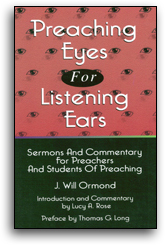
Preaching Eyes for Listening Ears
Sermons and Commentary For Preachers and Students of Preaching
This is an imaginary story with imaginary characters. The story is told through a conversation between a carpenter and his young apprentice as they construct crosses to be used in a crucifixion. The carpenter is the only one whom we hear speak. The words of the other characters are reflected in the carpenter's responses to them.

The purpose of the sermon is to seek to draw the hearers into the reality of the crucifixion of Jesus by imagining the emotions stirred up in the hearts of some of the people who were there. It also seeks to suggest how both the life and the death of Jesus affected the lives of people with whom he came in contact.
The sermon does not claim to be historically correct insofar as the construction of crosses in the first century is concerned. The first sentence is designed to make that clear.
This sermon was first preached on Good Friday, 1951, in Tuscaloosa, Alabama, while I was pastor of the Covenant Presbyterian Church in the city. It has also been preached in the chapel of Columbia Seminary.
The story I am about to tell does not accurately reflect how crosses were built in the first century, but it may suggest how we build them now.
Come, go with me to old Jerusalem and stand there beside a builder's door and listen as the carpenter speaks to his helper, a young man named Michael:
Step lively there.
You know these crosses three must needs be finished by the morrow.
The Roman captain gave me certain orders to have them ready by the dawn.
There's no need to smooth and plane the upright piece - just so the timber's strong - just so the cross--arm's steady.
What will it matter to the fools who die upon them if there's a splinter here and there?
Oh, you cannot help but wonder who shall die upon them.
Have you not heard?
It is the leader of that robber band that terrorized the city some weeks back. You remember, Barabbas and his crew.
Some said he meant to start a revolution, but I doubt it. Not Barabbas. That black--hearted knave cares not who sits upon the throne and, though his father was a rabbi, it matters not to him who is the priest, nor why. He's bent on pillage. He'd as leave murder for six shekels as for a silver talent.
So don't waste your time making that cross smooth. That's the cross for Barabbas.
So - you even want the cross of Barabbas to be smooth?
What strange notions you received when you apprenticed in that shop at Nazareth. Each tiny task must be just so. You care not how much of time and tools it may cost me.
Now just last week - that kneading trough the widow near the Fish Gate ordered. All day long you measured, smoothed, and rubbed, and for it picked the best wood in the shop. The task - for her - could have been finished in an hour's time. (We did well to get a shekel for it.) But one would think that she was Pilate's wife, the pains you took. And now with dawn about to break you want to make Barabbas' cross so smooth.
Well, at last the task is done.
Go, hitch the oxen to the cart, then hurry back and help me load these crosses.
Heave ho, there. Push them farther toward the front. I don't care to lose one on the way and have to stop and pick it up or put my shoulder under it and drag it through the streets like one condemned.
There! They seem secure.
The Praetorium's the place they are to go, or so the Roman captain said. Here, hand me that goad! These oxen are as slow as you.
When we return you must rub some tallow on these axles. Never have I heard the wheels give out with such a groaning squeak. It seems they do protest the load. They know full well that they have carried thrice as much with less than half the noise.
While you were gone to hitch the oxen to the cart, a man stopped by the shop and said that lights burned all night long in Annas' house.
A crowd was gathered in his courtyard 'round a fire, and he could hear the servants laughing as he passed, but their laughs seemed not of mirth.
And, he said, a company of soldiers and a crowd moved through the streets from Annas' to Caiaphas' palace after midnight.
And after dawn they wakened Pilate, who came out on the balcony and spoke to them in angry tones.
I wonder if it has aught to do with the executions that take place today. I see not how, for Barabbas and the others have been condemned already, and they shall surely die upon these crosses we have made.
It could not be a trial for someone else, for the court cannot pass judgment in the night. It is against the law.
And yet I wonder what's afoot. I hope there're no more crosses to be built. Although they pay us for them well, and though they take no special pains - or shouldn't - I, myself, had rather make a yoke for oxen or a baby's crib than turn my hand to make a cross.
But building is our business, and we must build what those who pay do ask.
How now? What's this?
How shall we ever push beyond this crowd that presses 'round the proud Praetorium's door? How can we deliver crosses with such traffic in the way?
What ails them? The chant seems "Crucify!"
Oh, no - if there's to be another crucifixion I hope they hire another shop to build the cross, for we have toiled all night on these, and I am tired.
They cry a name. Ah, it is "Barabbas." They shout Barabbas' name. I see it now. They know this is his execution day, and they are so incensed at all his crimes that they clamor for his blood.
Come, let us skirt the crowd and guide the oxen to the back door of the Judgment Hall. For we bring Barabbas' cross, and since it seems he may need it sooner than he thought, we must not delay a customer.
Sir, here are the crosses that you ordered - all three. That one there - the strong, straight, smooth one - my helper made. It is the one we measured for Barabbas.
Did I hear you aright, sir?
Did you say Barabbas will not need it?
Then we have made one cross too many?
(All your careful work, my friend, seems to have been in vain.)
Oh, it shall not be wasted, but shall be used? But, who, sir? Who shall bear Barabbas' cross? Whose crimes are worse than his? Whose heart more black? Whose hands more bloody? What notorious thief takes Barabbas' place upon his cross?
No thief at all, sir? No man with bloody hands? But one whom Pilate said was innocent of any crime? He calls himself a king? A king who is a carpenter? A carpenter from Nazareth?
Michael, did you hear the captain? The man's a carpenter - from Nazareth. Could it be the One from whom you learned the trade? You said he left the shop some three years back. And I have heard of him myself. It's strange things they tell of him - of raising the dead and making the lame walk.
And he's the one, I think, who from the Temple drove the money changers out the other day. They say old Caiaphas was aflame with anger after that.
So - Barabbas will go free and this man will die because the people will it so.
Look, Michael, they bring him now.
It is your carpenter! I can tell it by your face. Look, he said he was a king, and now he wears a crown - though it be of thorns. And a robe - but it is old and torn and faded. And the scepter in his hand is but a broken reed - but he's kingly still!
His eyes, his eyes! They turn on me! Never have I seen such eyes before - or never have such eyes seen me. They sear my soul!
This man's a carpenter, and somehow I sense he knows how I've dealt with the trade. How could he know? But as he looks upon me, all those times I've patched a broken piece and passed it off for whole, I do remember. The yokes I've made and knew that they would gall the ox because I did not take the time to shape them well. The widows I have overcharged - the sick whose very beds I've taken back because they could not pay the full price on the day. The timbers I have sneaked by night from off my rival's pile of lumber.
And, Michael - your wages. I know it's been a fortnight since you had it, and I said my purse was low. But now I do confess I had it all the while. And never, Michael, have I ever paid you what you really earned. But you were young and from the country, and I did not think you'd know just what the wage should be. But now that your Master Carpenter has looked on me, I think you knew my errors all the while.
Not a word he utters, Michael, as they show him to his cross - the cross you made. You made it for Barabbas, not for him! And yet he takes it almost joyously, it seems, as if it were his own.
Oh what a world is this that will release Barabbas and lead a man like this to death. I see now why Caiaphas could not let him live. He could not bear his eyes upon his shriveled soul.
The scribes, the Pharisees, those hidebound legalists, how could they hope to understand the likes of him?
And vacillating Pilate - sensual and fat - he must please the howling mob and let justice die.
Ah, yes, I know it's heavy. Did we not load it on the cart? And they will make him carry it alone as he takes Barabbas' place. I'm not surprised he stumbles, for look, his back is raw. He's lost much blood already.
Ah, see! They'll make the black Cyrenian take it for him, but when they reach the top of Calvary it will be his again.
There it goes, Michael - the cross we made. But we made it not alone. The whole world made it for him. And as I watch it move up Golgotha - the cross made for Barabbas - the cross carried by the black Cyrenian - the cross for the Christ - I know that it is not Barabbas' cross - nor Simon's - not even Christ's. But that it is in all justice mine. Only by God's mercy is it his.
Oh, Michael, I am glad you made Barabbas' cross so smooth.
The purpose of the sermon is to seek to draw the hearers into the reality of the crucifixion of Jesus by imagining the emotions stirred up in the hearts of some of the people who were there. It also seeks to suggest how both the life and the death of Jesus affected the lives of people with whom he came in contact.
The sermon does not claim to be historically correct insofar as the construction of crosses in the first century is concerned. The first sentence is designed to make that clear.
This sermon was first preached on Good Friday, 1951, in Tuscaloosa, Alabama, while I was pastor of the Covenant Presbyterian Church in the city. It has also been preached in the chapel of Columbia Seminary.
The story I am about to tell does not accurately reflect how crosses were built in the first century, but it may suggest how we build them now.
Come, go with me to old Jerusalem and stand there beside a builder's door and listen as the carpenter speaks to his helper, a young man named Michael:
Step lively there.
You know these crosses three must needs be finished by the morrow.
The Roman captain gave me certain orders to have them ready by the dawn.
There's no need to smooth and plane the upright piece - just so the timber's strong - just so the cross--arm's steady.
What will it matter to the fools who die upon them if there's a splinter here and there?
Oh, you cannot help but wonder who shall die upon them.
Have you not heard?
It is the leader of that robber band that terrorized the city some weeks back. You remember, Barabbas and his crew.
Some said he meant to start a revolution, but I doubt it. Not Barabbas. That black--hearted knave cares not who sits upon the throne and, though his father was a rabbi, it matters not to him who is the priest, nor why. He's bent on pillage. He'd as leave murder for six shekels as for a silver talent.
So don't waste your time making that cross smooth. That's the cross for Barabbas.
So - you even want the cross of Barabbas to be smooth?
What strange notions you received when you apprenticed in that shop at Nazareth. Each tiny task must be just so. You care not how much of time and tools it may cost me.
Now just last week - that kneading trough the widow near the Fish Gate ordered. All day long you measured, smoothed, and rubbed, and for it picked the best wood in the shop. The task - for her - could have been finished in an hour's time. (We did well to get a shekel for it.) But one would think that she was Pilate's wife, the pains you took. And now with dawn about to break you want to make Barabbas' cross so smooth.
Well, at last the task is done.
Go, hitch the oxen to the cart, then hurry back and help me load these crosses.
Heave ho, there. Push them farther toward the front. I don't care to lose one on the way and have to stop and pick it up or put my shoulder under it and drag it through the streets like one condemned.
There! They seem secure.
The Praetorium's the place they are to go, or so the Roman captain said. Here, hand me that goad! These oxen are as slow as you.
When we return you must rub some tallow on these axles. Never have I heard the wheels give out with such a groaning squeak. It seems they do protest the load. They know full well that they have carried thrice as much with less than half the noise.
While you were gone to hitch the oxen to the cart, a man stopped by the shop and said that lights burned all night long in Annas' house.
A crowd was gathered in his courtyard 'round a fire, and he could hear the servants laughing as he passed, but their laughs seemed not of mirth.
And, he said, a company of soldiers and a crowd moved through the streets from Annas' to Caiaphas' palace after midnight.
And after dawn they wakened Pilate, who came out on the balcony and spoke to them in angry tones.
I wonder if it has aught to do with the executions that take place today. I see not how, for Barabbas and the others have been condemned already, and they shall surely die upon these crosses we have made.
It could not be a trial for someone else, for the court cannot pass judgment in the night. It is against the law.
And yet I wonder what's afoot. I hope there're no more crosses to be built. Although they pay us for them well, and though they take no special pains - or shouldn't - I, myself, had rather make a yoke for oxen or a baby's crib than turn my hand to make a cross.
But building is our business, and we must build what those who pay do ask.
How now? What's this?
How shall we ever push beyond this crowd that presses 'round the proud Praetorium's door? How can we deliver crosses with such traffic in the way?
What ails them? The chant seems "Crucify!"
Oh, no - if there's to be another crucifixion I hope they hire another shop to build the cross, for we have toiled all night on these, and I am tired.
They cry a name. Ah, it is "Barabbas." They shout Barabbas' name. I see it now. They know this is his execution day, and they are so incensed at all his crimes that they clamor for his blood.
Come, let us skirt the crowd and guide the oxen to the back door of the Judgment Hall. For we bring Barabbas' cross, and since it seems he may need it sooner than he thought, we must not delay a customer.
Sir, here are the crosses that you ordered - all three. That one there - the strong, straight, smooth one - my helper made. It is the one we measured for Barabbas.
Did I hear you aright, sir?
Did you say Barabbas will not need it?
Then we have made one cross too many?
(All your careful work, my friend, seems to have been in vain.)
Oh, it shall not be wasted, but shall be used? But, who, sir? Who shall bear Barabbas' cross? Whose crimes are worse than his? Whose heart more black? Whose hands more bloody? What notorious thief takes Barabbas' place upon his cross?
No thief at all, sir? No man with bloody hands? But one whom Pilate said was innocent of any crime? He calls himself a king? A king who is a carpenter? A carpenter from Nazareth?
Michael, did you hear the captain? The man's a carpenter - from Nazareth. Could it be the One from whom you learned the trade? You said he left the shop some three years back. And I have heard of him myself. It's strange things they tell of him - of raising the dead and making the lame walk.
And he's the one, I think, who from the Temple drove the money changers out the other day. They say old Caiaphas was aflame with anger after that.
So - Barabbas will go free and this man will die because the people will it so.
Look, Michael, they bring him now.
It is your carpenter! I can tell it by your face. Look, he said he was a king, and now he wears a crown - though it be of thorns. And a robe - but it is old and torn and faded. And the scepter in his hand is but a broken reed - but he's kingly still!
His eyes, his eyes! They turn on me! Never have I seen such eyes before - or never have such eyes seen me. They sear my soul!
This man's a carpenter, and somehow I sense he knows how I've dealt with the trade. How could he know? But as he looks upon me, all those times I've patched a broken piece and passed it off for whole, I do remember. The yokes I've made and knew that they would gall the ox because I did not take the time to shape them well. The widows I have overcharged - the sick whose very beds I've taken back because they could not pay the full price on the day. The timbers I have sneaked by night from off my rival's pile of lumber.
And, Michael - your wages. I know it's been a fortnight since you had it, and I said my purse was low. But now I do confess I had it all the while. And never, Michael, have I ever paid you what you really earned. But you were young and from the country, and I did not think you'd know just what the wage should be. But now that your Master Carpenter has looked on me, I think you knew my errors all the while.
Not a word he utters, Michael, as they show him to his cross - the cross you made. You made it for Barabbas, not for him! And yet he takes it almost joyously, it seems, as if it were his own.
Oh what a world is this that will release Barabbas and lead a man like this to death. I see now why Caiaphas could not let him live. He could not bear his eyes upon his shriveled soul.
The scribes, the Pharisees, those hidebound legalists, how could they hope to understand the likes of him?
And vacillating Pilate - sensual and fat - he must please the howling mob and let justice die.
Ah, yes, I know it's heavy. Did we not load it on the cart? And they will make him carry it alone as he takes Barabbas' place. I'm not surprised he stumbles, for look, his back is raw. He's lost much blood already.
Ah, see! They'll make the black Cyrenian take it for him, but when they reach the top of Calvary it will be his again.
There it goes, Michael - the cross we made. But we made it not alone. The whole world made it for him. And as I watch it move up Golgotha - the cross made for Barabbas - the cross carried by the black Cyrenian - the cross for the Christ - I know that it is not Barabbas' cross - nor Simon's - not even Christ's. But that it is in all justice mine. Only by God's mercy is it his.
Oh, Michael, I am glad you made Barabbas' cross so smooth.