This Above All
Sermon
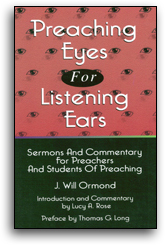
Preaching Eyes for Listening Ears
Sermons and Commentary For Preachers and Students of Preaching
It you celebrated your fortieth birthday - or younger - in 1995, the term "Lucy Riots" probably means nothing to you. You might also be rather vague about what momentous decision the Supreme Court of the United States handed down in 1954.
But for those of us who were living in Tuscaloosa, Alabama, in 1956, both these events had a tremendous impact on our lives as individuals and as a community.

If you are forty or younger you may find it difficult to believe that prior to 1954 it was against the law in Alabama, and in most Southern states, for white people and black people to attend the same schools. This included state--supported universities and colleges. In 1954 the Supreme Court handed down a decision which declared that such segregation of public schools was unconstitutional. In spite of this ruling, many institutions, including the University of Alabama, resisted the enrollment of black students.
In 1956 the University was under court order to admit its first black student. Her name was Authurine Lucy. When she was finally admitted, riots broke out in the city of Tuscaloosa and on the campus. The atmosphere was extremely tense, not only in the city and on the campus, but also in the church. The violence increased. These riots became known as the "Lucy Riots."
This sermon was preached in Covenant Presbyterian Church, Tuscaloosa, the Sunday following the Lucy Riots. It seeks to deal with a serious crisis in the community by the use of Romans, the thirteenth chapter, and is an example of how scripture can be used to address a specific situation in the community.
(This sermon reflects the historical era when it was prepared and preached. This was before there was much concern for inclusive language. Therefore, I have left the language as it was at the time.)
Today is Race Relations Sunday. It has been so designated by the National Council of Churches. It is so marked by our own denomination. Never since its first observance 34 years ago has it been so strategically timed, at least insofar as our own community is concerned.
Doubtless there are those who feel that in the present charged atmosphere in which we live the less said about race the better. Perhaps some of you had hoped for this one hour of quiet and calm in the House of God to be spared any mention of the turbulence which has engulfed us.
If I were free to follow my natural bent of the avoidance of controversy and the pursuit of peace at any price, I would ignore the subject. But I am not free. I am a bond slave of Jesus Christ; therefore, I am bound insofar as I can discern his Spirit's leading to follow his will and not my own.
I do not see how I can be true to my calling, true to my Church, true to the community, and most especially, true to him whom I profess to serve unless I seek, however inadequately and feebly, to bring to bear upon the tensions of our time some light from the Word of God. And it must be from the Word of God, for who among us is sufficient for these things? Who among us is wise enough or prophetic enough to untangle the complex web of conflicting forces in which we are caught?
It seems to me that Romans, the thirteenth chapter, has some clear and definite things to say to us in our present crisis.
One of the questions which has erupted suddenly in our midst and turned the eyes of the whole world upon us is this: Where is the final authority? What forces shall be obeyed? What powers shall prevail?
Is the final authority the government of the nation of which we are citizens, or is it the enforced will of a group of self--appointed defenders of the status quo? Shall we obey the law of the land, or shall we obey the threatening decrees of an undisciplined mob? Shall the powers of decency, order, and reasonableness prevail, or shall the forces of prejudice, hate, and violence win the day?
Paul, writing in the thirteenth chapter of Romans, seems to make the Christian's position abundantly clear. He writes, "Let every person be subject to the governing authorities. For there is no authority except from God, and those that exist have been instituted by God. Therefore he who resists the authorities resists what God has appointed, and those who resist will incur judgment" (Romans 13:1--2).
This would seem to be so plain as to need little comment. It is the Christian's duty to obey the law and uphold orderly government. God has ordained an organized society for the welfare of mankind, to encourage good conduct, and to judge wickedness. Those who set themselves against law and order and who seek by violence and force to nullify the law are setting themselves against God's order and are placing themselves under his judgment. The University of Alabama was seeking to obey the law quietly and calmly when forces of violence and hate stepped in to try to nullify the law. Let those who take part in or condone this breach of the peace remember that law and order are ordained of God.
But if it is un--Christian to flaunt the law by violent means, is it not the Christian's duty to obey the law by peaceful means? Much time and thought, energy and discussion have been expended in our country to find ways to circumvent the law as expressed in the much maligned decision of the Supreme Court. Recognizing that this decision has confronted us with problems which seem almost insurmountable and which are so complex and deep--seated as to take years to solve, ought it not be the Christian's attitude to give our best thought and effort and energy to seeking calm and workable ways to obey the law rather than exhausting ourselves in trying to nullify the law? Granted that when those who are supported in their efforts by the law flaunt their gains in our faces and parade their triumphs, it makes the situation tremendously more difficult. But that does not excuse us as Christians from our responsibility as citizens to obey the law and to seek to solve our problems within the framework of organized, orderly government.
But Christians are citizens of two realms and are under a higher law than that of the state. Christians are citizens of their particular nations, but they are citizens also of the Kingdom of God. They owe allegiance to the laws of the land, but they have a higher loyalty to the royal law of God.
Paul recognizes this dual citizenship, for he follows his discussion of the Christian's duty as a citizen in the secular realm with a brief summary of the law which must govern the Christian in every area of life: "Owe no man anything, except to love one another; for he who loves his neighbor has fulfilled the law. The commandments ... are summed up in this sentence, 'You shall love your neighbor as yourself.' Love does no wrong to a neighbor; therefore love is the fulfilling of the law" (Romans 13:8--10).
Our present crisis and the social revolution of which it is a symptom will not be resolved by legislation, litigation, court decisions, or the due processes of law. Since the crisis has to do with the relation of people one to another, then the determining factor will be the human element of attitude, feelings, emotions, humility, and willingness to get along with one another. Only within the framework of Christian love can we have the grace to work out our differences. Christian love is not determined by the lovableness of the other person nor is it conditioned by whether or not there is a mutual and equal response of love. It is a gift of God, a ruling principle that involves goodwill, forgiveness, and humility. It is our response to God's love for us in giving himself to us, and it reaches out to all men everywhere.
Since we as Christians are under the law of love, it is our duty not to do or say anything that will add to or encourage the atmosphere of hate and prejudice which is all too evident in our community. It is also our Christian part to do any positive acts which will demonstrate our love for all people. For the law of love is an active force, and it must find ways of expression in other ways than simply refraining from evil.
In the last part of the thirteenth chapter of Romans, Paul reminds us of the urgency which attends the Christian life. He says that the Christian is living in a new day, and that there is only one source of power for living a Christian life under any circumstances.
There is time only to touch on these points. Paul speaks with urgency about the time being pressing. It is time to rouse ourselves. Christians cannot put off forever the facing of issues and trying to solve problems and find answers. The Christian life is a growth, a pilgrimage, a moving on to new insights and new advantages in faith.
The Christian lives in the light of a newly dawning day. His eyes must be toward the future, not always straining toward the past. He must put on the armor of light in order to live in the new day. And this above all - put on the Lord Jesus Christ.
We are Christians only by God's grace. When I surrender to him so that he takes over my life, then it is not I who live, but Christ who lives in me.
Surely we who are Christians believe that in the gospel of Christ there is the answer to the complexities of our problems of race. The events of the past week have thrust upon us the necessity of searching more diligently for those answers.
If the answers are in Christ, then why have we not found them before now? I can think of only two reasons. Either we do not know Christ well enough, or we do see the answer in him, but we choose to be blind. Having eyes we deliberately see not; having ears we hear not.
If either of these conditions is true, or if a mixture of these two is nearer to the facts, then two courses are open to us.
First, to re--examine this gospel with open and humble hearts and without preconceived notions; to seek to know Christ more intimately than we know our closest relative or friend; to surrender to his leading, no matter what the cost.
The other course is to pray in agonizing repentance for forgiveness; to ask God to open our eyes and unstop our ears, and to give us the courage and the wisdom to follow what we see and hear. Neither course, nor a combination of them, is easy. Being a Christian was never meant to be easy. But when the Lord made the way straight and narrow he never meant for us to walk it without him.
But for those of us who were living in Tuscaloosa, Alabama, in 1956, both these events had a tremendous impact on our lives as individuals and as a community.
If you are forty or younger you may find it difficult to believe that prior to 1954 it was against the law in Alabama, and in most Southern states, for white people and black people to attend the same schools. This included state--supported universities and colleges. In 1954 the Supreme Court handed down a decision which declared that such segregation of public schools was unconstitutional. In spite of this ruling, many institutions, including the University of Alabama, resisted the enrollment of black students.
In 1956 the University was under court order to admit its first black student. Her name was Authurine Lucy. When she was finally admitted, riots broke out in the city of Tuscaloosa and on the campus. The atmosphere was extremely tense, not only in the city and on the campus, but also in the church. The violence increased. These riots became known as the "Lucy Riots."
This sermon was preached in Covenant Presbyterian Church, Tuscaloosa, the Sunday following the Lucy Riots. It seeks to deal with a serious crisis in the community by the use of Romans, the thirteenth chapter, and is an example of how scripture can be used to address a specific situation in the community.
(This sermon reflects the historical era when it was prepared and preached. This was before there was much concern for inclusive language. Therefore, I have left the language as it was at the time.)
Today is Race Relations Sunday. It has been so designated by the National Council of Churches. It is so marked by our own denomination. Never since its first observance 34 years ago has it been so strategically timed, at least insofar as our own community is concerned.
Doubtless there are those who feel that in the present charged atmosphere in which we live the less said about race the better. Perhaps some of you had hoped for this one hour of quiet and calm in the House of God to be spared any mention of the turbulence which has engulfed us.
If I were free to follow my natural bent of the avoidance of controversy and the pursuit of peace at any price, I would ignore the subject. But I am not free. I am a bond slave of Jesus Christ; therefore, I am bound insofar as I can discern his Spirit's leading to follow his will and not my own.
I do not see how I can be true to my calling, true to my Church, true to the community, and most especially, true to him whom I profess to serve unless I seek, however inadequately and feebly, to bring to bear upon the tensions of our time some light from the Word of God. And it must be from the Word of God, for who among us is sufficient for these things? Who among us is wise enough or prophetic enough to untangle the complex web of conflicting forces in which we are caught?
It seems to me that Romans, the thirteenth chapter, has some clear and definite things to say to us in our present crisis.
One of the questions which has erupted suddenly in our midst and turned the eyes of the whole world upon us is this: Where is the final authority? What forces shall be obeyed? What powers shall prevail?
Is the final authority the government of the nation of which we are citizens, or is it the enforced will of a group of self--appointed defenders of the status quo? Shall we obey the law of the land, or shall we obey the threatening decrees of an undisciplined mob? Shall the powers of decency, order, and reasonableness prevail, or shall the forces of prejudice, hate, and violence win the day?
Paul, writing in the thirteenth chapter of Romans, seems to make the Christian's position abundantly clear. He writes, "Let every person be subject to the governing authorities. For there is no authority except from God, and those that exist have been instituted by God. Therefore he who resists the authorities resists what God has appointed, and those who resist will incur judgment" (Romans 13:1--2).
This would seem to be so plain as to need little comment. It is the Christian's duty to obey the law and uphold orderly government. God has ordained an organized society for the welfare of mankind, to encourage good conduct, and to judge wickedness. Those who set themselves against law and order and who seek by violence and force to nullify the law are setting themselves against God's order and are placing themselves under his judgment. The University of Alabama was seeking to obey the law quietly and calmly when forces of violence and hate stepped in to try to nullify the law. Let those who take part in or condone this breach of the peace remember that law and order are ordained of God.
But if it is un--Christian to flaunt the law by violent means, is it not the Christian's duty to obey the law by peaceful means? Much time and thought, energy and discussion have been expended in our country to find ways to circumvent the law as expressed in the much maligned decision of the Supreme Court. Recognizing that this decision has confronted us with problems which seem almost insurmountable and which are so complex and deep--seated as to take years to solve, ought it not be the Christian's attitude to give our best thought and effort and energy to seeking calm and workable ways to obey the law rather than exhausting ourselves in trying to nullify the law? Granted that when those who are supported in their efforts by the law flaunt their gains in our faces and parade their triumphs, it makes the situation tremendously more difficult. But that does not excuse us as Christians from our responsibility as citizens to obey the law and to seek to solve our problems within the framework of organized, orderly government.
But Christians are citizens of two realms and are under a higher law than that of the state. Christians are citizens of their particular nations, but they are citizens also of the Kingdom of God. They owe allegiance to the laws of the land, but they have a higher loyalty to the royal law of God.
Paul recognizes this dual citizenship, for he follows his discussion of the Christian's duty as a citizen in the secular realm with a brief summary of the law which must govern the Christian in every area of life: "Owe no man anything, except to love one another; for he who loves his neighbor has fulfilled the law. The commandments ... are summed up in this sentence, 'You shall love your neighbor as yourself.' Love does no wrong to a neighbor; therefore love is the fulfilling of the law" (Romans 13:8--10).
Our present crisis and the social revolution of which it is a symptom will not be resolved by legislation, litigation, court decisions, or the due processes of law. Since the crisis has to do with the relation of people one to another, then the determining factor will be the human element of attitude, feelings, emotions, humility, and willingness to get along with one another. Only within the framework of Christian love can we have the grace to work out our differences. Christian love is not determined by the lovableness of the other person nor is it conditioned by whether or not there is a mutual and equal response of love. It is a gift of God, a ruling principle that involves goodwill, forgiveness, and humility. It is our response to God's love for us in giving himself to us, and it reaches out to all men everywhere.
Since we as Christians are under the law of love, it is our duty not to do or say anything that will add to or encourage the atmosphere of hate and prejudice which is all too evident in our community. It is also our Christian part to do any positive acts which will demonstrate our love for all people. For the law of love is an active force, and it must find ways of expression in other ways than simply refraining from evil.
In the last part of the thirteenth chapter of Romans, Paul reminds us of the urgency which attends the Christian life. He says that the Christian is living in a new day, and that there is only one source of power for living a Christian life under any circumstances.
There is time only to touch on these points. Paul speaks with urgency about the time being pressing. It is time to rouse ourselves. Christians cannot put off forever the facing of issues and trying to solve problems and find answers. The Christian life is a growth, a pilgrimage, a moving on to new insights and new advantages in faith.
The Christian lives in the light of a newly dawning day. His eyes must be toward the future, not always straining toward the past. He must put on the armor of light in order to live in the new day. And this above all - put on the Lord Jesus Christ.
We are Christians only by God's grace. When I surrender to him so that he takes over my life, then it is not I who live, but Christ who lives in me.
Surely we who are Christians believe that in the gospel of Christ there is the answer to the complexities of our problems of race. The events of the past week have thrust upon us the necessity of searching more diligently for those answers.
If the answers are in Christ, then why have we not found them before now? I can think of only two reasons. Either we do not know Christ well enough, or we do see the answer in him, but we choose to be blind. Having eyes we deliberately see not; having ears we hear not.
If either of these conditions is true, or if a mixture of these two is nearer to the facts, then two courses are open to us.
First, to re--examine this gospel with open and humble hearts and without preconceived notions; to seek to know Christ more intimately than we know our closest relative or friend; to surrender to his leading, no matter what the cost.
The other course is to pray in agonizing repentance for forgiveness; to ask God to open our eyes and unstop our ears, and to give us the courage and the wisdom to follow what we see and hear. Neither course, nor a combination of them, is easy. Being a Christian was never meant to be easy. But when the Lord made the way straight and narrow he never meant for us to walk it without him.