Turning Inkblots into Angels
Worship
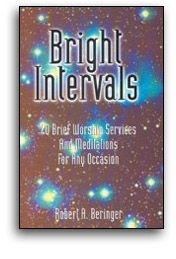
Bright Intervals
40 Brief Worship Services and Meditations for Any Occasion
Object:
Greeting and Call To Worship
In this the love of God was made manifest among us, that God sent the only Son into the world, so that we might live through him!
Opening Prayer
Eternal God, your love is like a light in the midst of this world's darkness. Pardon our sin, and give us such joy in Jesus Christ that darkness may be driven from our lives and your light will shine forth in us. We pray in the name of Christ our Lord. Amen.
Lord's Prayer
Special Hymn
"Dear Lord And Father Of Mankind"

John Greenleaf Whittier, the "Quaker poet," was born in Haverhill, Massachusetts, in 1807. He began life as a farm boy and then became a village shoemaker. With only a meager education, he entered the field of journalism and eventually held editorial positions in Boston, Hartford, and Philadelphia. He was an ardent opponent of slavery, and used his skills as a writer to work for its abolition. Eventually he was recognized as one of America's great poets, and over fifty hymns in modern use found their inspiration in his beautiful poems. The melody by Frederick Charles Maker is the perfect setting for the Quaker poet's prayerful words.
Scripture Reading
Romans 8:28-39
Meditation
From Scotland comes the story of Joseph Craik, who became known all over that land as the man who could turn inkblots into angels. Craik was a talented penman and artist. He was appointed "writing master" in a village school back in the days when students learned to write by dipping their pens into inkwells. If you recall, most of us ended up turning in papers to our teacher with unwanted inkblots all over them! Most teachers in that school circled the inkblots on the student's papers in large red circles. But Craik, instead of chastising his students for their mistakes, would add a line here and there to their inkblots so that they became pictures of angels. As you can imagine, Joseph Craik became a legend in his own time as the "man who could turn inkblots into angels."
That story is a wonderful parable of the difference Christian faith can make in a person's life. By the miracle of grace, God turns the inkblots and mistakes in our lives into something good. God takes our feeble efforts and uses them for good in a way we never thought possible. That is precisely what Paul was saying in this magnificent portion of his Roman Letter: "We know that in everything, God is at work for good ... nothing shall ever separate us from the love of God in Christ Jesus our Lord!" Let me remind you that the person who wrote those words was no television talk-show host handing out easy advice. Paul knew firsthand about hardship, disappointment, rejection, physical pain, and chronic illness. But Paul discovered in Christ someone whose power could transform the inkblots in his life into angels.
God is still ready to transform our despair into hope. In those moments of life where we hurt the most, the God who is at work for good in everything that happens to us is still able to turn dark inkblots into angels of hope. Author Frederick Buechner was at a low point in his life. He was worried to death about his daughter, who was ill, and was so weighed down with despair that he questioned the very existence of God. One day while driving his car his eyes filled with tears, and he had to pull to the side of the road. As he sat there crying, "God, where are you?" a car came toward him with one of those personalized license plates on the front. On the license plate was the single word "TRUST." For Buechner, it was one of those transforming moments when his doubt was overcome, his trust in God renewed, and his life turned around. He later learned that the license plate belonged to the Trust Officer of his local bank! But isn't that exactly how God works to turn inkblots into angels in our everyday lives?
Sometimes God turns our problems into opportunities. Back in 1850 a young man from Bavaria came to this country to get in on the gold rush in our Western states. He carried with him rolls of canvas which he believed could be made into tents for the miners traveling westward in search of gold. But to his dismay, the miners did not want tents! They said to him, "What we really need are pants -- durable pants that can stand up to the rough life of a miner." So this young man from Bavaria decided to turn his rolls of canvas into blue pants that could survive the rigors of the mining camps. He got a harness-maker to reinforce the pockets with copper studs, and his pants became an overnight success! In case you haven't guessed, the name of the young man from Bavaria was Levi Strauss, and his pants, called "Levi's," have been selling in basically their original form for the last 130 years!
Inkblots into angels -- the God we meet in Jesus Christ is a God whose love will never let us go. This is a God who is at work in everything that happens to us for good.
Closing Prayer
"Dear Lord and Father of mankind, forgive our foolish ways; Reclothe us in our rightful mind, in purer lives Thy service find, in deeper reverence, praise."
In this the love of God was made manifest among us, that God sent the only Son into the world, so that we might live through him!
Opening Prayer
Eternal God, your love is like a light in the midst of this world's darkness. Pardon our sin, and give us such joy in Jesus Christ that darkness may be driven from our lives and your light will shine forth in us. We pray in the name of Christ our Lord. Amen.
Lord's Prayer
Special Hymn
"Dear Lord And Father Of Mankind"
John Greenleaf Whittier, the "Quaker poet," was born in Haverhill, Massachusetts, in 1807. He began life as a farm boy and then became a village shoemaker. With only a meager education, he entered the field of journalism and eventually held editorial positions in Boston, Hartford, and Philadelphia. He was an ardent opponent of slavery, and used his skills as a writer to work for its abolition. Eventually he was recognized as one of America's great poets, and over fifty hymns in modern use found their inspiration in his beautiful poems. The melody by Frederick Charles Maker is the perfect setting for the Quaker poet's prayerful words.
Scripture Reading
Romans 8:28-39
Meditation
From Scotland comes the story of Joseph Craik, who became known all over that land as the man who could turn inkblots into angels. Craik was a talented penman and artist. He was appointed "writing master" in a village school back in the days when students learned to write by dipping their pens into inkwells. If you recall, most of us ended up turning in papers to our teacher with unwanted inkblots all over them! Most teachers in that school circled the inkblots on the student's papers in large red circles. But Craik, instead of chastising his students for their mistakes, would add a line here and there to their inkblots so that they became pictures of angels. As you can imagine, Joseph Craik became a legend in his own time as the "man who could turn inkblots into angels."
That story is a wonderful parable of the difference Christian faith can make in a person's life. By the miracle of grace, God turns the inkblots and mistakes in our lives into something good. God takes our feeble efforts and uses them for good in a way we never thought possible. That is precisely what Paul was saying in this magnificent portion of his Roman Letter: "We know that in everything, God is at work for good ... nothing shall ever separate us from the love of God in Christ Jesus our Lord!" Let me remind you that the person who wrote those words was no television talk-show host handing out easy advice. Paul knew firsthand about hardship, disappointment, rejection, physical pain, and chronic illness. But Paul discovered in Christ someone whose power could transform the inkblots in his life into angels.
God is still ready to transform our despair into hope. In those moments of life where we hurt the most, the God who is at work for good in everything that happens to us is still able to turn dark inkblots into angels of hope. Author Frederick Buechner was at a low point in his life. He was worried to death about his daughter, who was ill, and was so weighed down with despair that he questioned the very existence of God. One day while driving his car his eyes filled with tears, and he had to pull to the side of the road. As he sat there crying, "God, where are you?" a car came toward him with one of those personalized license plates on the front. On the license plate was the single word "TRUST." For Buechner, it was one of those transforming moments when his doubt was overcome, his trust in God renewed, and his life turned around. He later learned that the license plate belonged to the Trust Officer of his local bank! But isn't that exactly how God works to turn inkblots into angels in our everyday lives?
Sometimes God turns our problems into opportunities. Back in 1850 a young man from Bavaria came to this country to get in on the gold rush in our Western states. He carried with him rolls of canvas which he believed could be made into tents for the miners traveling westward in search of gold. But to his dismay, the miners did not want tents! They said to him, "What we really need are pants -- durable pants that can stand up to the rough life of a miner." So this young man from Bavaria decided to turn his rolls of canvas into blue pants that could survive the rigors of the mining camps. He got a harness-maker to reinforce the pockets with copper studs, and his pants became an overnight success! In case you haven't guessed, the name of the young man from Bavaria was Levi Strauss, and his pants, called "Levi's," have been selling in basically their original form for the last 130 years!
Inkblots into angels -- the God we meet in Jesus Christ is a God whose love will never let us go. This is a God who is at work in everything that happens to us for good.
Closing Prayer
"Dear Lord and Father of mankind, forgive our foolish ways; Reclothe us in our rightful mind, in purer lives Thy service find, in deeper reverence, praise."