Third Sunday Of Advent
Preaching
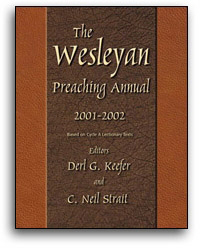
THE WESLEYAN PREACHING ANNUAL 2001--2002
WORSHIP HELPS
CALL TO WORSHIP
Speaker 1: God loves the world.
Speaker 2: God loves the world enough to send His Son.
Speaker 3: If we believe, we will have life.
Speakers 1 & 2: Come let us believe His Son.
Speaker 3: Come let us receive God's Son.
OFFERING THOUGHT
"Ascribe to the Lord the glory due his name; bring an offering and come into his courts." (Psalm 96:8)
BENEDICTION

We glorify the name of the God who has chosen to dwell in the hearts of seekers. You have revealed Your holy self in the child Jesus. May we take Him with us in love and faith, humbly sharing the joy of the revelation of this baby. Amen.
SERMON BRIEFS
Patience: The Orphan Virtue
James 5:7--10
I don't like to wait for anything, do you? I get eyeglasses where they promise to get me in and out in one hour. I like fast food restaurants because I can get a meal in a hurry. My bank has an automatic teller machine so I can go there at three o'clock in the morning and not have to wait in line. I can get overnight delivery on packages. I can get pizza delivered in thirty minutes, guaranteed. I've got an alarm clock on my coffeepot so my coffee will be ready when I get up. I want a new computer because the one I have now is too slow. (Sometimes it makes me wait almost a second while it performs a series of one million electronic functions.) I can't wait that long. I hate stoplights, waiting rooms and call waiting. I hate to wait.
But do you know something? Waiting is good for you. Patience is the orphan virtue. It's the virtue that nobody wants.
Everybody admits that we need to be loving and kind. Most people want to be good, gentle and even self--controlled. But nobody wants to be patient. We like being in a hurry. We hate to wait.
But true Christianity includes tolerance for people and circumstances that we don't like. You need patience. And you can have patience, if you choose it. James the apostle teaches us about patience.
I. Patience is required.
Simply put, it is not permitted for God's people to act like spoiled brats. Patience is a required virtue. The Bible commands us to exercise patience.
Mention the idea of patience to some Christians today and you're liable to be met with a jesting reply like, "If I'd wanted 'patients,' I'd have been a doctor." Some don't take patience seriously. Often, impatience is treated as a virtue. We respect people who are able to bully their way past others and get their own way.
But patience is a clear requirement of Scripture. In Galatians 5:22 it's called a fruit of the Spirit. In Ephesians 4:2 Paul reminds us to be patient with one another. Colossians 3:12 states, "Therefore as God's chosen people, holy and beloved, clothe yourselves with compassion, kindness, humility, gentleness and patience." Over and over God's people are instructed in his Word to exercise patience. In fact, patience is a distinguishing feature of Christian character.
Yet I wonder whether we really believe that in this day of road rage and "extreme" sports? Do we really believe that God expects his people to be patient?
The fact is, we can't pick and choose the principles of the Bible like items on a cafeteria line. As followers of Christ, we have made a commitment, like the witness in a court of law, to the "whole truth and nothing but the truth, so help me God!"
It's time to take God's Word to heart. The marks of Christianity are seen in our behavior toward others. James wrote, "Religion that God our Father accepts as pure and faultless is this: to look after orphans and widows in their distress and to keep oneself from being polluted by the world" (James 1:27). We are patient ...
´ When we are tolerant of the foibles and failures of others.
´ When we are slow to anger.
´ When we suffer without complaint.
´ When we are gentle and kind with family members.
´ When we refuse to quit when things are difficult.
´ When we learn to wait without becoming irritated.
´ When we let others go first.
I'm not asking if you already have patience. I am assuming that you, like most other human beings, would prefer that the world run on your schedule. Rather, I am calling you to learn to be patient. To live as Christ lived means surrendering yourself. It means putting others first. It means being tolerant. Being able to wait. It means being patient. Are you willing to do that?
II. Patience is reasonable.
Benjamin Franklin said that he who can have patience can have what he will. That's probably true. For the Christian, patience is not just required it is also reasonable. Exercising it just makes good sense. Life just goes better when you're willing to wait.
The psalmist said, "The precepts of the Lord are right, giving joy to the heart" (Psalm 19:8a). Notice that James' appeal is based on reason. He expects the reader of this book to be swayed by the logical arguments that he gives for being patient. First, he uses the example of a farmer, who reads the seasons. It doesn't make sense to work against nature. The successful farmer is the one who learns to read the sky and wait on the weather. Sometimes it just makes more sense to be patient.
Next, James appeals to the example of the prophets. These heroes of the faith waited for years to see God work. In fact, many of them never did see the fulfillment of their prophecies. They had a vision from God, and they were willing to be patient until it was accomplished.
James also reminds us of the Old Testament character, Job. He was patient through unimaginable suffering, and God eventually blessed him. Patience actually pays off!
Yet, incredibly, some value impatience as a virtue. The stereotype of a successful person is one who is on the go - even if it means going around (or over) others. Demanding people always seem to get better service. "You be patient if you want to, but the squeaky wheel gets the grease!" Impatient people are sometimes viewed as more effective.
But impatience is ugly. Here's what an impatient person looks like. He flies into a rage over simple things. He rants, raves, grunts and intimidates. Nobody knows what will set him off. People at work are afraid to talk with him until they see what his mood is. If there's a problem, nobody wants to break it to him. Some people think he is mentally unstable. Everywhere he does business the workers hate to see him enter the store. His family is tired of making excuses for his foul moods. Those who know him the best respect him the least.
Impatience really is ugly. Fits of rage, selfishness, temper tantrums, angry outbursts. No wonder God wants us to behave differently!
Patience, on the other hand, is productive. Patient people are easier to be around. Patient people are easier to work with, and are sooner promoted. Patient people are happier. Patient people are better respected by family, friends and co--workers.
Doesn't it make sense to admit that? The book of James is sometimes called a book of wisdom. James, like the writers of Proverbs, gives practical and reasonable advice. One of those good bits of advice is this: Be patient. It makes good sense.
III. Patience is realistic.
"Lord, give me patience," one man prayed, "and I want it right now!" In one way or another, we've all prayed similar prayers. And probably some of us have given up on patience just as quickly. We've assumed that patience is unattainable. But it isn't. You can be patient.
Here's how. First, you can develop patience by imitating God's character. James 5:11 tells us that God is full of compassion and mercy. In the first chapter of Romans, Paul reminds us that God has been patient with our sin. Peter shows us that God's patience with sinners means salvation for all. Ask yourself this question: If God had not been patient with me, where would I be right now? Isn't it reasonable for us to behave in the same tolerant way with others? As with all virtues, gaining patience is gaining the mind of Christ.
Also, patience is cultivated by surrendering control. Impatience reflects the desire for control. We control people through anger. We control situations by aggressive actions. Impatience shows our frustration at not being in control of our health, of others, or of our circumstances.
But that's exactly the opposite of what Scripture teaches us! We are not in control, God is! That is seen in the life of Christ. "Being found in appearance as a man, he humbled himself and became obedient to death - even death on a cross!" (Philippians 2:8). When we surrender our will to God, patience is one of the results.
When you deal with your children, you remember that your heavenly Father has been patient with you. When your spouse disappoints you, you remember that you have disappointed God many times. When you're in the waiting room, you remember that God waited thousands of years to bring His Son to earth. When you are ill, you remember that it is God who is in control of your life. When you are angry and frustrated with the circumstances of your life, you remember that Jesus is coming soon!
And third, patience is cultivated by submitting to the leadership of the Holy Spirit. Romans 8:5--6, "Those who live according to the sinful nature have their minds set on what that nature desires; but those who live in accordance with the Spirit have their minds set on what the Spirit desires. The mind of sinful man is death, but the mind controlled by the Spirit is life and peace."
Tolerant. Longsuffering. Slow to anger. Hard to rattle. Forgiving. Forbearing. Generous. Patient. Do those words describe you? They can.
And if you are a follower of Christ, they should.
And, as you surrender the control of your emotions to the Holy Spirit, and conform to the character of Christ, they will.
Stan Toler
I have been preaching the holiness message for 36 years. The message is still relevant to today's world!
The God Of The Needy
Psalm 146:5--10
An art gallery in Florence, Italy, at one time displayed a picture of the Battle of Ivry in which Henry IV of Navarre is waging a fierce battle. There is no question as to the battle's outcome because the artist gives us a tremendous hint. Painted in the right--hand corner over the contending armies is a group of angels with drawn swords. The guiding divine force will win the day! Is it any wonder we can be filled with courage and hope even in our need when we can feel a power like that? It is God who is on our side.
During the Christmas season we have an even greater demonstration of God's love and power - Jesus! In our greatest need God knew we would need help. God sent His one and only Son to invade our world not with a sword, but with love. God is with us in our need.
I. The God of the needy gives help and hope. (v. 5)
An English child many years ago had to make a lengthy journey to the next town. When he was ready to start, he paused at the front doorway. "Mother," he said in a trembling voice, "it's so far and a strange road, I - I'm not 'zactly afraid, but could you go a teeny way with me?" The sensitive mother caught her son's anxiety and taking his hand in hers said, "My son, Mother will go all the way with you." Hand in hand they walked and the boy went fearlessly.1
A. In the midst of our need God is there to hold our hands giving help and hope.
1. Help and hope when death takes a loved one.
2. Help and hope when healing is needed.
3. Help and hope when discouragement raises its ugly head.
4. Help and hope when torture and destruction hits our home.
5. Help and hope when the business collapses.
6. Help and hope when the heart is broken by divorce.
B. This help and hope comes in forms of people responding to our need. Sometimes through a miracle and at other times through our own understanding. Through it all we see the hand of God moving through our circumstances.
II. The God of the needy remains faithful forever. (v. 6)
We struggle with the concept of forever faithful. God is not fickle like a crowd at a sporting event. One minute the crowd cheers the athlete and in the next moment he is booed. God is not like that - He is faithful forever.
People desert us in our hardest times. They divorce us in attitude and separate themselves when they want. Not God. He is real and true and wonderful.
Robert Leslie Holmes says he chuckles every time he thinks about Lawrence of Arabia's entourage taking the water taps from the Paris hotel bathrooms after the 1919 Paris Peace Talks. They were tired of the "No Water" signs in their desert homes and tents. They figured if they could connect those magic taps they would have water anytime! Those desert compatriots of Lawrence's just didn't understand the intricacies of indoor plumbing. Not understanding it, they decided it was something inside the tap that made it run. So it made sense to them to take taps instead of towels from their hotel rooms!2
God defies our understanding but the truth is He will remain faithful forever even if everyone else leaves.
III. The God of the needy sets them free. (v. 7)
We become imprisoned by our thoughts, deeds and sin. Dr. W.F. Crafts tells the story about a man relaxing on the grass. He noticed a little plant called "sundew." A few moments later a tiny fly lit upon the plant and began to have its lunch. Suddenly three crimson--tipped, finger like hairs bent over and touched its wings with a sticky touch which held it firmly. The fly struggled unsuccessfully to get free. It still kept feasting on the plant leaf protruding its tongue in and out. When the captive fly was entirely at the mercy of the plant, the edges of the leaf folded inwards, and looked like a closed fist. Two hours later the fly was an empty sucked skin, and the leaf was opening for another unwary visitor.
The only way we can be freed from the sticky life of sin is through Jesus Christ. He has come to set us free!
IV. The God of the needy loves and sustains them. (vv. 8--9)
I like the story about a child named Bradley who came down to breakfast one morning and put a neatly folded piece of paper at his mother's place. His mom opened it. Little Bradley had written, "Mother owes Bradley: For running errands - 25 cents; for being good - 10 cents; for taking music lessons - 15 cents; extras - 5 cents; total 55 cents." His mother smiled but did not say a word.
When lunchtime came, she placed the bill on Bradley's place with the 55 cents. Bradley's eyes danced when he saw the money, and he thought his business ability had been quickly rewarded. But with the money was another bill, which read: "Bradley owes Mother: For being good - 00; for nursing him through his long illness - 00; for all his meals and his comfortable room - 00."
Bradley got the message. He put the 55 cents in his mother's hand and said, "Take the money all back, Mama, and let me love you and do things for nothing."
That is what God does - He loves and sustains and died for us. We did nothing to deserve it.
Conclusion
The psalmist understood his need and our need and lays them down one by one. Each of those needs he realizes God meets. Is it any reason he shouts, "Praise the Lord!"
Derl G. Keefer
____________
1. G.B.F. Hallock, Five Thousand Best Modern Illustrations (Richard R. Smith, Inc., 1931), p. 319.
2. Robert Leslie Holmes, Lifelines (Belfast, Ireland: Ambassador/Emerald Int., 2000), pp. 55--60.
The doctrine of holiness that John Wesley proposed reminds one of our desperate need of living in the presence of power of the Holy Spirit. The
experience does not belong to a "privileged few"
but to all who desire to live like Jesus!
CALL TO WORSHIP
Speaker 1: God loves the world.
Speaker 2: God loves the world enough to send His Son.
Speaker 3: If we believe, we will have life.
Speakers 1 & 2: Come let us believe His Son.
Speaker 3: Come let us receive God's Son.
OFFERING THOUGHT
"Ascribe to the Lord the glory due his name; bring an offering and come into his courts." (Psalm 96:8)
BENEDICTION
We glorify the name of the God who has chosen to dwell in the hearts of seekers. You have revealed Your holy self in the child Jesus. May we take Him with us in love and faith, humbly sharing the joy of the revelation of this baby. Amen.
SERMON BRIEFS
Patience: The Orphan Virtue
James 5:7--10
I don't like to wait for anything, do you? I get eyeglasses where they promise to get me in and out in one hour. I like fast food restaurants because I can get a meal in a hurry. My bank has an automatic teller machine so I can go there at three o'clock in the morning and not have to wait in line. I can get overnight delivery on packages. I can get pizza delivered in thirty minutes, guaranteed. I've got an alarm clock on my coffeepot so my coffee will be ready when I get up. I want a new computer because the one I have now is too slow. (Sometimes it makes me wait almost a second while it performs a series of one million electronic functions.) I can't wait that long. I hate stoplights, waiting rooms and call waiting. I hate to wait.
But do you know something? Waiting is good for you. Patience is the orphan virtue. It's the virtue that nobody wants.
Everybody admits that we need to be loving and kind. Most people want to be good, gentle and even self--controlled. But nobody wants to be patient. We like being in a hurry. We hate to wait.
But true Christianity includes tolerance for people and circumstances that we don't like. You need patience. And you can have patience, if you choose it. James the apostle teaches us about patience.
I. Patience is required.
Simply put, it is not permitted for God's people to act like spoiled brats. Patience is a required virtue. The Bible commands us to exercise patience.
Mention the idea of patience to some Christians today and you're liable to be met with a jesting reply like, "If I'd wanted 'patients,' I'd have been a doctor." Some don't take patience seriously. Often, impatience is treated as a virtue. We respect people who are able to bully their way past others and get their own way.
But patience is a clear requirement of Scripture. In Galatians 5:22 it's called a fruit of the Spirit. In Ephesians 4:2 Paul reminds us to be patient with one another. Colossians 3:12 states, "Therefore as God's chosen people, holy and beloved, clothe yourselves with compassion, kindness, humility, gentleness and patience." Over and over God's people are instructed in his Word to exercise patience. In fact, patience is a distinguishing feature of Christian character.
Yet I wonder whether we really believe that in this day of road rage and "extreme" sports? Do we really believe that God expects his people to be patient?
The fact is, we can't pick and choose the principles of the Bible like items on a cafeteria line. As followers of Christ, we have made a commitment, like the witness in a court of law, to the "whole truth and nothing but the truth, so help me God!"
It's time to take God's Word to heart. The marks of Christianity are seen in our behavior toward others. James wrote, "Religion that God our Father accepts as pure and faultless is this: to look after orphans and widows in their distress and to keep oneself from being polluted by the world" (James 1:27). We are patient ...
´ When we are tolerant of the foibles and failures of others.
´ When we are slow to anger.
´ When we suffer without complaint.
´ When we are gentle and kind with family members.
´ When we refuse to quit when things are difficult.
´ When we learn to wait without becoming irritated.
´ When we let others go first.
I'm not asking if you already have patience. I am assuming that you, like most other human beings, would prefer that the world run on your schedule. Rather, I am calling you to learn to be patient. To live as Christ lived means surrendering yourself. It means putting others first. It means being tolerant. Being able to wait. It means being patient. Are you willing to do that?
II. Patience is reasonable.
Benjamin Franklin said that he who can have patience can have what he will. That's probably true. For the Christian, patience is not just required it is also reasonable. Exercising it just makes good sense. Life just goes better when you're willing to wait.
The psalmist said, "The precepts of the Lord are right, giving joy to the heart" (Psalm 19:8a). Notice that James' appeal is based on reason. He expects the reader of this book to be swayed by the logical arguments that he gives for being patient. First, he uses the example of a farmer, who reads the seasons. It doesn't make sense to work against nature. The successful farmer is the one who learns to read the sky and wait on the weather. Sometimes it just makes more sense to be patient.
Next, James appeals to the example of the prophets. These heroes of the faith waited for years to see God work. In fact, many of them never did see the fulfillment of their prophecies. They had a vision from God, and they were willing to be patient until it was accomplished.
James also reminds us of the Old Testament character, Job. He was patient through unimaginable suffering, and God eventually blessed him. Patience actually pays off!
Yet, incredibly, some value impatience as a virtue. The stereotype of a successful person is one who is on the go - even if it means going around (or over) others. Demanding people always seem to get better service. "You be patient if you want to, but the squeaky wheel gets the grease!" Impatient people are sometimes viewed as more effective.
But impatience is ugly. Here's what an impatient person looks like. He flies into a rage over simple things. He rants, raves, grunts and intimidates. Nobody knows what will set him off. People at work are afraid to talk with him until they see what his mood is. If there's a problem, nobody wants to break it to him. Some people think he is mentally unstable. Everywhere he does business the workers hate to see him enter the store. His family is tired of making excuses for his foul moods. Those who know him the best respect him the least.
Impatience really is ugly. Fits of rage, selfishness, temper tantrums, angry outbursts. No wonder God wants us to behave differently!
Patience, on the other hand, is productive. Patient people are easier to be around. Patient people are easier to work with, and are sooner promoted. Patient people are happier. Patient people are better respected by family, friends and co--workers.
Doesn't it make sense to admit that? The book of James is sometimes called a book of wisdom. James, like the writers of Proverbs, gives practical and reasonable advice. One of those good bits of advice is this: Be patient. It makes good sense.
III. Patience is realistic.
"Lord, give me patience," one man prayed, "and I want it right now!" In one way or another, we've all prayed similar prayers. And probably some of us have given up on patience just as quickly. We've assumed that patience is unattainable. But it isn't. You can be patient.
Here's how. First, you can develop patience by imitating God's character. James 5:11 tells us that God is full of compassion and mercy. In the first chapter of Romans, Paul reminds us that God has been patient with our sin. Peter shows us that God's patience with sinners means salvation for all. Ask yourself this question: If God had not been patient with me, where would I be right now? Isn't it reasonable for us to behave in the same tolerant way with others? As with all virtues, gaining patience is gaining the mind of Christ.
Also, patience is cultivated by surrendering control. Impatience reflects the desire for control. We control people through anger. We control situations by aggressive actions. Impatience shows our frustration at not being in control of our health, of others, or of our circumstances.
But that's exactly the opposite of what Scripture teaches us! We are not in control, God is! That is seen in the life of Christ. "Being found in appearance as a man, he humbled himself and became obedient to death - even death on a cross!" (Philippians 2:8). When we surrender our will to God, patience is one of the results.
When you deal with your children, you remember that your heavenly Father has been patient with you. When your spouse disappoints you, you remember that you have disappointed God many times. When you're in the waiting room, you remember that God waited thousands of years to bring His Son to earth. When you are ill, you remember that it is God who is in control of your life. When you are angry and frustrated with the circumstances of your life, you remember that Jesus is coming soon!
And third, patience is cultivated by submitting to the leadership of the Holy Spirit. Romans 8:5--6, "Those who live according to the sinful nature have their minds set on what that nature desires; but those who live in accordance with the Spirit have their minds set on what the Spirit desires. The mind of sinful man is death, but the mind controlled by the Spirit is life and peace."
Tolerant. Longsuffering. Slow to anger. Hard to rattle. Forgiving. Forbearing. Generous. Patient. Do those words describe you? They can.
And if you are a follower of Christ, they should.
And, as you surrender the control of your emotions to the Holy Spirit, and conform to the character of Christ, they will.
Stan Toler
I have been preaching the holiness message for 36 years. The message is still relevant to today's world!
The God Of The Needy
Psalm 146:5--10
An art gallery in Florence, Italy, at one time displayed a picture of the Battle of Ivry in which Henry IV of Navarre is waging a fierce battle. There is no question as to the battle's outcome because the artist gives us a tremendous hint. Painted in the right--hand corner over the contending armies is a group of angels with drawn swords. The guiding divine force will win the day! Is it any wonder we can be filled with courage and hope even in our need when we can feel a power like that? It is God who is on our side.
During the Christmas season we have an even greater demonstration of God's love and power - Jesus! In our greatest need God knew we would need help. God sent His one and only Son to invade our world not with a sword, but with love. God is with us in our need.
I. The God of the needy gives help and hope. (v. 5)
An English child many years ago had to make a lengthy journey to the next town. When he was ready to start, he paused at the front doorway. "Mother," he said in a trembling voice, "it's so far and a strange road, I - I'm not 'zactly afraid, but could you go a teeny way with me?" The sensitive mother caught her son's anxiety and taking his hand in hers said, "My son, Mother will go all the way with you." Hand in hand they walked and the boy went fearlessly.1
A. In the midst of our need God is there to hold our hands giving help and hope.
1. Help and hope when death takes a loved one.
2. Help and hope when healing is needed.
3. Help and hope when discouragement raises its ugly head.
4. Help and hope when torture and destruction hits our home.
5. Help and hope when the business collapses.
6. Help and hope when the heart is broken by divorce.
B. This help and hope comes in forms of people responding to our need. Sometimes through a miracle and at other times through our own understanding. Through it all we see the hand of God moving through our circumstances.
II. The God of the needy remains faithful forever. (v. 6)
We struggle with the concept of forever faithful. God is not fickle like a crowd at a sporting event. One minute the crowd cheers the athlete and in the next moment he is booed. God is not like that - He is faithful forever.
People desert us in our hardest times. They divorce us in attitude and separate themselves when they want. Not God. He is real and true and wonderful.
Robert Leslie Holmes says he chuckles every time he thinks about Lawrence of Arabia's entourage taking the water taps from the Paris hotel bathrooms after the 1919 Paris Peace Talks. They were tired of the "No Water" signs in their desert homes and tents. They figured if they could connect those magic taps they would have water anytime! Those desert compatriots of Lawrence's just didn't understand the intricacies of indoor plumbing. Not understanding it, they decided it was something inside the tap that made it run. So it made sense to them to take taps instead of towels from their hotel rooms!2
God defies our understanding but the truth is He will remain faithful forever even if everyone else leaves.
III. The God of the needy sets them free. (v. 7)
We become imprisoned by our thoughts, deeds and sin. Dr. W.F. Crafts tells the story about a man relaxing on the grass. He noticed a little plant called "sundew." A few moments later a tiny fly lit upon the plant and began to have its lunch. Suddenly three crimson--tipped, finger like hairs bent over and touched its wings with a sticky touch which held it firmly. The fly struggled unsuccessfully to get free. It still kept feasting on the plant leaf protruding its tongue in and out. When the captive fly was entirely at the mercy of the plant, the edges of the leaf folded inwards, and looked like a closed fist. Two hours later the fly was an empty sucked skin, and the leaf was opening for another unwary visitor.
The only way we can be freed from the sticky life of sin is through Jesus Christ. He has come to set us free!
IV. The God of the needy loves and sustains them. (vv. 8--9)
I like the story about a child named Bradley who came down to breakfast one morning and put a neatly folded piece of paper at his mother's place. His mom opened it. Little Bradley had written, "Mother owes Bradley: For running errands - 25 cents; for being good - 10 cents; for taking music lessons - 15 cents; extras - 5 cents; total 55 cents." His mother smiled but did not say a word.
When lunchtime came, she placed the bill on Bradley's place with the 55 cents. Bradley's eyes danced when he saw the money, and he thought his business ability had been quickly rewarded. But with the money was another bill, which read: "Bradley owes Mother: For being good - 00; for nursing him through his long illness - 00; for all his meals and his comfortable room - 00."
Bradley got the message. He put the 55 cents in his mother's hand and said, "Take the money all back, Mama, and let me love you and do things for nothing."
That is what God does - He loves and sustains and died for us. We did nothing to deserve it.
Conclusion
The psalmist understood his need and our need and lays them down one by one. Each of those needs he realizes God meets. Is it any reason he shouts, "Praise the Lord!"
Derl G. Keefer
____________
1. G.B.F. Hallock, Five Thousand Best Modern Illustrations (Richard R. Smith, Inc., 1931), p. 319.
2. Robert Leslie Holmes, Lifelines (Belfast, Ireland: Ambassador/Emerald Int., 2000), pp. 55--60.
The doctrine of holiness that John Wesley proposed reminds one of our desperate need of living in the presence of power of the Holy Spirit. The
experience does not belong to a "privileged few"
but to all who desire to live like Jesus!