Thinking About Suicide
Sermon
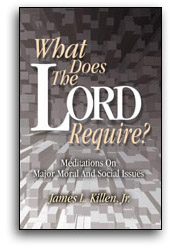
What Does The Lord Require?
Meditations On Major Moral And Social Issues
One day several years ago, a pastor was called by a church member and asked to visit one of his neighbors in whose home a tragedy had just happened. The neighbor's teenage son had used a rifle from a family gun collection to end his own life. The family was distraught and they had asked to talk to a minister. The pastor arrived less than an hour after the suicide happened. The family told him the whole heartbreaking story about family troubles, a young person who just couldn't seem to get his life together, a trivial conflict that triggered a terrible reaction, and the emotional devastation that the whole family was experiencing. The family joined the church and the pastor became their friend and worked with them during the following months to help them work through all of the problems and issues that came in the aftermath of that tragedy. They believed that the Christian faith had something to offer to people who are trying to cope with suicide. Indeed it does.

Our faith has important and helpful things to say to communities in which suicide happens, to families and friends of people who have committed suicide, and to people who may secretly be thinking of suicide as a way of ending their own lives. Every now and again, suicide pushes itself into our lives, and we find ourselves thinking about suicide. Let's think about it for a while in the light of the Christian faith.
It is hard for most of us to imagine what would make a person commit suicide. Yet, many people do not find it unthinkable. It is the second largest cause of death among teenagers in our country. And depression, the emotional condition which leads many to commit suicide, is widespread among people of all ages.
Suicide is a tragedy that happens when people lose hope. Suicide beckons to some people when they have lost all self--esteem, when they feel alone and not close to anyone who can help, when life is experienced as being "not good" and when there is no visible reason to hope that it will get better, when the problems of life seem overwhelming and there is nothing apparent that could solve them. Under circumstances like that, some may eventually begin to think that suicide would be a solution.
What does the Christian faith say about suicide? We have heard that many Christians believe that a person who commits suicide cannot hope to go to heaven because he or she has committed a sin for which he or she will have no opportunity to ask to be forgiven. But that imposes a very legalistic structure on a situation that is very complex. Our hope for heaven depends, not on our own rightness, but upon God's mercy. God, whose mercy reaches out past so many of our failures, can surely reach out past one act done in desperation, and deal with the whole person.
Well, what does the Bible say about suicide? Surprisingly, very little. From history, we know that suicides did happen in biblical days. But the Bible doesn't say much about it.
The Bible does, however, say lots of things that are relevant to people thinking about suicide. It tells us that God loves us with a great and perfect love, that God accepts us and forgives us, that God values us as precious children of God. The Bible tells us that life is a good gift from God and that God wants us to receive it gratefully and live it fully. The Bible tells us that God is at work in our lives and in the history of our world, often in ways that we cannot see or know, and that God is at work in all of those ways to save us from our troubles and to help us make life good. And the Bible tells us that God wants us to love one another and to do what we can to help each other make life good. All of these basic affirmations of the Bible have a lot to say to anyone who is thinking about suicide.
Even though the Bible says very little about suicide, it says a great deal about desperation and despair. The psalm we read as our text is one of a type of psalms that is often found in the Bible. It is the prayer of someone who is in trouble. "Out of the depths have I cried to you, O Lord." The psalmist then goes on to remember that God has been there to help his people in their times of trouble down through the years. In faith and expectancy, the person praying turns to the invisible God who often works in ways beyond our understanding, and asks for help. That is an approach to trouble that can be very helpful to anyone who is thinking about suicide.
What does our faith have to say to communities in which suicides happen? Paul reminds us that the decisions we make help to create the environment in which others live, and he urges us to make our decisions, not insisting upon our own rights but rather in loving concern for our neighbors. One of the big issues in the church in Paul's day had to do with whether the early Christians should eat meat that had been offered to idols. Paul said that there is really nothing wrong with eating meat but, because it was causing real spiritual problems for some recent converts from idol worship, he would abstain from eating meat. He said, "... it is good not to eat meat or drink wine or do anything that makes your brother or sister stumble" (Romans 14:21). In another place, he said, "For you were called to freedom, brothers and sisters, only do not use your freedom as an opportunity for self--indulgence, but through love become slaves to one another. For the whole law is summed up in one commandment, 'You shall love your neighbor as yourself' " (Galatians 5:13--14). By following that rule, we may actually save the lives of some who are in danger of suicide.
There are lots of people who have very low self--esteem. We should learn to relate ourselves to every person in a way that affirms and evokes his or her own dignity as a person. Some of us, especially men and young people, practice a kind of humor that cuts other people down. We don't mean anything by it. But our cutting humor hurts. And we have developed a way of evaluating persons' lives that recognizes only one way to be a success. Those who can't be winners in that game must always think of themselves as failures. All of that is dangerous to people with a tenuous hold on the will to live. Could we change that?
And we need to think seriously about the social customs that set traps for people who are at risk. For instance, we need to think seriously about our love for the use of alcohol and other drugs. A high school conducted an assembly to help young people cope with the recent suicide of a fellow student. There were several speakers. The students heard each one appreciatively and responded with affirming applause. Then the school counselor spoke and reckoned with the fact that the student had been intoxicated when he took his life. He ended by saying, "Alcohol is killing us." The applause of the students was about half what it had been for the other speakers. They were communicating an ambivalence which reflects the ambivalence of our society as a whole. We know that alcohol and other drugs are killing people. But we are not willing to give them up as a part of our lives. Love requires us to reckon with that.
Finally, we need to be sensitive and responsive to the needs of others around us. There are lots of troubled people who need someone to talk to. We always seem to be too busy for each other, even for those who are closest to us. We need to find ways of being available to listen to each other when someone really needs to talk. And when someone communicates to us that he or she is deeply troubled, especially if there are thoughts about suicide, we need to take those needs seriously and help the person find the help that is needed.
Our world is often harsh and demanding and indifferent to our hurting. It is probably unrealistic to say that we need to change all of that about our world. But we can create little clearings of compassion in the forest of hurtfulness where people in trouble can find affirmation and help.
What does the Christian faith have to say to someone who has lost a friend or family member to suicide? Pretty much the same thing it has to say to anyone who has lost a loved one to any tragic death. We have already said that it is not necessary to think that a person who has ended his or her own life as a person cannot be saved. There are many premature or accidental deaths that crash into the lives of families and communities and are devastating in very similar ways. Think of suicide as one of these.
Of course, that will by no means make the death easy to deal with. Tragic deaths often fill the lives of friends and family members with great storms of guilt and anger and grief and all sorts of other experiences that are hard to explain.
If there are feelings of guilt making us wonder if there was something we could have done to prevent the suicide, we will need to deal with that. If, in fact, you could have done more, and we usually could have, then repent of that shortcoming and resolve to be a more responsive person. But know that we all fall short and we all need God's saving grace to enable us to accept ourselves so that we can take up our lives and live them on into the future. Remember, you are not the one who decided to end your friend's life. He or she did. It will be important for you to pull your own life together with the help of God.
Anger may be another part of the experience. You may be angry at the one who committed suicide, angry at yourself for not being able to prevent it, angry at God for letting it happen. Anger can be a healthy emotion. It cries out, "This was wrong." Own your anger. But keep it in perspective. Deal with it until you can forgive yourself and your friend - and God. Deal with it until you can accept the fact that, wrong as it was, the suicide happened. Assimilate it into your lifetime of experiences and move ahead, having learned from it.
Of course grief is a part of the experience of losing someone you love. There is a big empty spot. Life has to be reorganized without one who once was part of it. The Christian's faith in the resurrection can always help us deal with grief. It is no different in the case of a loss by suicide. Entrust your loved one to God who loves us all and trust God's promise to receive and to raise those whom he loves up to new life beyond this life. And entrust yourself, too, to the risen Christ, who is at work in our lives, in the hope that you, too, will eventually be raised up out of guilt and anger and grief and all of the other bewildering things you may be experiencing and that you will be given back your life so that you can live fully again.
Finally, we have to ask, what does the Christian faith have to say to those who may be thinking about committing suicide? What does it give us to hold on to when our lives seem to darken into gloom and we begin to think that the best thing we can do is to end our lives?
Our Christian faith tells us that God loves us, even when we can't love ourselves, and that our lives are precious to God, even if they seem, for a time, not to be precious to us. It tells us that God has given us our lives as good gifts and that God wants our lives to be good and that God is working to make our lives good, even if we cannot see that. It tells us that even when our lives are terribly messed up and we cannot see any way for them to be put right again, there is one whom we can't see who is at work to save. Remember those things and, if you ever find yourself thinking about suicide, talk to yourself about them.
While you are talking to yourself, talk back to those sinister voices that talk nonsense from the dark corners of your mind. Don't let yourself get enamored with the idea of suicide as if there is something glamorous or heroic about it. There is nothing glamorous about it. In most cases, it is terrible. And it is not heroic. There is all of the difference in the world between going to meet your death with courage when it is time to die on the one hand, and using death as a way to escape from the difficulties of life on the other. And don't let yourself be seduced into thinking that your suicide will solve problems that you have caused in the lives of people you love. Far from solving problems, your suicide would create more problems than you can imagine for the ones you love. The stepfather of a young man who had committed suicide told his classmates, "If you think this world will be a better place without you, forget it. This world will not be a better place without you!" And don't try to escape into alcohol or other drugs. They will only deepen your depression and take away what good judgment you have left.
Hold on tightly to the good gift of life and believe that, because God is a living God, there is always hope for you. Then look for the ways in which God may be reaching out to help you. Much depression may actually be the result of chemical imbalances in our bodies, and medical care can be the agent of God's saving work. Go to see a doctor. If the problems are more complex than that, then sharing your feelings with a caring friend can help you to get things into perspective. Find someone who is willing to listen to you. Keep looking until you find someone who will take your hand and help you climb out of the gloom. If you need to, get psychiatric help. Forget the stigma. This is your life we are talking about. Even if you can't see how your problems could ever be solved, know that there is one who is at work to help in your life in ways that you cannot know or anticipate. Put your trust in God and God will give you back your future.
Resurrections still happen. One of the most prominent preachers in our country witnessed to an experience of saving grace. He told about a time when he had sunk so deep into depression that the only thing that kept him from taking his own life was that he didn't want his children to remember that their father had been both a minister and a suicide. Finally, he checked himself into a hospital for psychiatric treatment. He said that healing did not come soon or easily. But finally, a great light came into his darkness and led him back to life. That was his way of describing what happened to him. He was able to pick up his life again and to live it fully, joyfully, and fruitfully and to be an effective servant of the Lord for many years. Resurrection can happen to you, too.
Take the words of the psalmist for your prayer and discover the hope into which they have led people for thousands of years. "Out of the depths have I cried to you, O Lord. Lord hear my voice ... There is forgiveness with you ... I wait for the Lord, my soul waits and in his word I hope; my soul waits for the Lord more than those who watch for the morning, more than those who watch for the morning." Hold on to your life and trust God to make it better. If you hold on to it, your life can get better. If you let it go, it can't. Hold on and wait for the morning.
Our faith has important and helpful things to say to communities in which suicide happens, to families and friends of people who have committed suicide, and to people who may secretly be thinking of suicide as a way of ending their own lives. Every now and again, suicide pushes itself into our lives, and we find ourselves thinking about suicide. Let's think about it for a while in the light of the Christian faith.
It is hard for most of us to imagine what would make a person commit suicide. Yet, many people do not find it unthinkable. It is the second largest cause of death among teenagers in our country. And depression, the emotional condition which leads many to commit suicide, is widespread among people of all ages.
Suicide is a tragedy that happens when people lose hope. Suicide beckons to some people when they have lost all self--esteem, when they feel alone and not close to anyone who can help, when life is experienced as being "not good" and when there is no visible reason to hope that it will get better, when the problems of life seem overwhelming and there is nothing apparent that could solve them. Under circumstances like that, some may eventually begin to think that suicide would be a solution.
What does the Christian faith say about suicide? We have heard that many Christians believe that a person who commits suicide cannot hope to go to heaven because he or she has committed a sin for which he or she will have no opportunity to ask to be forgiven. But that imposes a very legalistic structure on a situation that is very complex. Our hope for heaven depends, not on our own rightness, but upon God's mercy. God, whose mercy reaches out past so many of our failures, can surely reach out past one act done in desperation, and deal with the whole person.
Well, what does the Bible say about suicide? Surprisingly, very little. From history, we know that suicides did happen in biblical days. But the Bible doesn't say much about it.
The Bible does, however, say lots of things that are relevant to people thinking about suicide. It tells us that God loves us with a great and perfect love, that God accepts us and forgives us, that God values us as precious children of God. The Bible tells us that life is a good gift from God and that God wants us to receive it gratefully and live it fully. The Bible tells us that God is at work in our lives and in the history of our world, often in ways that we cannot see or know, and that God is at work in all of those ways to save us from our troubles and to help us make life good. And the Bible tells us that God wants us to love one another and to do what we can to help each other make life good. All of these basic affirmations of the Bible have a lot to say to anyone who is thinking about suicide.
Even though the Bible says very little about suicide, it says a great deal about desperation and despair. The psalm we read as our text is one of a type of psalms that is often found in the Bible. It is the prayer of someone who is in trouble. "Out of the depths have I cried to you, O Lord." The psalmist then goes on to remember that God has been there to help his people in their times of trouble down through the years. In faith and expectancy, the person praying turns to the invisible God who often works in ways beyond our understanding, and asks for help. That is an approach to trouble that can be very helpful to anyone who is thinking about suicide.
What does our faith have to say to communities in which suicides happen? Paul reminds us that the decisions we make help to create the environment in which others live, and he urges us to make our decisions, not insisting upon our own rights but rather in loving concern for our neighbors. One of the big issues in the church in Paul's day had to do with whether the early Christians should eat meat that had been offered to idols. Paul said that there is really nothing wrong with eating meat but, because it was causing real spiritual problems for some recent converts from idol worship, he would abstain from eating meat. He said, "... it is good not to eat meat or drink wine or do anything that makes your brother or sister stumble" (Romans 14:21). In another place, he said, "For you were called to freedom, brothers and sisters, only do not use your freedom as an opportunity for self--indulgence, but through love become slaves to one another. For the whole law is summed up in one commandment, 'You shall love your neighbor as yourself' " (Galatians 5:13--14). By following that rule, we may actually save the lives of some who are in danger of suicide.
There are lots of people who have very low self--esteem. We should learn to relate ourselves to every person in a way that affirms and evokes his or her own dignity as a person. Some of us, especially men and young people, practice a kind of humor that cuts other people down. We don't mean anything by it. But our cutting humor hurts. And we have developed a way of evaluating persons' lives that recognizes only one way to be a success. Those who can't be winners in that game must always think of themselves as failures. All of that is dangerous to people with a tenuous hold on the will to live. Could we change that?
And we need to think seriously about the social customs that set traps for people who are at risk. For instance, we need to think seriously about our love for the use of alcohol and other drugs. A high school conducted an assembly to help young people cope with the recent suicide of a fellow student. There were several speakers. The students heard each one appreciatively and responded with affirming applause. Then the school counselor spoke and reckoned with the fact that the student had been intoxicated when he took his life. He ended by saying, "Alcohol is killing us." The applause of the students was about half what it had been for the other speakers. They were communicating an ambivalence which reflects the ambivalence of our society as a whole. We know that alcohol and other drugs are killing people. But we are not willing to give them up as a part of our lives. Love requires us to reckon with that.
Finally, we need to be sensitive and responsive to the needs of others around us. There are lots of troubled people who need someone to talk to. We always seem to be too busy for each other, even for those who are closest to us. We need to find ways of being available to listen to each other when someone really needs to talk. And when someone communicates to us that he or she is deeply troubled, especially if there are thoughts about suicide, we need to take those needs seriously and help the person find the help that is needed.
Our world is often harsh and demanding and indifferent to our hurting. It is probably unrealistic to say that we need to change all of that about our world. But we can create little clearings of compassion in the forest of hurtfulness where people in trouble can find affirmation and help.
What does the Christian faith have to say to someone who has lost a friend or family member to suicide? Pretty much the same thing it has to say to anyone who has lost a loved one to any tragic death. We have already said that it is not necessary to think that a person who has ended his or her own life as a person cannot be saved. There are many premature or accidental deaths that crash into the lives of families and communities and are devastating in very similar ways. Think of suicide as one of these.
Of course, that will by no means make the death easy to deal with. Tragic deaths often fill the lives of friends and family members with great storms of guilt and anger and grief and all sorts of other experiences that are hard to explain.
If there are feelings of guilt making us wonder if there was something we could have done to prevent the suicide, we will need to deal with that. If, in fact, you could have done more, and we usually could have, then repent of that shortcoming and resolve to be a more responsive person. But know that we all fall short and we all need God's saving grace to enable us to accept ourselves so that we can take up our lives and live them on into the future. Remember, you are not the one who decided to end your friend's life. He or she did. It will be important for you to pull your own life together with the help of God.
Anger may be another part of the experience. You may be angry at the one who committed suicide, angry at yourself for not being able to prevent it, angry at God for letting it happen. Anger can be a healthy emotion. It cries out, "This was wrong." Own your anger. But keep it in perspective. Deal with it until you can forgive yourself and your friend - and God. Deal with it until you can accept the fact that, wrong as it was, the suicide happened. Assimilate it into your lifetime of experiences and move ahead, having learned from it.
Of course grief is a part of the experience of losing someone you love. There is a big empty spot. Life has to be reorganized without one who once was part of it. The Christian's faith in the resurrection can always help us deal with grief. It is no different in the case of a loss by suicide. Entrust your loved one to God who loves us all and trust God's promise to receive and to raise those whom he loves up to new life beyond this life. And entrust yourself, too, to the risen Christ, who is at work in our lives, in the hope that you, too, will eventually be raised up out of guilt and anger and grief and all of the other bewildering things you may be experiencing and that you will be given back your life so that you can live fully again.
Finally, we have to ask, what does the Christian faith have to say to those who may be thinking about committing suicide? What does it give us to hold on to when our lives seem to darken into gloom and we begin to think that the best thing we can do is to end our lives?
Our Christian faith tells us that God loves us, even when we can't love ourselves, and that our lives are precious to God, even if they seem, for a time, not to be precious to us. It tells us that God has given us our lives as good gifts and that God wants our lives to be good and that God is working to make our lives good, even if we cannot see that. It tells us that even when our lives are terribly messed up and we cannot see any way for them to be put right again, there is one whom we can't see who is at work to save. Remember those things and, if you ever find yourself thinking about suicide, talk to yourself about them.
While you are talking to yourself, talk back to those sinister voices that talk nonsense from the dark corners of your mind. Don't let yourself get enamored with the idea of suicide as if there is something glamorous or heroic about it. There is nothing glamorous about it. In most cases, it is terrible. And it is not heroic. There is all of the difference in the world between going to meet your death with courage when it is time to die on the one hand, and using death as a way to escape from the difficulties of life on the other. And don't let yourself be seduced into thinking that your suicide will solve problems that you have caused in the lives of people you love. Far from solving problems, your suicide would create more problems than you can imagine for the ones you love. The stepfather of a young man who had committed suicide told his classmates, "If you think this world will be a better place without you, forget it. This world will not be a better place without you!" And don't try to escape into alcohol or other drugs. They will only deepen your depression and take away what good judgment you have left.
Hold on tightly to the good gift of life and believe that, because God is a living God, there is always hope for you. Then look for the ways in which God may be reaching out to help you. Much depression may actually be the result of chemical imbalances in our bodies, and medical care can be the agent of God's saving work. Go to see a doctor. If the problems are more complex than that, then sharing your feelings with a caring friend can help you to get things into perspective. Find someone who is willing to listen to you. Keep looking until you find someone who will take your hand and help you climb out of the gloom. If you need to, get psychiatric help. Forget the stigma. This is your life we are talking about. Even if you can't see how your problems could ever be solved, know that there is one who is at work to help in your life in ways that you cannot know or anticipate. Put your trust in God and God will give you back your future.
Resurrections still happen. One of the most prominent preachers in our country witnessed to an experience of saving grace. He told about a time when he had sunk so deep into depression that the only thing that kept him from taking his own life was that he didn't want his children to remember that their father had been both a minister and a suicide. Finally, he checked himself into a hospital for psychiatric treatment. He said that healing did not come soon or easily. But finally, a great light came into his darkness and led him back to life. That was his way of describing what happened to him. He was able to pick up his life again and to live it fully, joyfully, and fruitfully and to be an effective servant of the Lord for many years. Resurrection can happen to you, too.
Take the words of the psalmist for your prayer and discover the hope into which they have led people for thousands of years. "Out of the depths have I cried to you, O Lord. Lord hear my voice ... There is forgiveness with you ... I wait for the Lord, my soul waits and in his word I hope; my soul waits for the Lord more than those who watch for the morning, more than those who watch for the morning." Hold on to your life and trust God to make it better. If you hold on to it, your life can get better. If you let it go, it can't. Hold on and wait for the morning.