The Secret Of The Right Attitude
Adult study
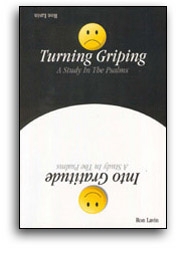
Turning Griping Into Gratitude
A Study In The Psalms
Object:
O Lord, my God, in You I take refuge; save me from all my pursuers, and deliver me ...
-- Psalm 7:1, NRSV
* * *
Have you had conflicts in your family? Have you ever experienced misunderstandings and accusations from a spouse, a parent, a son or daughter? Have you ever had a family member point an accusing finger at you when you were innocent? If so, this psalm verse is for you.

At work, have you ever had conflicts with your boss or your employees or your fellow workers? Has anyone so totally misunderstood you and your motives that it was difficult for you to go on at work? If so, the psalm verse is for you.
Psalm 7:1 was written in the context of conflict and false accusation. "Yes," someone may be saying, "but under these circumstances ... do you really think that an ancient psalm verse can help me?" Yes, I do. Because this verse raises us from being under our circumstances to being above them by having a right attitude.
The Secret Of The Psalmist Is Having A Right Attitude
There are three ways to deal with conflict: fight, flee, or face them head on with faith in God. Most folks choose the way of the loser -- by fighting or fleeing. The psalmist chose the winner's way, the way less traveled: facing the conflicts with faith in God.
You know my greatest enemy is myself, how ineffectual I am in dealing with my inner conflicts. You know, and You have assured me that You care. You have judged my wickedness; now rise up to deliver me from its ugly consequences.6
This paraphrase of Psalm 7 from Leslie Brandt's book, Psalms Now, a brilliant insight into the way to face conflict while relying on God as our refuge, clearly shows a salutary change of attitude which brought resolution to a conflict situation. What was the secret of the psalmist? After much struggle, the psalmist recognized that the real problem was not out there in what others said or did, but in his own heart. He moved from self-pity to self-insight and a new attitude.
In Psalm 7 we have the description of the outward and inner struggle of a soul before God. The psalmist feels that he has been wronged by someone. He has been falsely accused. Ever feel that way? One scholar says that the issue here is that the psalmist was wrongfully accused of stealing someone else's property.
He stands charged with theft, yes more, with breach of confidence in relation to a fellow countryman. The accused has been brought to the Temple and there takes upon himself an oath of innocence."
-- 1 Kings 8:31b7
Whether the presenting problem was stealing or some other conflict, what we have here is the inner struggle of a man who initially blamed everyone else for his conflicts. It finally dawned on him that his attitude was contributing to his problem. "You know my greatest enemy is myself, how ineffectual I am in dealing with inner conflicts."
It isn't what happens to us in life, but how we interpret what happens, that determines how we come out. The method of interpretation is called a right attitude. The psalmist gained a new attitude.
One pastor described the importance of a right attitude this way:
The remarkable thing is we have a choice every day regarding the attitude we will embrace for that day. We cannot change our past ... we cannot change the fact that people will act in a certain way. We cannot change the inevitable. The only thing we can do is play on the one thing we have, and that is our attitude ... I am convinced that life is ten percent what happens to me and ninety percent how I react to it."
-- Charles Swindoll
A new attitude -- what we need to face life's conflicts, but the movement in this psalm is not just from a negative to a positive attitude. The movement in this psalm and the secret of this psalmist is a new attitude grounded in God, not self, as our refuge.
The Secret Of The Psalmist Is That He Turned From Self-pity To God As His Refuge
It is a long journey from self-pity and griping to gratitude to God for the lessons learned from life's conflicts, but it is the most important journey of life. The psalmist made that difficult journey as we learn from verse 17: "I will give to the Lord the thanks due to his righteousness, and sing praise to the name of the Lord, the Most High" (Psalm 7:17, NRSV).
The best way to handle conflict is with a positive attitude grounded in faith in God. When that happens, the conflict, or disputed passage as it can be called, can be a point of growth. Sometimes it is only conflict which causes us to find this new dependence on God as our refuge.
In his novel Disputed Passage, Lloyd C. Douglas said: "Have you not learned more from those who have disputed the passage with you than all the others?"
The disputed passage where someone is in conflict with you can become the point in life to learn that you may be your own worst enemy. When you discover that secret, you can turn to God in a new way. The secret of the psalmist is that he learned to walk with God and to depend on God in times of conflict and apparent defeat. "I must persist in running to God in my defeats that I may learn to walk with Him in His victories" (Psalm 7:17, Brandt paraphrase).
How do we move from feeling like victims to knowing that we are victors in God? That's the question of a lifetime. That's the question which, when answered correctly, changes our lives. The first step is to accept those things I cannot change.
I cannot change others. I can only change myself. That's the secret of the psalmist -- to change himself. We cannot change the attitudes of others, but we can change our attitudes, the way we look at things. The resentment and anger which we feel when we are falsely accused or things go wrong, gets resolved only when we take this first step; then take the second -- turning to God. Let me illustrate the secret of the psalmist by three true stories.
Harold was a very athletic young man and did well in school. In fact, in high school he was voted the person most likely to succeed of all his class. But within ten years, he had become a chronic alcoholic and found that, far from succeeding, he was in fact destroying his own life and the lives of those around him. He was jailed in six different states and court-martialed by the Army.
By the end of World War II, Harold had lost most of his faith in God, and had become in his own words an "agnostic," with more doubts about God than faith in God. During this period of time, he underwent much emotional upheaval, the outcome of which was a strong self-hatred. Having nothing to turn to, he decided to kill himself. Before he did it, he thought that he'd better square things with God first.
I got down on my knees for the first time in ten years, and I prayed to God for the first time in many, many years. Without fraud, without deceit, and without deception ... my heart cried out in its agony. There was no eloquence in it; there was a cry of despair for help. "God help me. I can't help myself. And if there's any reason for me to live, any reason at all, then take over my life now or let me die. At least let me have the courage to pull the trigger on this gun. And don't stay my hand, because I never want to see another sunrise if I must go on the way I've been going."
Harold writes:
Something happened to me ... I felt something happening deep inside of me, and a peace settled over me that I had never felt in my life ... I knew deep inside of me that God had not only heard my prayer, but that He had answered it and that He would lead me for His purpose. I knew that I had covenanted with God, that if He would take over my life and lead me ... that wherever He called I would try to follow ... I got up, unloaded the gun and went to bed. I slept peacefully for the first time that I could remember.
Harold's life had been filled with resentment, revenge, and blaming other people for what was wrong.
These are all self-defeating tendencies centered in an attitude of self-pity. Harold had to learn the basic creed: "I cannot change other people, but I can change myself. I can change my attitude toward a situation by a focus on God who is at work in all situations."
That's how the psalmist discovered the secret of life -- by changing what he could change, namely himself, and accepting what he could not change -- others. The psalmist saw God as his refuge. He turned from being a victim to being a victor.
In Alcoholics Anonymous, Harold learned the secret of the psalmist which is expressed in what is called the Serenity Prayer:
God, give me the courage to change
those things I can change,
The serenity to accept those things
I cannot change,
and the wisdom to know the difference.
-- Anonymous
When Harold began to slip back into the negative attitude of blaming others, a friend challenged him to move toward a more positive attitude. At this time in his life, Harold was a truck driver. He didn't like the laws of the State of Iowa regarding big rigs. "If you don't like the laws, run for office and change them," his friend advised. Harold did just that.
Harold's political career took an unexpected turn in 1957. It marked the beginning of a political career which resulted in Harold's becoming governor of the State of Iowa. Later Harold had a distinguished career as a United States Senator. Still later, in the process of being a viable nominee for President, he suddenly withdrew from the race, and took on the Christian calling of working in prisons with prisoners and other outcasts of society.
Because of his faith in Jesus Christ, Harold began his work with people like he had been, when his attitude was to blame everyone but himself for his troubles. He worked in prisons with outcasts, the incorrigible, the lost, and the damned.
U. S. Senator Harold Hughes was also a key figure in the conversion of Charles Colson, another stubborn sinner caught in the vice of self-pity and pride.
The second story is about Charles Colson. Like Harold Hughes, Charles Colson turned from self-pity to self-insight and repentance before God. As the "hatchet man" in the Nixon administration, Colson at first blamed everyone but himself for the conflicts he was experiencing. As the details of the Watergate scandal began to emerge, Colson at first tried to protect himself.
Senator Harold Hughes and others helped lead Charles Colson on the journey from self-pity and blame to self-insight with God as refuge. It was a very difficult journey at first.
In his own words, here is how Colson responded defensively to a Christian friend named Tom Phillips who tried to help him in the long journey home to God through self-insight:
Tom, one thing you don't understand. In politics it's dog-eat-dog; you simply can't survive otherwise. I've been in the political business for twenty years, including several campaigns right here in Massachusetts. I know how things are done. Politics is like war. If you don't keep the enemy on the defensive, you'll be on the defensive yourself. Tom, this man Nixon has been under constant attack all of his life. The only way he could make it was to fight back. Look at the criticism he took over Vietnam. Yet he was right. We never would have made it if we hadn't fought the way we did, hitting our critics, never letting them get the best of us. We didn't have any choice.8
Colson began with defensiveness based on self-pity. He had to move to a new attitude toward God. The change was difficult. He goes on:
Even as I talked, the words sounded more and more empty to me. Tired old lies, I realized. I was describing the ways of the political world ... while suddenly wondering if there could be a better way.
Tom believed so, anyway. He was so gentle I couldn't resent what he said as he cut right through it all: "Chuck, I hate to say this, but you guys brought it on yourselves. If you had put your faith in God, and if your cause was just, He would have guided you. And His help would have been a thousand times more powerful than all your phony ads and shady schemes put together."
Tom went on:
"Chuck, I don't think you will understand what I'm saying about God until you are willing to face yourself honestly and squarely. This is the first step." Tom reached to the corner table and picked up a small paperback book. I read the title: Mere Christianity by C.S. Lewis.
"I suggest you take this with you and read it while you are on vacation." Tom started to hand it to me, then paused. "Let me read you one chapter."
Colson leaned back, still on the defensive, his mind and emotions whirling. Here is what Colson's friend read from the book by C.S. Lewis:
"There is one vice of which no man in the world is free; which every one in the world loathes when he sees it in someone else; and of which hardly any people, except Christians, ever imagine that they are guilty themselves. I have heard people admit that they are bad-tempered, or that they cannot keep their heads about girls or drink, or even that they are cowards. I do not think I have ever heard anyone who was not a Christian accuse himself of this vice ... There is no fault ... which we are more unconscious of in ourselves. And the more we have it ourselves, the more we dislike it in others.
"The vice I am talking of is Pride or Self-Conceit ... Pride leads to every other vice: it is the complete anti-God state of mind."
Colson's thoughts and feelings slowly began to change from defensiveness to openness. Here is what he thought:
As Tom read, I could feel a flush coming into my face and a curious burning sensation that made the night seem even warmer. Lewis' words seemed to pound straight at me.
"... It is Pride which has been the chief cause of misery in every nation and every family since the world began. Other vices may sometimes bring people together. You may find good fellowship and jokes and friendliness among drunken people or unchaste people. But Pride always means enmity -- it is enmity. And not only enmity between man and man, but enmity to God.
"In God you come up against something which is in every respect immeasurably superior to yourself. Unless you know God as that -- and, therefore, know yourself as nothing in comparison -- you do not know God at all. As long as you are proud you cannot know God. A proud man is always looking down on things and people; and, of course, as long as you are looking down, you cannot see something that is above you."
Colson thought:
Suddenly I felt naked and unclean, my bravado defenses gone. I was exposed, unprotected, for Lewis's words were describing me. As he continued, one passage in particular seemed to sum up what had happened to all of us at the White House:
"For Pride is spiritual cancer: it eats up the very possibility of love, or contentment, or even common sense."9
Tom did not succeed that night in reaching Chuck Colson for Christ, but he left him a copy of C.S. Lewis' book Mere Christianity. He prayed with Colson and then said, "Let me know what you think of the book."
Later, at a quiet cottage by the sea, Charles Colson picked up the copy of C.S. Lewis' book, saw his pride for what it was, and turned his life over to Christ.10 He went to prison for his Watergate crimes and there discovered the same attitude of self-pity and pride in other prisoners that had ruined his life. When he was released, Charles Colson began a Christian vocation of helping prisoners turn from self-pity and false pride to God as refuge.
Colson also began to read the Bible as his guide. There he discovered that Saint Paul had made the same long, hard journey to a new attitude of God as refuge.
The third story is about Saint Paul, the Apostle. Saint Paul started out as an arrogant, rude and crude persecutor of Christians. It was a hard journey to conversion with many conflicts within himself and with others. Once converted, Saint Paul still faced serious conflict everywhere he went as a missionary. His own people, the Jews, and the Judaizers among the Christians, opposed him. At one point, some Jewish leaders stoned him and left him for dead. Friends came by and lifted the rocks from him. Saint Paul dusted himself off, and immediately went back to work preaching the gospel of Jesus Christ. How did he do that? He knew the secret of facing conflict by taking God as his refuge. Like the psalmist, Saint Paul was falsely accused of wrongdoing. Like the psalmist, he learned a spiritual secret to bring resolution to his conflict.
Saint Paul describes this secret in two little words he used 164 times in one form or another in his writings. Those words are "in Christ." In Romans 8:1 Saint Paul says, "... There is no condemnation for those who are in Christ Jesus." Conflicts may come, but all condemnations pass for those who are in Christ.
Later in Romans 8 Saint Paul writes: "And we know that in all things God works for the good of those who love him" (Romans 8:28). Conflict notwithstanding, resolution comes to those who love the Lord.
At the end of Romans 8, Saint Paul offers a vision of the biblical secret for conflict resolution.
What, then, shall we say in response to this? If God is for us, who can be against us? He who did not spare his own Son, but gave him up for us all -- how will he not also, along with him, graciously give us all things? Who will bring any charge against those whom God has chosen? It is God who justifies. Who is he that condemns?
-- Romans 8:31-34a
Conflicts and condemnations are seen from an eternal perspective when we take refuge in God. Jesus Christ brings resolution to our conflicts as Saint Paul declares in Romans 8:34b-36:
Christ Jesus, who died -- more than that, who was raised to life -- is at the right hand of God and is also interceding for us. Who shall separate us from the love of Christ? Shall trouble or hardship or persecution or famine or nakedness or danger or sword?
The psalmist said, "For your sake we face death all day long; we are considered as sheep to be slaughtered" (Psalm 44:22).
Saint Paul rose from being under his circumstances to being above his circumstances as he described the work of Jesus Christ taking us from being victims to victors.
No, in all these things we are more than conquerors through him who loved us. For I am convinced that neither death nor life, neither angels nor demons, neither the present nor the future, nor any powers, neither height nor depth, nor anything else in all creation, will be able to separate us from the love of God that is in Christ Jesus our Lord.
-- Romans 8:37-39
In Philippians Saint Paul described the secret of taking refuge in God in good times and bad, in times of success and times of conflict.
I have learned, in whatever state I am, to be content. I know how to be abased, and I know how to abound; in any and all circumstances I have learned the secret of facing plenty and hunger, abundance and want. I can do all things in him who strengthens me.
-- Philippians 4:11-13, RSV
There are three ways of dealing with conflicts: fighting, fleeing, and facing them. The first two do not work. The third, facing conflicts with God as our refuge and Jesus as our Lord, not only brings resolution to conflicts but turns victims into victors. The biblical secret for facing abundance and want, success and failure, is that we can do all things in him who strengthens us. It happens by a change of attitude.
"Yes, pastor," a stubborn man responded to a pastor's sermon about attitude to overcome hard times. "But under these circumstances...." He then went on to describe in detail how badly he had been treated by life. He repeated, "Under these circumstances...." The wise old pastor interrupted him: "As Christians we are called to live above the circumstances, not under them."
Questions For Meditation
Or Group Discussion
1. What difference has a right attitude made in your life at critical times?
2. What did Senator Harold Hughes learn which changed him?
3. What did Charles Colson learn?
4. What did Saint Paul learn?
__________
6. Leslie Brandt, Psalms Now (St. Louis: Concordia, 1973).
7. Elmer A. Leslie, The Psalms (Nashville: Abingdon Press, 1956), p. 316.
8. Charles Colson, Born Again (Old Tappan, N.Y.: Spire Books, 1927), p. 111.
9. Ibid., pp. 111-113.
10.
Ibid., pp. 118-130.
-- Psalm 7:1, NRSV
* * *
Have you had conflicts in your family? Have you ever experienced misunderstandings and accusations from a spouse, a parent, a son or daughter? Have you ever had a family member point an accusing finger at you when you were innocent? If so, this psalm verse is for you.
At work, have you ever had conflicts with your boss or your employees or your fellow workers? Has anyone so totally misunderstood you and your motives that it was difficult for you to go on at work? If so, the psalm verse is for you.
Psalm 7:1 was written in the context of conflict and false accusation. "Yes," someone may be saying, "but under these circumstances ... do you really think that an ancient psalm verse can help me?" Yes, I do. Because this verse raises us from being under our circumstances to being above them by having a right attitude.
The Secret Of The Psalmist Is Having A Right Attitude
There are three ways to deal with conflict: fight, flee, or face them head on with faith in God. Most folks choose the way of the loser -- by fighting or fleeing. The psalmist chose the winner's way, the way less traveled: facing the conflicts with faith in God.
You know my greatest enemy is myself, how ineffectual I am in dealing with my inner conflicts. You know, and You have assured me that You care. You have judged my wickedness; now rise up to deliver me from its ugly consequences.6
This paraphrase of Psalm 7 from Leslie Brandt's book, Psalms Now, a brilliant insight into the way to face conflict while relying on God as our refuge, clearly shows a salutary change of attitude which brought resolution to a conflict situation. What was the secret of the psalmist? After much struggle, the psalmist recognized that the real problem was not out there in what others said or did, but in his own heart. He moved from self-pity to self-insight and a new attitude.
In Psalm 7 we have the description of the outward and inner struggle of a soul before God. The psalmist feels that he has been wronged by someone. He has been falsely accused. Ever feel that way? One scholar says that the issue here is that the psalmist was wrongfully accused of stealing someone else's property.
He stands charged with theft, yes more, with breach of confidence in relation to a fellow countryman. The accused has been brought to the Temple and there takes upon himself an oath of innocence."
-- 1 Kings 8:31b7
Whether the presenting problem was stealing or some other conflict, what we have here is the inner struggle of a man who initially blamed everyone else for his conflicts. It finally dawned on him that his attitude was contributing to his problem. "You know my greatest enemy is myself, how ineffectual I am in dealing with inner conflicts."
It isn't what happens to us in life, but how we interpret what happens, that determines how we come out. The method of interpretation is called a right attitude. The psalmist gained a new attitude.
One pastor described the importance of a right attitude this way:
The remarkable thing is we have a choice every day regarding the attitude we will embrace for that day. We cannot change our past ... we cannot change the fact that people will act in a certain way. We cannot change the inevitable. The only thing we can do is play on the one thing we have, and that is our attitude ... I am convinced that life is ten percent what happens to me and ninety percent how I react to it."
-- Charles Swindoll
A new attitude -- what we need to face life's conflicts, but the movement in this psalm is not just from a negative to a positive attitude. The movement in this psalm and the secret of this psalmist is a new attitude grounded in God, not self, as our refuge.
The Secret Of The Psalmist Is That He Turned From Self-pity To God As His Refuge
It is a long journey from self-pity and griping to gratitude to God for the lessons learned from life's conflicts, but it is the most important journey of life. The psalmist made that difficult journey as we learn from verse 17: "I will give to the Lord the thanks due to his righteousness, and sing praise to the name of the Lord, the Most High" (Psalm 7:17, NRSV).
The best way to handle conflict is with a positive attitude grounded in faith in God. When that happens, the conflict, or disputed passage as it can be called, can be a point of growth. Sometimes it is only conflict which causes us to find this new dependence on God as our refuge.
In his novel Disputed Passage, Lloyd C. Douglas said: "Have you not learned more from those who have disputed the passage with you than all the others?"
The disputed passage where someone is in conflict with you can become the point in life to learn that you may be your own worst enemy. When you discover that secret, you can turn to God in a new way. The secret of the psalmist is that he learned to walk with God and to depend on God in times of conflict and apparent defeat. "I must persist in running to God in my defeats that I may learn to walk with Him in His victories" (Psalm 7:17, Brandt paraphrase).
How do we move from feeling like victims to knowing that we are victors in God? That's the question of a lifetime. That's the question which, when answered correctly, changes our lives. The first step is to accept those things I cannot change.
I cannot change others. I can only change myself. That's the secret of the psalmist -- to change himself. We cannot change the attitudes of others, but we can change our attitudes, the way we look at things. The resentment and anger which we feel when we are falsely accused or things go wrong, gets resolved only when we take this first step; then take the second -- turning to God. Let me illustrate the secret of the psalmist by three true stories.
Harold was a very athletic young man and did well in school. In fact, in high school he was voted the person most likely to succeed of all his class. But within ten years, he had become a chronic alcoholic and found that, far from succeeding, he was in fact destroying his own life and the lives of those around him. He was jailed in six different states and court-martialed by the Army.
By the end of World War II, Harold had lost most of his faith in God, and had become in his own words an "agnostic," with more doubts about God than faith in God. During this period of time, he underwent much emotional upheaval, the outcome of which was a strong self-hatred. Having nothing to turn to, he decided to kill himself. Before he did it, he thought that he'd better square things with God first.
I got down on my knees for the first time in ten years, and I prayed to God for the first time in many, many years. Without fraud, without deceit, and without deception ... my heart cried out in its agony. There was no eloquence in it; there was a cry of despair for help. "God help me. I can't help myself. And if there's any reason for me to live, any reason at all, then take over my life now or let me die. At least let me have the courage to pull the trigger on this gun. And don't stay my hand, because I never want to see another sunrise if I must go on the way I've been going."
Harold writes:
Something happened to me ... I felt something happening deep inside of me, and a peace settled over me that I had never felt in my life ... I knew deep inside of me that God had not only heard my prayer, but that He had answered it and that He would lead me for His purpose. I knew that I had covenanted with God, that if He would take over my life and lead me ... that wherever He called I would try to follow ... I got up, unloaded the gun and went to bed. I slept peacefully for the first time that I could remember.
Harold's life had been filled with resentment, revenge, and blaming other people for what was wrong.
These are all self-defeating tendencies centered in an attitude of self-pity. Harold had to learn the basic creed: "I cannot change other people, but I can change myself. I can change my attitude toward a situation by a focus on God who is at work in all situations."
That's how the psalmist discovered the secret of life -- by changing what he could change, namely himself, and accepting what he could not change -- others. The psalmist saw God as his refuge. He turned from being a victim to being a victor.
In Alcoholics Anonymous, Harold learned the secret of the psalmist which is expressed in what is called the Serenity Prayer:
God, give me the courage to change
those things I can change,
The serenity to accept those things
I cannot change,
and the wisdom to know the difference.
-- Anonymous
When Harold began to slip back into the negative attitude of blaming others, a friend challenged him to move toward a more positive attitude. At this time in his life, Harold was a truck driver. He didn't like the laws of the State of Iowa regarding big rigs. "If you don't like the laws, run for office and change them," his friend advised. Harold did just that.
Harold's political career took an unexpected turn in 1957. It marked the beginning of a political career which resulted in Harold's becoming governor of the State of Iowa. Later Harold had a distinguished career as a United States Senator. Still later, in the process of being a viable nominee for President, he suddenly withdrew from the race, and took on the Christian calling of working in prisons with prisoners and other outcasts of society.
Because of his faith in Jesus Christ, Harold began his work with people like he had been, when his attitude was to blame everyone but himself for his troubles. He worked in prisons with outcasts, the incorrigible, the lost, and the damned.
U. S. Senator Harold Hughes was also a key figure in the conversion of Charles Colson, another stubborn sinner caught in the vice of self-pity and pride.
The second story is about Charles Colson. Like Harold Hughes, Charles Colson turned from self-pity to self-insight and repentance before God. As the "hatchet man" in the Nixon administration, Colson at first blamed everyone but himself for the conflicts he was experiencing. As the details of the Watergate scandal began to emerge, Colson at first tried to protect himself.
Senator Harold Hughes and others helped lead Charles Colson on the journey from self-pity and blame to self-insight with God as refuge. It was a very difficult journey at first.
In his own words, here is how Colson responded defensively to a Christian friend named Tom Phillips who tried to help him in the long journey home to God through self-insight:
Tom, one thing you don't understand. In politics it's dog-eat-dog; you simply can't survive otherwise. I've been in the political business for twenty years, including several campaigns right here in Massachusetts. I know how things are done. Politics is like war. If you don't keep the enemy on the defensive, you'll be on the defensive yourself. Tom, this man Nixon has been under constant attack all of his life. The only way he could make it was to fight back. Look at the criticism he took over Vietnam. Yet he was right. We never would have made it if we hadn't fought the way we did, hitting our critics, never letting them get the best of us. We didn't have any choice.8
Colson began with defensiveness based on self-pity. He had to move to a new attitude toward God. The change was difficult. He goes on:
Even as I talked, the words sounded more and more empty to me. Tired old lies, I realized. I was describing the ways of the political world ... while suddenly wondering if there could be a better way.
Tom believed so, anyway. He was so gentle I couldn't resent what he said as he cut right through it all: "Chuck, I hate to say this, but you guys brought it on yourselves. If you had put your faith in God, and if your cause was just, He would have guided you. And His help would have been a thousand times more powerful than all your phony ads and shady schemes put together."
Tom went on:
"Chuck, I don't think you will understand what I'm saying about God until you are willing to face yourself honestly and squarely. This is the first step." Tom reached to the corner table and picked up a small paperback book. I read the title: Mere Christianity by C.S. Lewis.
"I suggest you take this with you and read it while you are on vacation." Tom started to hand it to me, then paused. "Let me read you one chapter."
Colson leaned back, still on the defensive, his mind and emotions whirling. Here is what Colson's friend read from the book by C.S. Lewis:
"There is one vice of which no man in the world is free; which every one in the world loathes when he sees it in someone else; and of which hardly any people, except Christians, ever imagine that they are guilty themselves. I have heard people admit that they are bad-tempered, or that they cannot keep their heads about girls or drink, or even that they are cowards. I do not think I have ever heard anyone who was not a Christian accuse himself of this vice ... There is no fault ... which we are more unconscious of in ourselves. And the more we have it ourselves, the more we dislike it in others.
"The vice I am talking of is Pride or Self-Conceit ... Pride leads to every other vice: it is the complete anti-God state of mind."
Colson's thoughts and feelings slowly began to change from defensiveness to openness. Here is what he thought:
As Tom read, I could feel a flush coming into my face and a curious burning sensation that made the night seem even warmer. Lewis' words seemed to pound straight at me.
"... It is Pride which has been the chief cause of misery in every nation and every family since the world began. Other vices may sometimes bring people together. You may find good fellowship and jokes and friendliness among drunken people or unchaste people. But Pride always means enmity -- it is enmity. And not only enmity between man and man, but enmity to God.
"In God you come up against something which is in every respect immeasurably superior to yourself. Unless you know God as that -- and, therefore, know yourself as nothing in comparison -- you do not know God at all. As long as you are proud you cannot know God. A proud man is always looking down on things and people; and, of course, as long as you are looking down, you cannot see something that is above you."
Colson thought:
Suddenly I felt naked and unclean, my bravado defenses gone. I was exposed, unprotected, for Lewis's words were describing me. As he continued, one passage in particular seemed to sum up what had happened to all of us at the White House:
"For Pride is spiritual cancer: it eats up the very possibility of love, or contentment, or even common sense."9
Tom did not succeed that night in reaching Chuck Colson for Christ, but he left him a copy of C.S. Lewis' book Mere Christianity. He prayed with Colson and then said, "Let me know what you think of the book."
Later, at a quiet cottage by the sea, Charles Colson picked up the copy of C.S. Lewis' book, saw his pride for what it was, and turned his life over to Christ.10 He went to prison for his Watergate crimes and there discovered the same attitude of self-pity and pride in other prisoners that had ruined his life. When he was released, Charles Colson began a Christian vocation of helping prisoners turn from self-pity and false pride to God as refuge.
Colson also began to read the Bible as his guide. There he discovered that Saint Paul had made the same long, hard journey to a new attitude of God as refuge.
The third story is about Saint Paul, the Apostle. Saint Paul started out as an arrogant, rude and crude persecutor of Christians. It was a hard journey to conversion with many conflicts within himself and with others. Once converted, Saint Paul still faced serious conflict everywhere he went as a missionary. His own people, the Jews, and the Judaizers among the Christians, opposed him. At one point, some Jewish leaders stoned him and left him for dead. Friends came by and lifted the rocks from him. Saint Paul dusted himself off, and immediately went back to work preaching the gospel of Jesus Christ. How did he do that? He knew the secret of facing conflict by taking God as his refuge. Like the psalmist, Saint Paul was falsely accused of wrongdoing. Like the psalmist, he learned a spiritual secret to bring resolution to his conflict.
Saint Paul describes this secret in two little words he used 164 times in one form or another in his writings. Those words are "in Christ." In Romans 8:1 Saint Paul says, "... There is no condemnation for those who are in Christ Jesus." Conflicts may come, but all condemnations pass for those who are in Christ.
Later in Romans 8 Saint Paul writes: "And we know that in all things God works for the good of those who love him" (Romans 8:28). Conflict notwithstanding, resolution comes to those who love the Lord.
At the end of Romans 8, Saint Paul offers a vision of the biblical secret for conflict resolution.
What, then, shall we say in response to this? If God is for us, who can be against us? He who did not spare his own Son, but gave him up for us all -- how will he not also, along with him, graciously give us all things? Who will bring any charge against those whom God has chosen? It is God who justifies. Who is he that condemns?
-- Romans 8:31-34a
Conflicts and condemnations are seen from an eternal perspective when we take refuge in God. Jesus Christ brings resolution to our conflicts as Saint Paul declares in Romans 8:34b-36:
Christ Jesus, who died -- more than that, who was raised to life -- is at the right hand of God and is also interceding for us. Who shall separate us from the love of Christ? Shall trouble or hardship or persecution or famine or nakedness or danger or sword?
The psalmist said, "For your sake we face death all day long; we are considered as sheep to be slaughtered" (Psalm 44:22).
Saint Paul rose from being under his circumstances to being above his circumstances as he described the work of Jesus Christ taking us from being victims to victors.
No, in all these things we are more than conquerors through him who loved us. For I am convinced that neither death nor life, neither angels nor demons, neither the present nor the future, nor any powers, neither height nor depth, nor anything else in all creation, will be able to separate us from the love of God that is in Christ Jesus our Lord.
-- Romans 8:37-39
In Philippians Saint Paul described the secret of taking refuge in God in good times and bad, in times of success and times of conflict.
I have learned, in whatever state I am, to be content. I know how to be abased, and I know how to abound; in any and all circumstances I have learned the secret of facing plenty and hunger, abundance and want. I can do all things in him who strengthens me.
-- Philippians 4:11-13, RSV
There are three ways of dealing with conflicts: fighting, fleeing, and facing them. The first two do not work. The third, facing conflicts with God as our refuge and Jesus as our Lord, not only brings resolution to conflicts but turns victims into victors. The biblical secret for facing abundance and want, success and failure, is that we can do all things in him who strengthens us. It happens by a change of attitude.
"Yes, pastor," a stubborn man responded to a pastor's sermon about attitude to overcome hard times. "But under these circumstances...." He then went on to describe in detail how badly he had been treated by life. He repeated, "Under these circumstances...." The wise old pastor interrupted him: "As Christians we are called to live above the circumstances, not under them."
Questions For Meditation
Or Group Discussion
1. What difference has a right attitude made in your life at critical times?
2. What did Senator Harold Hughes learn which changed him?
3. What did Charles Colson learn?
4. What did Saint Paul learn?
__________
6. Leslie Brandt, Psalms Now (St. Louis: Concordia, 1973).
7. Elmer A. Leslie, The Psalms (Nashville: Abingdon Press, 1956), p. 316.
8. Charles Colson, Born Again (Old Tappan, N.Y.: Spire Books, 1927), p. 111.
9. Ibid., pp. 111-113.
10.
Ibid., pp. 118-130.