Salvation Serving
Sermon
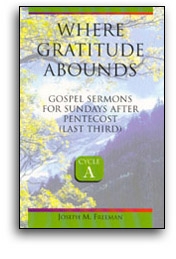
Where Gratitude Abounds
Gospel Sermons For Sundays After Pentecost (Last Third)
When I was in high school, I had a bad case of acne. Many teenagers did then and many still do now. An English teacher, Mrs. Veler, cared enough about this that she volunteered to take me to a dermatologist and to pay for the appointment as well as for the prescription. She was a Christian woman married to the Lutheran Bishop of Ohio. Together they introduced me to Wittenberg University, their alma mater, and they encouraged me to think seriously about college. I was invited to their home innumerable times, an urban boy visiting a beautiful suburban home. Mrs. Veler even insisted that I work harder on my vocabulary and that I prepare well for the P.S.A.T., A.C.T., and S.A.T. college entrance exams. Quite frankly, if it weren't for her kind personal initiative in awakening me to opportunities I was formerly oblivious to, I would not have applied to and entered college. And for my life, that also means I would probably not have heard God's call into ministry, nor have experienced and chosen Lutheranism as an expression of faith in which to serve Lord and church. She was a sure and certain example of those persons (sheep) Jesus invited into his kingdom on Judgment Day. She was so unlike another English teacher who seemed to prize only those students who were super-popular, athletic, and photogenic.

Salvation is a gift that makes not just an eternal difference, in terms of where we abide next, but also an attitudinal and dispositional difference within ourselves now, where we currently abide on earth. People who come to value salvation enough not just to be grateful for the hell it helps one to avoid, but more and more for the new attitudes and dispositions it calls forth and fosters within oneself, express these growing personal qualities in helpful, servant acts to others. Hence, my sermon title: "Salvation Serving."
This is the last Sunday of the church year. It's a sabbath reading of Jesus' last discourse and thus builds to a climax. Last Judgment is the theme. And though many of us would not see Christ in the life of a person in need, Christ implies from this story that people of salvation have it in them, given their new nature, to meet those needs. Don't be tripped up by the sheep and goat imagery. More important is your convicted awareness that two very different types of persons can both claim to be persons of salvation, but only one of them truly is: the one whose personal qualities are kindred indeed to those of verses 34-36. To be rich with Christ in our life is to invite oneself to develop qualities of personhood that lead/motivate one to use one's resources where God can use them to help and bless others.
In verses 31-33, we read of the day and time when indeed Jesus will be in full glory, in the presence of angels and in a position of authority. It will be a time when, whether willingly or unwillingly, all nations, that is, all persons, will have an irreversible accounting of their lives before the Creator and Judge of life. Those formerly gathered under some national or ethnic or other kind of shared identity, in many instances, will be separated from one another forever, in favor of a deeper discriminating factor: Was Jesus Christ rich and central enough to your life that it went deeper than words and piety, to heart and activity (Matthew 7:21)? And Jesus shares it with those who believe in him, so it will be no secret. This is the Word of the Lord!!
In verses 34-36, Jesus deeply shares his heart here regarding those matters of earth and earthly living that are the most important to him. Are we willing to reclaim people who need to be regathered into the loop of community and care? Are we intuitive and perceptive enough to see Christ aching when we notice their aching? Do we unnecessarily "deskill" ourselves when someone needs a helping hand, for example, some bread, water, a coat, a prison visit, and so forth? Notice that such acts don't require all of our own personal possessions and resources, but only small portions. Those truly on a transformation trek in and through Jesus uncalculatingly answer in the affirmative. Their genuine acts of love are expressed from an ever-increasing Christian nature within them. They had no idea their simple acts of benevolence had such eternal weight to them.
In verses 37-40, we note that these benevolent resource-sharers, who simply give from their heart by a decision of mind, and by an act of will, are genuinely surprised about Jesus' comment on such activity as he invites them into eternal, kingdom living. The beauty of this surprise is that their deeds were not motivated to accrue brownie points with the Big Teacher, but simply to give genuine focus and loving response to a person carrying a particular need. That's the kind of heart and life that Jesus rejoices over. It is indeed beautiful (and unfortunately rare!) that those mature in Christ have the fruits of the Spirit so well-placed in their lives that they freely choose to do these gracious and generous acts out of their new nature in Christ -- and without thought of credit.
In verses 41-46, we see people who erroneously believed that, because they had the right religious words in their lives and the practice of faith and piety on some helpful level for themselves, they were a shoo-in for salvation. Unfortunately, their religious sentiments were not deep-seated enough to give Christ the depth of permission truly to transform them.Their question to Jesus after he barred them entrance into kingdom living, in verse 44, "Lord, when was it that we saw you ..." reveals that they would have helped others if they had known he was disguised within these persons in need. That is, they would have sought to accrue brownie points with the Big Teacher had they only known it would have affected their salvational status and standing. On a level that only Jesus can accurately measure, they wanted salvation strictly for themselves and would do anything to secure it further. But it was more from a selfish motive to establish oneself rather than from an aching need to have oneself transformed. Selfishness, even when placed in a religious quest, still does not come out as generosity. These persons simply would have helped others so that they could then win God's approval, rather than like their brothers and sisters mentioned earlier who helped for the sake of being helpful.
In the words of one commentator,
Mother Teresa was asked how she could minister to people with such horrid illnesses, and she replied, "I just pretend they are Jesus." What a wonderful attitude. Every time we do something that helps those who cannot help themselves, we are ministering to Jesus. It's obvious that this attitude makes Mother Teresa look for as many people to help as possible. Have you done something thoughtful for someone else this week? Then you have done something thoughtful for Jesus ... (Yes) ... good acts are the outgrowth of a life which is connected to Christ.1
Salvation is not just the most precious gift one could ever receive. It's also a gift that settles so deeply into a life genuinely receptive to it that it creates and calls forth loving acts of service -- service to lives in which the hidden Christ wants to be better known and shown.
____________
1. Stanley Meade, "Surprised Sheep and Graceless Goats," Dynamic Preaching, November-December, 1996, Volume. XI, No. 9, p. 31.
Salvation is a gift that makes not just an eternal difference, in terms of where we abide next, but also an attitudinal and dispositional difference within ourselves now, where we currently abide on earth. People who come to value salvation enough not just to be grateful for the hell it helps one to avoid, but more and more for the new attitudes and dispositions it calls forth and fosters within oneself, express these growing personal qualities in helpful, servant acts to others. Hence, my sermon title: "Salvation Serving."
This is the last Sunday of the church year. It's a sabbath reading of Jesus' last discourse and thus builds to a climax. Last Judgment is the theme. And though many of us would not see Christ in the life of a person in need, Christ implies from this story that people of salvation have it in them, given their new nature, to meet those needs. Don't be tripped up by the sheep and goat imagery. More important is your convicted awareness that two very different types of persons can both claim to be persons of salvation, but only one of them truly is: the one whose personal qualities are kindred indeed to those of verses 34-36. To be rich with Christ in our life is to invite oneself to develop qualities of personhood that lead/motivate one to use one's resources where God can use them to help and bless others.
In verses 31-33, we read of the day and time when indeed Jesus will be in full glory, in the presence of angels and in a position of authority. It will be a time when, whether willingly or unwillingly, all nations, that is, all persons, will have an irreversible accounting of their lives before the Creator and Judge of life. Those formerly gathered under some national or ethnic or other kind of shared identity, in many instances, will be separated from one another forever, in favor of a deeper discriminating factor: Was Jesus Christ rich and central enough to your life that it went deeper than words and piety, to heart and activity (Matthew 7:21)? And Jesus shares it with those who believe in him, so it will be no secret. This is the Word of the Lord!!
In verses 34-36, Jesus deeply shares his heart here regarding those matters of earth and earthly living that are the most important to him. Are we willing to reclaim people who need to be regathered into the loop of community and care? Are we intuitive and perceptive enough to see Christ aching when we notice their aching? Do we unnecessarily "deskill" ourselves when someone needs a helping hand, for example, some bread, water, a coat, a prison visit, and so forth? Notice that such acts don't require all of our own personal possessions and resources, but only small portions. Those truly on a transformation trek in and through Jesus uncalculatingly answer in the affirmative. Their genuine acts of love are expressed from an ever-increasing Christian nature within them. They had no idea their simple acts of benevolence had such eternal weight to them.
In verses 37-40, we note that these benevolent resource-sharers, who simply give from their heart by a decision of mind, and by an act of will, are genuinely surprised about Jesus' comment on such activity as he invites them into eternal, kingdom living. The beauty of this surprise is that their deeds were not motivated to accrue brownie points with the Big Teacher, but simply to give genuine focus and loving response to a person carrying a particular need. That's the kind of heart and life that Jesus rejoices over. It is indeed beautiful (and unfortunately rare!) that those mature in Christ have the fruits of the Spirit so well-placed in their lives that they freely choose to do these gracious and generous acts out of their new nature in Christ -- and without thought of credit.
In verses 41-46, we see people who erroneously believed that, because they had the right religious words in their lives and the practice of faith and piety on some helpful level for themselves, they were a shoo-in for salvation. Unfortunately, their religious sentiments were not deep-seated enough to give Christ the depth of permission truly to transform them.Their question to Jesus after he barred them entrance into kingdom living, in verse 44, "Lord, when was it that we saw you ..." reveals that they would have helped others if they had known he was disguised within these persons in need. That is, they would have sought to accrue brownie points with the Big Teacher had they only known it would have affected their salvational status and standing. On a level that only Jesus can accurately measure, they wanted salvation strictly for themselves and would do anything to secure it further. But it was more from a selfish motive to establish oneself rather than from an aching need to have oneself transformed. Selfishness, even when placed in a religious quest, still does not come out as generosity. These persons simply would have helped others so that they could then win God's approval, rather than like their brothers and sisters mentioned earlier who helped for the sake of being helpful.
In the words of one commentator,
Mother Teresa was asked how she could minister to people with such horrid illnesses, and she replied, "I just pretend they are Jesus." What a wonderful attitude. Every time we do something that helps those who cannot help themselves, we are ministering to Jesus. It's obvious that this attitude makes Mother Teresa look for as many people to help as possible. Have you done something thoughtful for someone else this week? Then you have done something thoughtful for Jesus ... (Yes) ... good acts are the outgrowth of a life which is connected to Christ.1
Salvation is not just the most precious gift one could ever receive. It's also a gift that settles so deeply into a life genuinely receptive to it that it creates and calls forth loving acts of service -- service to lives in which the hidden Christ wants to be better known and shown.
____________
1. Stanley Meade, "Surprised Sheep and Graceless Goats," Dynamic Preaching, November-December, 1996, Volume. XI, No. 9, p. 31.