Resurrection In A Cross--Shaped World
Sermon
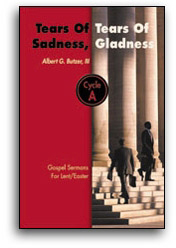
Tears Of Sadness, Tears Of Gladness
Gospel Sermons For Lent/Easter
In one of his songs, Paul Simon of Simon and Garfunkel fame suggests that we live in a time "of miracle and wonder."1 Yes, these are the days of miracle and wonder, and this is especially true of Easter. Can you think of any other day that contains more miracle and wonder than Easter? That's why we're here this morning, why the pews are especially crowded today, why we're decked out in our best Easter clothes, why we've covered the communion table with fragrant lilies, each of them like a miniature trumpet proclaiming the resurrection. That's why our choir is in tip--top form with beautiful brass accompaniment. That's why even those who rarely darken the door of the church the rest of the year are here today! Because this is a day of miracle and wonder, and we want to be part of it.

However, as someone has written, all of the wonderful things going on around us on Easter remind us "... that nothing even close to all that wonderful is going on inside of ourselves."2 I think I know about that. A quick glance at the calendar says that it's Easter, but a review of my daily appointment book reads more like Good Friday. Rarely, will people sit down with the minister to talk about the joys of life. Rather, they come to talk about pain, suffering, and grief:
´ a marriage which began with the promise "as long as we both shall live," has died an early death and led to a painful divorce;
´ a faithful employee, loyal to the same company for years, has just been let go;
´ a high school senior, a good student, is surprisingly wait--listed by the college of his choice;
´ a middle--aged man estranged from his own parents says, "I just hope our next contact is not when one of them dies";
´ a father is concerned about his troubled teenager;
´ a wife is in anguish over her alcoholic husband.
´ Some come and share their frustrations about the state of our nation: the wealth of the suburbs and the poverty of the inner city, the erosion of personal morality, the political posturing, and the scandals of Washington.
´ And, of course, there are those who want to talk about death and grief: the first--time parents with the miscarriage, the dutiful son who watches helplessly as Alzheimer's makes mush of his father's brain; the lonely widow who still can't believe that her husband of 49 years is gone.
The calendar says Easter, but you'd never know it by the tears in our eyes.
"Mary stood weeping outside the tomb" (John 20:11), writes John, weeping, we presume, not only because they had crucified Jesus, not only because she is grieving his death, but weeping because someone has stolen his body. Or so she thinks. "They have taken away my Lord, and I do not know where they have laid him" (John 20:13).
John does not describe the extent of Mary's grief. But those of us who have lost a loved one know something of what she's feeling. We come around the corner of the house and expect to see our loved one sitting in her favorite chair, but the chair is empty. Habitually, we set a place for him at the dinner table and then foolishly remember that he is gone. We pick up the telephone and wish to God that the voice on the other end is hers, but, of course, it's not. Writing shortly after the death of her very best friend, American poet Edna St. Vincent Millay puts it like this:
But your voice -
... For the beauty of that sound
That in no new way at all
Ever will be heard again.3
How painful to think we will never hear the voice of that loved one again. And that's why what happens next makes Easter all the more a day of miracle and wonder. Suddenly, Mary comes face to face with the Risen Christ. Only, she doesn't recognize him. Presumably, something about his resurrected appearance is different. Something leads her to believe that he is the gardener. He doesn't look like anything or anyone she had expected to see.
Morgan Roberts is a retired Presbyterian minister who used to serve a church in Pittsburgh. For years that church has broadcast its Sunday services on the radio, which means that the preacher becomes familiar to many who have never set foot in the church. One Saturday morning Roberts was speaking at another church in Pittsburgh. Prior to the speech, a woman leaned over to a friend and said, "I've heard Morgan Roberts on the radio, but I've never met him." Then looking in the direction of the speaker's table, she said, "Which one is he?" When the friend pointed toward the one with thinning gray hair, wearing a dark gray preacher's suit and a regimental stripe red and black tie, the woman exclaimed, "Oh my! He doesn't look anything like he is supposed to look!" It was only when he began to speak that she recognized his familiar voice. Later Roberts would quip, "I was not at all surprised. No Welshman ever looks as good as his voice sounds!"4
Something like that happened to Mary on that first Easter morning. She fails to recognize the Risen Christ until he speaks her name, "Mary!" It was the hearing of his voice when he called her by name that transformed her Good Friday grief into the miracle and wonder of Easter.
But then, strangely, that familiar voice spoke a disturbing word. "Do not hold on to me," he says, "for I have not yet ascended to the Father" (John 20:17). Do not hold on to him? Why in the world not? Isn't that the very thing we want to do when we've been reunited with a loved one - to wrap our arms around him and hug him to ourself? What kind of callous and uncaring Christ is this who says, "Do not hold on to me"?
Barbara Brown Taylor, the eloquent Episcopal priest, points out that the scripture never says that Mary reached out and tried to hold Jesus. His comment, she writes, was a peculiar thing to say, unless ...
Unless it was what she called him - my Teacher - the old name she used to call him ... but that was his Friday name and here it was Sunday - an entirely new day in an entirely new life.5
"Do not hold on to me," says the Risen Christ. It is as if he says: Don't think that you can go back and pick up where we left off before Good Friday, because you can't. Don't think that you can re--live the past, because you can't. Don't think you can go back, sit on that grassy hillside, and listen to me teach, for you can't; from now on, you will teach others in my name. And don't think that you can go back to that day when I fed the hungry multitude with five barley loaves and two fish, because you can't; from now on, you will feed the hungry in my name. Life is going to be different, he says, totally different, now that I have been raised from the dead. For I am no longer just that rabbi, that teacher from Nazareth. Now I am the Risen and Living Lord who calls you to let go of the past and follow me into an entirely new day in an entirely new life. "Do not hold on to me," he says, do not hold on to the past.
But we do, at least some of us do some of the time. In one of my former congregations, a woman had lost her husband the winter before I began my ministry in that church. When I first met her and she spoke extensively about her husband, I thought it was perfectly normal. She was recently widowed; I'd never met the man to whom she'd been happily married all those years; she simply wanted to tell me what he was like. But as the months became years and her conversations began to sound like a broken record - she was always talking about him and never about herself and what tomorrow might bring - I began to realize that this was not healthy. She was holding on to the past; she was lost in a wilderness of Good Friday grief. She desperately needed to let go of her pain and embrace the miracle and wonder of Easter, but she could not. And nothing I said to her could change her mind.
But, it doesn't have to be that way. Part of what Easter means is that this cross--shaped world in which we live does not have the final word. If the Risen Christ could transform the cross of Calvary, the Roman means of capital punishment, into a symbol of faith, hope, and love, which we even proudly wear as jewelry, just think what he can do for the cross--shaped struggles of your life and mine.
In his best--selling book The Road Less Traveled, Christian psychiatrist Scott Peck writes about a young man named Ted. When he came to see Dr. Peck, Ted had lost his enthusiasm for life. All his life he had suffered one bitter disappointment after another. His parents had punished him when he was a boy by taking away what he wanted the most. His brothers had teased him relentlessly. A young woman had dumped him the week before he went off to college. His best friend had been killed in a car accident during their sophomore year of college. When he was young, Ted had believed in God but gradually he began to shut God out, blaming God for all the bad things that had happened to him.
One day in one of his sessions with Dr. Peck, Ted recalled a time when he had nearly drowned. When Peck asked Ted how he felt about being saved, Ted said, "I guess I was fortunate."
"Fortunate?" asked the doctor. "Just an unusual coincidence?"
"I guess I was lucky," said Ted.
"Lucky?" asked Peck. "It's interesting, Ted, that when something painful happens to you, you rail against God. You rail against what a crappy, terrible world this is. But when something good happens, you guess you're lucky. A minor tragedy and it's God's fault. A miraculous blessing and you're a bit lucky."
To make a long story short, gradually Ted began to get well. With Dr. Peck's help and by the grace of God, he was able to let go of his painful past and reclaim his enthusiasm for life and for God. Then one day, Peck noticed something different about the check Ted made out to pay for his appointment. Instead of "Ted," he had signed his name Theodore. When Peck asked him about it, Ted told him that his aunt once urged him to be proud of the name Theodore because it means "lover of God." He said, "I was proud, but then my brothers made fun of me. 'Sissy choir boy,' they said, 'why don't you go kiss the altar.' So I became embarrassed by the name. But now I'm no longer embarrassed. I've decided to use my full name again. After all, I am a lover of God, aren't I?"6
Outside the tomb on Easter morning, the Risen Christ called Mary by name and invited her to let go of the past and follow him into a whole new day and a whole new life. He continues to call out to us today: "Theodore, Sally, Alice, Albert." Such, at least in part, is the miracle and the wonder of Easter.
____________
1. Paul Simon, "The Boy in the Bubble" from the Graceland CD, Warner Brothers Records, 1986.
2. Frederick Buechner, The Longing For Home (San Francisco: Harper Collins Publishers, 1996), p. 144.
3. Edna St. Vincent Millay, "Elegy" in Contemporary American Poetry, H. Lincoln Foster, ed. (New York: Macmillan Company, 1963), pp. 36--37.
4. F. Morgan Roberts, Are There Horses In Heaven? (Pittsburgh: Lighthouse Point Press, 1996), p. 17.
5. Barbara Brown Taylor, "The Unnatural Truth" in The Christian Century, March 20--27, 1996, p. 325.
6.
However, as someone has written, all of the wonderful things going on around us on Easter remind us "... that nothing even close to all that wonderful is going on inside of ourselves."2 I think I know about that. A quick glance at the calendar says that it's Easter, but a review of my daily appointment book reads more like Good Friday. Rarely, will people sit down with the minister to talk about the joys of life. Rather, they come to talk about pain, suffering, and grief:
´ a marriage which began with the promise "as long as we both shall live," has died an early death and led to a painful divorce;
´ a faithful employee, loyal to the same company for years, has just been let go;
´ a high school senior, a good student, is surprisingly wait--listed by the college of his choice;
´ a middle--aged man estranged from his own parents says, "I just hope our next contact is not when one of them dies";
´ a father is concerned about his troubled teenager;
´ a wife is in anguish over her alcoholic husband.
´ Some come and share their frustrations about the state of our nation: the wealth of the suburbs and the poverty of the inner city, the erosion of personal morality, the political posturing, and the scandals of Washington.
´ And, of course, there are those who want to talk about death and grief: the first--time parents with the miscarriage, the dutiful son who watches helplessly as Alzheimer's makes mush of his father's brain; the lonely widow who still can't believe that her husband of 49 years is gone.
The calendar says Easter, but you'd never know it by the tears in our eyes.
"Mary stood weeping outside the tomb" (John 20:11), writes John, weeping, we presume, not only because they had crucified Jesus, not only because she is grieving his death, but weeping because someone has stolen his body. Or so she thinks. "They have taken away my Lord, and I do not know where they have laid him" (John 20:13).
John does not describe the extent of Mary's grief. But those of us who have lost a loved one know something of what she's feeling. We come around the corner of the house and expect to see our loved one sitting in her favorite chair, but the chair is empty. Habitually, we set a place for him at the dinner table and then foolishly remember that he is gone. We pick up the telephone and wish to God that the voice on the other end is hers, but, of course, it's not. Writing shortly after the death of her very best friend, American poet Edna St. Vincent Millay puts it like this:
But your voice -
... For the beauty of that sound
That in no new way at all
Ever will be heard again.3
How painful to think we will never hear the voice of that loved one again. And that's why what happens next makes Easter all the more a day of miracle and wonder. Suddenly, Mary comes face to face with the Risen Christ. Only, she doesn't recognize him. Presumably, something about his resurrected appearance is different. Something leads her to believe that he is the gardener. He doesn't look like anything or anyone she had expected to see.
Morgan Roberts is a retired Presbyterian minister who used to serve a church in Pittsburgh. For years that church has broadcast its Sunday services on the radio, which means that the preacher becomes familiar to many who have never set foot in the church. One Saturday morning Roberts was speaking at another church in Pittsburgh. Prior to the speech, a woman leaned over to a friend and said, "I've heard Morgan Roberts on the radio, but I've never met him." Then looking in the direction of the speaker's table, she said, "Which one is he?" When the friend pointed toward the one with thinning gray hair, wearing a dark gray preacher's suit and a regimental stripe red and black tie, the woman exclaimed, "Oh my! He doesn't look anything like he is supposed to look!" It was only when he began to speak that she recognized his familiar voice. Later Roberts would quip, "I was not at all surprised. No Welshman ever looks as good as his voice sounds!"4
Something like that happened to Mary on that first Easter morning. She fails to recognize the Risen Christ until he speaks her name, "Mary!" It was the hearing of his voice when he called her by name that transformed her Good Friday grief into the miracle and wonder of Easter.
But then, strangely, that familiar voice spoke a disturbing word. "Do not hold on to me," he says, "for I have not yet ascended to the Father" (John 20:17). Do not hold on to him? Why in the world not? Isn't that the very thing we want to do when we've been reunited with a loved one - to wrap our arms around him and hug him to ourself? What kind of callous and uncaring Christ is this who says, "Do not hold on to me"?
Barbara Brown Taylor, the eloquent Episcopal priest, points out that the scripture never says that Mary reached out and tried to hold Jesus. His comment, she writes, was a peculiar thing to say, unless ...
Unless it was what she called him - my Teacher - the old name she used to call him ... but that was his Friday name and here it was Sunday - an entirely new day in an entirely new life.5
"Do not hold on to me," says the Risen Christ. It is as if he says: Don't think that you can go back and pick up where we left off before Good Friday, because you can't. Don't think that you can re--live the past, because you can't. Don't think you can go back, sit on that grassy hillside, and listen to me teach, for you can't; from now on, you will teach others in my name. And don't think that you can go back to that day when I fed the hungry multitude with five barley loaves and two fish, because you can't; from now on, you will feed the hungry in my name. Life is going to be different, he says, totally different, now that I have been raised from the dead. For I am no longer just that rabbi, that teacher from Nazareth. Now I am the Risen and Living Lord who calls you to let go of the past and follow me into an entirely new day in an entirely new life. "Do not hold on to me," he says, do not hold on to the past.
But we do, at least some of us do some of the time. In one of my former congregations, a woman had lost her husband the winter before I began my ministry in that church. When I first met her and she spoke extensively about her husband, I thought it was perfectly normal. She was recently widowed; I'd never met the man to whom she'd been happily married all those years; she simply wanted to tell me what he was like. But as the months became years and her conversations began to sound like a broken record - she was always talking about him and never about herself and what tomorrow might bring - I began to realize that this was not healthy. She was holding on to the past; she was lost in a wilderness of Good Friday grief. She desperately needed to let go of her pain and embrace the miracle and wonder of Easter, but she could not. And nothing I said to her could change her mind.
But, it doesn't have to be that way. Part of what Easter means is that this cross--shaped world in which we live does not have the final word. If the Risen Christ could transform the cross of Calvary, the Roman means of capital punishment, into a symbol of faith, hope, and love, which we even proudly wear as jewelry, just think what he can do for the cross--shaped struggles of your life and mine.
In his best--selling book The Road Less Traveled, Christian psychiatrist Scott Peck writes about a young man named Ted. When he came to see Dr. Peck, Ted had lost his enthusiasm for life. All his life he had suffered one bitter disappointment after another. His parents had punished him when he was a boy by taking away what he wanted the most. His brothers had teased him relentlessly. A young woman had dumped him the week before he went off to college. His best friend had been killed in a car accident during their sophomore year of college. When he was young, Ted had believed in God but gradually he began to shut God out, blaming God for all the bad things that had happened to him.
One day in one of his sessions with Dr. Peck, Ted recalled a time when he had nearly drowned. When Peck asked Ted how he felt about being saved, Ted said, "I guess I was fortunate."
"Fortunate?" asked the doctor. "Just an unusual coincidence?"
"I guess I was lucky," said Ted.
"Lucky?" asked Peck. "It's interesting, Ted, that when something painful happens to you, you rail against God. You rail against what a crappy, terrible world this is. But when something good happens, you guess you're lucky. A minor tragedy and it's God's fault. A miraculous blessing and you're a bit lucky."
To make a long story short, gradually Ted began to get well. With Dr. Peck's help and by the grace of God, he was able to let go of his painful past and reclaim his enthusiasm for life and for God. Then one day, Peck noticed something different about the check Ted made out to pay for his appointment. Instead of "Ted," he had signed his name Theodore. When Peck asked him about it, Ted told him that his aunt once urged him to be proud of the name Theodore because it means "lover of God." He said, "I was proud, but then my brothers made fun of me. 'Sissy choir boy,' they said, 'why don't you go kiss the altar.' So I became embarrassed by the name. But now I'm no longer embarrassed. I've decided to use my full name again. After all, I am a lover of God, aren't I?"6
Outside the tomb on Easter morning, the Risen Christ called Mary by name and invited her to let go of the past and follow him into a whole new day and a whole new life. He continues to call out to us today: "Theodore, Sally, Alice, Albert." Such, at least in part, is the miracle and the wonder of Easter.
____________
1. Paul Simon, "The Boy in the Bubble" from the Graceland CD, Warner Brothers Records, 1986.
2. Frederick Buechner, The Longing For Home (San Francisco: Harper Collins Publishers, 1996), p. 144.
3. Edna St. Vincent Millay, "Elegy" in Contemporary American Poetry, H. Lincoln Foster, ed. (New York: Macmillan Company, 1963), pp. 36--37.
4. F. Morgan Roberts, Are There Horses In Heaven? (Pittsburgh: Lighthouse Point Press, 1996), p. 17.
5. Barbara Brown Taylor, "The Unnatural Truth" in The Christian Century, March 20--27, 1996, p. 325.
6.