
Proper 6 / Pentecost 4 / Ordinary Time 11
Preaching
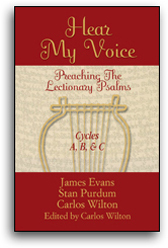
Hear My Voice
Preaching The Lectionary Psalms for Cycles A, B, C
Among the greatest political speeches ever written is Abraham Lincoln's Second Inaugural Address. His brief Gettysburg Address is more famous, but those who take the time to read the Second Inaugural Address will come away impressed not only by Lincoln's rhetorical skills, but also with his probing philosophical mind and deep piety.

Lincoln wrote these words as the Civil War was drawing to a close. Victory had not yet been achieved, but the South had become so worn down by years of bloody fighting that the triumph of the North was inevitable. Yet, in his big moment in the national (and even international) spotlight, Lincoln resists the easy path to triumphalism. With remarkable humility for a national leader, he struggles with the thorny theological question of whose side God is on:
Both read the same Bible, and pray to the same God, and each invokes His aid against the other. It may seem strange that any men should ask a just God's assistance in wringing the bread from the sweat of other men's faces, but let us judge not that we be not judged. The prayers of both could not be answered. That of neither has been answered fully. The Almighty has his own purpose ... Fondly do we hope, fervently do we pray, that this mighty scourge of war may speedily pass away. Yet, if God wills that it continue until all the wealth piled by the bondman's two hundred and fifty years of unrequited toil shall be sunk, and until every drop of blood drawn with the lash, shall be paid by another drawn with the sword, as was said three thousand years ago, so still it must be said "the judgments of the Lord are true and righteous altogether."
The prayers of neither side have been answered fully. Such is the realistic assessment of a Christian believer, after the dreadful scourge of war has exerted its price. At the beginning of armed conflict, there is typically greater optimism and an easy assurance of God's favor.
Such is the sunny assessment of Psalm 20, a prayer on the king's behalf, imploring God for help on the eve of war. These words are addressed to the king: "May [the Lord] grant you your heart's desire, and fulfill all your plans. May we shout for joy over your victory, and in the name of our God set up our banners" (vv. 4-5a).
Verse 6 goes on to declare, without equivocation, that the Lord will be on the king's side in the coming battle. But then, in verse 7, is planted the seed for a broader, more universal view: "Some take pride in chariots, and some in horses, but our pride is in the name of the Lord our God. They will collapse and fall, but we shall rise and stand upright" (vv. 7-8).
God does not take sides in war. Far more important is whether or not we take God's side.
-- C. W.
Lincoln wrote these words as the Civil War was drawing to a close. Victory had not yet been achieved, but the South had become so worn down by years of bloody fighting that the triumph of the North was inevitable. Yet, in his big moment in the national (and even international) spotlight, Lincoln resists the easy path to triumphalism. With remarkable humility for a national leader, he struggles with the thorny theological question of whose side God is on:
Both read the same Bible, and pray to the same God, and each invokes His aid against the other. It may seem strange that any men should ask a just God's assistance in wringing the bread from the sweat of other men's faces, but let us judge not that we be not judged. The prayers of both could not be answered. That of neither has been answered fully. The Almighty has his own purpose ... Fondly do we hope, fervently do we pray, that this mighty scourge of war may speedily pass away. Yet, if God wills that it continue until all the wealth piled by the bondman's two hundred and fifty years of unrequited toil shall be sunk, and until every drop of blood drawn with the lash, shall be paid by another drawn with the sword, as was said three thousand years ago, so still it must be said "the judgments of the Lord are true and righteous altogether."
The prayers of neither side have been answered fully. Such is the realistic assessment of a Christian believer, after the dreadful scourge of war has exerted its price. At the beginning of armed conflict, there is typically greater optimism and an easy assurance of God's favor.
Such is the sunny assessment of Psalm 20, a prayer on the king's behalf, imploring God for help on the eve of war. These words are addressed to the king: "May [the Lord] grant you your heart's desire, and fulfill all your plans. May we shout for joy over your victory, and in the name of our God set up our banners" (vv. 4-5a).
Verse 6 goes on to declare, without equivocation, that the Lord will be on the king's side in the coming battle. But then, in verse 7, is planted the seed for a broader, more universal view: "Some take pride in chariots, and some in horses, but our pride is in the name of the Lord our God. They will collapse and fall, but we shall rise and stand upright" (vv. 7-8).
God does not take sides in war. Far more important is whether or not we take God's side.
-- C. W.

