Proper 12/Pentecost 10/Ordinary Time 17
Preaching
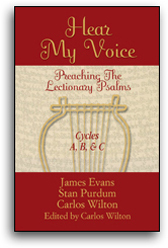
Hear My Voice
Preaching The Lectionary Psalms for Cycles A, B, C
Object:
This Psalm is difficult to preach in our modern culture, because of the central section (vv. 3-4) which addresses devout men exclusively, and which celebrates the gifts of a fertile wife and many children as a blessing from God. That portion of this psalm may preach in Amish country, but in any other part of the twenty-first-century Christian church, its message seems quaint at best and archaic at worst. In a world threatened by overpopulation, there are major ethical questions connected with the image of a large crop of children springing up "like olive shoots around your table."

There are two other portions of this brief psalm, however, that do offer preaching possibilities:
1. "Happy is everyone who fears the Lord" (v. 1). Fear of the Lord is likewise a hard sell in our self-centered, God-is-my-copilot religious culture, but one can at least address the experience of fear in a pastoral way. What is it that our people most fear? Would it not be better to seek to fear the Lord, rather than lesser things?
2. "You shall eat the fruit of the labor of your hands" (v. 2). Perhaps this text could be paired with the prophetic challenge of Isaiah 55:2: "Why do you spend your money for that which is not bread, and your labor for that which does not satisfy?" There was a time when a great many Christians could readily see the labor of their hands. In that simpler era, most people either worked the land, or worked in small cottage industries. Even assembly-line industries had some kind of visible output -- however far that output may have been from an individual worker's position on the production line. In our present economy -- dominated by service and information industries, and characterized by frequent employment disruptions and job changes -- it is hard for many of our people to gain the satisfaction of knowing their work has accomplished something. It is truly a blessing to see the labor of our hands, to know we are exercising our God-given talents to make the world a better place. As one of the characters in Gail Godwin's novel, Evensong, says: "Your vocation is something that keeps making more of you." Frederick Buechner describes Christian vocation as "the place where your deep gladness and the world's deep hunger meet" (Wishful Thinking: A Theological ABC [New York: Harper & Row, 1973], p. 95). May more and more of our people come to discover that blessed place of meeting!
-- C. W.
There are two other portions of this brief psalm, however, that do offer preaching possibilities:
1. "Happy is everyone who fears the Lord" (v. 1). Fear of the Lord is likewise a hard sell in our self-centered, God-is-my-copilot religious culture, but one can at least address the experience of fear in a pastoral way. What is it that our people most fear? Would it not be better to seek to fear the Lord, rather than lesser things?
2. "You shall eat the fruit of the labor of your hands" (v. 2). Perhaps this text could be paired with the prophetic challenge of Isaiah 55:2: "Why do you spend your money for that which is not bread, and your labor for that which does not satisfy?" There was a time when a great many Christians could readily see the labor of their hands. In that simpler era, most people either worked the land, or worked in small cottage industries. Even assembly-line industries had some kind of visible output -- however far that output may have been from an individual worker's position on the production line. In our present economy -- dominated by service and information industries, and characterized by frequent employment disruptions and job changes -- it is hard for many of our people to gain the satisfaction of knowing their work has accomplished something. It is truly a blessing to see the labor of our hands, to know we are exercising our God-given talents to make the world a better place. As one of the characters in Gail Godwin's novel, Evensong, says: "Your vocation is something that keeps making more of you." Frederick Buechner describes Christian vocation as "the place where your deep gladness and the world's deep hunger meet" (Wishful Thinking: A Theological ABC [New York: Harper & Row, 1973], p. 95). May more and more of our people come to discover that blessed place of meeting!
-- C. W.