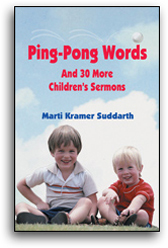
Ping-Pong Words
Children's sermon
Ping-Pong Words
And 30 More Children's Sermons
Object:
Scripture Reference
A soft answer turns away wrath, but a harsh word stirs up anger.
-- Proverbs 15:1
Scientific Reference
Snell's law: The angle of incidence equals the angle of reflection.
Materials needed
Board
Ping-pong balls (one for each child if you are going to hand them out after the story)
Card stock printed with scripture reference and verse on one side and Snell's law on the other
Assistant
Telling The Story

(Introduce your assistant. Ask your assistant to hold the board perpendicular to the floor. Stand three or four feet away and throw a ping-pong ball at a 90-degree angle at the board. The ball should bounce back to you. Ask the children to describe what happened. Stand at a 45-degree angle from the board and throw another ping-pong ball at the board at that angle. The ball should bounce off the board and away from you.) Do you know what just happened? (Let the children answer.) What I just demonstrated is Snell's law.
(Hold up the card stock printed with Snell's law and read it to the children.) Snell's law says, "The angle of incidence equals the angle of reflection." This is a scientific way of saying that the way the ball bounces off the board is influenced by the way the ball hits the board. Ping-pong players use this law every time they play. The way they bounce the ball onto the ping-pong table influences the way the ball bounces off, which determines where the ball will go. What does this have to do with the Bible?
Sometimes we get upset with someone we know. When that happens, God wants us to talk to that person rather than gossip with other people. But not just any conversation will do. Imagine that I'm upset with a person named Ignatz. Now imagine that I go to Ignatz and I say (use an angry voice): "Ignatz! You idiot! How could you do something so stupid?" How will Ignatz feel like answering me? He probably will feel like using very angry words, too.
Now imagine that I go to Ignatz and I say (use a gentle voice): "Ignatz, I don't understand something. Can we talk about it?" Now, how will Ignatz feel like answering me? He's much more likely to use gentle words back.
Human beings aren't as predictable as ping-pong balls. It's possible that Ignatz is a calm, mature person who will take a deep breath and count to ten before answering calmly, even if I yell at him. It's also possible that Ignatz will answer me harshly no matter how gently I speak, but I'm much more likely to get an angry answer if I use angry words myself or a gentle answer if I use gentle words.
I learned this in the book of Proverbs. Proverbs was written by Solomon, the wisest man in the world. (Hold up the card stock printed with scripture reference and verse and read the verse.) In Proverbs, Solomon says, "A soft answer turns away wrath, but a harsh word stirs up anger." Solomon isn't talking about science, but maybe Snell learned from Solomon. Thousands of years ago Solomon realized that the way you speak to someone influences the way that person speaks back to you. When we use harsh words, we're likely to get harsh words back, just like the ping-pong ball bounces back when I throw it straight at the board. (Throw the ping-pong ball at the board at a 90 degree angle.)
When we use gentle words, the anger is more likely to bounce away ... (throw the ping-pong ball at the board at 45-degree angle) ... just like the ping-pong ball thrown at an angle.
The next time you find yourself angry at someone, the first thing you should do is pray and ask for God to give you wisdom. Your next step is to either forgive and forget or to go talk to the person gently and try to work things out. Talking calmly is harder than yelling angrily, but remember God is there to help you.
Prayer
Dear Lord,
Thank you for this beautiful day and for giving Solomon the wisdom that he shares with us in the book of Proverbs. Thank you for letting us know that we should use gentle words and for helping us when using gentle words is difficult. Please help us to remember that we can ask you for wisdom, too.
In Jesus' name. Amen.
Optional: Give each child a ping-pong ball to remind him or her of the harsh words and the gentle words.
A soft answer turns away wrath, but a harsh word stirs up anger.
-- Proverbs 15:1
Scientific Reference
Snell's law: The angle of incidence equals the angle of reflection.
Materials needed
Board
Ping-pong balls (one for each child if you are going to hand them out after the story)
Card stock printed with scripture reference and verse on one side and Snell's law on the other
Assistant
Telling The Story
(Introduce your assistant. Ask your assistant to hold the board perpendicular to the floor. Stand three or four feet away and throw a ping-pong ball at a 90-degree angle at the board. The ball should bounce back to you. Ask the children to describe what happened. Stand at a 45-degree angle from the board and throw another ping-pong ball at the board at that angle. The ball should bounce off the board and away from you.) Do you know what just happened? (Let the children answer.) What I just demonstrated is Snell's law.
(Hold up the card stock printed with Snell's law and read it to the children.) Snell's law says, "The angle of incidence equals the angle of reflection." This is a scientific way of saying that the way the ball bounces off the board is influenced by the way the ball hits the board. Ping-pong players use this law every time they play. The way they bounce the ball onto the ping-pong table influences the way the ball bounces off, which determines where the ball will go. What does this have to do with the Bible?
Sometimes we get upset with someone we know. When that happens, God wants us to talk to that person rather than gossip with other people. But not just any conversation will do. Imagine that I'm upset with a person named Ignatz. Now imagine that I go to Ignatz and I say (use an angry voice): "Ignatz! You idiot! How could you do something so stupid?" How will Ignatz feel like answering me? He probably will feel like using very angry words, too.
Now imagine that I go to Ignatz and I say (use a gentle voice): "Ignatz, I don't understand something. Can we talk about it?" Now, how will Ignatz feel like answering me? He's much more likely to use gentle words back.
Human beings aren't as predictable as ping-pong balls. It's possible that Ignatz is a calm, mature person who will take a deep breath and count to ten before answering calmly, even if I yell at him. It's also possible that Ignatz will answer me harshly no matter how gently I speak, but I'm much more likely to get an angry answer if I use angry words myself or a gentle answer if I use gentle words.
I learned this in the book of Proverbs. Proverbs was written by Solomon, the wisest man in the world. (Hold up the card stock printed with scripture reference and verse and read the verse.) In Proverbs, Solomon says, "A soft answer turns away wrath, but a harsh word stirs up anger." Solomon isn't talking about science, but maybe Snell learned from Solomon. Thousands of years ago Solomon realized that the way you speak to someone influences the way that person speaks back to you. When we use harsh words, we're likely to get harsh words back, just like the ping-pong ball bounces back when I throw it straight at the board. (Throw the ping-pong ball at the board at a 90 degree angle.)
When we use gentle words, the anger is more likely to bounce away ... (throw the ping-pong ball at the board at 45-degree angle) ... just like the ping-pong ball thrown at an angle.
The next time you find yourself angry at someone, the first thing you should do is pray and ask for God to give you wisdom. Your next step is to either forgive and forget or to go talk to the person gently and try to work things out. Talking calmly is harder than yelling angrily, but remember God is there to help you.
Prayer
Dear Lord,
Thank you for this beautiful day and for giving Solomon the wisdom that he shares with us in the book of Proverbs. Thank you for letting us know that we should use gentle words and for helping us when using gentle words is difficult. Please help us to remember that we can ask you for wisdom, too.
In Jesus' name. Amen.
Optional: Give each child a ping-pong ball to remind him or her of the harsh words and the gentle words.