The Nail Of Indecision
Sermon
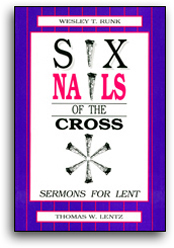
SIX NAILS OF THE CROSS
Sermons For Lent
Pilate was caught: he wanted to make the best of two worlds.
Should he sentence Jesus to death? That's hard to do to a man
who has impressed you so favorably ... with his innocence, with
his strength, with his wisdom. But what should he do with the
overwhelming opposition to Jesus? Should he, Pilate, take a stand
against the majority who opposed him?
Releasing Jesus would mean an encounter with the Sanhedrin in
the Jewish court, and Pilate did not want that. Sentencing Jesus

would mean putting to death a man who had done nothing to deserve
capital punishment. Yet there seemed to be only these two
alternatives with their consequences: to defy the majority and
the governing powers, or to defy his own conscience. But Pilate
opted for a third alternative: to make no decision, to wash his
hands of the matter, to repudiate his responsibility.
If Christianity has anything to say in the area of ethics and
morality, one thing is certain: it does not recognize morally
neutral situations. The ethic of Christianity is either/or. There
is no third way beside doing good or evil. To do nothing is
equivalent to doing evil. As it is written in Revelation: "I know
your works; you are neither cold nor hot. Would that you
were cold or hot. So, because you are lukewarm, and neither cold
nor hot, I will spew you out of my mouth." Or listen to the
prophet whose words leave no room for moral ambiguity. "Choose
the good that you might live. Hate the evil and love the good."
On the words of Joshua, "And if you be unwilling to serve the
Lord, choose this day whom you will serve ..."
Our Lord's own command issues forth the same call for
unequivocal obedience. "You shall love the Lord your God with all
your heart, soul, mind and strength." The call of discipleship is
black and white. It is an either/or situation. When Jesus called
his disciples he made it quite plain that there was no room for
compromise: he said, follow me, even if it means to turn your
back on mother or father. To the young man who wanted to bury his
dead relative first, Jesus said, "No, leave the dead to bury the
dead." He left no room for procrastination, for excuses.
In the gospels, the way of the cross appears difficult; it
involves suffering and trial, but the choice is still black and
white. In both the Old and New Testaments, the issues of life are
seen in terms of faithfulness. The Christian life is pictured as
doing battle in the world, and this battle belongs not to the
strong, or the wise, but to the faithful. Paul's letter to the
Ephesians exhorts Christians to put on the whole armor of God.
One must be faithful and strong to stand. The Psalmist speaks of
double-minded men who are rebuked by God. But the promise to
those who make a single-minded decision is God's peace which
passes all understanding.
To live is to choose. It is the very negation of life to act
against one's better judgment through weakness, because one
doesn't dare to take the responsibility for one's decisions.
Prolonged indecision is a poison in one's life. It indicates a
prolonged fear to face responsibility. To make a decision is to
be willing to accept the responsibility for what one chooses.
Domineering parents may thwart the decision-making process in
a child in a way which may persist throughout his life, not by
the strictness of their discipline, but by making
all the child's decisions for him. When that child becomes an
adult, he does not know what his tastes are, his beliefs, his aim
in life. As soon as this person does make a decision, he begins
to wonder if he had not made a mistake. And so he is content to
let others make decisions for him. His constant concern is to
shelter himself under the authority of others.
When persons such as this come to us seeking advice, we have
an obligation not to make their decisions for them, but to help
them make their own decisions.
When parents or friends decide everything for a child or
adult, it indicates that they do not trust his judgment. Thus,
they have sown in him a lack of self-confidence, which makes him
weak, incapable of decision, less than adult. And so trust is of
prime importance -- trust in the person's ability to make a
responsible choice, even if the decision seems questionable to us
sometimes.
I read recently that worry is created by those who live in the
past or the future, but never in the present. These people live
provisional lives, their lives are never in their present lives
for they are always waiting for the time, which never comes, when
their true lives will begin.
Some women merely tolerate their lives. Each day, while their
children are young, they wait for those moments of liberation
when their children are grown and they can at last do the things
they want. These are the very ones who find themselves at a loss,
unprepared to enjoy those moments of freedom when they do come;
for they have not learned to live in the present.
The same thing is true in the case of persons who look upon
their present occupations as provisional. In such a state of mind
they lose all interest and pleasure in their work. Perhaps they
go frequently from one provisional employment to another and
their ability to throw themselves heart and soul into their work
diminishes daily.
Many do not even realize that what determined their occupation
was a set of circumstances in the face of which they remained
entirely passive, so that on their part there was nothing that
could be called a choice.
Having a vocation means acting in the spirit of vocation,
being convinced that what one is doing is what one is called to
do. And if a person should realize that his occupation does not
fit in with his ambitions, it means risking the choice of change.
Sometimes the rebirth of a person takes place when such a risk is
ventured, even at the cost of material security.
But let us not fall into the trap of thinking that it matters
little what choice or decision we make, so long as we do choose
or decide. This would be like the young girl who said we must
experience all things for ourselves. To choose to experience all
things is to ignore that all experiences are not equally good. A
true choice necessarily implies reference to a scale of values.
The Bible is indeed the book which demands decisions but not
blind decisions. For it shows us where true life and liberty are
to be found.
One of the problems which plagues youth today is not that they
do not choose, but that they do not carry their choice far
enough. True, there is hypocrisy and materialism in our culture,
and the social drop-outs may have a legitimate complaint when
they regard our culture as a sham. But their lives contain no
vision, no hope, for they are shaped and molded around rebellion,
revolt. The child may choose to reject the authority of his
parents. But he must realize that this is not enough. That will
not nourish his life. He must choose another truly personal
inspiration. He is oppressed by his parents' domination. To prove
himself no longer a child, he defies it. It is a movement toward
liberty, but it is not liberty itself. Decisions are not true
decisions if they are merely in reaction or rebellion to the
status quo. The world is full of too many of those who merely
decide by taking the opposing viewpoint, with no other rational
reasons, than taking pride in belonging to the opposition. These
peoples' lives are not their own, for they are not determined by
their own goals and visions.
But how do we escape the nail of indecision in our lives
today? What can we do?
First of all, most issues today come to us crystal clearly; it
is not a matter of what to do, but will I in fact do what
I know in my heart is right? Most of the issues of life are
clear: I know that I should seek out the lonely, rather than only
my friends all the time; I know that I should forgive my neighbor
instead of maintaining my hostility toward him; I know that I
should give up my party strife. In many of these things no amount
of preaching or church-going can turn the will of a person until
he decides for himself that the decision of obedience has to be
made if he is to find peace of mind.
Yet in other issues confusion remains. Sometimes the ethical
problems today are not merely a matter of obedience or
disobedience. Sometimes the evidence seems to weigh equally on
either side. While our commitment to God is black or white,
either/or, it can't be totally identified with our commitments in
the world. The context of the world is one of compromise. Equally
Christians can take opposing sides on many political issues.
And so we have to determine what areas in our lives can be
decided entirely by disobedience or obedience, and those areas
which require more information, more questioning, a different
strategy.
Some say, inflation or not, you can still get a decision from
a tossed nickel.
But that is not the way to responsible decisions. In these
areas, we must collect the evidence, we must be responsible
citizens, and then in the milieu of a sinful world, we must make
the best decision we can. But we must always realize that our
worldly decisions can not contain the ultimate solution. There is
no person, no clerical body, no ethical principle that always
works. There is no group of people who have all the answers.
And this is the reason we meet in a body; we learn to await
the Spirit; to listen with open heart and mind to the scripture,
to learn the will of God. The church under pressure waits for
God, and it maintains an openness to the living spirit of the
eternal God.
Should he sentence Jesus to death? That's hard to do to a man
who has impressed you so favorably ... with his innocence, with
his strength, with his wisdom. But what should he do with the
overwhelming opposition to Jesus? Should he, Pilate, take a stand
against the majority who opposed him?
Releasing Jesus would mean an encounter with the Sanhedrin in
the Jewish court, and Pilate did not want that. Sentencing Jesus
would mean putting to death a man who had done nothing to deserve
capital punishment. Yet there seemed to be only these two
alternatives with their consequences: to defy the majority and
the governing powers, or to defy his own conscience. But Pilate
opted for a third alternative: to make no decision, to wash his
hands of the matter, to repudiate his responsibility.
If Christianity has anything to say in the area of ethics and
morality, one thing is certain: it does not recognize morally
neutral situations. The ethic of Christianity is either/or. There
is no third way beside doing good or evil. To do nothing is
equivalent to doing evil. As it is written in Revelation: "I know
your works; you are neither cold nor hot. Would that you
were cold or hot. So, because you are lukewarm, and neither cold
nor hot, I will spew you out of my mouth." Or listen to the
prophet whose words leave no room for moral ambiguity. "Choose
the good that you might live. Hate the evil and love the good."
On the words of Joshua, "And if you be unwilling to serve the
Lord, choose this day whom you will serve ..."
Our Lord's own command issues forth the same call for
unequivocal obedience. "You shall love the Lord your God with all
your heart, soul, mind and strength." The call of discipleship is
black and white. It is an either/or situation. When Jesus called
his disciples he made it quite plain that there was no room for
compromise: he said, follow me, even if it means to turn your
back on mother or father. To the young man who wanted to bury his
dead relative first, Jesus said, "No, leave the dead to bury the
dead." He left no room for procrastination, for excuses.
In the gospels, the way of the cross appears difficult; it
involves suffering and trial, but the choice is still black and
white. In both the Old and New Testaments, the issues of life are
seen in terms of faithfulness. The Christian life is pictured as
doing battle in the world, and this battle belongs not to the
strong, or the wise, but to the faithful. Paul's letter to the
Ephesians exhorts Christians to put on the whole armor of God.
One must be faithful and strong to stand. The Psalmist speaks of
double-minded men who are rebuked by God. But the promise to
those who make a single-minded decision is God's peace which
passes all understanding.
To live is to choose. It is the very negation of life to act
against one's better judgment through weakness, because one
doesn't dare to take the responsibility for one's decisions.
Prolonged indecision is a poison in one's life. It indicates a
prolonged fear to face responsibility. To make a decision is to
be willing to accept the responsibility for what one chooses.
Domineering parents may thwart the decision-making process in
a child in a way which may persist throughout his life, not by
the strictness of their discipline, but by making
all the child's decisions for him. When that child becomes an
adult, he does not know what his tastes are, his beliefs, his aim
in life. As soon as this person does make a decision, he begins
to wonder if he had not made a mistake. And so he is content to
let others make decisions for him. His constant concern is to
shelter himself under the authority of others.
When persons such as this come to us seeking advice, we have
an obligation not to make their decisions for them, but to help
them make their own decisions.
When parents or friends decide everything for a child or
adult, it indicates that they do not trust his judgment. Thus,
they have sown in him a lack of self-confidence, which makes him
weak, incapable of decision, less than adult. And so trust is of
prime importance -- trust in the person's ability to make a
responsible choice, even if the decision seems questionable to us
sometimes.
I read recently that worry is created by those who live in the
past or the future, but never in the present. These people live
provisional lives, their lives are never in their present lives
for they are always waiting for the time, which never comes, when
their true lives will begin.
Some women merely tolerate their lives. Each day, while their
children are young, they wait for those moments of liberation
when their children are grown and they can at last do the things
they want. These are the very ones who find themselves at a loss,
unprepared to enjoy those moments of freedom when they do come;
for they have not learned to live in the present.
The same thing is true in the case of persons who look upon
their present occupations as provisional. In such a state of mind
they lose all interest and pleasure in their work. Perhaps they
go frequently from one provisional employment to another and
their ability to throw themselves heart and soul into their work
diminishes daily.
Many do not even realize that what determined their occupation
was a set of circumstances in the face of which they remained
entirely passive, so that on their part there was nothing that
could be called a choice.
Having a vocation means acting in the spirit of vocation,
being convinced that what one is doing is what one is called to
do. And if a person should realize that his occupation does not
fit in with his ambitions, it means risking the choice of change.
Sometimes the rebirth of a person takes place when such a risk is
ventured, even at the cost of material security.
But let us not fall into the trap of thinking that it matters
little what choice or decision we make, so long as we do choose
or decide. This would be like the young girl who said we must
experience all things for ourselves. To choose to experience all
things is to ignore that all experiences are not equally good. A
true choice necessarily implies reference to a scale of values.
The Bible is indeed the book which demands decisions but not
blind decisions. For it shows us where true life and liberty are
to be found.
One of the problems which plagues youth today is not that they
do not choose, but that they do not carry their choice far
enough. True, there is hypocrisy and materialism in our culture,
and the social drop-outs may have a legitimate complaint when
they regard our culture as a sham. But their lives contain no
vision, no hope, for they are shaped and molded around rebellion,
revolt. The child may choose to reject the authority of his
parents. But he must realize that this is not enough. That will
not nourish his life. He must choose another truly personal
inspiration. He is oppressed by his parents' domination. To prove
himself no longer a child, he defies it. It is a movement toward
liberty, but it is not liberty itself. Decisions are not true
decisions if they are merely in reaction or rebellion to the
status quo. The world is full of too many of those who merely
decide by taking the opposing viewpoint, with no other rational
reasons, than taking pride in belonging to the opposition. These
peoples' lives are not their own, for they are not determined by
their own goals and visions.
But how do we escape the nail of indecision in our lives
today? What can we do?
First of all, most issues today come to us crystal clearly; it
is not a matter of what to do, but will I in fact do what
I know in my heart is right? Most of the issues of life are
clear: I know that I should seek out the lonely, rather than only
my friends all the time; I know that I should forgive my neighbor
instead of maintaining my hostility toward him; I know that I
should give up my party strife. In many of these things no amount
of preaching or church-going can turn the will of a person until
he decides for himself that the decision of obedience has to be
made if he is to find peace of mind.
Yet in other issues confusion remains. Sometimes the ethical
problems today are not merely a matter of obedience or
disobedience. Sometimes the evidence seems to weigh equally on
either side. While our commitment to God is black or white,
either/or, it can't be totally identified with our commitments in
the world. The context of the world is one of compromise. Equally
Christians can take opposing sides on many political issues.
And so we have to determine what areas in our lives can be
decided entirely by disobedience or obedience, and those areas
which require more information, more questioning, a different
strategy.
Some say, inflation or not, you can still get a decision from
a tossed nickel.
But that is not the way to responsible decisions. In these
areas, we must collect the evidence, we must be responsible
citizens, and then in the milieu of a sinful world, we must make
the best decision we can. But we must always realize that our
worldly decisions can not contain the ultimate solution. There is
no person, no clerical body, no ethical principle that always
works. There is no group of people who have all the answers.
And this is the reason we meet in a body; we learn to await
the Spirit; to listen with open heart and mind to the scripture,
to learn the will of God. The church under pressure waits for
God, and it maintains an openness to the living spirit of the
eternal God.