A Monologue of "Rocky" Barjona
Drama
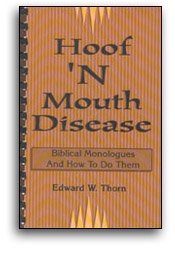
Hoof 'N Mouth Disease
Biblical Monologues and How to Do Them
Object:
THEME:
Peter is like many of us who preach. He thinks he must talk, even when he has little to say.
SETTING FOR THE MONOLOGUE SERMON:
The lectionary reading was Mark 8. It was the Lenten season. What does it mean for Messiah to die? Peter wrestles with that eventuality in a manner that we Monday morning quarterbacks sometimes can't quite comprehend.
* * *
In the year 1988, the Democratic Convention opened with a bleached blonde,
whose time on terra firma was enough to designate her
"numerically challenged,"

speaking of the then Republican presidential
candidate.
Her startling introduction began with the words:
"Poor George, he cain't help it;
he was born with a silver foot in his mouth."
That somewhat abrasive statement brought down the house, and it eventually ushered Ann Richards into the Texas governor's mansion.
I cannot say I, Peter, was born with a silver foot in my mouth,
but there are certainly more than a few who assert
that I was born with "hoof and mouth disease."
I guess people are pretty much the same --
no matter what era,
or country they were born in.
Almost two millennia have gone by, but I, Simon Peter --
(By the way, "Peter" means "rock" --
that was what people called me -- Rocky) --
Anyway, I, Peter, or Rocky, remember some of my awkward remarks like they were yesterday.
Thank God, with my ruddy complexion,
it was not too easy to discern that my cheeks were burning.
That ruddiness didn't all come from the imbibing of liquid "refreshment" as might be rumored.
I was a fisherman.
We fishermen work out in the sun and the wind,
the rain,
the snow.
It was a rough life --
not one in which one practices social niceties --
acquires a smooth tongue,
or learns the vocabulary of a diplomat.
Our vocabulary was -- uhh --
somewhat different, too, from church talk,
though it certainly was sprinkled with some "theological" verbiage.
I thought my life would go on like this forever.
For centuries the men of my family had been fishermen --
my father,
my grandfather,
my great-grandfather --
When I was born, my father, Jonah, was glad that I was a boy --
because, he said, "Simon can help me at my trade."
When a second son, Andrew, was born, Father was overjoyed.
In time Andrew and I, along with our good friends James and John,
formed a most effective fishing team.
Even though all of us had our spiritual yearnings,
I don't think it ever occurred to us that we would be anything but fishermen --
certainly not rabbis.
We were hardly the rabbi type.
You in twentieth century America can barely understand what it meant to change one's vocation.
You folks do it all the time.
Back then one usually learned the family trade --
had a certain niche in life --
and we never aspired to anything else.
Indeed, when the Master called us to follow him,
we left our nets --
but we also kept our boats and equipment.
You may have noticed in your gospels that we were in our boats quite a lot --
we continued to be fishermen at times.
It never dawned on us that we might become rabbis.
Jesus even preached from my boat once when the mob kept
pushing closer and closer along the Galilean Sea.
And --
do you not recall --
even after the resurrection --
Jesus came to see us on several occasions.
Yet, we all went back to fishing.
It was a familiar outlet.
It was something we understood.
It was only as we met with Him on the beach one post-resurrection
day while we were fishing --
and He fried fish for us,
He did --
He sat down and had breakfast with us on the beach --
that I fully responded to my call.
I confess that each time He came to us, I had mixed emotions. I loved Him, but I had failed Him --
I who had boldly proclaimed that though everyone else might desert Him --
He could depend on me!
That very night, however, I denied that I ever knew Him.
On the beach --
He met us where we were --
not where we ought to be --
but where we were --
as we ate the fish --
three times He asked, "Peter, do you love me?"
I was in anguish as I replied, "Lord, you know I love you."
Each time I replied, He commanded, "Feed my sheep."
That, for me, was a moment of truth --
about my vocation --
and about my glib speech.
Often I ran off at the face before I got my brain in gear.
I've since discovered that when the mind goes blank
it is wise to switch off the mouth.
I meant well, but I was a much better talker than I was a listener.
So many times --
example: the woman who had an issue of blood for twelve years -- to herself she kept saying,
"If I could but touch the hem of his garment,
I would be healed."
When she slipped in among the crowd and touched Jesus,
He stopped and said loudly, "Someone touched me!"
"Of course -- of course, Master," I said impatiently --
"the crowd is so close, they're touching all of us!"
I didn't wait for Him to clarify what He meant,
I just shot off my motormouth.
Jesus ignored me and said again, "Someone has touched me --
power has gone out from me."
The woman came forward, knelt before him, proclaiming that she
was the one,
and that she was healed.
We followed Jesus, the twelve of us --
followed Him for three years.
We ministered with Him, and for Him.
We were glad to be "insiders" with the Messiah.
We were expecting to have positions of power in His soon coming kingdom.
Then He threw us a curve ball -- anachronistically speaking.
Jesus had just miraculously fed four thousand people.
We were certain He was the Messiah.
Afterwards we walked on to other villages to minister.
Along the way Jesus asked us,
"Who do people say I am?"
We replied,
"Well, some say 'John the Baptist,'
others 'Elijah,'
and some 'one of the prophets.' "
But Jesus pressed us further with another question.
"Who do you say that I am?"
Like always, I was the one that answered the question.
The others took time to measure their answers to these questions very deliberately.
Not me!
I just responded, "You are the Messiah" --
to which Jesus said, "Blessed are you Rocky, Son of Jonah."
Then He began to teach us --
and here's where the curveball came --
teach us that He would suffer many things;
be rejected of the chief priests, the elders
and the teachers of the law --
resulting in His death --
but that in three days He would rise again.
Well, I hardly hesitated!
I took him aside and began to rebuke Him --
"No way, Lord" --
"Not you" --
I didn't want to hear it.
I guess what I was trying to say to Jesus was that death could permanently hurt Him --
for a long time.
Or let me state it in an even more modern and politically correct way --
"Jesus," I said, "death could be very injurious to your
wellness potential."
I just had His best interest in mind --
and of course my interests, too.
Turning to the disciples, however, Jesus began to rebuke me.
He got right up into my face and said,
"Get behind me, Satan.
You do not have in mind the things of God,
but the things of men."
Talk about getting one's foot in one's mouth;
I turned crimson.
I was confused.
How could this happen?
How could He suffer death at the hands of mere mortals?
He had the power to prevent it.
What about us?
We had invested three years in this venture.
Our fishing business had suffered.
Now, He was saying it was all for naught --
at least that's what we heard.
Six days later He took me, James, and John with Him up a high mountain.
There He was transformed before our very eyes.
His face shone like the sun.
Even His clothes were transformed into a dazzling whiteness that no bleach in the world could create.
Then I understood what the scriptures were saying when they
reported that after Moses had seen the back of God on Mount Sinai, upon receiving the ten commandments --
his face shone so brightly
that no person could look on it.
In fact, Moses and Elijah met with Jesus on this mountain
and conversed with him as we watched.
And of course --
frightened and not knowing what to say,
but never at a loss for words,
I blurted out, "Lord,
Lord,
it's good for us to be here.
Let us put up three shelters:
one for you,
one for Moses, and
one for Elijah."
Then a cloud appeared and enveloped them,
and a voice came from the cloud:
"This is my beloved Son; listen to Him."
Suddenly we looked around and no one was there but Jesus.
As we went down the mountain, Jesus commanded us to tell no one about this until He was raised from the dead.
For once I was at a loss for words --
but not for questions.
James, John, and I kept discussing among ourselves what Jesus meant about "rising from the dead,"
but we said nothing to the others.
I'm sure you are wondering how I could have been so stupid --
how I could hear Him say again and again that He would die and rise again,
but fail to believe, to comprehend it --
to even experience it and still not comprehend.
It's a matter of focus --
selective perception.
Let me explain it this way.
While I speak to you, some of you are daydreaming --
about an upcoming vacation,
about a meeting with a friend or family member,
or even your boss.
Others of you are carrying burdens --
grief,
physical discomfort,
disappointment,
or anxiety.
Still others will at times whisper to a friend
and miss part of what I say --
Indeed, everyone of you has, at points in my narrative,
been distracted --
even though almost all of you are tuning in to me at
some points,
everyone of you has daydreamed
as I have been speaking.
As a consequence,
each of you is hearing a slightly different message.
That's selective perception.
There is also a matter of expectation, and belief systems,
through which we filter all information.
Indeed, we avoid information that is contrary to strongly held beliefs.
We expected a Messiah that was very politically powerful --
a world ruler over the kingdoms of this world.
We thought Jesus would do this, and do it now.
We simply tuned out any hint of vulnerability.
Let me illustrate from an event in your time.
In the early '60s it was discovered that there was a clear
connection between health and the use of tobacco.
The American Cancer Society wrote up the information in pamphlet form --
put such pamphlets in public places for people to read.
Guess who read them --
not the smokers who needed the information,
but the non-smokers,
three to one.
We tend to seek information that confirms our deeply held beliefs
and ignore those sources of information that don't support our beliefs,
because such information is uncomfortable to deal with.
That's known as "selective exposure."
Furthermore, if we are exposed to information contrary to our strongly held beliefs,
we tend to be much more likely to forget it,
than do those who find the information confirming their beliefs.
That's called "selective retention."
Between selective perception,
selective exposure, and
selective retention,
it is difficult to change a person's basic belief system.
Something like that was happening with me and all of us.
He spoke of suffering, death, and servanthood.
We dreamed of royalty, palaces, and power.
We simply weren't listening --
Instead of contemplation, I was engaged in insensitive and
excessive articulation --
But, somehow, Jesus knew me better than I knew myself --
He chose me --
and I am a privileged man!
He has taken this voice of mine that has gotten me in so much trouble --
and used it to help others find themselves --
three thousand people responded to my message of the
kingdom on the day of Pentecost alone.
Over and over He, the Savior, has used this voice.
At least I don't suffer from stage fright --
My friend, the apostle Paul,
who wrestled much with God over his frailties,
reports that he had the distinct impression
that the Almighty was saying to him,
"My grace is sufficient for you, Paul."
But additionally, He said something we often don't hear.
He said, "My strength is made perfect in your weakness."
I don't know what his problem was --
something about "thorns" --
but in his very weakness God used him.
I guess that's my message to you:
What others,
indeed you yourself,
consider to be your greatest fault, may,
from a divine viewpoint,
be your greatest asset --
when that troublesome characteristic is
consecrated to Him.
If the Lord can take an unpolished, raw fisherman like me,
He can use you too.
"Hoof and mouth disease" --
you better believe it --
no question I got it --
but what is more important is that the Lord has me --
all of me,
including my mouth.
Peter is like many of us who preach. He thinks he must talk, even when he has little to say.
SETTING FOR THE MONOLOGUE SERMON:
The lectionary reading was Mark 8. It was the Lenten season. What does it mean for Messiah to die? Peter wrestles with that eventuality in a manner that we Monday morning quarterbacks sometimes can't quite comprehend.
* * *
In the year 1988, the Democratic Convention opened with a bleached blonde,
whose time on terra firma was enough to designate her
"numerically challenged,"
speaking of the then Republican presidential
candidate.
Her startling introduction began with the words:
"Poor George, he cain't help it;
he was born with a silver foot in his mouth."
That somewhat abrasive statement brought down the house, and it eventually ushered Ann Richards into the Texas governor's mansion.
I cannot say I, Peter, was born with a silver foot in my mouth,
but there are certainly more than a few who assert
that I was born with "hoof and mouth disease."
I guess people are pretty much the same --
no matter what era,
or country they were born in.
Almost two millennia have gone by, but I, Simon Peter --
(By the way, "Peter" means "rock" --
that was what people called me -- Rocky) --
Anyway, I, Peter, or Rocky, remember some of my awkward remarks like they were yesterday.
Thank God, with my ruddy complexion,
it was not too easy to discern that my cheeks were burning.
That ruddiness didn't all come from the imbibing of liquid "refreshment" as might be rumored.
I was a fisherman.
We fishermen work out in the sun and the wind,
the rain,
the snow.
It was a rough life --
not one in which one practices social niceties --
acquires a smooth tongue,
or learns the vocabulary of a diplomat.
Our vocabulary was -- uhh --
somewhat different, too, from church talk,
though it certainly was sprinkled with some "theological" verbiage.
I thought my life would go on like this forever.
For centuries the men of my family had been fishermen --
my father,
my grandfather,
my great-grandfather --
When I was born, my father, Jonah, was glad that I was a boy --
because, he said, "Simon can help me at my trade."
When a second son, Andrew, was born, Father was overjoyed.
In time Andrew and I, along with our good friends James and John,
formed a most effective fishing team.
Even though all of us had our spiritual yearnings,
I don't think it ever occurred to us that we would be anything but fishermen --
certainly not rabbis.
We were hardly the rabbi type.
You in twentieth century America can barely understand what it meant to change one's vocation.
You folks do it all the time.
Back then one usually learned the family trade --
had a certain niche in life --
and we never aspired to anything else.
Indeed, when the Master called us to follow him,
we left our nets --
but we also kept our boats and equipment.
You may have noticed in your gospels that we were in our boats quite a lot --
we continued to be fishermen at times.
It never dawned on us that we might become rabbis.
Jesus even preached from my boat once when the mob kept
pushing closer and closer along the Galilean Sea.
And --
do you not recall --
even after the resurrection --
Jesus came to see us on several occasions.
Yet, we all went back to fishing.
It was a familiar outlet.
It was something we understood.
It was only as we met with Him on the beach one post-resurrection
day while we were fishing --
and He fried fish for us,
He did --
He sat down and had breakfast with us on the beach --
that I fully responded to my call.
I confess that each time He came to us, I had mixed emotions. I loved Him, but I had failed Him --
I who had boldly proclaimed that though everyone else might desert Him --
He could depend on me!
That very night, however, I denied that I ever knew Him.
On the beach --
He met us where we were --
not where we ought to be --
but where we were --
as we ate the fish --
three times He asked, "Peter, do you love me?"
I was in anguish as I replied, "Lord, you know I love you."
Each time I replied, He commanded, "Feed my sheep."
That, for me, was a moment of truth --
about my vocation --
and about my glib speech.
Often I ran off at the face before I got my brain in gear.
I've since discovered that when the mind goes blank
it is wise to switch off the mouth.
I meant well, but I was a much better talker than I was a listener.
So many times --
example: the woman who had an issue of blood for twelve years -- to herself she kept saying,
"If I could but touch the hem of his garment,
I would be healed."
When she slipped in among the crowd and touched Jesus,
He stopped and said loudly, "Someone touched me!"
"Of course -- of course, Master," I said impatiently --
"the crowd is so close, they're touching all of us!"
I didn't wait for Him to clarify what He meant,
I just shot off my motormouth.
Jesus ignored me and said again, "Someone has touched me --
power has gone out from me."
The woman came forward, knelt before him, proclaiming that she
was the one,
and that she was healed.
We followed Jesus, the twelve of us --
followed Him for three years.
We ministered with Him, and for Him.
We were glad to be "insiders" with the Messiah.
We were expecting to have positions of power in His soon coming kingdom.
Then He threw us a curve ball -- anachronistically speaking.
Jesus had just miraculously fed four thousand people.
We were certain He was the Messiah.
Afterwards we walked on to other villages to minister.
Along the way Jesus asked us,
"Who do people say I am?"
We replied,
"Well, some say 'John the Baptist,'
others 'Elijah,'
and some 'one of the prophets.' "
But Jesus pressed us further with another question.
"Who do you say that I am?"
Like always, I was the one that answered the question.
The others took time to measure their answers to these questions very deliberately.
Not me!
I just responded, "You are the Messiah" --
to which Jesus said, "Blessed are you Rocky, Son of Jonah."
Then He began to teach us --
and here's where the curveball came --
teach us that He would suffer many things;
be rejected of the chief priests, the elders
and the teachers of the law --
resulting in His death --
but that in three days He would rise again.
Well, I hardly hesitated!
I took him aside and began to rebuke Him --
"No way, Lord" --
"Not you" --
I didn't want to hear it.
I guess what I was trying to say to Jesus was that death could permanently hurt Him --
for a long time.
Or let me state it in an even more modern and politically correct way --
"Jesus," I said, "death could be very injurious to your
wellness potential."
I just had His best interest in mind --
and of course my interests, too.
Turning to the disciples, however, Jesus began to rebuke me.
He got right up into my face and said,
"Get behind me, Satan.
You do not have in mind the things of God,
but the things of men."
Talk about getting one's foot in one's mouth;
I turned crimson.
I was confused.
How could this happen?
How could He suffer death at the hands of mere mortals?
He had the power to prevent it.
What about us?
We had invested three years in this venture.
Our fishing business had suffered.
Now, He was saying it was all for naught --
at least that's what we heard.
Six days later He took me, James, and John with Him up a high mountain.
There He was transformed before our very eyes.
His face shone like the sun.
Even His clothes were transformed into a dazzling whiteness that no bleach in the world could create.
Then I understood what the scriptures were saying when they
reported that after Moses had seen the back of God on Mount Sinai, upon receiving the ten commandments --
his face shone so brightly
that no person could look on it.
In fact, Moses and Elijah met with Jesus on this mountain
and conversed with him as we watched.
And of course --
frightened and not knowing what to say,
but never at a loss for words,
I blurted out, "Lord,
Lord,
it's good for us to be here.
Let us put up three shelters:
one for you,
one for Moses, and
one for Elijah."
Then a cloud appeared and enveloped them,
and a voice came from the cloud:
"This is my beloved Son; listen to Him."
Suddenly we looked around and no one was there but Jesus.
As we went down the mountain, Jesus commanded us to tell no one about this until He was raised from the dead.
For once I was at a loss for words --
but not for questions.
James, John, and I kept discussing among ourselves what Jesus meant about "rising from the dead,"
but we said nothing to the others.
I'm sure you are wondering how I could have been so stupid --
how I could hear Him say again and again that He would die and rise again,
but fail to believe, to comprehend it --
to even experience it and still not comprehend.
It's a matter of focus --
selective perception.
Let me explain it this way.
While I speak to you, some of you are daydreaming --
about an upcoming vacation,
about a meeting with a friend or family member,
or even your boss.
Others of you are carrying burdens --
grief,
physical discomfort,
disappointment,
or anxiety.
Still others will at times whisper to a friend
and miss part of what I say --
Indeed, everyone of you has, at points in my narrative,
been distracted --
even though almost all of you are tuning in to me at
some points,
everyone of you has daydreamed
as I have been speaking.
As a consequence,
each of you is hearing a slightly different message.
That's selective perception.
There is also a matter of expectation, and belief systems,
through which we filter all information.
Indeed, we avoid information that is contrary to strongly held beliefs.
We expected a Messiah that was very politically powerful --
a world ruler over the kingdoms of this world.
We thought Jesus would do this, and do it now.
We simply tuned out any hint of vulnerability.
Let me illustrate from an event in your time.
In the early '60s it was discovered that there was a clear
connection between health and the use of tobacco.
The American Cancer Society wrote up the information in pamphlet form --
put such pamphlets in public places for people to read.
Guess who read them --
not the smokers who needed the information,
but the non-smokers,
three to one.
We tend to seek information that confirms our deeply held beliefs
and ignore those sources of information that don't support our beliefs,
because such information is uncomfortable to deal with.
That's known as "selective exposure."
Furthermore, if we are exposed to information contrary to our strongly held beliefs,
we tend to be much more likely to forget it,
than do those who find the information confirming their beliefs.
That's called "selective retention."
Between selective perception,
selective exposure, and
selective retention,
it is difficult to change a person's basic belief system.
Something like that was happening with me and all of us.
He spoke of suffering, death, and servanthood.
We dreamed of royalty, palaces, and power.
We simply weren't listening --
Instead of contemplation, I was engaged in insensitive and
excessive articulation --
But, somehow, Jesus knew me better than I knew myself --
He chose me --
and I am a privileged man!
He has taken this voice of mine that has gotten me in so much trouble --
and used it to help others find themselves --
three thousand people responded to my message of the
kingdom on the day of Pentecost alone.
Over and over He, the Savior, has used this voice.
At least I don't suffer from stage fright --
My friend, the apostle Paul,
who wrestled much with God over his frailties,
reports that he had the distinct impression
that the Almighty was saying to him,
"My grace is sufficient for you, Paul."
But additionally, He said something we often don't hear.
He said, "My strength is made perfect in your weakness."
I don't know what his problem was --
something about "thorns" --
but in his very weakness God used him.
I guess that's my message to you:
What others,
indeed you yourself,
consider to be your greatest fault, may,
from a divine viewpoint,
be your greatest asset --
when that troublesome characteristic is
consecrated to Him.
If the Lord can take an unpolished, raw fisherman like me,
He can use you too.
"Hoof and mouth disease" --
you better believe it --
no question I got it --
but what is more important is that the Lord has me --
all of me,
including my mouth.