Looking the Part
Drama
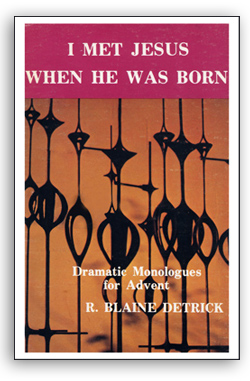
I Met Jesus When He Was Born
DRAMATIC MONOLOGUES FOR ADVENT
Marguerite Detrick
When I do a monologue in costume - making the characterization as dramatic and realistic as possible - my wife is indispensable, because she is my expert in planning and arranging my garment, applying make-up, etc. Honestly, without her able assistance, my monologues would not be nearly as effective. For this reason, I have asked her to write a chapter about this important area, where she is well qualified to offer counsel and guidance.
- R.B.D.

THE PURPOSE OF COSTUME AND MAKE-UP. Costume and make-up have but one function in the religious monologue: to make it more realistic. The audience should not be aware of a visual effect, but only of the presence of the character before them. Anything that detracts from the characterization, anything that takes attention away from the words, is out of place.
This means that the effect you should strive for is naturalness. You will fail if your make-up or costume call attention to themselves, either by being poorly done, or by being so elaborate that they overshadow your performance. Nor should you try to surprise or shock your audience; rather, have your character appear as one would expect to see him step from the pages of Scripture. Remember, that, unlike a performance whose primary purpose is to entertain, in a religious monologue the message is paramount, the entertainment secondary. Nothing should detract from the story you have to relate.
WAYS TO DRESS FOR A MONOLOGUE. The simplest way of presenting the monologue is to wear your ordinary clothing, with no special costuming at all. The imagination of the audience clothes you with garments that are lowly or luxurious, according to the cues you give in your opening remarks.
The next step in assuming a role is to slip into a simple robe, or encircle your waist with a sash, or don a headdress. This can be done offstage, but may also be part of your introductory comments, as you "become" the character right in front of the audience.
A third way to present your monologue is to put on a complete costume backstage and appear before the audience as the actual person you are portraying. Of course, the final step toward realism is to apply make-up to heighten the illusion. You will probably find this the most effective and satisfying type of performance that you can give.
YOUR COSTUME. You will usually dress in a tunic, sash, a robe or mantle, headdress, and sandals.
The tunic is the basic piece of clothing: a simple, slipon garment, it can be sleeveless, or may have short or long sleeves; its length can vary - anywhere from above the knee to the ankle - according to the way you wish to appear.
A sash, of any width you desire, is fastened around the waist.
A robe, usually with sleeves, is worn over the tunic.
A mantle, a sleeveless wraparound garment, may be worn instead of a robe; it looks best over a sleeved tunic.
A headdress, made from a square of cloth, is secured with circles of cording or rope.
Sandals are appropriate footwear - or go barefoot.
To stimulate your creativity when you are designing your costumes, make a collection of pictures of biblical characters. (Two good sources are church school literature and Christmas cards.) Make notes about any styles, color combinations, or special effects that appeal to you, and try to duplicate them.
Buying cloth can be quite an expense, so be on the lookout for bargains in fabrics and trimmings. Go to a rummage sale now and then, with an eye cocked for usable material in castoffs: draperies, bedspreads, sheets, and table cloths are good possibilities, and can be dyed to the colors you desire.
Finding patterns suitable for the garments you want to make may prove difficult. Look first for costume patterns. Failing there, you may have to use your ingenuity and alter a pattern to meet your needs. For example, a pattern for a man's shirt can be used to make a tunic if you lengthen it, omit the collar and cuffs, and close most of the front seam.
Some things can be made without a pattern. A long, narrow piece of fabric is easily sewn into a sash. (It will keep its shape better if the front is faced with a stiff interlining.) For a headdress, choose cloth that will drape nicely and cut a square; 44-inch material gives a full, graceful effect. Sew ball or looped fringe on two, three, or four sides. To hold the cloth on, measure a piece of rope or cording to fit around head; sew the ends together to form a circle; two or more of these circles may be joined together, if desired; finish by covering stitches with a tassel that will hang at the back of headdress.
To make a simple tunic, measure the distance from your shoulder down to the length you want the finished garment to reach, and add two inches for the hem allowance. Using that measurement, cut two matching pieces of 36-inch material: they will be the front and back of your tunic. Place one rectangular piece on top of the other, right sides of the cloth together. Sew a seam twelve inches long on each side of the top of the garment for the shoulder seams, leaving a twelve-inch neckhole at the center. Sew the two side seams, leaving about ten inches open at the top of each side for the armholes. Then finish the neckhole, armholes, and bottom of the tunic by turning back narrow hems and either sewing them by hand or machine, or fusing them with an iron-on adherent.
A mantle is extremely easy to make: just hem the raw edges of a three-yard length of 36 to 44-inch material. If you wish, you can sew fringe or braid to the bottom edge. Choose a material that will drape well, for the mantle is wrapped around the body, under the arms, once or twice, and then drawn up across the chest and arranged so that it falls gracefully over the shoulder and down the back. It may be pinned inconspicuously to make it secure.
There are a few garments that can be remade to serve your purpose. An old choir robe can be transformed into a robe, by turning back the two front facings toward the inside, and trimming the front, sleeves, and hem with contrasting bands or braid. A woman's cape can be adorned with fur or jewels and it becomes a traveling robe for the wise man. (I've never had much luck with a bathrobe, though; it always ends up looking like a bathrobe!)
Some of your characters will require variations of the basic costume or special props to add authenticity. John the Baptizer presents some difficulties, but a short tunic made of fake fur passes for his "raiment of camel's hair," and a wide leather belt completes his costume. You might carry a staff, since John was a wandering man. He probably had an unkempt beard and a shaggy head of hair, but you could wear a brown headdress and still be in character.
A white tunic and mantle approximate the toga worn by the Romans; you may add gold braid or a colored border to the mantle to designate the rank of your character.
A crook will identify you as a shepherd. A crown or other kingly headdress will make you look the way a wise man is expected to look - though I doubt if the magi dressed like that when they rode across the desert. But, in designing costumes, the only limit is your own imagination!
APPLYING YOUR MAKE-UP. Whether it be a few quick lines drawn with a dark pencil, or the full treatment, complete with highlighting, make-up can be the factor that transforms a good monologue into an unforgettable event.
Begin by practicing before a mirror, and experiment to discover what effects you can achieve. The method described is not the only way to apply make-up, but it is the way that has worked best for us. You will soon develop your own routine.
An important word of warning: check all make-up for possible allergic reactions!
1. Lay out your supplies; put things in the order in which you'll use them.
2. Prepare crepe hair: remove string, and stretch and separate hair; cut into correct lengths and lay out on paper toweling, arranging sections as they will appear on face.
3. Drape shoulders with a large towel.
4. Apply a thin layer of cold cream, then darken complexion with foundation: use grease paint if you perspire heavily; otherwise, pancake will do. Don't forget the area around the eyes. If you will be wearing a beard, don't apply anything greasy to that section of the face.
5. Apply beard. (If you grow your own, this part is easy! The color can be changed with spray-on tints, or with white shoe polish. Another easy solution is a tie-on-beard, but we can't recommend this for speaking roles.) Crepe hair may be used quite effectively. Brush spirit gum where beard is to be applied, following the natural growth of your beard. (Just use the "five o'clock shadow" as your pattern.) Be sure to include the area under the chin if you want a full, luxuriant crop of whiskers. When the gum is tacky, apply mustache, then fill in area under chin, sideburns, lower cheek area, and, finally, the chin. If the gum dries too fast, apply a second coat. Press beard firmly with palms of hands, then let the beard set for a few minutes. (You can go on to the rest of your make-up job, then complete the beard when gum has dried.) To finish the grooming, gently separate the strands of hair with your fingers or a wire pick, then trim with scissors to the desired length and style. (If you are giving a performance in the evening, it might be wise to shave shortly before applying the beard; it will be easier to remove if it isn't glued to your own whiskers. However, if your skin is sensitive after shaving, you might prefer to forget that idea.) When it's time to remove the beard, alcohol will help soften the spirit gum so the beard can be pulled off - gently, please!
6. To age a character, add lines to your face. To determine where they should be drawn, frown, squint, and laugh: where you see lines, trace them with a brown pencil or a fine brush dipped in brown liner. A fine-line eyebrow pencil is my favorite tool for this task. If you wish, you can draw a white line above each dark one to highlight it. Don't forget to make frown lines, crow's feet, and nose and mouth brackets. If you are not wearing a beard, also make double chin lines. (Here the highlights will be under the dark lines.) Blend lines with finger to soften. Don't get carried away and use so much liner that your face looks dirty!
7. Also, to age, use brown or gray eyeshadow to make a half-moon under each eye; white eye liner can be used on the lower lids to make them appear to droop. Dark shadows can be applied to accentuate hollows in the cheeks.
8. Apply powder to face to set make-up. Brush off. Be careful not to get powder on beard. Some prefer to attach the beard as the final step, to keep it clean from make-up, but I like to be able to work while the spirit gum is drying; that way my husband does not have to sit still so long.
9. If brows need to be darkened, use an eyebrow pencil (black, brown, or gray); to give the appearance of age, apply white shoe polish to the top hairs.
10. Put natural lipstick on lips if more color is needed.
11. Apply cake rouge or blusher to the cheeks: place high for youthful look; lower to indicate age.
12. Put a tiny spot of red lipstick on a toothpick and touch the inside corner of each eye:
13. Finish grooming your beard.
14. Stand back from the mirror and take a good look at yourself. You will look different, but your appearance should be natural, not a grotesque caricature. If you're satisfied with the image the mirror reflects, it's time to put on your costume and to assume the character you'll be portraying.
WHERE TO FIND SUPPLIES. If you're married, you can raid your wife's cosmetic drawer for lots of the things you'll need. Many of the items can be purchased at costumers and at cosmetic counters of variety, drug, and department stores.
YOUR MAKE-UP BOX. These are things that you will want to keep in a box or suitcase, ready for your performance:
Mirror (on a stand, if possible)
Cold cream (to condition and cleanse skin)
Foundation (grease paint or pancake - olive)
Lining color sticks or liquid (brown and white)
Eyebrow pencils (black, brown, and gray)
Eye shadow (brown or gray)
Powder (olive)
Eyeliner (white)
Cake rouge or blusher
Lipstick (natural and red)
Toothpicks (for delicate touches)
Small, pointed brush
Make-up brush (for removing excess powder)
Spirit gum
Crepe hair
Wire pick
Scissors (barber's shears work best for trimming beard)
Spray tint and/or white shoe polish
Cotton
Tissues
Paper toweling
Needle and thread (for emergency repairs)
Safety pins (for urgent emergency repairs)
Double-faced sticky tape (brown type, not transparent kind)
Alcohol (for removing spirit gum)
Towels, wash cloth, and soap
Comb
AFTER YOUR PERFORMANCE. Your make-up will be easy to remove if you lather on lots of cold cream and wipe it off with tissues or paper toweling. Repeat if necessary. Patience is the main requirement in removing the crepe hair. Soften the spirit gum with alcohol as you go along, and gently pull the beard off, a section at a time. Alcohol and cold cream will take care of the last vestiges of your former self. Then lots of soap and hot water should complete the job. After you've finished cleansing, a film of cold cream spread on your face and neck will make you feel comfortable.
As soon as possible after your performance, put your make-up box in order, checking to see if any supplies will need to be replaced; and clean and press your costume before you store it away for your next performance.
THINGS I'VE WORRIED ABOUT
That we wouldn't be ready on time. After a trial run, we decided that an hour in make-up would be long enough, and it always has been, with time to spare for interruptions and accidents. Of course, we had the costume and make-up all ready before we left home. You can make your own "trial run" to determine how much time you will need, and then allow a little to spare. It's better to have time to walk about in your costume, getting the feel of it, than to rush from the mirror to the stage in a breathless dash!
That I wouldn't use the correct amount of make-up.
We've learned from experience how much make-up is enough. We discovered that subtle details are wasted under some conditions: sanctuary lighting at night isn't usually good enough to make it worthwhile to spend a lot of time applying highlights and shadows. But some situations warrant it: stage lighting, a television appearance, or a performance where the monologist will be mingling with the audience. At times like these, I may carry the make-up one step farther, and apply dark grease paint to the hands, arms, and feet.
That the beard would fall off. This fear was especially strong the first time I did the make-up for television. I watched the taping of the show with great apprehension, and then, when the telecast was made, I studied the closeups for any flaws. But all went well, and since then I've relaxed a bit. (My husband says that, if I ever had to struggle to remove the stuff, I'd quit worrying!)
That the headdress would slip. I still worry about this, even after watching the casual way the Arabs wear this gear. I wore it myself once, on a trip from Jerusalem to Petra. I had neglected to take a hat, so one of the guides loaned me his headdress, and I rode horseback, climbed a mountain, and explored ruins, all in perfect comfort. A young Arab who was with us bounded over the rocky terrain like a mountain goat - and if the cloth slipped a bit to one side of his head, he just pushed it back into place. He gave us a demonstration of the many different ways the headdress can be worn, and it's quite a useful and expressive piece of apparel! So I have instructed my husband to remember that Arab youth, so that if the headdress ever does slip he can ad lib and make it seem to be part of the monologue. But to be sure he won't be put in that spot, I use a material that is not slippery, but rather soft and pliable. And I've learned that a few pieces of double-faced tape will secure the cloth to skin, or folds of cloth to itself.
When I do a monologue in costume - making the characterization as dramatic and realistic as possible - my wife is indispensable, because she is my expert in planning and arranging my garment, applying make-up, etc. Honestly, without her able assistance, my monologues would not be nearly as effective. For this reason, I have asked her to write a chapter about this important area, where she is well qualified to offer counsel and guidance.
- R.B.D.
THE PURPOSE OF COSTUME AND MAKE-UP. Costume and make-up have but one function in the religious monologue: to make it more realistic. The audience should not be aware of a visual effect, but only of the presence of the character before them. Anything that detracts from the characterization, anything that takes attention away from the words, is out of place.
This means that the effect you should strive for is naturalness. You will fail if your make-up or costume call attention to themselves, either by being poorly done, or by being so elaborate that they overshadow your performance. Nor should you try to surprise or shock your audience; rather, have your character appear as one would expect to see him step from the pages of Scripture. Remember, that, unlike a performance whose primary purpose is to entertain, in a religious monologue the message is paramount, the entertainment secondary. Nothing should detract from the story you have to relate.
WAYS TO DRESS FOR A MONOLOGUE. The simplest way of presenting the monologue is to wear your ordinary clothing, with no special costuming at all. The imagination of the audience clothes you with garments that are lowly or luxurious, according to the cues you give in your opening remarks.
The next step in assuming a role is to slip into a simple robe, or encircle your waist with a sash, or don a headdress. This can be done offstage, but may also be part of your introductory comments, as you "become" the character right in front of the audience.
A third way to present your monologue is to put on a complete costume backstage and appear before the audience as the actual person you are portraying. Of course, the final step toward realism is to apply make-up to heighten the illusion. You will probably find this the most effective and satisfying type of performance that you can give.
YOUR COSTUME. You will usually dress in a tunic, sash, a robe or mantle, headdress, and sandals.
The tunic is the basic piece of clothing: a simple, slipon garment, it can be sleeveless, or may have short or long sleeves; its length can vary - anywhere from above the knee to the ankle - according to the way you wish to appear.
A sash, of any width you desire, is fastened around the waist.
A robe, usually with sleeves, is worn over the tunic.
A mantle, a sleeveless wraparound garment, may be worn instead of a robe; it looks best over a sleeved tunic.
A headdress, made from a square of cloth, is secured with circles of cording or rope.
Sandals are appropriate footwear - or go barefoot.
To stimulate your creativity when you are designing your costumes, make a collection of pictures of biblical characters. (Two good sources are church school literature and Christmas cards.) Make notes about any styles, color combinations, or special effects that appeal to you, and try to duplicate them.
Buying cloth can be quite an expense, so be on the lookout for bargains in fabrics and trimmings. Go to a rummage sale now and then, with an eye cocked for usable material in castoffs: draperies, bedspreads, sheets, and table cloths are good possibilities, and can be dyed to the colors you desire.
Finding patterns suitable for the garments you want to make may prove difficult. Look first for costume patterns. Failing there, you may have to use your ingenuity and alter a pattern to meet your needs. For example, a pattern for a man's shirt can be used to make a tunic if you lengthen it, omit the collar and cuffs, and close most of the front seam.
Some things can be made without a pattern. A long, narrow piece of fabric is easily sewn into a sash. (It will keep its shape better if the front is faced with a stiff interlining.) For a headdress, choose cloth that will drape nicely and cut a square; 44-inch material gives a full, graceful effect. Sew ball or looped fringe on two, three, or four sides. To hold the cloth on, measure a piece of rope or cording to fit around head; sew the ends together to form a circle; two or more of these circles may be joined together, if desired; finish by covering stitches with a tassel that will hang at the back of headdress.
To make a simple tunic, measure the distance from your shoulder down to the length you want the finished garment to reach, and add two inches for the hem allowance. Using that measurement, cut two matching pieces of 36-inch material: they will be the front and back of your tunic. Place one rectangular piece on top of the other, right sides of the cloth together. Sew a seam twelve inches long on each side of the top of the garment for the shoulder seams, leaving a twelve-inch neckhole at the center. Sew the two side seams, leaving about ten inches open at the top of each side for the armholes. Then finish the neckhole, armholes, and bottom of the tunic by turning back narrow hems and either sewing them by hand or machine, or fusing them with an iron-on adherent.
A mantle is extremely easy to make: just hem the raw edges of a three-yard length of 36 to 44-inch material. If you wish, you can sew fringe or braid to the bottom edge. Choose a material that will drape well, for the mantle is wrapped around the body, under the arms, once or twice, and then drawn up across the chest and arranged so that it falls gracefully over the shoulder and down the back. It may be pinned inconspicuously to make it secure.
There are a few garments that can be remade to serve your purpose. An old choir robe can be transformed into a robe, by turning back the two front facings toward the inside, and trimming the front, sleeves, and hem with contrasting bands or braid. A woman's cape can be adorned with fur or jewels and it becomes a traveling robe for the wise man. (I've never had much luck with a bathrobe, though; it always ends up looking like a bathrobe!)
Some of your characters will require variations of the basic costume or special props to add authenticity. John the Baptizer presents some difficulties, but a short tunic made of fake fur passes for his "raiment of camel's hair," and a wide leather belt completes his costume. You might carry a staff, since John was a wandering man. He probably had an unkempt beard and a shaggy head of hair, but you could wear a brown headdress and still be in character.
A white tunic and mantle approximate the toga worn by the Romans; you may add gold braid or a colored border to the mantle to designate the rank of your character.
A crook will identify you as a shepherd. A crown or other kingly headdress will make you look the way a wise man is expected to look - though I doubt if the magi dressed like that when they rode across the desert. But, in designing costumes, the only limit is your own imagination!
APPLYING YOUR MAKE-UP. Whether it be a few quick lines drawn with a dark pencil, or the full treatment, complete with highlighting, make-up can be the factor that transforms a good monologue into an unforgettable event.
Begin by practicing before a mirror, and experiment to discover what effects you can achieve. The method described is not the only way to apply make-up, but it is the way that has worked best for us. You will soon develop your own routine.
An important word of warning: check all make-up for possible allergic reactions!
1. Lay out your supplies; put things in the order in which you'll use them.
2. Prepare crepe hair: remove string, and stretch and separate hair; cut into correct lengths and lay out on paper toweling, arranging sections as they will appear on face.
3. Drape shoulders with a large towel.
4. Apply a thin layer of cold cream, then darken complexion with foundation: use grease paint if you perspire heavily; otherwise, pancake will do. Don't forget the area around the eyes. If you will be wearing a beard, don't apply anything greasy to that section of the face.
5. Apply beard. (If you grow your own, this part is easy! The color can be changed with spray-on tints, or with white shoe polish. Another easy solution is a tie-on-beard, but we can't recommend this for speaking roles.) Crepe hair may be used quite effectively. Brush spirit gum where beard is to be applied, following the natural growth of your beard. (Just use the "five o'clock shadow" as your pattern.) Be sure to include the area under the chin if you want a full, luxuriant crop of whiskers. When the gum is tacky, apply mustache, then fill in area under chin, sideburns, lower cheek area, and, finally, the chin. If the gum dries too fast, apply a second coat. Press beard firmly with palms of hands, then let the beard set for a few minutes. (You can go on to the rest of your make-up job, then complete the beard when gum has dried.) To finish the grooming, gently separate the strands of hair with your fingers or a wire pick, then trim with scissors to the desired length and style. (If you are giving a performance in the evening, it might be wise to shave shortly before applying the beard; it will be easier to remove if it isn't glued to your own whiskers. However, if your skin is sensitive after shaving, you might prefer to forget that idea.) When it's time to remove the beard, alcohol will help soften the spirit gum so the beard can be pulled off - gently, please!
6. To age a character, add lines to your face. To determine where they should be drawn, frown, squint, and laugh: where you see lines, trace them with a brown pencil or a fine brush dipped in brown liner. A fine-line eyebrow pencil is my favorite tool for this task. If you wish, you can draw a white line above each dark one to highlight it. Don't forget to make frown lines, crow's feet, and nose and mouth brackets. If you are not wearing a beard, also make double chin lines. (Here the highlights will be under the dark lines.) Blend lines with finger to soften. Don't get carried away and use so much liner that your face looks dirty!
7. Also, to age, use brown or gray eyeshadow to make a half-moon under each eye; white eye liner can be used on the lower lids to make them appear to droop. Dark shadows can be applied to accentuate hollows in the cheeks.
8. Apply powder to face to set make-up. Brush off. Be careful not to get powder on beard. Some prefer to attach the beard as the final step, to keep it clean from make-up, but I like to be able to work while the spirit gum is drying; that way my husband does not have to sit still so long.
9. If brows need to be darkened, use an eyebrow pencil (black, brown, or gray); to give the appearance of age, apply white shoe polish to the top hairs.
10. Put natural lipstick on lips if more color is needed.
11. Apply cake rouge or blusher to the cheeks: place high for youthful look; lower to indicate age.
12. Put a tiny spot of red lipstick on a toothpick and touch the inside corner of each eye:
13. Finish grooming your beard.
14. Stand back from the mirror and take a good look at yourself. You will look different, but your appearance should be natural, not a grotesque caricature. If you're satisfied with the image the mirror reflects, it's time to put on your costume and to assume the character you'll be portraying.
WHERE TO FIND SUPPLIES. If you're married, you can raid your wife's cosmetic drawer for lots of the things you'll need. Many of the items can be purchased at costumers and at cosmetic counters of variety, drug, and department stores.
YOUR MAKE-UP BOX. These are things that you will want to keep in a box or suitcase, ready for your performance:
Mirror (on a stand, if possible)
Cold cream (to condition and cleanse skin)
Foundation (grease paint or pancake - olive)
Lining color sticks or liquid (brown and white)
Eyebrow pencils (black, brown, and gray)
Eye shadow (brown or gray)
Powder (olive)
Eyeliner (white)
Cake rouge or blusher
Lipstick (natural and red)
Toothpicks (for delicate touches)
Small, pointed brush
Make-up brush (for removing excess powder)
Spirit gum
Crepe hair
Wire pick
Scissors (barber's shears work best for trimming beard)
Spray tint and/or white shoe polish
Cotton
Tissues
Paper toweling
Needle and thread (for emergency repairs)
Safety pins (for urgent emergency repairs)
Double-faced sticky tape (brown type, not transparent kind)
Alcohol (for removing spirit gum)
Towels, wash cloth, and soap
Comb
AFTER YOUR PERFORMANCE. Your make-up will be easy to remove if you lather on lots of cold cream and wipe it off with tissues or paper toweling. Repeat if necessary. Patience is the main requirement in removing the crepe hair. Soften the spirit gum with alcohol as you go along, and gently pull the beard off, a section at a time. Alcohol and cold cream will take care of the last vestiges of your former self. Then lots of soap and hot water should complete the job. After you've finished cleansing, a film of cold cream spread on your face and neck will make you feel comfortable.
As soon as possible after your performance, put your make-up box in order, checking to see if any supplies will need to be replaced; and clean and press your costume before you store it away for your next performance.
THINGS I'VE WORRIED ABOUT
That we wouldn't be ready on time. After a trial run, we decided that an hour in make-up would be long enough, and it always has been, with time to spare for interruptions and accidents. Of course, we had the costume and make-up all ready before we left home. You can make your own "trial run" to determine how much time you will need, and then allow a little to spare. It's better to have time to walk about in your costume, getting the feel of it, than to rush from the mirror to the stage in a breathless dash!
That I wouldn't use the correct amount of make-up.
We've learned from experience how much make-up is enough. We discovered that subtle details are wasted under some conditions: sanctuary lighting at night isn't usually good enough to make it worthwhile to spend a lot of time applying highlights and shadows. But some situations warrant it: stage lighting, a television appearance, or a performance where the monologist will be mingling with the audience. At times like these, I may carry the make-up one step farther, and apply dark grease paint to the hands, arms, and feet.
That the beard would fall off. This fear was especially strong the first time I did the make-up for television. I watched the taping of the show with great apprehension, and then, when the telecast was made, I studied the closeups for any flaws. But all went well, and since then I've relaxed a bit. (My husband says that, if I ever had to struggle to remove the stuff, I'd quit worrying!)
That the headdress would slip. I still worry about this, even after watching the casual way the Arabs wear this gear. I wore it myself once, on a trip from Jerusalem to Petra. I had neglected to take a hat, so one of the guides loaned me his headdress, and I rode horseback, climbed a mountain, and explored ruins, all in perfect comfort. A young Arab who was with us bounded over the rocky terrain like a mountain goat - and if the cloth slipped a bit to one side of his head, he just pushed it back into place. He gave us a demonstration of the many different ways the headdress can be worn, and it's quite a useful and expressive piece of apparel! So I have instructed my husband to remember that Arab youth, so that if the headdress ever does slip he can ad lib and make it seem to be part of the monologue. But to be sure he won't be put in that spot, I use a material that is not slippery, but rather soft and pliable. And I've learned that a few pieces of double-faced tape will secure the cloth to skin, or folds of cloth to itself.