Liturgy Of The Passion
Preaching
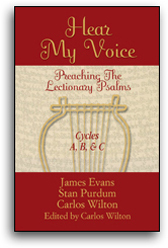
Hear My Voice
Preaching The Lectionary Psalms for Cycles A, B, C
Object:
(Occurs in all three cycles of the lectionary; see Liturgy Of The Passion, Cycle B and Cycle C, for alternative approaches; see also Easter 5, Cycle A, for an alternative approach to vv. 1-5, 15-16.)

On this day when preachers have to decide whether to pursue the palms or the Passion, it should be noted that Psalm 31:9-16 is part of the Liturgy Of The Passion, not the Liturgy Of The Palms, and it occupies that place for all three years of the Revised Common Lectionary. But even if one did not know that, the tone of these verses would surely push one away from any triumphalism. These words are the cry of a person in agony.
A couple of preaching possibilities:
1. Verse 9 and especially verse 10 can be taken literally, as references to serious illness. Many sufferers have found courage and hope in viewing the voluntary suffering of Jesus. One pastor mentioned visiting a Christian woman who was in the end stages of cancer, and was in terrible pain. Yet she said to the pastor, "If Jesus suffered for me, I can suffer for him." For his own part, the pastor thought the woman's comment was simplistic. How could her embracing her own suffering, which was caused not by sin but by rogue cells, be doing anything for God? But the fact was, that self-understanding was helping the woman handle her ordeal. Wisely, the pastor did nothing to challenge her view. Maybe the woman was right anyway. Here's a place to talk about redemptive suffering.
2. Verse 12, "I have passed out of mind like one who is dead," could easily be the lament of a person "downsized" out of a job and unable to find new employment. Those who have "been there" testify that it really does feel like being forgotten by one's former workmates, employers, and even the crowd one ran with while employed. What will it take to get a person in such straits to trust that "my times are in your hands" (v. 15)?
-- S. P.
On this day when preachers have to decide whether to pursue the palms or the Passion, it should be noted that Psalm 31:9-16 is part of the Liturgy Of The Passion, not the Liturgy Of The Palms, and it occupies that place for all three years of the Revised Common Lectionary. But even if one did not know that, the tone of these verses would surely push one away from any triumphalism. These words are the cry of a person in agony.
A couple of preaching possibilities:
1. Verse 9 and especially verse 10 can be taken literally, as references to serious illness. Many sufferers have found courage and hope in viewing the voluntary suffering of Jesus. One pastor mentioned visiting a Christian woman who was in the end stages of cancer, and was in terrible pain. Yet she said to the pastor, "If Jesus suffered for me, I can suffer for him." For his own part, the pastor thought the woman's comment was simplistic. How could her embracing her own suffering, which was caused not by sin but by rogue cells, be doing anything for God? But the fact was, that self-understanding was helping the woman handle her ordeal. Wisely, the pastor did nothing to challenge her view. Maybe the woman was right anyway. Here's a place to talk about redemptive suffering.
2. Verse 12, "I have passed out of mind like one who is dead," could easily be the lament of a person "downsized" out of a job and unable to find new employment. Those who have "been there" testify that it really does feel like being forgotten by one's former workmates, employers, and even the crowd one ran with while employed. What will it take to get a person in such straits to trust that "my times are in your hands" (v. 15)?
-- S. P.