
Listening For The Voice Of The Good Shepherd
Sermon
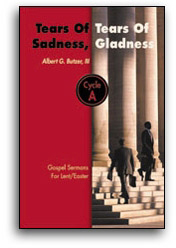
Tears Of Sadness, Tears Of Gladness
Gospel Sermons For Lent/Easter
I know a woman who says that her husband has a listening problem. Incidentally, this is not autobiographical. To be sure, he does have a hearing problem and wears hearing aids to compensate, but his real problem - at least according to his wife - is not a hearing problem but a listening problem. She says to him, "I'm going to the store, so would you please turn the oven to 350 degrees at 5:30 and put in the casserole." "Sure," he replies, "no problem." But when she comes home, the dinner is still cold. By the way, did I remember to tell you that this is not autobiographical! She says to him, "Would you please keep Saturday morning free. I need you to take the kids to the orthodontist." "Of course, honey," he answers. But when Saturday comes he suddenly remembers that he has something else to do - a conflict. "I can't take the kids to the orthodontist," he protests. "Why didn't you ask me sooner?"

Why do you suppose that husband has so much trouble listening to his wife? We might be tempted to explain it away by saying that he's just becoming forgetful. He's having one of those, so called "senior moments." Or maybe we could blame it on the male chromosome. Men are born not to listen to the important women in their lives, just as they are born not to ask for directions when they get lost! But such explanations seem too silly and simplistic for these complex times in which we live.
A better explanation would be to say this - we live in a time in which many different voices compete for our attention. And with so many voices crying out to us, it's hard to pay attention to the voices that really matter. Have you ever stopped to think about all of these competing voices? For example:
´ There is the voice of success or career ambition, which says, "You want to be somebody, don't you? Don't you want to make a name for yourself? Don't you want to climb your way up the career ladder? Work harder" says this voice. "Become a success." And competing with this voice is the voice which says, "If you spend all your time striving for success, you won't have any time left for your boyfriend or your girlfriend, your beloved, your family. If you work 60 or 65 hours a week, how will you ever spend time with those who are most important to you?"
´ There is the voice of consumerism, which tells you why you need this new car, this new computer, this new kitchen appliance, this new golf club, this new pair of shoes. "Go ahead," says the voice of consumerism, "spend, buy, accumulate - you deserve it; you are entitled to it." This is the voice that urges us to paste a bumper sticker on the back of the mobile home that says, "We're spending our grandchildren's inheritance." This is the voice that takes as its motto, "Shop Till You Drop." As Sharon Daloz Parks has written:
Once, we only went to market. Now the market comes to us ... through television, telemarketing, magazines, catalogues, and online services. We wear advertising on our clothing and plaster it on every fa ade of our common life. And it works. Americans now spend more time and money shopping than do citizens of any other nation.1
And competing with this voice is the voice of simplicity, the voice that says, "Do you really need all of these things? Does filling your life (not to mention your house and your closet) with all this stuff make you a better person? Does it increase your self worth?" Why not try to live a simpler life, free from what the Quakers call "cumber"?
´ There is the voice of community, which invites you to be part of something bigger than yourself. It is the voice that President Kennedy invoked in his Inaugural Address when he said, "Ask not what your country can do for you - ask what you can do for your country."2 It is the voice that says, "Get involved. Give of your time and talent. Make a difference in our common life." And competing with this voice is the voice that says, "You need to look out for yourself. No one else is going to take care of you, so take care of yourself. Don't waste your time in the community. It's like putting a Band--Aid on a cancerous tumor. Instead, protect your own best interests. Collect, hoard, stockpile. If you don't look out for yourself, no one else will."
´ There is the voice of faith, which invites you into a world of mystery and meaning and says to you, "Trust, believe, pray, have faith in things unseen." And competing with this voice is the voice of reason and common sense, which says to you, "You don't believe any of that religious nonsense, do you? Proof is what you need. Science is the answer to all your questions. Faith is for the birds!"
These are but a few of the many voices that compete daily for our attention. Is it any wonder why we find it so hard to pay attention to the voices that really matter? Is it any wonder why so many of us have a listening problem?
How fortunate, therefore, that into a world of many voices comes the one we call Jesus. In fact, his voice was so clear and compelling - indeed, his whole life was such a miracle of speech - that some of his followers began to refer to him as the logos, that is the Word of God in human form. "In the beginning was the Word," writes John in the prologue to his Gospel, "and the Word was with God and the Word was God" (John 1:1).
The tenth chapter of John offers us one of the most beautiful images found anywhere in the Bible. At the same time it makes one of the most radical claims in scripture. By association, it invites us to recall some of the most endearing words ever written, the words of Psalm 23:
The LORD is my shepherd; I shall not want. He maketh me to lie down in green pastures: he leadeth me beside the still waters. He restoreth my soul: he leadeth me in the paths of righteousness for his name's sake. Yea, though I walk through the valley of the shadow of death, I will fear no evil: for thou art with me; thy rod and thy staff they comfort me. Thou preparest a table before me in the presence of mine enemies: thou anointest my head with oil; my cup runneth over. Surely goodness and mercy shall follow me all the days of my life: and I will dwell in the house of the LORD for ever.
- Psalm 23 (KJV)
After leading us back to those green pastures beside the still waters, John says in essence, "If you really want to know what God is like, then look at Jesus. If you want to come face to face with that divine Shepherd about whom the psalmist wrote, then follow Jesus for he is the Good Shepherd." Not only that, says John, but this Good Shepherd "calls his own sheep by name ... and the sheep follow him because they know his voice" (John 10:3--4).
Some might think of the idea of the sheep knowing the voice of the shepherd is a romantic notion far removed from reality. But it's actually true. Those who travel to the Holy Land often return with stories of nomadic shepherds leading their flocks to "the still waters" of some gentle stream running through the desert. Three or four shepherds and several dozen sheep all crowd together at the same place. Then, when the time to leave comes, one by one the shepherds break off from the others and call out to their own sheep with a distinct whistle, a familiar word, or the shrill sound from a pipe. Amazingly, only some of the sheep follow because they know their shepherd's voice. They know to whom they belong.
Do you know to whom you belong? Do you realize that the words longing and belonging come from the same root word?3 In other words, there is in each of us a longing to belong, a basic need to be part of something or someone to whom we can give our heart and soul. That is why some people join a club, a fraternity or a sorority; why others get lured into a gang or a cult. All of us long to belong to something or to someone.
´ "Our souls are restless until they find their rest in thee," said Saint Augustine in a familiar quote.
´ "It is not good that the man should be alone," said God at the time of creation. "I will make him a helper as his partner" (Genesis 2:18).
´ "What is your only comfort in life and death?" asks the first question of The Heidelberg Catechism. Answer: "That I belong - body and soul, in life and death - not to myself but to my faithful Savior, Jesus Christ, who at the cost of his own blood has fully paid for all my sins."4
"I am the Good Shepherd," says Jesus. "The Good Shepherd lays down his life for the sheep" (John 10:11).
Have you noticed what this passage requires of us if we want to belong to the flock of the Good Shepherd? Nothing! We belong, not because of any effort or belief on our part; rather, we belong simply because the Good Shepherd claims us as his own. Sadly, some people assume that they can't belong if they are unable first to say what they believe. For them, believing precedes belonging. Such people need to hear the advice of Episcopal priest Barbara Brown Taylor. In one of her books she writes:
Please stop exiling yourself from the flock because of your beliefs about what it takes to belong ... we belong to the flock not because we are certain of God, but because God is certain of us ... whether you are here because you believe or because you want to believe, you are here because you belong to God's sheep.5
Often we think that believing precedes belonging. However, in both life and faith the opposite is true most of the time. Belonging precedes believing. For example, when a first--grader places her hand above her heart and recites the words of the Pledge of Allegiance, does she understand all that it means to be an American? Of course not. But by reciting the words of the Pledge, she is affirming that she belongs, even if she is too young to express exactly what she believes.
It's the same for people of faith. When we decide to be part of the flock of the Good Shepherd, when we decide to belong, gradually we grow in our beliefs. Gradually we learn what it means to confess Christ as Savior and Lord. Gradually we realize that his voice is the one voice that really matters.
We live in a time in which many different voices compete for our attention. With so many voices crying out to us, how important to learn to listen to the voice of the Good Shepherd. The Good Shepherd "calls his own sheep by name and leads them out ... and the sheep follow him" - why? - "because they know his voice."
____________
1. Sharon Daloz Parks, "Household Economics," Practicing Our Faith, Dorothy C. Bass, ed. (San Francisco: Jossey--Bass Publishers, 1997), pp. 45--46.
2. John F. Kennedy "Inaugural Address," Great American Speeches, Gregory R. Suriano, ed. (New York; Gramercy Books, 1993), pp. 219--220.
3. This insight is offered by Frederick Buechner, The Longing For Home (San Francisco: Harper Collins Publishers, 1996), p. 18.
4. The Heidelberg Catechism, in The Book Of Confessions (Louisville: Published by The Office of the General Assembly of the Presbyterian Church, 1994), 4.001.
5. Barbara Brown Taylor, The Preaching Life (Cambridge: Cowley Publications, 1993), pp. 144--145.
Why do you suppose that husband has so much trouble listening to his wife? We might be tempted to explain it away by saying that he's just becoming forgetful. He's having one of those, so called "senior moments." Or maybe we could blame it on the male chromosome. Men are born not to listen to the important women in their lives, just as they are born not to ask for directions when they get lost! But such explanations seem too silly and simplistic for these complex times in which we live.
A better explanation would be to say this - we live in a time in which many different voices compete for our attention. And with so many voices crying out to us, it's hard to pay attention to the voices that really matter. Have you ever stopped to think about all of these competing voices? For example:
´ There is the voice of success or career ambition, which says, "You want to be somebody, don't you? Don't you want to make a name for yourself? Don't you want to climb your way up the career ladder? Work harder" says this voice. "Become a success." And competing with this voice is the voice which says, "If you spend all your time striving for success, you won't have any time left for your boyfriend or your girlfriend, your beloved, your family. If you work 60 or 65 hours a week, how will you ever spend time with those who are most important to you?"
´ There is the voice of consumerism, which tells you why you need this new car, this new computer, this new kitchen appliance, this new golf club, this new pair of shoes. "Go ahead," says the voice of consumerism, "spend, buy, accumulate - you deserve it; you are entitled to it." This is the voice that urges us to paste a bumper sticker on the back of the mobile home that says, "We're spending our grandchildren's inheritance." This is the voice that takes as its motto, "Shop Till You Drop." As Sharon Daloz Parks has written:
Once, we only went to market. Now the market comes to us ... through television, telemarketing, magazines, catalogues, and online services. We wear advertising on our clothing and plaster it on every fa ade of our common life. And it works. Americans now spend more time and money shopping than do citizens of any other nation.1
And competing with this voice is the voice of simplicity, the voice that says, "Do you really need all of these things? Does filling your life (not to mention your house and your closet) with all this stuff make you a better person? Does it increase your self worth?" Why not try to live a simpler life, free from what the Quakers call "cumber"?
´ There is the voice of community, which invites you to be part of something bigger than yourself. It is the voice that President Kennedy invoked in his Inaugural Address when he said, "Ask not what your country can do for you - ask what you can do for your country."2 It is the voice that says, "Get involved. Give of your time and talent. Make a difference in our common life." And competing with this voice is the voice that says, "You need to look out for yourself. No one else is going to take care of you, so take care of yourself. Don't waste your time in the community. It's like putting a Band--Aid on a cancerous tumor. Instead, protect your own best interests. Collect, hoard, stockpile. If you don't look out for yourself, no one else will."
´ There is the voice of faith, which invites you into a world of mystery and meaning and says to you, "Trust, believe, pray, have faith in things unseen." And competing with this voice is the voice of reason and common sense, which says to you, "You don't believe any of that religious nonsense, do you? Proof is what you need. Science is the answer to all your questions. Faith is for the birds!"
These are but a few of the many voices that compete daily for our attention. Is it any wonder why we find it so hard to pay attention to the voices that really matter? Is it any wonder why so many of us have a listening problem?
How fortunate, therefore, that into a world of many voices comes the one we call Jesus. In fact, his voice was so clear and compelling - indeed, his whole life was such a miracle of speech - that some of his followers began to refer to him as the logos, that is the Word of God in human form. "In the beginning was the Word," writes John in the prologue to his Gospel, "and the Word was with God and the Word was God" (John 1:1).
The tenth chapter of John offers us one of the most beautiful images found anywhere in the Bible. At the same time it makes one of the most radical claims in scripture. By association, it invites us to recall some of the most endearing words ever written, the words of Psalm 23:
The LORD is my shepherd; I shall not want. He maketh me to lie down in green pastures: he leadeth me beside the still waters. He restoreth my soul: he leadeth me in the paths of righteousness for his name's sake. Yea, though I walk through the valley of the shadow of death, I will fear no evil: for thou art with me; thy rod and thy staff they comfort me. Thou preparest a table before me in the presence of mine enemies: thou anointest my head with oil; my cup runneth over. Surely goodness and mercy shall follow me all the days of my life: and I will dwell in the house of the LORD for ever.
- Psalm 23 (KJV)
After leading us back to those green pastures beside the still waters, John says in essence, "If you really want to know what God is like, then look at Jesus. If you want to come face to face with that divine Shepherd about whom the psalmist wrote, then follow Jesus for he is the Good Shepherd." Not only that, says John, but this Good Shepherd "calls his own sheep by name ... and the sheep follow him because they know his voice" (John 10:3--4).
Some might think of the idea of the sheep knowing the voice of the shepherd is a romantic notion far removed from reality. But it's actually true. Those who travel to the Holy Land often return with stories of nomadic shepherds leading their flocks to "the still waters" of some gentle stream running through the desert. Three or four shepherds and several dozen sheep all crowd together at the same place. Then, when the time to leave comes, one by one the shepherds break off from the others and call out to their own sheep with a distinct whistle, a familiar word, or the shrill sound from a pipe. Amazingly, only some of the sheep follow because they know their shepherd's voice. They know to whom they belong.
Do you know to whom you belong? Do you realize that the words longing and belonging come from the same root word?3 In other words, there is in each of us a longing to belong, a basic need to be part of something or someone to whom we can give our heart and soul. That is why some people join a club, a fraternity or a sorority; why others get lured into a gang or a cult. All of us long to belong to something or to someone.
´ "Our souls are restless until they find their rest in thee," said Saint Augustine in a familiar quote.
´ "It is not good that the man should be alone," said God at the time of creation. "I will make him a helper as his partner" (Genesis 2:18).
´ "What is your only comfort in life and death?" asks the first question of The Heidelberg Catechism. Answer: "That I belong - body and soul, in life and death - not to myself but to my faithful Savior, Jesus Christ, who at the cost of his own blood has fully paid for all my sins."4
"I am the Good Shepherd," says Jesus. "The Good Shepherd lays down his life for the sheep" (John 10:11).
Have you noticed what this passage requires of us if we want to belong to the flock of the Good Shepherd? Nothing! We belong, not because of any effort or belief on our part; rather, we belong simply because the Good Shepherd claims us as his own. Sadly, some people assume that they can't belong if they are unable first to say what they believe. For them, believing precedes belonging. Such people need to hear the advice of Episcopal priest Barbara Brown Taylor. In one of her books she writes:
Please stop exiling yourself from the flock because of your beliefs about what it takes to belong ... we belong to the flock not because we are certain of God, but because God is certain of us ... whether you are here because you believe or because you want to believe, you are here because you belong to God's sheep.5
Often we think that believing precedes belonging. However, in both life and faith the opposite is true most of the time. Belonging precedes believing. For example, when a first--grader places her hand above her heart and recites the words of the Pledge of Allegiance, does she understand all that it means to be an American? Of course not. But by reciting the words of the Pledge, she is affirming that she belongs, even if she is too young to express exactly what she believes.
It's the same for people of faith. When we decide to be part of the flock of the Good Shepherd, when we decide to belong, gradually we grow in our beliefs. Gradually we learn what it means to confess Christ as Savior and Lord. Gradually we realize that his voice is the one voice that really matters.
We live in a time in which many different voices compete for our attention. With so many voices crying out to us, how important to learn to listen to the voice of the Good Shepherd. The Good Shepherd "calls his own sheep by name and leads them out ... and the sheep follow him" - why? - "because they know his voice."
____________
1. Sharon Daloz Parks, "Household Economics," Practicing Our Faith, Dorothy C. Bass, ed. (San Francisco: Jossey--Bass Publishers, 1997), pp. 45--46.
2. John F. Kennedy "Inaugural Address," Great American Speeches, Gregory R. Suriano, ed. (New York; Gramercy Books, 1993), pp. 219--220.
3. This insight is offered by Frederick Buechner, The Longing For Home (San Francisco: Harper Collins Publishers, 1996), p. 18.
4. The Heidelberg Catechism, in The Book Of Confessions (Louisville: Published by The Office of the General Assembly of the Presbyterian Church, 1994), 4.001.
5. Barbara Brown Taylor, The Preaching Life (Cambridge: Cowley Publications, 1993), pp. 144--145.

