Listening To The Dreams
Sermon
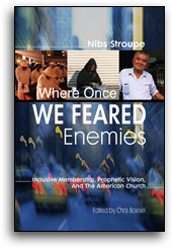
Where Once We Feared Enemies
Inclusive Membership, Prophetic Vision, And The American Church
These two sermons constitute the heart of Stroupe's homiletic response to the events of 9/11. They model how preaching can become a prophetic voice addressing the momentous events of the day through a deep and vital explication of scripture. These sermons also model the risk of following through on the counter-cultural implications of the gospel proclaimed: we belong to God as the true source of our identity and security. In a very specific and highly charged historical moment, Stroupe's prophetic voice speaks radically against the grain of the overwhelming chorus of cultural and political voices giving expression to the corporate sense of violation and vulnerability and the communal desire for retaliation and security. This chorus of voices was not limited to the general culture outside the doors of Oakhurst, but was echoed by many within the congregation of Oakhurst itself. As is clear throughout this collection of sermons, Stroupe's preaching is clearly informed by, and gives expression to, the distinctive voices of Oakhurst. However, these sermons demonstrate that the risk of prophetic speech modeled by Stroupe involves confronting the local congregation itself, as well as the culture and nation at large.

Comes The Dreamer
Genesis 41:1-36
November 4, 2001
Who among us has not been awakened by a scary and disturbing dream? Even young children are aware of these kinds of dreams. We who are adults know it, also. It is a dream that leaves us full of fear and anxiety, that shakes up our view of ourselves, and our view of the world. No one is quite sure what dreams are. Freud said that dreams are the repressed part of ourselves speaking to the conscious part of ourselves. Jung said that dreams are the collective wisdom of the ages speaking to us. Wise people in many cultures tell us that dreams are our ancestors speaking to us, or perhaps even God speaking to us.
Whatever the nature of dreams, they have a way of helping us to step outside ourselves, outside our normal way of perceiving and thinking and understanding, helping us to gain perspective on ourselves and our lives, and on life itself. That's why people like Martin Luther King, Jr., used dream imagery in his most famous speech in Washington, D.C. in 1963. "I have a dream," he said. He was not talking about a dream that he had the night before. He was talking about a vision of a new and different reality, a reality that was difficult to imagine in the middle of white supremacy. A dream that was nonetheless being imagined, a dream where racial classification would not be an essential component of life. "I have a dream," he said, and that dream began to change the face and character of American society.
Whatever the nature of dreams, in today's scripture lesson we see that one of the most powerful men in the world has a dream that shakes him to the core. The great Pharaoh, king of the Egyptian empire, dreams about terrible things happening to his cattle and his grain. These terrible things originate not in an alien source outside Egypt, but from the great source of Egyptian fertility and power, from the Nile River itself. So it is no wonder Pharaoh is troubled and shaken by his dreams. The heart of the Egyptian economy, livestock and agriculture are attacked, and they are attacked not by aliens but by the very symbol of Egypt. The Nile River is the source of the ugly ears and the lean cows that devour the good corn and the fat cattle. The Nile River becomes a place of death, not life, and the entire empire is shaken.
Pharaoh calls all of the wise leaders of his empire -- his advisers, his visionaries. He calls the secretary of state, the secretary of defense, the secretary of commerce, but they cannot give him insight into his dreams. These advisers undoubtedly have interpretations of Pharaoh's dreams. After all, that is what they are paid to do, to interpret the meaning of what is going on. But none of these interpreters can speak to the trouble that occupies Pharaoh's heart. The best and brightest of the empire are stumped, and their vision is truncated. They cannot see what these dreams mean.
They are stumped because these dreams call into question the very reality that Pharaoh and Egypt think they know. Because these dreams attack the heart of the Egyptian empire, no one whose reality depends upon Egypt's view of life is able to interpret these dreams. The best wisdom of Egypt is useless.
That brings us to a hinge point in this story, indeed in the entire Old Testament history of Israel. Pharaoh's cupbearer remembers a promise that he made to somebody in prison, to a foreigner in jail. He remembers that he had promised to remember this prisoner when the right time came, but it has been two years since his release from prison, and he has forgotten his promise. But now he remembers, and he confesses to Pharaoh that he has made a mistake. He tells Pharaoh that he remembers a Hebrew prisoner who is a visionary, a dreamer. Pharaoh is wise enough to send for the prisoner.
We must not underestimate Pharaoh's wisdom in seeking the advice of this young Hebrew prisoner. Pharaoh, one of the most powerful men in the world, could have dismissed the cupbearer's suggestion as idiotic. How can a foreigner, a prisoner, a convicted sex offender bring wisdom to the great Pharaoh? What can this prisoner discern that the great, wise leaders of Egypt have not discerned? Yet, to his credit, he sends for this young Hebrew named Joseph.
We must take a moment and notice how highly unusual this is. Almost always, dreamers and visionaries are greeted with skepticism and often with contempt. We have seen this earlier in the Joseph saga. Just before the boy Joseph is thrown into a pit the first time -- not by a foreigner, but by his brothers -- they say with contempt, "Here comes the dreamer." Dreamers and visionaries are often seen as naive, as unrealistic, not understanding the real world and how it works. Sometimes they are seen as threatening because they are able to see deeper and longer. They see beneath the surface of what we call "real." They are able to see root causes and a deeper understanding of life. They are able to see long-term consequences of actions long before most of us even notice the action, much less the consequences. They're able to see beneath the surface of existing systems.
In 1963, when Martin Luther King, Jr., said, "I have a dream," white society thought he was ridiculous. He was considered to be a communist, a threat to the social order. Though he was no communist, he was a threat to the existing social order of white supremacy. He envisioned a new reality in which white people would not be on top. He envisioned a reality in which humanity would be a family instead of a hierarchy with white people on top. And in today's scripture story, comes another dreamer. Nothing could be more ridiculous or outlandish than this scene that is given to us in chapter 41 of Genesis: the powerless prisoner Joseph, a foreigner, standing before one of the most powerful people in the world. Joseph is there because he has been summoned as a dreamer and a visionary.
We must also note Joseph's demeanor here. He has learned a lot in prison. He knows his strengths. The narrator in Genesis tells us that before he goes to see Pharaoh, he cleans himself up. He's good looking, and he's charming, and he wants to make sure that Pharaoh sees that. He knows how to get his message across. Joseph also knows his weaknesses. His two "pit stops" have taught him about his weaknesses. No prancing around here, as he did with his brothers, telling them how great he was. In today's story, he doesn't even take credit for his visions. When Pharaoh says to him, "I've heard that you have a gift for interpreting dreams," Joseph discounts himself and says, "It's not me. It's God. God will give the interpretation if God chooses." He gives the credit to God and not to himself. His two times in the pit, in exile, has humbled and deepened him.
Through God's power, Joseph the outcast, the prisoner, the powerless one, offers profound insight into Pharaoh's dream. Joseph is able to interpret the dreams because he stands outside the value system of the Egyptian empire. To him, the Nile is just another river and is not the source of creativity and life that it is to the Egyptians. He brings wisdom and insight to the dilemma of Pharaoh and Egypt. He is able to see root causes and discern long-term consequences. Comes the dreamer, and he brings truth and discernment.
Pharaoh and Egypt are shaken to their core by these dreams. The central symbols of their reality are attacked -- cows and crops and the Nile River. The discernment of Joseph through God's power helps Egypt avoid great disaster. Prior to Joseph's discernment, all of Egypt is shaken and afraid. We know that feeling in our country. In many ways, we in the United States find ourselves in the same predicament as Pharaoh was after September 11. Our predicament is not a dream. We've seen thousands killed in our country. But in many ways, we are like Pharaoh and Egypt. The attackers of September 11 used our airplanes to carry out the attack. Our airplanes, symbols of our economic and military power now used as implements of destruction, now becoming symbols of death rather than economic power. None of us can trust getting on an airplane right now, and none of us can trust airplanes coming toward us. Our military now has standing orders to shoot down our own commercial airplanes. Our view of ourselves as a superpower able to control the world with our economic and military power has been interrupted and not only interrupted, but severely shaken.
Like Pharaoh, our leaders have called in their wise advisers, their interpreters -- the secretaries of state and of defense and of commerce and all kinds of other visionaries -- to help them interpret the meaning of these events and this predicament. What does it mean? The most commonly accepted interpretation given is that innocent Americans were attacked by fanatical, if not insane, terrorists, those who are haters of America and the freedom, equality, and opportunity of the modern world that it represents. The course of action that follows from this interpretation is to kill or imprison the terrorists, even if it means destroying towns and civilians to do it. Indeed, that is our present interpretation and course of action. Our symbols of power and might, like Pharaoh's symbols, have been attacked, and our response is to attack in return.
In our struggles and in our present interpretation and actions, we must be very careful to remember this biblical story of Pharaoh and Joseph. Pharaoh was wise enough to discern that the predicament was too profound and too threatening to leave the interpretation of it to the powerful. It is no surprise that our president calls in Donald Rumsfeld, John Ashcroft, and Dick Cheney or that the previous president called William Cohen and Janet Reno. They are trusted advisers and should be consulted. What this biblical story of Pharaoh and Joseph tells us, however, is that the interpretations of these powerful people are not helpful in the situation because they are so aligned to the symbols of our culture that their visions are truncated.
This biblical story tells us that because this situation is so threatening, the powerful will not be able to interpret it well. In order to discern the truth, we must turn to those who are powerless as Joseph was. We must turn to those who are not greatly invested in the system that is so threatened. The dreamers and the visionaries, like Joseph, are the ones who must be consulted to help us interpret our predicament. They will be able to discern deeper truths in this situation, truths that the powerful cannot discern. Now, of course, the dreamers and the visionaries are going to be seen as naive and unrealistic. To believe that we must not answer violence with violence is seen as unrealistic and even as treason. But we must listen carefully to this biblical story in Genesis. Our future depends upon our listening to the dreamers and the visionaries in our midst. In today's story in Genesis, the future of Pharaoh and Egypt depended upon the system listening to the dreamer. So does ours.
Where are the Josephs of our day and our time? Oh, they are in our midst -- those who are poor, who are in prison, who are powerless, who are oppressed and outcast. Many have been crushed by their oppression and marginality, but some are like Joseph. They have developed the capacity to see deeper realities, and they see more than Islamic fundamentalists in our current predicament. They see Islamic fundamentalists, but they see more than that, and that is what we need to hear. Where are the Josephs? They are in our midst, and next week we will look at some of them and seek their insights and interpretations.
For today, as we tremble before the approach of another week, as our leaders contemplate whether we will bomb during the holy season of Ramadan in Afghanistan, we must ask ourselves, "Will we be wise enough to listen to the dreamers and visionaries in our midst?" Pharaoh sent for Joseph. Joseph didn't invite himself into Pharaoh's presence, that's not how it is done. Pharaoh sent for Joseph. Will our leaders do that? Will we send for people like Joseph? Or will we say with contempt as Joseph's brothers did, "Comes the dreamer," naive, unrealistic, doesn't know how the world really works.
There is an alternative to this contempt. Will we say with Pharaoh -- the one we would least expect to do it -- will we say with desperation and longing and hope, "Comes the dreamer!" Come, help us discern the deeper meaning, the deeper realities which our truncated vision prevents us from seeing. We are at the watershed point in our history. This is not a game. This is fundamental. In the midst of tragedy and death, God is moving in our history. Like Pharaoh and Egypt, we are at a crucial turning point. Whose voices, whose interpretations will we heed? The court advisers? The powerful? Or the dreamers like Joseph? It is a hinge point in our history. The future of our children and our grandchildren await our decision. Let us remember this biblical story, and let us listen to the dreamers. Amen.
Seeing Beneath The Surface
Genesis 41:37-57
November 11, 2001
As we read in our scripture lesson for today, Pharaoh has had dreams that have shaken him and the Egyptian empire to their core. The symbols of Egyptian power and wealth -- cows and corn and the Nile River -- are attacked in dreams. Pharaoh calls for the secretary of state, the secretary of defense, and Alan Greenspan, the head of the Federal Reserve, to help him interpret the situation. What's going on here? They have many things to tell him, but none of them strike Pharaoh as being true. There's still something missing. He has not heard what he needs to hear in order to understand the true meaning of these dreams. In his desperation, he turns to a foreigner, a Hebrew prisoner named Joseph.
Joseph tells Pharaoh that these dreams mean that seven years of plenty are coming, followed by seven years of famine. When Joseph tells Pharaoh this interpretation, it strikes home for Pharaoh. He is both pleased and astonished. He has found a visionary, someone who is able to see beneath the surface of Egyptian society, someone who is able to see deeper realities and powers that are often hidden from most of us because we are so caught up in the values of our systems. When crisis comes, we are unable to respond well because these deeper realities are hidden from us. Pharaoh finds a visionary who is able to see these realities.
Pharaoh receives these insights, and he does a highly unusual thing. He makes a radical change in his public policy because he has discerned the truth of these deeper realities. He puts the visionary in charge of re-ordering the Egyptian way of life. We must recall that this visionary is a prisoner, convicted of a sex offense. It is as if President Lyndon Johnson called Martin Luther King, Jr., on April 3, 1968, to tell Dr. King that he wanted to put him in charge of the Justice Department of the United States. Not the Martin Luther King, Jr., who has been sanitized by our national holiday, but the King who was so threatening to the American way of life that he was jailed almost thirty times and was finally assassinated on April 4, 1968, as he came to Memphis to help striking garbage workers seek living wages. It is an astonishing development in Egypt, that Pharaoh brings a foreigner out of prison to become the number two person in charge of the Egyptian empire.
It is a stunning development for Joseph. From the pit he comes, a dreamer and a visionary, but also a prisoner and a foreigner who becomes the head of the Egyptian government, answering only to Pharaoh. I can think of only one comparable rise in modern times, Nelson Mandela's rise in South Africa. He was not a foreigner as was Joseph, but to most white people in South Africa, he was a foreigner, a huge threat to their way of life. Yet after 27 years in prison, Nelson Mandela rises to become president of South Africa, a pivotal figure at a pivotal time.
Pharaoh shows wisdom. He recognizes the limits of the Egyptian empire, a recognition that is unusual in itself for kings. He calls on a visionary to help discern and to help implement the realities revealed in Pharaoh's dream. Pharaoh was shaken by his dreams. It was such a deep and disturbing threat that he was forced to open his ears and his heart to receive the voice of a visionary who was outside the circle of the powerful. The deep realities that would shape Egypt for the next fifty years could be seen only by one who was not heavily invested in the Egyptian system.
We have had that same experience in this country since September 11. The attacks of September 11 have shaken us to our core. The advice from the powerful is the same that it has always been and the same that it will always be. In the Cold War, it was the communists. In the new century, it is the terrorists. It has reinforced the conservative ideology that the world is a dangerous and threatening place. It has reinforced the idea that our lives must be based on protecting ourselves from being contaminated by others. In this atmosphere, everyone becomes a suspect. We are now holding over 1,000 people in our jails without specific charges. It is the most that we have jailed without specific charges since we rounded up people of Japanese descent in World War II. We should not be surprised at this reaction by our leadership. After all, the Bush administration began its term by renouncing treaties on global warming and a missile defense system, indicating that we were a people on our own, an island to ourselves. The current administration also attacked the common good by pushing a tax relief bill that only helped rich and comfortable people, and now we are beginning to pay the price for it.
However, it's not just the conservatives who can't see the deeper realities. Many of us are so threatened that we, too, get caught up in the fear. One of my favorite columnists, Leonard Pitts, who writes for the Miami Herald, has sounded like a writer for Jesse Helms since September 11. People who are normally moderate like Jonathan Alter, a columnist in Newsweek, lambasted those visionaries among us who sought to discern deeper realities. He called them "Blame America Firsters" and dismissed them as fools. This is part of that column.
And none but a fool would say, as the novelist Alice Walker did in The Village Voice, that "the only punishment that works is love." We've tried turning the other cheek. After the 1993 World Trade Center bombing we held our fire and treated the attack as a law-enforcement matter. The terrorists struck again, anyway. This time the Munich analogy is right: appeasement is doomed.
America Firsters grasped this point after Pearl Harbor and the isolationists ran off to enlist. So why can't Blame America Firsters grasp it now? Al Qaeda was planning its attack at exactly the time the United States was offering a Mideast peace deal favorable to the Palestinians. Nothing from us would have satisfied the fanatics, and nothing ever will. Peace won't be with you, brother. It's kill or be killed.1
These are the kind of times in which we live, the kind of times when dreamers and visionaries are seen as naive and unrealistic and even as traitors. When Congresswoman Cynthia McKinney suggests that Mideast realities are connected to September 11, she is branded as a traitor in this country. Those who see an endless cycle of violence in Afghanistan that threatens to spiral out of control are dismissed as unrealistic in the real, dangerous, and threatening world. Those who suggest that our participation in injustice in the Mideast and other parts of the world is connected to September 11 are called naive at best and traitors and un-American at worst. Difficult to hear. Difficult words to speak. Yet, like Pharaoh in Egypt, we would be well advised to listen to the Joseph's in our midst, to the dreamers and the visionaries. In their dreams and perceptions we will glimpse the redeeming activity of God in a terrible time. I've compiled a list of some of the insights from dreamers and visionaries in our midst. Folks like Martin Luther King, Jr., Dorothy Day, June Jordan, Wendell Berry, Michael Lerner, and many others. I want to share five insights culled from their work. You may not agree with all of them. Indeed, you may not agree with any of them. Some of our members have called me un-American because of my sermons on the issues of September 11. But, I hope that these visionaries will provoke all of us to go beneath the surface, to compile our own lists of insights and revelations.
In the midst of a terrible time, I want to share five insights from dreamers and visionaries in our midst. The first insight is that we in the United States are part of the world. That seems obvious in stating it, but many of us in this country believe that we are above the rest of the world, if not in control of the world. We somehow have developed the belief that we are aloof from the rest of the world. It is a difficult lesson for us to learn. Our president began his term by renouncing the treaty on global warming, indicating that we were aloof from this threat to the world community. He also renounced the treaty on the missile defense system, which has kept nuclear weapons out of the air. He indicated that we would go our own way on this. The events of September 11 should remind us that we are part of the world, no matter how much we would like to think otherwise.
It is one of the lessons that Joseph had to learn in order to grow up. He was his daddy's favorite, and he made sure that his siblings knew it. His attitude changed but only because of his time in exile, in the pit and in prison. He learned that he was part of a larger community. I was an only child growing up, and I felt that the world centered on me. There are many blessings of being an only child, but one of the curses is that one has trouble not focusing only on the self. I remember when I graduated from high school, I had this fantasy that the school would close down after I left, that its history was essentially over. I've noticed that somehow they've managed to go on without me. I also remember that when our second child was born, I was sad for our first child. He would no longer be an only child. He would not be able to receive the same amount of attention from my wife and me that he had been receiving, and he would feel the loss. Yet, I also felt good for him, because he would necessarily be forced to see that the world did not center on him. His sister would, and did, shift his worldview.
I believe that we have the same opportunity now as a nation. In many ways before September 11, we thought of ourselves as only children in the world of nations. We believed that the world centered on us. Now we see that there are siblings out there, and that we must learn to live together. If we do not learn to live together as sisters and brothers, the consequences will be drastic. Not just for them, but for us, too.
The second insight is to understand the way the rest of the world sees us, and to be frank in that assessment. They see us as a greedy empire. There is no other way to put it. Some of them may envy us, but most of them see us as an empire that sucks money and labor and resources from other cultures, as an empire that has the military might to back up this system. They see us as believing that money is life, that money is God. That's the way most of the world sees us. They may not tell us that directly because they want stuff from us, but most of the world sees us as a greedy empire.
Our own president seems to be gaining insight on this perception. He alluded to it in his speech in Atlanta. He said, "Too many have the wrong idea of Americans as shallow, materialist consumers who care only about getting rich or getting ahead."2 He has been listening to some Joseph in his midst. I don't know who it is, but I'd like to think that it is Condoleezza Rice, since she is Presbyterian.
The third insight is that while we must protect ourselves in the short run, we must recognize a longer view. Those who organized the attacks of September 11 are a threat to us and to humanity. They are smart and dangerous, and they must be contained. We must recognize, however, that in the long run, we will not be able to bomb them away. The only way that we will have protection in the long run is to make sure that we are working for justice as a nation and that other nations are moving toward justice. If we pursue this course there will be no Afghanistan or Saudi Arabia or other nations that will harbor these folk because they believe that they are fighting against injustice. We must recognize that in the long run the only real protection we have is to do what Pharaoh did and change our perception of reality. In our case, such a change will mean a shift of energy toward justice and peace and away from dominating the world and away from believing that affluence and individualism are the primary goals of life.
That leads to the fourth insight. We must use the same amount of energy that we are using in Afghanistan to work for a just peace in the Middle East. We must make it clear to Israel that the Palestinians need a homeland and make it clear to the Palestinians that Israel will exist. This fourth insight may sound impossible, but in 1993-1995, when Yitzak Rabin was the leader of Israel, he was working for peace. During this time there were few acts of Palestinian violence toward Israel. There was one central act of violence during this time, and it took Rabin's life. This violence came not from a Palestinian terrorist, but from a right wing Israeli terrorist, and it ended the time of relative peace in the Middle East.
We must re-focus our understanding of justice and sharing. We have turned a deaf ear and a hard heart to our hoarding of most of the world's resources. We have indeed touted globalization and have demanded that other people give us their resources and their labor and their capital so that we can live better lives, all the while telling them that they will live better lives. That brings us to the fifth insight. We must have a reformation here at home. We must turn away from our idolatrous worship of the free market that requires universal pollution, produces global warming, promotes greed as a virtue, increases geometrically the gap between the rich and the poor, and which needs a strong military to enforce this belief system. We must turn away from that and turn toward loving and engagement and community. We must turn away from believing that money is life. If we do not, the events of September 11 will happen again and again, the consequences of our idolatrous worship.
In this area, once again, a Joseph seems to be getting the ear of President Bush. Initially, after September 11, he told us that the answer for us was to go shopping while the military killed the terrorists. I think that Bill Clinton would have said the same thing, so let no one hear me criticizing the president just because he's a Republican. The point here is that those in power have difficulty perceiving the deeper realities and hearing different voices that point to those deeper realities.
In his Atlanta speech, President Bush seemed to float a trial balloon for a different view, telling us to get involved, indeed telling us to serve.
Ours is a wonderful nation full of kind and loving people, people of faith who want freedom and opportunity for people everywhere. One way to defeat terrorism is to show the world the true values of America through the gathering momentum of a million acts of responsibility and decency and service.3
He's on to something there. That is the way that we will defeat terrorism in the long run, by moving from a model of individualism and self-sufficiency to a model of community and interdependence. It remains to be seen what kind of leadership our president will give us, but I recognize that God is great. Just as God transformed Abraham Lincoln, another Republican in a difficult time, so may God transform George W. Bush. I pray that God will.
Whatever our leaders tell us and wherever our leaders seek to take us, these must be our guiding values. First, we must recognize ourselves as children of God. That's who we are. That's our primary definition. And the second value is like unto it. We must recognize others as children of God. That's their primary definition. I've read many articles on the September 11 events. Some of them have been awful. Some of them have been very challenging to me. Some of them have been very insightful. Of all of them, I want to return to my longtime mentor, Wendell Berry, to hear some words from him on our current predicament:
In a time such as this when we have been seriously and most cruelly hurt by those who hate us, and when we must consider ourselves to be gravely threatened by those same people, it is hard to speak of the ways of peace and to remember that Christ enjoined us to love our enemies, but this is no less necessary for being difficult. Even now we dare not forget that since the attack of Pearl Harbor -- to which the present attack has been often and not usefully compared -- we humans have suffered an almost uninterrupted sequence of wars, none of which has brought peace or made us more peaceable. The aim and result of war necessarily justifies the violence that won it and leads to further violence. If we are serious about innovation, must we not conclude that we need something new to replace our perpetual "war to end war"? What leads to peace is not violence but peaceableness, which is not passivity, but an alert, informed, practiced and active state of being. We should recognize that while we have extravagantly subsidized the means of war, we have almost totally neglected the ways of peaceableness. We have, for example, several national military academies, but not one peace academy. We have ignored the teachings and the examples of Christ, Gandhi, Martin Luther King, and other peaceable leaders. And here we have an inescapable duty to notice also that war is profitable, whereas the means of peaceableness, being cheap or free, make no money. The key to peaceableness is continuous practice.4
This is an exhausting and difficult list of insights, and there are other helpful insights, but I've run out of time. I hope that each of us, whether we applaud these insights or whether they make us boil with anger, will take the time to go beneath the surface and look at the deeper realities. Like Pharaoh in Joseph's time, we have been thrust into a terrible nightmare, full of dread and anxiety. But there are Josephs in our midst, visionaries and dreamers who can help us chart our course to health and safety. May we find those Josephs and listen to their insights.
This Pharaoh in Genesis 41 listened to Joseph, and his nation turned a terrible situation into a blessing for all people. Another Pharaoh, generations later, whose story is found in Exodus, did not listen to the visionary in his midst, a visionary named Moses. That Pharaoh saw his army obliterated in the sea. We, too, are in the same difficult times as were those Pharaohs in Egypt. The visionaries and dreamers like Joseph and Moses call us to see the deeper realities. There is no long-term protection other than justice and peace. Every book in the Bible proclaims this in one way or another. All of our Christian tradition emphasizes this again and again and again. There is no long-term protection other than justice and peace, centered in the God of all creation. Those voices are calling to us now in a difficult time. Let us hear them. Let us heed them. Let us believe them. Let us live them. Amen.
____________
1.�Jonathan Alter, "Blame America Firsters," Newsweek, October 15, 2001.
2.�"Bush: Courage, optimism will guide America," The Atlanta Constitution, November 9, 2001.
3.�Ibid.
4.�Wendell Berry, "Thoughts in the Presence of Fear," October 23, 2001, Internet Communications.
Comes The Dreamer
Genesis 41:1-36
November 4, 2001
Who among us has not been awakened by a scary and disturbing dream? Even young children are aware of these kinds of dreams. We who are adults know it, also. It is a dream that leaves us full of fear and anxiety, that shakes up our view of ourselves, and our view of the world. No one is quite sure what dreams are. Freud said that dreams are the repressed part of ourselves speaking to the conscious part of ourselves. Jung said that dreams are the collective wisdom of the ages speaking to us. Wise people in many cultures tell us that dreams are our ancestors speaking to us, or perhaps even God speaking to us.
Whatever the nature of dreams, they have a way of helping us to step outside ourselves, outside our normal way of perceiving and thinking and understanding, helping us to gain perspective on ourselves and our lives, and on life itself. That's why people like Martin Luther King, Jr., used dream imagery in his most famous speech in Washington, D.C. in 1963. "I have a dream," he said. He was not talking about a dream that he had the night before. He was talking about a vision of a new and different reality, a reality that was difficult to imagine in the middle of white supremacy. A dream that was nonetheless being imagined, a dream where racial classification would not be an essential component of life. "I have a dream," he said, and that dream began to change the face and character of American society.
Whatever the nature of dreams, in today's scripture lesson we see that one of the most powerful men in the world has a dream that shakes him to the core. The great Pharaoh, king of the Egyptian empire, dreams about terrible things happening to his cattle and his grain. These terrible things originate not in an alien source outside Egypt, but from the great source of Egyptian fertility and power, from the Nile River itself. So it is no wonder Pharaoh is troubled and shaken by his dreams. The heart of the Egyptian economy, livestock and agriculture are attacked, and they are attacked not by aliens but by the very symbol of Egypt. The Nile River is the source of the ugly ears and the lean cows that devour the good corn and the fat cattle. The Nile River becomes a place of death, not life, and the entire empire is shaken.
Pharaoh calls all of the wise leaders of his empire -- his advisers, his visionaries. He calls the secretary of state, the secretary of defense, the secretary of commerce, but they cannot give him insight into his dreams. These advisers undoubtedly have interpretations of Pharaoh's dreams. After all, that is what they are paid to do, to interpret the meaning of what is going on. But none of these interpreters can speak to the trouble that occupies Pharaoh's heart. The best and brightest of the empire are stumped, and their vision is truncated. They cannot see what these dreams mean.
They are stumped because these dreams call into question the very reality that Pharaoh and Egypt think they know. Because these dreams attack the heart of the Egyptian empire, no one whose reality depends upon Egypt's view of life is able to interpret these dreams. The best wisdom of Egypt is useless.
That brings us to a hinge point in this story, indeed in the entire Old Testament history of Israel. Pharaoh's cupbearer remembers a promise that he made to somebody in prison, to a foreigner in jail. He remembers that he had promised to remember this prisoner when the right time came, but it has been two years since his release from prison, and he has forgotten his promise. But now he remembers, and he confesses to Pharaoh that he has made a mistake. He tells Pharaoh that he remembers a Hebrew prisoner who is a visionary, a dreamer. Pharaoh is wise enough to send for the prisoner.
We must not underestimate Pharaoh's wisdom in seeking the advice of this young Hebrew prisoner. Pharaoh, one of the most powerful men in the world, could have dismissed the cupbearer's suggestion as idiotic. How can a foreigner, a prisoner, a convicted sex offender bring wisdom to the great Pharaoh? What can this prisoner discern that the great, wise leaders of Egypt have not discerned? Yet, to his credit, he sends for this young Hebrew named Joseph.
We must take a moment and notice how highly unusual this is. Almost always, dreamers and visionaries are greeted with skepticism and often with contempt. We have seen this earlier in the Joseph saga. Just before the boy Joseph is thrown into a pit the first time -- not by a foreigner, but by his brothers -- they say with contempt, "Here comes the dreamer." Dreamers and visionaries are often seen as naive, as unrealistic, not understanding the real world and how it works. Sometimes they are seen as threatening because they are able to see deeper and longer. They see beneath the surface of what we call "real." They are able to see root causes and a deeper understanding of life. They are able to see long-term consequences of actions long before most of us even notice the action, much less the consequences. They're able to see beneath the surface of existing systems.
In 1963, when Martin Luther King, Jr., said, "I have a dream," white society thought he was ridiculous. He was considered to be a communist, a threat to the social order. Though he was no communist, he was a threat to the existing social order of white supremacy. He envisioned a new reality in which white people would not be on top. He envisioned a reality in which humanity would be a family instead of a hierarchy with white people on top. And in today's scripture story, comes another dreamer. Nothing could be more ridiculous or outlandish than this scene that is given to us in chapter 41 of Genesis: the powerless prisoner Joseph, a foreigner, standing before one of the most powerful people in the world. Joseph is there because he has been summoned as a dreamer and a visionary.
We must also note Joseph's demeanor here. He has learned a lot in prison. He knows his strengths. The narrator in Genesis tells us that before he goes to see Pharaoh, he cleans himself up. He's good looking, and he's charming, and he wants to make sure that Pharaoh sees that. He knows how to get his message across. Joseph also knows his weaknesses. His two "pit stops" have taught him about his weaknesses. No prancing around here, as he did with his brothers, telling them how great he was. In today's story, he doesn't even take credit for his visions. When Pharaoh says to him, "I've heard that you have a gift for interpreting dreams," Joseph discounts himself and says, "It's not me. It's God. God will give the interpretation if God chooses." He gives the credit to God and not to himself. His two times in the pit, in exile, has humbled and deepened him.
Through God's power, Joseph the outcast, the prisoner, the powerless one, offers profound insight into Pharaoh's dream. Joseph is able to interpret the dreams because he stands outside the value system of the Egyptian empire. To him, the Nile is just another river and is not the source of creativity and life that it is to the Egyptians. He brings wisdom and insight to the dilemma of Pharaoh and Egypt. He is able to see root causes and discern long-term consequences. Comes the dreamer, and he brings truth and discernment.
Pharaoh and Egypt are shaken to their core by these dreams. The central symbols of their reality are attacked -- cows and crops and the Nile River. The discernment of Joseph through God's power helps Egypt avoid great disaster. Prior to Joseph's discernment, all of Egypt is shaken and afraid. We know that feeling in our country. In many ways, we in the United States find ourselves in the same predicament as Pharaoh was after September 11. Our predicament is not a dream. We've seen thousands killed in our country. But in many ways, we are like Pharaoh and Egypt. The attackers of September 11 used our airplanes to carry out the attack. Our airplanes, symbols of our economic and military power now used as implements of destruction, now becoming symbols of death rather than economic power. None of us can trust getting on an airplane right now, and none of us can trust airplanes coming toward us. Our military now has standing orders to shoot down our own commercial airplanes. Our view of ourselves as a superpower able to control the world with our economic and military power has been interrupted and not only interrupted, but severely shaken.
Like Pharaoh, our leaders have called in their wise advisers, their interpreters -- the secretaries of state and of defense and of commerce and all kinds of other visionaries -- to help them interpret the meaning of these events and this predicament. What does it mean? The most commonly accepted interpretation given is that innocent Americans were attacked by fanatical, if not insane, terrorists, those who are haters of America and the freedom, equality, and opportunity of the modern world that it represents. The course of action that follows from this interpretation is to kill or imprison the terrorists, even if it means destroying towns and civilians to do it. Indeed, that is our present interpretation and course of action. Our symbols of power and might, like Pharaoh's symbols, have been attacked, and our response is to attack in return.
In our struggles and in our present interpretation and actions, we must be very careful to remember this biblical story of Pharaoh and Joseph. Pharaoh was wise enough to discern that the predicament was too profound and too threatening to leave the interpretation of it to the powerful. It is no surprise that our president calls in Donald Rumsfeld, John Ashcroft, and Dick Cheney or that the previous president called William Cohen and Janet Reno. They are trusted advisers and should be consulted. What this biblical story of Pharaoh and Joseph tells us, however, is that the interpretations of these powerful people are not helpful in the situation because they are so aligned to the symbols of our culture that their visions are truncated.
This biblical story tells us that because this situation is so threatening, the powerful will not be able to interpret it well. In order to discern the truth, we must turn to those who are powerless as Joseph was. We must turn to those who are not greatly invested in the system that is so threatened. The dreamers and the visionaries, like Joseph, are the ones who must be consulted to help us interpret our predicament. They will be able to discern deeper truths in this situation, truths that the powerful cannot discern. Now, of course, the dreamers and the visionaries are going to be seen as naive and unrealistic. To believe that we must not answer violence with violence is seen as unrealistic and even as treason. But we must listen carefully to this biblical story in Genesis. Our future depends upon our listening to the dreamers and the visionaries in our midst. In today's story in Genesis, the future of Pharaoh and Egypt depended upon the system listening to the dreamer. So does ours.
Where are the Josephs of our day and our time? Oh, they are in our midst -- those who are poor, who are in prison, who are powerless, who are oppressed and outcast. Many have been crushed by their oppression and marginality, but some are like Joseph. They have developed the capacity to see deeper realities, and they see more than Islamic fundamentalists in our current predicament. They see Islamic fundamentalists, but they see more than that, and that is what we need to hear. Where are the Josephs? They are in our midst, and next week we will look at some of them and seek their insights and interpretations.
For today, as we tremble before the approach of another week, as our leaders contemplate whether we will bomb during the holy season of Ramadan in Afghanistan, we must ask ourselves, "Will we be wise enough to listen to the dreamers and visionaries in our midst?" Pharaoh sent for Joseph. Joseph didn't invite himself into Pharaoh's presence, that's not how it is done. Pharaoh sent for Joseph. Will our leaders do that? Will we send for people like Joseph? Or will we say with contempt as Joseph's brothers did, "Comes the dreamer," naive, unrealistic, doesn't know how the world really works.
There is an alternative to this contempt. Will we say with Pharaoh -- the one we would least expect to do it -- will we say with desperation and longing and hope, "Comes the dreamer!" Come, help us discern the deeper meaning, the deeper realities which our truncated vision prevents us from seeing. We are at the watershed point in our history. This is not a game. This is fundamental. In the midst of tragedy and death, God is moving in our history. Like Pharaoh and Egypt, we are at a crucial turning point. Whose voices, whose interpretations will we heed? The court advisers? The powerful? Or the dreamers like Joseph? It is a hinge point in our history. The future of our children and our grandchildren await our decision. Let us remember this biblical story, and let us listen to the dreamers. Amen.
Seeing Beneath The Surface
Genesis 41:37-57
November 11, 2001
As we read in our scripture lesson for today, Pharaoh has had dreams that have shaken him and the Egyptian empire to their core. The symbols of Egyptian power and wealth -- cows and corn and the Nile River -- are attacked in dreams. Pharaoh calls for the secretary of state, the secretary of defense, and Alan Greenspan, the head of the Federal Reserve, to help him interpret the situation. What's going on here? They have many things to tell him, but none of them strike Pharaoh as being true. There's still something missing. He has not heard what he needs to hear in order to understand the true meaning of these dreams. In his desperation, he turns to a foreigner, a Hebrew prisoner named Joseph.
Joseph tells Pharaoh that these dreams mean that seven years of plenty are coming, followed by seven years of famine. When Joseph tells Pharaoh this interpretation, it strikes home for Pharaoh. He is both pleased and astonished. He has found a visionary, someone who is able to see beneath the surface of Egyptian society, someone who is able to see deeper realities and powers that are often hidden from most of us because we are so caught up in the values of our systems. When crisis comes, we are unable to respond well because these deeper realities are hidden from us. Pharaoh finds a visionary who is able to see these realities.
Pharaoh receives these insights, and he does a highly unusual thing. He makes a radical change in his public policy because he has discerned the truth of these deeper realities. He puts the visionary in charge of re-ordering the Egyptian way of life. We must recall that this visionary is a prisoner, convicted of a sex offense. It is as if President Lyndon Johnson called Martin Luther King, Jr., on April 3, 1968, to tell Dr. King that he wanted to put him in charge of the Justice Department of the United States. Not the Martin Luther King, Jr., who has been sanitized by our national holiday, but the King who was so threatening to the American way of life that he was jailed almost thirty times and was finally assassinated on April 4, 1968, as he came to Memphis to help striking garbage workers seek living wages. It is an astonishing development in Egypt, that Pharaoh brings a foreigner out of prison to become the number two person in charge of the Egyptian empire.
It is a stunning development for Joseph. From the pit he comes, a dreamer and a visionary, but also a prisoner and a foreigner who becomes the head of the Egyptian government, answering only to Pharaoh. I can think of only one comparable rise in modern times, Nelson Mandela's rise in South Africa. He was not a foreigner as was Joseph, but to most white people in South Africa, he was a foreigner, a huge threat to their way of life. Yet after 27 years in prison, Nelson Mandela rises to become president of South Africa, a pivotal figure at a pivotal time.
Pharaoh shows wisdom. He recognizes the limits of the Egyptian empire, a recognition that is unusual in itself for kings. He calls on a visionary to help discern and to help implement the realities revealed in Pharaoh's dream. Pharaoh was shaken by his dreams. It was such a deep and disturbing threat that he was forced to open his ears and his heart to receive the voice of a visionary who was outside the circle of the powerful. The deep realities that would shape Egypt for the next fifty years could be seen only by one who was not heavily invested in the Egyptian system.
We have had that same experience in this country since September 11. The attacks of September 11 have shaken us to our core. The advice from the powerful is the same that it has always been and the same that it will always be. In the Cold War, it was the communists. In the new century, it is the terrorists. It has reinforced the conservative ideology that the world is a dangerous and threatening place. It has reinforced the idea that our lives must be based on protecting ourselves from being contaminated by others. In this atmosphere, everyone becomes a suspect. We are now holding over 1,000 people in our jails without specific charges. It is the most that we have jailed without specific charges since we rounded up people of Japanese descent in World War II. We should not be surprised at this reaction by our leadership. After all, the Bush administration began its term by renouncing treaties on global warming and a missile defense system, indicating that we were a people on our own, an island to ourselves. The current administration also attacked the common good by pushing a tax relief bill that only helped rich and comfortable people, and now we are beginning to pay the price for it.
However, it's not just the conservatives who can't see the deeper realities. Many of us are so threatened that we, too, get caught up in the fear. One of my favorite columnists, Leonard Pitts, who writes for the Miami Herald, has sounded like a writer for Jesse Helms since September 11. People who are normally moderate like Jonathan Alter, a columnist in Newsweek, lambasted those visionaries among us who sought to discern deeper realities. He called them "Blame America Firsters" and dismissed them as fools. This is part of that column.
And none but a fool would say, as the novelist Alice Walker did in The Village Voice, that "the only punishment that works is love." We've tried turning the other cheek. After the 1993 World Trade Center bombing we held our fire and treated the attack as a law-enforcement matter. The terrorists struck again, anyway. This time the Munich analogy is right: appeasement is doomed.
America Firsters grasped this point after Pearl Harbor and the isolationists ran off to enlist. So why can't Blame America Firsters grasp it now? Al Qaeda was planning its attack at exactly the time the United States was offering a Mideast peace deal favorable to the Palestinians. Nothing from us would have satisfied the fanatics, and nothing ever will. Peace won't be with you, brother. It's kill or be killed.1
These are the kind of times in which we live, the kind of times when dreamers and visionaries are seen as naive and unrealistic and even as traitors. When Congresswoman Cynthia McKinney suggests that Mideast realities are connected to September 11, she is branded as a traitor in this country. Those who see an endless cycle of violence in Afghanistan that threatens to spiral out of control are dismissed as unrealistic in the real, dangerous, and threatening world. Those who suggest that our participation in injustice in the Mideast and other parts of the world is connected to September 11 are called naive at best and traitors and un-American at worst. Difficult to hear. Difficult words to speak. Yet, like Pharaoh in Egypt, we would be well advised to listen to the Joseph's in our midst, to the dreamers and the visionaries. In their dreams and perceptions we will glimpse the redeeming activity of God in a terrible time. I've compiled a list of some of the insights from dreamers and visionaries in our midst. Folks like Martin Luther King, Jr., Dorothy Day, June Jordan, Wendell Berry, Michael Lerner, and many others. I want to share five insights culled from their work. You may not agree with all of them. Indeed, you may not agree with any of them. Some of our members have called me un-American because of my sermons on the issues of September 11. But, I hope that these visionaries will provoke all of us to go beneath the surface, to compile our own lists of insights and revelations.
In the midst of a terrible time, I want to share five insights from dreamers and visionaries in our midst. The first insight is that we in the United States are part of the world. That seems obvious in stating it, but many of us in this country believe that we are above the rest of the world, if not in control of the world. We somehow have developed the belief that we are aloof from the rest of the world. It is a difficult lesson for us to learn. Our president began his term by renouncing the treaty on global warming, indicating that we were aloof from this threat to the world community. He also renounced the treaty on the missile defense system, which has kept nuclear weapons out of the air. He indicated that we would go our own way on this. The events of September 11 should remind us that we are part of the world, no matter how much we would like to think otherwise.
It is one of the lessons that Joseph had to learn in order to grow up. He was his daddy's favorite, and he made sure that his siblings knew it. His attitude changed but only because of his time in exile, in the pit and in prison. He learned that he was part of a larger community. I was an only child growing up, and I felt that the world centered on me. There are many blessings of being an only child, but one of the curses is that one has trouble not focusing only on the self. I remember when I graduated from high school, I had this fantasy that the school would close down after I left, that its history was essentially over. I've noticed that somehow they've managed to go on without me. I also remember that when our second child was born, I was sad for our first child. He would no longer be an only child. He would not be able to receive the same amount of attention from my wife and me that he had been receiving, and he would feel the loss. Yet, I also felt good for him, because he would necessarily be forced to see that the world did not center on him. His sister would, and did, shift his worldview.
I believe that we have the same opportunity now as a nation. In many ways before September 11, we thought of ourselves as only children in the world of nations. We believed that the world centered on us. Now we see that there are siblings out there, and that we must learn to live together. If we do not learn to live together as sisters and brothers, the consequences will be drastic. Not just for them, but for us, too.
The second insight is to understand the way the rest of the world sees us, and to be frank in that assessment. They see us as a greedy empire. There is no other way to put it. Some of them may envy us, but most of them see us as an empire that sucks money and labor and resources from other cultures, as an empire that has the military might to back up this system. They see us as believing that money is life, that money is God. That's the way most of the world sees us. They may not tell us that directly because they want stuff from us, but most of the world sees us as a greedy empire.
Our own president seems to be gaining insight on this perception. He alluded to it in his speech in Atlanta. He said, "Too many have the wrong idea of Americans as shallow, materialist consumers who care only about getting rich or getting ahead."2 He has been listening to some Joseph in his midst. I don't know who it is, but I'd like to think that it is Condoleezza Rice, since she is Presbyterian.
The third insight is that while we must protect ourselves in the short run, we must recognize a longer view. Those who organized the attacks of September 11 are a threat to us and to humanity. They are smart and dangerous, and they must be contained. We must recognize, however, that in the long run, we will not be able to bomb them away. The only way that we will have protection in the long run is to make sure that we are working for justice as a nation and that other nations are moving toward justice. If we pursue this course there will be no Afghanistan or Saudi Arabia or other nations that will harbor these folk because they believe that they are fighting against injustice. We must recognize that in the long run the only real protection we have is to do what Pharaoh did and change our perception of reality. In our case, such a change will mean a shift of energy toward justice and peace and away from dominating the world and away from believing that affluence and individualism are the primary goals of life.
That leads to the fourth insight. We must use the same amount of energy that we are using in Afghanistan to work for a just peace in the Middle East. We must make it clear to Israel that the Palestinians need a homeland and make it clear to the Palestinians that Israel will exist. This fourth insight may sound impossible, but in 1993-1995, when Yitzak Rabin was the leader of Israel, he was working for peace. During this time there were few acts of Palestinian violence toward Israel. There was one central act of violence during this time, and it took Rabin's life. This violence came not from a Palestinian terrorist, but from a right wing Israeli terrorist, and it ended the time of relative peace in the Middle East.
We must re-focus our understanding of justice and sharing. We have turned a deaf ear and a hard heart to our hoarding of most of the world's resources. We have indeed touted globalization and have demanded that other people give us their resources and their labor and their capital so that we can live better lives, all the while telling them that they will live better lives. That brings us to the fifth insight. We must have a reformation here at home. We must turn away from our idolatrous worship of the free market that requires universal pollution, produces global warming, promotes greed as a virtue, increases geometrically the gap between the rich and the poor, and which needs a strong military to enforce this belief system. We must turn away from that and turn toward loving and engagement and community. We must turn away from believing that money is life. If we do not, the events of September 11 will happen again and again, the consequences of our idolatrous worship.
In this area, once again, a Joseph seems to be getting the ear of President Bush. Initially, after September 11, he told us that the answer for us was to go shopping while the military killed the terrorists. I think that Bill Clinton would have said the same thing, so let no one hear me criticizing the president just because he's a Republican. The point here is that those in power have difficulty perceiving the deeper realities and hearing different voices that point to those deeper realities.
In his Atlanta speech, President Bush seemed to float a trial balloon for a different view, telling us to get involved, indeed telling us to serve.
Ours is a wonderful nation full of kind and loving people, people of faith who want freedom and opportunity for people everywhere. One way to defeat terrorism is to show the world the true values of America through the gathering momentum of a million acts of responsibility and decency and service.3
He's on to something there. That is the way that we will defeat terrorism in the long run, by moving from a model of individualism and self-sufficiency to a model of community and interdependence. It remains to be seen what kind of leadership our president will give us, but I recognize that God is great. Just as God transformed Abraham Lincoln, another Republican in a difficult time, so may God transform George W. Bush. I pray that God will.
Whatever our leaders tell us and wherever our leaders seek to take us, these must be our guiding values. First, we must recognize ourselves as children of God. That's who we are. That's our primary definition. And the second value is like unto it. We must recognize others as children of God. That's their primary definition. I've read many articles on the September 11 events. Some of them have been awful. Some of them have been very challenging to me. Some of them have been very insightful. Of all of them, I want to return to my longtime mentor, Wendell Berry, to hear some words from him on our current predicament:
In a time such as this when we have been seriously and most cruelly hurt by those who hate us, and when we must consider ourselves to be gravely threatened by those same people, it is hard to speak of the ways of peace and to remember that Christ enjoined us to love our enemies, but this is no less necessary for being difficult. Even now we dare not forget that since the attack of Pearl Harbor -- to which the present attack has been often and not usefully compared -- we humans have suffered an almost uninterrupted sequence of wars, none of which has brought peace or made us more peaceable. The aim and result of war necessarily justifies the violence that won it and leads to further violence. If we are serious about innovation, must we not conclude that we need something new to replace our perpetual "war to end war"? What leads to peace is not violence but peaceableness, which is not passivity, but an alert, informed, practiced and active state of being. We should recognize that while we have extravagantly subsidized the means of war, we have almost totally neglected the ways of peaceableness. We have, for example, several national military academies, but not one peace academy. We have ignored the teachings and the examples of Christ, Gandhi, Martin Luther King, and other peaceable leaders. And here we have an inescapable duty to notice also that war is profitable, whereas the means of peaceableness, being cheap or free, make no money. The key to peaceableness is continuous practice.4
This is an exhausting and difficult list of insights, and there are other helpful insights, but I've run out of time. I hope that each of us, whether we applaud these insights or whether they make us boil with anger, will take the time to go beneath the surface and look at the deeper realities. Like Pharaoh in Joseph's time, we have been thrust into a terrible nightmare, full of dread and anxiety. But there are Josephs in our midst, visionaries and dreamers who can help us chart our course to health and safety. May we find those Josephs and listen to their insights.
This Pharaoh in Genesis 41 listened to Joseph, and his nation turned a terrible situation into a blessing for all people. Another Pharaoh, generations later, whose story is found in Exodus, did not listen to the visionary in his midst, a visionary named Moses. That Pharaoh saw his army obliterated in the sea. We, too, are in the same difficult times as were those Pharaohs in Egypt. The visionaries and dreamers like Joseph and Moses call us to see the deeper realities. There is no long-term protection other than justice and peace. Every book in the Bible proclaims this in one way or another. All of our Christian tradition emphasizes this again and again and again. There is no long-term protection other than justice and peace, centered in the God of all creation. Those voices are calling to us now in a difficult time. Let us hear them. Let us heed them. Let us believe them. Let us live them. Amen.
____________
1.�Jonathan Alter, "Blame America Firsters," Newsweek, October 15, 2001.
2.�"Bush: Courage, optimism will guide America," The Atlanta Constitution, November 9, 2001.
3.�Ibid.
4.�Wendell Berry, "Thoughts in the Presence of Fear," October 23, 2001, Internet Communications.