
Lent 2
Preaching
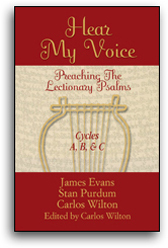
Hear My Voice
Preaching The Lectionary Psalms for Cycles A, B, C
Object:
This is a hymn of praise. The psalm is easily understandable even without knowing the circumstances of ancient Israel. It straightforwardly says, "The Lord is my helper." Preaching possibilities include:

1. Knowing where our help comes from. A pastor had built a church with a freestanding altar placed so that he could look up through a translucent window, at mountains rising beyond. He said, "Isn't it wonderful to be able to say, 'I lift my eyes to the hills' when I preach and pray?" But he missed the question mark in the Hebrew construction of verse 1. Do I lift up my eyes to the hills that my help should come from there? No. My help comes from the Lord who has made the hills, not from nature itself. The majesty of the natural world can lift our sights, but only God can bring help.
2. Looking for the highest help. The great preacher of an earlier era, Phillips Brooks, preached a sermon on this psalm called "Help from the Hills" -- which, despite its misleading title, urged his hearers to seek their help from the highest place. While acknowledging other sources of help, Brooks said, "The real relief, the only final comfort, is God" and that we should "refuse to let ourselves be satisfied with any supply but him."
3. Being kept by God. In the NRSV, this psalm uses the word "keep" four times and "keeper" once. It is worthwhile to juxtapose this psalm with Cain's excuse in Genesis 4:9, "Am I my brother's keeper?" What does it show about the character of God, self-revealed as the keeper of Israel -- and, by extension, our keeper as well? Another parallel could be drawn to Jesus' identification of himself as the gatekeeper of the sheepfold (John 10:3).
-- S. P.
1. Knowing where our help comes from. A pastor had built a church with a freestanding altar placed so that he could look up through a translucent window, at mountains rising beyond. He said, "Isn't it wonderful to be able to say, 'I lift my eyes to the hills' when I preach and pray?" But he missed the question mark in the Hebrew construction of verse 1. Do I lift up my eyes to the hills that my help should come from there? No. My help comes from the Lord who has made the hills, not from nature itself. The majesty of the natural world can lift our sights, but only God can bring help.
2. Looking for the highest help. The great preacher of an earlier era, Phillips Brooks, preached a sermon on this psalm called "Help from the Hills" -- which, despite its misleading title, urged his hearers to seek their help from the highest place. While acknowledging other sources of help, Brooks said, "The real relief, the only final comfort, is God" and that we should "refuse to let ourselves be satisfied with any supply but him."
3. Being kept by God. In the NRSV, this psalm uses the word "keep" four times and "keeper" once. It is worthwhile to juxtapose this psalm with Cain's excuse in Genesis 4:9, "Am I my brother's keeper?" What does it show about the character of God, self-revealed as the keeper of Israel -- and, by extension, our keeper as well? Another parallel could be drawn to Jesus' identification of himself as the gatekeeper of the sheepfold (John 10:3).
-- S. P.

