How Do You Vote?
Sermon
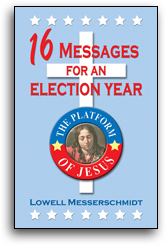
16 MESSAGES FOR AN ELECTION YEAR
The Platform Of Jesus
Every four years we select a president. For months prior to the election we are bombarded by advertisements telling why people should vote for one candidate or the other. After all the visual and auditory bombardment, everyone seems relieved when election day is finally over.

That there is a political campaign means people have an opportunity to choose from a very limited field, the person who shall head the government for the following four years. That there are usually two major candidates, plus several minor ones, means there is a division in the minds of the people as to who will be president.
It is not only in the area of politics that we find a division of opinion. An advertisement in a bus reads, 'Yes, you can vote more than once! You vote every time you buy a branded product. You vote for one trademark, reject several others. Manufacturers of branded wares… welcome this continuous election. It keeps them on their toes, every day, making a variety of the world's finest products to please you. You are the BOSS in this land of brands.'
Because of these choices, whether in politics or in what we eat or wear, there is a division of opinion. A division of opinion is nothing new. Jesus experienced a great division of opinion over himself. This conflict among the minds of people is described in the seventh chapter of the gospel of John. Often we think we are confused as to whom to follow. It is apparent that this was true in Jesus' day, too.
It was time for the feast of the Tabernacles. Jesus did not go to Jerusalem immediately for this traditional sacred and important celebration. In those days the festival lasted for eight days.
In the sixth chapter of John we are told that many of the followers of Jesus had left him because he did not seem to fulfill their hopes. In the succeeding chapter Jesus' brothers felt that he had better try to regain popularity and prestige in the eyes of the people. We read that his brothers said to him, 'Leave here (Galilee) and go to Judea, that your disciples may see the works you are doing. For no man works in secret if he seeks to be known openly. If you do these things, show yourself to the world (John 7:3-4).'
His brothers did not question that Jesus had great powers, but they believed that he must prove himself in the limelight of the crowds who were gathering at Jerusalem. That was astute political advice. But Jesus told his brothers to go to the feast by themselves. He would not go with them. After they had gone, Jesus went to Jerusalem, not with great fanfare, but privately. At once there was arguing over Jesus. John tells us, 'There was much muttering about him among the people. While some said, ‘He is a good man,' others said, ‘No, he is leading the people astray' (John 7:12).'
The longer Jesus stayed in Jerusalem, the more people learned he was there. By the middle of the Feast, he went into the temple and taught. As usual, his teaching was so forceful that people marveled. A discussion arose over the issue of healing on the sabbath. Some began to discuss whether this might be the Christ.
By the last day of the Feast, people seemed to be completely confused. John reports that some said this was really a prophet. Others said this was the Christ. There was a debate on the issue because they looked for Christ to come from Judea, not from Galilee. John reports, 'So there was a division among the people over him (John 7:43).'
The division among the people over Christ means that people in that day as well as today have a choice in life. There could be no divisions among the people over candidates today if there was no choice. In some countries there is no choice. In some nations there is only one candidate and in some places, no vote is even possible.
There are people who surrender their choices to the stars. These are the persons who read the astrology columns carried by most daily newspapers in the United States. Those who rely on the 'advice' of such columns are living in an easy way. Believing in astrology removes the necessity to think for oneself; the stars do the thinking. If everyone believed in astrology, we would truly have a one party system. Since no one would have the privilege of thinking for oneself, one could sit back and let the stars rule one's life.
That is not the way life works. We canot do anything about physical heredity. Most people inherit some of the physical features of their parents or grandparents. No one can do much about that aspect of one's heredity.
There is an aspect of heredity which we can control and about which we have a voice. Someone has called this 'choosing our ancestors.' While no one can choose his parents, he does have power to choose to follow great minds of the past or those who have been a detriment to the world. No one can choose the bloodstream of life, but people can choose the thought stream.
We have the power to choose to read great literature or trash. In our decisions we are voting what our family life shall be. The Archbishop of Canterbury once addressed the bride and bridegroom at a prominent wedding: 'We all wish you happiness, but our wishes cannot give it. Nor can it come from outward circumstances. It can only come from yourselves, from the spirit that is within you. You cannot choose what changes and chances are to befall you in the coming years. But you can choose the spirit in which you will meet them.' Like Joshua, everyone must choose every day whom he will serve. Everyone has choices in life.
Not only do we have choices in life, but we must also learn that there are no split tickets. This is important for those who claim to follow Christ. Jesus emphasized this time and again. He said that whoever put his hand to the plow and looked back was not fit for the kingdom of God. Another time: 'Whoever does not bear his own cross and come after me, cannot be my disciple (Luke 14:27).' 'If a house is divided against itself, that house will not be able to stand (Mark 3:25).' Further, 'He who is not with me is against me, and he who does not gather with me scatters (Matthew 12:39).'
Too many people try to live by voting both ways. Life for many is like that of a skier who tries to ski down a hill, putting a leg on each side of a tree. What is needed is a clear-cut distinction between those who believe in Christ above everything else in the world and those who have no interest in him. Our votes are either 'Yes' for Christ or a 'No' against him. There is no third alternative.
When people do not vote 'Yes,' they loose any sense of direction. They become drifters. This is illustrated in one of the best-known novels of the early part of the 20th century, Main Street, by Sinclair Lewis. In the book Lewis describes the religious state of mind into which one of the town's doctors had drifted. He had continued as a conventional member of the church, without taking it seriously. When his wife finally rebelled at the dullness into which their church life had fallen, the husband was flustered and confused. The author says of him, 'He believed in the church but seldom attended its services. He believed in Christianity, but never thought about it. He was worried over his wife's lack of faith, but was not sure just what she lacked.' This was a case where not doing anything was a no vote.
Whenever we fail to fight injustice, whenever we tolerate racial prejudices, whenever we take an indifferent attitude toward the homeless and hungry, we are voting no to Christ. How we vote is not just a question that we face on election day; it is a question that faces all Christians every day.
It is important to remember that those who voted yes may not be the apparent winners. Many times one will find himself voting for those who receive a minority of the votes. In our democratic process, we accept the verdict of the majority insofar as, at least in the United States, we do not violently attempt to overthrow the verdict of the majority. However, we must always remember that the majority is not always on the winning side. Those who cast their vote for Christ are always on the winning side.
Chad Walsh was a midwestern college professor. For many years he voted 'no' to Jesus Christ. Eventually he saw the futility of his position. After submitting his life to Christ, he wrote a book, Stop Looking, and Listen. In it he called for a clear-cut distinction between those who believe in Christ above everything else in the world and those who have no interest in him. Then Dr. Walsh added:
'The net result may be that the number of names on the church rolls will be smaller a century from now, but that is a cause for hope, if the professing Christians make up in conviction for what they lack in statistics. Christians could never have won a plebiscite in the days when they were almost the only seeds of life in the dying Roman Empire.'
This gives courage and hope. The history of the Christian faith has not been marked by great majorities. Every time the Christian church tried to extend its power because it controlled a great majority and used that as a means to more power, it became bogged down in what should have been its primary task of redeeming people.
There are times people feel their vote does not count because the issue or person for whom they vote seems lost. Paul gives us a clue to meaning in our vote, even though we find ourselves in the minority. In his letter to the Romans he says 'we are more than conquers through Him who loved us (Romans 8:37).' We are winners!
Paul makes this statement after he points out the defeats that we encounter -- tribulation, distress, persecution, famine, nakedness, peril or the sword. In spite of these things, says Paul, we will find ourselves on the winning side if our vote is for Christ in our daily lives.
The committed Christian has confidence that right will ultimately win over wrong. Those who believe in a moral order of the universe as expressed in biblical truths will ultimately be on the winning side. Evil will seem to triumph at times, but God is still the ruler. Christ calls everyone to cast a yes vote for him and his platform.
How do you vote?
That there is a political campaign means people have an opportunity to choose from a very limited field, the person who shall head the government for the following four years. That there are usually two major candidates, plus several minor ones, means there is a division in the minds of the people as to who will be president.
It is not only in the area of politics that we find a division of opinion. An advertisement in a bus reads, 'Yes, you can vote more than once! You vote every time you buy a branded product. You vote for one trademark, reject several others. Manufacturers of branded wares… welcome this continuous election. It keeps them on their toes, every day, making a variety of the world's finest products to please you. You are the BOSS in this land of brands.'
Because of these choices, whether in politics or in what we eat or wear, there is a division of opinion. A division of opinion is nothing new. Jesus experienced a great division of opinion over himself. This conflict among the minds of people is described in the seventh chapter of the gospel of John. Often we think we are confused as to whom to follow. It is apparent that this was true in Jesus' day, too.
It was time for the feast of the Tabernacles. Jesus did not go to Jerusalem immediately for this traditional sacred and important celebration. In those days the festival lasted for eight days.
In the sixth chapter of John we are told that many of the followers of Jesus had left him because he did not seem to fulfill their hopes. In the succeeding chapter Jesus' brothers felt that he had better try to regain popularity and prestige in the eyes of the people. We read that his brothers said to him, 'Leave here (Galilee) and go to Judea, that your disciples may see the works you are doing. For no man works in secret if he seeks to be known openly. If you do these things, show yourself to the world (John 7:3-4).'
His brothers did not question that Jesus had great powers, but they believed that he must prove himself in the limelight of the crowds who were gathering at Jerusalem. That was astute political advice. But Jesus told his brothers to go to the feast by themselves. He would not go with them. After they had gone, Jesus went to Jerusalem, not with great fanfare, but privately. At once there was arguing over Jesus. John tells us, 'There was much muttering about him among the people. While some said, ‘He is a good man,' others said, ‘No, he is leading the people astray' (John 7:12).'
The longer Jesus stayed in Jerusalem, the more people learned he was there. By the middle of the Feast, he went into the temple and taught. As usual, his teaching was so forceful that people marveled. A discussion arose over the issue of healing on the sabbath. Some began to discuss whether this might be the Christ.
By the last day of the Feast, people seemed to be completely confused. John reports that some said this was really a prophet. Others said this was the Christ. There was a debate on the issue because they looked for Christ to come from Judea, not from Galilee. John reports, 'So there was a division among the people over him (John 7:43).'
The division among the people over Christ means that people in that day as well as today have a choice in life. There could be no divisions among the people over candidates today if there was no choice. In some countries there is no choice. In some nations there is only one candidate and in some places, no vote is even possible.
There are people who surrender their choices to the stars. These are the persons who read the astrology columns carried by most daily newspapers in the United States. Those who rely on the 'advice' of such columns are living in an easy way. Believing in astrology removes the necessity to think for oneself; the stars do the thinking. If everyone believed in astrology, we would truly have a one party system. Since no one would have the privilege of thinking for oneself, one could sit back and let the stars rule one's life.
That is not the way life works. We canot do anything about physical heredity. Most people inherit some of the physical features of their parents or grandparents. No one can do much about that aspect of one's heredity.
There is an aspect of heredity which we can control and about which we have a voice. Someone has called this 'choosing our ancestors.' While no one can choose his parents, he does have power to choose to follow great minds of the past or those who have been a detriment to the world. No one can choose the bloodstream of life, but people can choose the thought stream.
We have the power to choose to read great literature or trash. In our decisions we are voting what our family life shall be. The Archbishop of Canterbury once addressed the bride and bridegroom at a prominent wedding: 'We all wish you happiness, but our wishes cannot give it. Nor can it come from outward circumstances. It can only come from yourselves, from the spirit that is within you. You cannot choose what changes and chances are to befall you in the coming years. But you can choose the spirit in which you will meet them.' Like Joshua, everyone must choose every day whom he will serve. Everyone has choices in life.
Not only do we have choices in life, but we must also learn that there are no split tickets. This is important for those who claim to follow Christ. Jesus emphasized this time and again. He said that whoever put his hand to the plow and looked back was not fit for the kingdom of God. Another time: 'Whoever does not bear his own cross and come after me, cannot be my disciple (Luke 14:27).' 'If a house is divided against itself, that house will not be able to stand (Mark 3:25).' Further, 'He who is not with me is against me, and he who does not gather with me scatters (Matthew 12:39).'
Too many people try to live by voting both ways. Life for many is like that of a skier who tries to ski down a hill, putting a leg on each side of a tree. What is needed is a clear-cut distinction between those who believe in Christ above everything else in the world and those who have no interest in him. Our votes are either 'Yes' for Christ or a 'No' against him. There is no third alternative.
When people do not vote 'Yes,' they loose any sense of direction. They become drifters. This is illustrated in one of the best-known novels of the early part of the 20th century, Main Street, by Sinclair Lewis. In the book Lewis describes the religious state of mind into which one of the town's doctors had drifted. He had continued as a conventional member of the church, without taking it seriously. When his wife finally rebelled at the dullness into which their church life had fallen, the husband was flustered and confused. The author says of him, 'He believed in the church but seldom attended its services. He believed in Christianity, but never thought about it. He was worried over his wife's lack of faith, but was not sure just what she lacked.' This was a case where not doing anything was a no vote.
Whenever we fail to fight injustice, whenever we tolerate racial prejudices, whenever we take an indifferent attitude toward the homeless and hungry, we are voting no to Christ. How we vote is not just a question that we face on election day; it is a question that faces all Christians every day.
It is important to remember that those who voted yes may not be the apparent winners. Many times one will find himself voting for those who receive a minority of the votes. In our democratic process, we accept the verdict of the majority insofar as, at least in the United States, we do not violently attempt to overthrow the verdict of the majority. However, we must always remember that the majority is not always on the winning side. Those who cast their vote for Christ are always on the winning side.
Chad Walsh was a midwestern college professor. For many years he voted 'no' to Jesus Christ. Eventually he saw the futility of his position. After submitting his life to Christ, he wrote a book, Stop Looking, and Listen. In it he called for a clear-cut distinction between those who believe in Christ above everything else in the world and those who have no interest in him. Then Dr. Walsh added:
'The net result may be that the number of names on the church rolls will be smaller a century from now, but that is a cause for hope, if the professing Christians make up in conviction for what they lack in statistics. Christians could never have won a plebiscite in the days when they were almost the only seeds of life in the dying Roman Empire.'
This gives courage and hope. The history of the Christian faith has not been marked by great majorities. Every time the Christian church tried to extend its power because it controlled a great majority and used that as a means to more power, it became bogged down in what should have been its primary task of redeeming people.
There are times people feel their vote does not count because the issue or person for whom they vote seems lost. Paul gives us a clue to meaning in our vote, even though we find ourselves in the minority. In his letter to the Romans he says 'we are more than conquers through Him who loved us (Romans 8:37).' We are winners!
Paul makes this statement after he points out the defeats that we encounter -- tribulation, distress, persecution, famine, nakedness, peril or the sword. In spite of these things, says Paul, we will find ourselves on the winning side if our vote is for Christ in our daily lives.
The committed Christian has confidence that right will ultimately win over wrong. Those who believe in a moral order of the universe as expressed in biblical truths will ultimately be on the winning side. Evil will seem to triumph at times, but God is still the ruler. Christ calls everyone to cast a yes vote for him and his platform.
How do you vote?