Hidden In Our Prayers
Sermon
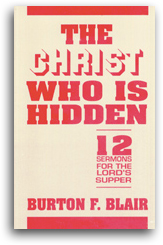
The Christ Who Is Hidden
Sermons For The Lord's Supper
Henri Nouwen, the Catholic theologian, has written a beautiful book on prayer. The name of the book is With Open Hands. The book is small, but it has a powerful lesson to teach. Nouwen begins by relating a story about an elderly woman who was being admitted to a psychiatric center. Nouwen had observed this event himself. The woman was wild, swinging at everything in sight, and scaring everyone so much so that the doctor had everything taken away from her. In the attempt to take everything away, so she would not hurt herself or anyone else, it was discovered that she had an object tightly gripped in her fist. Being afraid that the object might be dangerous, they pried open her tightly squeezed hand. It took two persons to open her hand. There in the palm of her hand was a small coin. And when it was taken away from her, it was as if she had lost her very self along with the coin. Now, being deprived of that one last possession, she had nothing more to give and she was nothing. That seemed to be her basic fear.

'When you are invited to pray you are asked to open your tightly clenched fists and give up your last coin. But who wants to do that? A first prayer, therefore, is often a painful prayer, because you discover you don't want to let go,' writes Nouwen (p. 4). We all fill our hands -- our lives -- with small, clammy coins that we do not want to surrender to God.
The Psalmist likely had this in mind when he prayed:
Search me, O God, and know my heart!
Try me and know my thoughts!
And see if there be any wicked way
in me, and lead me in the way
everlasting.
(139:23-24)
The Psalmist is struggling with surrendering everything to God. Earlier in the Psalm, the writer has contemplated how he might escape his persistent God. There is nowhere to hide from this God. The Psalmist weeps, 'Whither shall I go from thy Spirit (vs. 7)?' Scholars suggest that 'my thoughts' refer to the Psalmist's cares, worries, or burdens. The Psalmist's words ‘‘my wicked way'' is literally ‘‘a way of pain.'' The meaning seems to indicate a manner of living that brings pain and not joy to his life. It is a way of living that does not include the joy of being in relationship with God, or at least, not being in a faithful relationship. The phrase 'the way everlasting' describes the way of life ordained by God and which is a way of living in a right relationship with God. This is the way God meant for all of us to live.
In his desperate cry to God, the Psalmist is also inviting us to pray actively these words, to invite God into our lives. This kind of praying must be spontaneous. It cannot be thought out, planned, or concerned with being formed into the proper words. It is to flow naturally from the heart. 'O God, know my heart!' so invites the Psalmist. The Psalmist desires that which is hidden in the mind and heart be rooted out in the presence of God. The Hebrew word used by the Psalmist is a word used for surgery. The idea here is clear. He is asking God to 'cut' as deep as is needed so as to 'root' out the wicked ways in his life. The diseased part must be taken out so that healing can take place. Whatever is of no use in our relationship with God has to go. To be sure, this type of praying is very private. This is not something done for others to see or hear. Turning loose of some 'coins' can be awful painful and could be embarrassing to those that love us.
This depth of prayer is, as Nouwen says, 'often a painful prayer.' It is painful because to pray honestly the Psalmist's words is to see ourselves as we really are. And that is never easy for most of us. To pray such a prayer, we must be willing to rummage through our old sourness, which we think we cannot do without. We remember our old bitterness we have against another. Then there is some old burning hate. It is so difficult to open our clenched fists because, most of us really enjoy holding onto these. We thrive on reliving bitter and hurt feelings. In fact, there is a sense in which such reliving gives us a great pleasure. Oh, how we like to add coal to the burning flames of hate! We feel justified in our hate.
As we rummage through these thoughts and feelings, we are sure to run across jealousy. We do enjoy this one because it helps us feel sorry for ourselves. Jealousy mixed with hurt feelings stirs up the flames of revenge hotter and hotter. Can we surrender these 'coins?'
It is strange how we hold onto our sins, failures, and disappointments, refusing to let them go into the care of God. Often we are told, 'You must forgive yourself!' But that is easier said than done. We also take pleasure in punishing ourselves for our sins and shortcomings. We relive them and rehearse them until resentment toward ourselves is full-grown. We feel that we are no good, that no one could care about us, that even God could not love or care about us. We condemn ourselves for some sins or failure of yesterday. Surely, our sins could never be forgiven. Thus, since certainly God cannot forgive us, who are we to forgive ourselves?
How can we forgive ourselves? Is it possible? It is said that the geographical heart of London is Charing Cross. This center of London is simply referred to as 'the Cross.' One day a small boy was picked up by a London 'bobby' -- policeman -- and the child was unable to tell them exactly where he lived. Finally, in frustration, the little fellow said, 'If you can take me to ‘the Cross,' I think I can find my way from there.' To forgive ourselves, we must be willing to open our hands without fear, so that the Cross of Christ can cast its shadow on us to blot out ours sins.
This is what the Lord's supper is all about. The broken bread reminds us that he was broken for our sins, and the cup offers us his forgiving love. There are two things we must do at this altar as we kneel. First, we must admit our sin or failures to God. Don't mince words. Don't blame anyone else. However painful, say to God, 'I have sinned. I have failed you, Lord.' Second, we must entrust God with our failures, mistakes, and sins. Don't try to bargain with God. He doesn't accept deals. God alone can forgive you, and trust him to do so. Letting God forgive us is always the first step in forgiving ourselves.
Prayer that comes to the table of the Lord is prayer with open hands. It is a prayer that takes the clinched fist and turns it into an open hand. The 'coins' we thought we could not live without will be little more than dust blown away by a soft breeze. We will not be left in shame, or with guilt, nor in despair. Rather, we will be left with a joyful discovery. We will discover that we are only human -- nothing more, nothing less. And an even greater discovery will be that only God is God. We are not God. We are just human.
This prayer will be letting go of our weaknesses, faults, shortcomings, and our twisted past. Opening our clinched fists will bring a fresh experience of the breath of God -- the Holy Spirit. It is opening our hands to God and receiving the power of God into our lives. It is to be renewed… born again. We will no longer be happy with the way things now are, and we will long for what is not yet. It is opening up to the grace of God. Restating the meaning of the grace of God, Paul Tillich says, 'You are accepted. You are accepted, accepted by that which is greater than you… Simply accept that fact that you are accepted (p. 162)!'
Telling about this experience, Henri Nouwen writes, 'To pray means to open your hands before God. It means slowly relaxing the tension which squeezes your hands together and accepting your existence with an increasing readiness, not as a possession to defend, but as a gift to receive (p. 79).' The point that Nouwen makes is that we cannot receive God's grace with clinched fists -- only with open hands.
With the words of the Psalmist on our lips, as we come to the Lord's table, we come with open hands. 'Search us and know us, O God!' we pray.
'When you are invited to pray you are asked to open your tightly clenched fists and give up your last coin. But who wants to do that? A first prayer, therefore, is often a painful prayer, because you discover you don't want to let go,' writes Nouwen (p. 4). We all fill our hands -- our lives -- with small, clammy coins that we do not want to surrender to God.
The Psalmist likely had this in mind when he prayed:
Search me, O God, and know my heart!
Try me and know my thoughts!
And see if there be any wicked way
in me, and lead me in the way
everlasting.
(139:23-24)
The Psalmist is struggling with surrendering everything to God. Earlier in the Psalm, the writer has contemplated how he might escape his persistent God. There is nowhere to hide from this God. The Psalmist weeps, 'Whither shall I go from thy Spirit (vs. 7)?' Scholars suggest that 'my thoughts' refer to the Psalmist's cares, worries, or burdens. The Psalmist's words ‘‘my wicked way'' is literally ‘‘a way of pain.'' The meaning seems to indicate a manner of living that brings pain and not joy to his life. It is a way of living that does not include the joy of being in relationship with God, or at least, not being in a faithful relationship. The phrase 'the way everlasting' describes the way of life ordained by God and which is a way of living in a right relationship with God. This is the way God meant for all of us to live.
In his desperate cry to God, the Psalmist is also inviting us to pray actively these words, to invite God into our lives. This kind of praying must be spontaneous. It cannot be thought out, planned, or concerned with being formed into the proper words. It is to flow naturally from the heart. 'O God, know my heart!' so invites the Psalmist. The Psalmist desires that which is hidden in the mind and heart be rooted out in the presence of God. The Hebrew word used by the Psalmist is a word used for surgery. The idea here is clear. He is asking God to 'cut' as deep as is needed so as to 'root' out the wicked ways in his life. The diseased part must be taken out so that healing can take place. Whatever is of no use in our relationship with God has to go. To be sure, this type of praying is very private. This is not something done for others to see or hear. Turning loose of some 'coins' can be awful painful and could be embarrassing to those that love us.
This depth of prayer is, as Nouwen says, 'often a painful prayer.' It is painful because to pray honestly the Psalmist's words is to see ourselves as we really are. And that is never easy for most of us. To pray such a prayer, we must be willing to rummage through our old sourness, which we think we cannot do without. We remember our old bitterness we have against another. Then there is some old burning hate. It is so difficult to open our clenched fists because, most of us really enjoy holding onto these. We thrive on reliving bitter and hurt feelings. In fact, there is a sense in which such reliving gives us a great pleasure. Oh, how we like to add coal to the burning flames of hate! We feel justified in our hate.
As we rummage through these thoughts and feelings, we are sure to run across jealousy. We do enjoy this one because it helps us feel sorry for ourselves. Jealousy mixed with hurt feelings stirs up the flames of revenge hotter and hotter. Can we surrender these 'coins?'
It is strange how we hold onto our sins, failures, and disappointments, refusing to let them go into the care of God. Often we are told, 'You must forgive yourself!' But that is easier said than done. We also take pleasure in punishing ourselves for our sins and shortcomings. We relive them and rehearse them until resentment toward ourselves is full-grown. We feel that we are no good, that no one could care about us, that even God could not love or care about us. We condemn ourselves for some sins or failure of yesterday. Surely, our sins could never be forgiven. Thus, since certainly God cannot forgive us, who are we to forgive ourselves?
How can we forgive ourselves? Is it possible? It is said that the geographical heart of London is Charing Cross. This center of London is simply referred to as 'the Cross.' One day a small boy was picked up by a London 'bobby' -- policeman -- and the child was unable to tell them exactly where he lived. Finally, in frustration, the little fellow said, 'If you can take me to ‘the Cross,' I think I can find my way from there.' To forgive ourselves, we must be willing to open our hands without fear, so that the Cross of Christ can cast its shadow on us to blot out ours sins.
This is what the Lord's supper is all about. The broken bread reminds us that he was broken for our sins, and the cup offers us his forgiving love. There are two things we must do at this altar as we kneel. First, we must admit our sin or failures to God. Don't mince words. Don't blame anyone else. However painful, say to God, 'I have sinned. I have failed you, Lord.' Second, we must entrust God with our failures, mistakes, and sins. Don't try to bargain with God. He doesn't accept deals. God alone can forgive you, and trust him to do so. Letting God forgive us is always the first step in forgiving ourselves.
Prayer that comes to the table of the Lord is prayer with open hands. It is a prayer that takes the clinched fist and turns it into an open hand. The 'coins' we thought we could not live without will be little more than dust blown away by a soft breeze. We will not be left in shame, or with guilt, nor in despair. Rather, we will be left with a joyful discovery. We will discover that we are only human -- nothing more, nothing less. And an even greater discovery will be that only God is God. We are not God. We are just human.
This prayer will be letting go of our weaknesses, faults, shortcomings, and our twisted past. Opening our clinched fists will bring a fresh experience of the breath of God -- the Holy Spirit. It is opening our hands to God and receiving the power of God into our lives. It is to be renewed… born again. We will no longer be happy with the way things now are, and we will long for what is not yet. It is opening up to the grace of God. Restating the meaning of the grace of God, Paul Tillich says, 'You are accepted. You are accepted, accepted by that which is greater than you… Simply accept that fact that you are accepted (p. 162)!'
Telling about this experience, Henri Nouwen writes, 'To pray means to open your hands before God. It means slowly relaxing the tension which squeezes your hands together and accepting your existence with an increasing readiness, not as a possession to defend, but as a gift to receive (p. 79).' The point that Nouwen makes is that we cannot receive God's grace with clinched fists -- only with open hands.
With the words of the Psalmist on our lips, as we come to the Lord's table, we come with open hands. 'Search us and know us, O God!' we pray.