Hidden In Holy Communion
Sermon
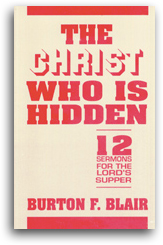
The Christ Who Is Hidden
Sermons For The Lord's Supper
In his early adolescence, already struggling with religious doubts, C. G. Jung, the well-known psychiatrist, had set his last hope on holy communion. His minister father had instructed him, along with other youth, during a confirmation class. But the class did not deal with any of the doubts he was experiencing. The day came for the first communion. Jung was hoping that his first communion would dissolve his doubts and establish him in the Christian faith.

In his book, Memories, Dreams, Reflections, Jung describes his experience: 'Suddenly my turn came. I ate the bread; it tasted flat, as I had expected. The wine, of which I took only the smallest sip, was thin and rather sour, plainly not the best… I had… expected something -- I knew not what -- to happen, and nothing at all had happened (p. 54).'
'Nothing at all had happened.' I wonder how many of us feel that way as we come to the Lord's table. If we are honest, some of us have felt that same way. We kneel, take the elements, and nothing seems to happen. All we experience is the bitterness of the juice and the dryness of the wafer. What is it that is supposed to happen when we kneel at the altar for the Lord's supper?
Evidently, the Christians at Corinth were having similar concerns. It is true that the Lord's supper was central in this young congregation, but some at Corinth had introduced gross pagan practices in the supper. Such practices, according to Paul, were sins against Christ himself, as Paul indicates in verse 27. Hence, Paul reminds them of the origin, nature, and meaning of the sacrament. When Paul writes to the church in Corinth, he explains:
The Lord Jesus, on the night when he was betrayed, took bread, and when he had given thanks, he broke it, and said, 'This is my body which is for you. Do this in remembrance of me.' In the same way also, the cup, after supper, saying, 'This cup is the new covenant in my blood. Do this, as often as you drink it, in remembrance of me.'
(vss. 23b-25)
As Protestant Christians, we have a certain understanding of the meaning and purpose of sacraments. Sacraments are to remind us of the redemptive acts of God as revealed in Jesus Christ. The sacraments re-enact the saving events of his life, ministry, death, and resurrection. This means that we do not have to wonder about God's love for us, or whether God cares about us. We have the answer in Jesus Christ, of course. The sacraments continue to remind us of that truth.
'Do this in remembrance of me' -- these are the earliest words written about the Lord's supper, and in these words Christians have found the meaning and purpose of the Lord's table. These words have united us as Christians. They have also divided us. It has been the Greek word anamnesis which has caused the confusion. The word means 'to remember.' The idea of remembering has been interpreted differently by Christians.
In Roman Catholic tradition, the concept of 'transubstantiation' became a way of dealing with the idea of remembering -- anamnesis. Theologians like Thomas Aquinas argued that the elements completely changed. That is, the bread and wine are converted into the actual body and blood. Christ is present in the elements because the bread and wine become the real flesh and the real blood. This understanding is still taken seriously by most Roman Catholics today.
In recent times, some Catholic theologians have reinterpreted this doctrine. They speak of 'transignafication.' They argue that the elements of bread and wine are to be understood in the same way Jesus used them. The bread represents the breaking of his body for our sins, and the outpouring of the wine represents the spilling of his blood for our forgiveness. The bread and wine do not change in substance. They remain what they are… just bread and wine. Simply put, they represent the body and blood of Jesus. This school of thought says that Christ is present in the sacrament. Max Thunan, in The Mystery Of The Eucharist, writes, 'The presence of Christ in the eucharist is a personal presence which enters into a personal relationship with those who believe and receive. The eucharistic presence is neither a thing nor an object, it is a relationship of person to person (p. 52).'
The idea of 'remembering' has been the source of the confusion and interpretation of what happens in the celebration of the Lord's supper. Most scholars understand anamnesis as what some call 'concrete remembering.' It is not reminiscing. It is not a sentimental journey into the past. It is not something that happens in the mind alone. It is bringing the past into one's present experience.
An experience like that happened to me several years ago. At a family gathering, we watched some 8-mm. film which was taken during Christmas, 1957. As I watched, something strange occurred in me. Suddenly, in the projected picture was my father. My father died in an auto accident on January 2, 1958. There was my father, whom I had not seen for over 20 years. Sitting and watching this film, I entered into anamnesis. The past became present to me. I could hear his voice again. I could feel his touch. I could smell his smell again. And I felt warm, because I knew he loved me.
Some Christians celebrate the Lord's supper as a 'memorial.' For them, the purpose of the Lord's supper is to memorialize a dead hero. It reminds them of all the great things their hero did and said. For other Christians, this is not enough. They celebrate a presence, which is the risen Christ.
As Christians, we have always believed in the 'real presence' in the Lord's supper. When we come to the table, we believe that we are met by the Christ, our risen Lord. The communion rituals in the new United Methodist Hymnal, for example, state that when we take the bread and wine 'we experience Christ anew.' This means that the purpose of the Lord's supper is to experience Christ as actually present at the table.
Referring to the Lord's supper, John Wesley called it a 'means of grace.' Wesley, in a sermon by the same name, writes, 'By ‘means of grace' I understand outward signs, words, or actions ordained by God, and appointed for this end -- to be the ordinary channels whereby he might convey to men preventing, justifying, or sanctifying grace.' God, according to Wesley, is offering himself to us in this sacrament.
It is interesting that Wesley includes what he called the three tenses of grace. For Wesley, God's 'preventing grace' is constantly being offered to us before we ever believe. As Francis Thompson portrays in his poem ‘‘The Hound of Heaven,' God 'hounds' us until we decide for or against him. We simply cannot get away from God's redeeming love. The majority of Christian denominations practice 'open communion,' because we believe that God is reaching out to all persons, regardless of age or condition of their soul. Of course, God's 'justifying grace' is our experience of being saved. Our sins are forgiven, and our relationship with God as savior and lord is established. And God's 'sanctifying grace' is our daily growth into the likeness of Christ. It is in the Lord's supper that God's grace is offered for all our needs.
When all is said and done, we must admit that we are dealing with a mystery. We really do not fully understand what happens and how it happens. As we come to the Lord's table, Christ will come to us in mystery and power. This is not a feeling. Jung was wrong in wanting just to feel something. Rather, what we experience is a person. We cannot explain why or how he is present. We can only experience it. We will experience it only if we come believing, and with open hands ready to receive. So, come, believing in the power of his cleansing forgiveness and receive his gift of new life. You are invited to come with faith, for he is hidden in the bread we break and in the cup we drink.
In his book, Memories, Dreams, Reflections, Jung describes his experience: 'Suddenly my turn came. I ate the bread; it tasted flat, as I had expected. The wine, of which I took only the smallest sip, was thin and rather sour, plainly not the best… I had… expected something -- I knew not what -- to happen, and nothing at all had happened (p. 54).'
'Nothing at all had happened.' I wonder how many of us feel that way as we come to the Lord's table. If we are honest, some of us have felt that same way. We kneel, take the elements, and nothing seems to happen. All we experience is the bitterness of the juice and the dryness of the wafer. What is it that is supposed to happen when we kneel at the altar for the Lord's supper?
Evidently, the Christians at Corinth were having similar concerns. It is true that the Lord's supper was central in this young congregation, but some at Corinth had introduced gross pagan practices in the supper. Such practices, according to Paul, were sins against Christ himself, as Paul indicates in verse 27. Hence, Paul reminds them of the origin, nature, and meaning of the sacrament. When Paul writes to the church in Corinth, he explains:
The Lord Jesus, on the night when he was betrayed, took bread, and when he had given thanks, he broke it, and said, 'This is my body which is for you. Do this in remembrance of me.' In the same way also, the cup, after supper, saying, 'This cup is the new covenant in my blood. Do this, as often as you drink it, in remembrance of me.'
(vss. 23b-25)
As Protestant Christians, we have a certain understanding of the meaning and purpose of sacraments. Sacraments are to remind us of the redemptive acts of God as revealed in Jesus Christ. The sacraments re-enact the saving events of his life, ministry, death, and resurrection. This means that we do not have to wonder about God's love for us, or whether God cares about us. We have the answer in Jesus Christ, of course. The sacraments continue to remind us of that truth.
'Do this in remembrance of me' -- these are the earliest words written about the Lord's supper, and in these words Christians have found the meaning and purpose of the Lord's table. These words have united us as Christians. They have also divided us. It has been the Greek word anamnesis which has caused the confusion. The word means 'to remember.' The idea of remembering has been interpreted differently by Christians.
In Roman Catholic tradition, the concept of 'transubstantiation' became a way of dealing with the idea of remembering -- anamnesis. Theologians like Thomas Aquinas argued that the elements completely changed. That is, the bread and wine are converted into the actual body and blood. Christ is present in the elements because the bread and wine become the real flesh and the real blood. This understanding is still taken seriously by most Roman Catholics today.
In recent times, some Catholic theologians have reinterpreted this doctrine. They speak of 'transignafication.' They argue that the elements of bread and wine are to be understood in the same way Jesus used them. The bread represents the breaking of his body for our sins, and the outpouring of the wine represents the spilling of his blood for our forgiveness. The bread and wine do not change in substance. They remain what they are… just bread and wine. Simply put, they represent the body and blood of Jesus. This school of thought says that Christ is present in the sacrament. Max Thunan, in The Mystery Of The Eucharist, writes, 'The presence of Christ in the eucharist is a personal presence which enters into a personal relationship with those who believe and receive. The eucharistic presence is neither a thing nor an object, it is a relationship of person to person (p. 52).'
The idea of 'remembering' has been the source of the confusion and interpretation of what happens in the celebration of the Lord's supper. Most scholars understand anamnesis as what some call 'concrete remembering.' It is not reminiscing. It is not a sentimental journey into the past. It is not something that happens in the mind alone. It is bringing the past into one's present experience.
An experience like that happened to me several years ago. At a family gathering, we watched some 8-mm. film which was taken during Christmas, 1957. As I watched, something strange occurred in me. Suddenly, in the projected picture was my father. My father died in an auto accident on January 2, 1958. There was my father, whom I had not seen for over 20 years. Sitting and watching this film, I entered into anamnesis. The past became present to me. I could hear his voice again. I could feel his touch. I could smell his smell again. And I felt warm, because I knew he loved me.
Some Christians celebrate the Lord's supper as a 'memorial.' For them, the purpose of the Lord's supper is to memorialize a dead hero. It reminds them of all the great things their hero did and said. For other Christians, this is not enough. They celebrate a presence, which is the risen Christ.
As Christians, we have always believed in the 'real presence' in the Lord's supper. When we come to the table, we believe that we are met by the Christ, our risen Lord. The communion rituals in the new United Methodist Hymnal, for example, state that when we take the bread and wine 'we experience Christ anew.' This means that the purpose of the Lord's supper is to experience Christ as actually present at the table.
Referring to the Lord's supper, John Wesley called it a 'means of grace.' Wesley, in a sermon by the same name, writes, 'By ‘means of grace' I understand outward signs, words, or actions ordained by God, and appointed for this end -- to be the ordinary channels whereby he might convey to men preventing, justifying, or sanctifying grace.' God, according to Wesley, is offering himself to us in this sacrament.
It is interesting that Wesley includes what he called the three tenses of grace. For Wesley, God's 'preventing grace' is constantly being offered to us before we ever believe. As Francis Thompson portrays in his poem ‘‘The Hound of Heaven,' God 'hounds' us until we decide for or against him. We simply cannot get away from God's redeeming love. The majority of Christian denominations practice 'open communion,' because we believe that God is reaching out to all persons, regardless of age or condition of their soul. Of course, God's 'justifying grace' is our experience of being saved. Our sins are forgiven, and our relationship with God as savior and lord is established. And God's 'sanctifying grace' is our daily growth into the likeness of Christ. It is in the Lord's supper that God's grace is offered for all our needs.
When all is said and done, we must admit that we are dealing with a mystery. We really do not fully understand what happens and how it happens. As we come to the Lord's table, Christ will come to us in mystery and power. This is not a feeling. Jung was wrong in wanting just to feel something. Rather, what we experience is a person. We cannot explain why or how he is present. We can only experience it. We will experience it only if we come believing, and with open hands ready to receive. So, come, believing in the power of his cleansing forgiveness and receive his gift of new life. You are invited to come with faith, for he is hidden in the bread we break and in the cup we drink.