God Wants Our Attention
Preaching
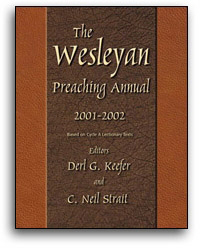
THE WESLEYAN PREACHING ANNUAL 2001--2002
Jim Cymbala, in his book, Fresh Wind, Fresh Fire, quotes a devotional writer who said, "The main thing God asks for is our attention" (Grand Rapids: Zondervan Publishing House, 1997, p. 57). If we have any history with God, we know that when He wants our attention He has something good for us. So, Pastor, be encouraged - God wants your attention and He has something good for you.

One, God wants our attention to His Word. Any pastor will confess that he/she has too often gone to the Word seeking something for the next sermon or devotional. On occasion, if we are honest, we would have to admit we were seeking a word for another person - a word to "set them straight" or to convince them we were right. God wants our hearts and mind to bring attention to His Word. And where we bring such focus, there the Word speaks and spreads its message to our hearts. We are graced by His word when He has our attention.
We must go to the Word in all our circumstances. The Word is a gold--mine of resources, waiting to comfort, inspire and instruct us. God wants our attention when we read the Word because He knows what life needs and knows the Word can resource our needs. Dr. Otto Piper said, "There is enough undiscovered truth in the Scriptures to produce a Reformation and an evangelical awakening in every generation." (Quoted by Dennis F. Kinlaw, Preaching in the Spirit, Wilmore, Ky.: Francis Asbury Press, 1985, p. 15.) If there is that much truth in the Word, then there is certainly something there to meet our individual needs.
We, as pastors, need the Word for our circumstances. We need its instruction and inspiration. We must bring ourselves to the Word with full attention to its feast--potential. Before we are ready to help our people, we must let the Word help us.
Neil B. Wiseman tells the story of a skilled technician who loved the Bible because it resourced his living so well. He was hired to repair a giant telescope, and, one day the chief astronomer happened upon the repairman reading his Bible during a lunch break. The scientist scoffed, "What good do you expect to get from the Bible? It is hopelessly out--of--date, and you don't even know who wrote it."
The puzzled repairman inquired after a thoughtful pause, "Do you use the multiplication table around this place? Do you know who wrote it?" Quickly, the scientist replied, "We must use the multiplication table because we know it works."
The repairman replied, "That's why I trust the Bible. It works" (Spirituality: God's RX for Stress, Kansas City: Beacon Hill Press of Kansas City, 1992, p. 192).
Two, God wants our attention to His care, His grace and His encouragement. Pastor, be encouraged - God is on your side. He is doing more than we realize, for too often we are focused on the problem and not on the power. God wants our attention for He wants to show His love for us, He wants us to observe His care and feel His presence. When we are focused on our hurts and anxieties, we can easily miss His care and healing.
Max Lucado has a good lesson for us in his book, Let the Journey Begin. One chapter has instructions: "Occupy yourself with the nature of God, not the size of your biceps." He describes God's meeting with Moses on the back side of the desert: "Take off your sandals because you are standing on holy ground" (Exodus 3:5). With these eleven words Moses is enrolled in a class on God. Immediately the roles are defined. God is holy. Approaching Him on even a quarter--inch of leather is too pompous ... No time is spent convincing Moses what Moses can do, but much time is spent explaining to Moses what God can do."
Later, Lucado observes, "The strength of Moses is never considered ... But many words are used to reveal God. The strength of Moses is not the issue: the strength of God is" (Nashville: Word Publishing, 1998, p. 3). When God has our attention, we can observe His love and His care. We can see what Dr. Earl Lee describes as the "tracks of God." Only when we take our focus off the problems - and there will always be problems - will we see the hand of God weaving His purpose in our lives. And when and where we see it, it will be an eternal point of reference for our journey. It will build our confidence in the care of God and it will make every problem seem a bit smaller. It will be by the "tracks of God" that we are encouraged and resourced to deal with the "stuff of ministry."
What all this boils down to is this - God wants our attention so He can unfold His will in our ministries! He does not want us to get so absorbed with the problems and events of ministry that we miss His Word and His care. Sometimes it is a fine line to walk, but, as pastors, we need to see the things of God - His love, His care, His purpose - before we are adequate to minister and to be shepherd.
Eugene H. Peterson, in his book, Subversive Spirituality, makes this observation: "I want to simplify your lives. When others are telling you to read more, I want to tell you to read less; when others are telling you to do more, I want to tell you to do less. The world does not need more of you; it needs more of God. Your friends do not need more of you; they need more of God. And you don't need more of you; you need more of God" (Christianity Today, "Classic and Contemporary Excerpts," April 27, 1998, p. 93).
So, Pastor, be encouraged. God wants our attention so we can have more of Him - for more of Him is what our ministries need, and more of what our people need.
C. Neil Strait
November 3, 2002 Twenty--fourth Sunday After Pentecost
WORSHIP HELPS
CALL TO WORSHIP
Leader: Let us look to the mountain of strength.
People: Where is the mountain of strength?
Leader: The mountain of strength is God who has made the heavens and earth.
All: We will climb His mountain today.
OFFERING THOUGHT
Let us give support to all those seeking God. May we bring God's mercy in life's tumultuous circumstances.
BENEDICTION
Walk boldly this week in the presence of the Lord. Marvel at His gift of the Holy Spirit and let Him give you power for living.
SERMON BRIEFS
Welcome To Ministry - Serving Others
1 Thessalonians 2:9--17
Introduction
I contend that if we are to be Bible believing, Bible preaching, Bible teaching Christians then we must be people who believe in ministry. To sit in a pew from one Sunday to the next Sunday and never minister throughout the week is absurd and de--christianizing. It can be argued that the relevant Christian and church will be those who discover ways to minister in Jesus' name and through the power of the Holy Spirit in the community and workplaces of contemporary people's lives.
Welcome to ministry where we serve others!
I. Serving others isn't always easy. (v. 9)
Chuck Swindoll remembers the words of the old Washington Redskin football team's quarterback, Sonny Jurgensen. The team was in the midst of a horrible slump and the sports writers and fans were criticizing the team and especially Jurgensen. One of the media persons asked if all the flack was getting to him. Swindoll said that Sonny flashed a big toothless smiled and replied, "Naw, not me. I've been in this game long enough to know that every week the quarterback is either in the penthouse or the outhouse" (Chuck Swindoll, The Tale of the Tardy Oxcart). Had Saint Paul been alive for that interview he would say that could aptly apply to ministry, too.
Service to others isn't always easy because of misunderstanding of motives, jealousy of position, skepticism that you really care and selfishness (that you are doing more for someone else then what you are doing for them) and more! Those are the moments you feel like you are in the outhouse of ministry!
But take heart - there are the penthouse times, too. Those moments occur when you hear a sincere "thank you," or feel the hug of a child, or see the maturing of a saint, or experience the deep satisfaction of a job well done for Jesus' sake.
No, serving others isn't always easy, but it is our job.
II. Serving others is testimony of being. (vv. 10--12)
While we are in the process of doing for others let us not forget "being" for others. As a minister, a servant to others, we must be holy, righteous and blameless.
Ministry is a call to higher standards of conduct not just for clergy but for all who serve others. We are to be men and women who live lives close to God. The old admonition of "Don't talk the talk unless you walk the walk" applies to every servant of the most Holy God!
Also as a minister - a servant to others - we are to be encouragers and comforters to those in need. Mark Guy Pearse says the word comfort means "co" - that is, together with or in company - and "fort" is strength. Pearse writes, "That is it precisely. The moment we sit out to live a better life, the gracious Master is ever going that way, and with gentle love he cometh to carry our burdens for us and to lead us on our way." May we follow His example!
III. Serving others centers in God. (vv. 13--17)
Ministry service is based clearly and definitely on the Word of God. That Word establishes relationships with others. God's Word actively involves others as a divinely purposed force in life. His love and justice comes into motion as Christians pursue peace, help and life for those around them.
As Albert Schweitzer said, "The only people who will be really happy are those who have sought and found how to serve." Will you be one of them? If so then - welcome to ministry through service to others!
Derl G. Keefer
The Greatest Among You
Matthew 23:1--12
Introduction
Repeatedly in Scripture one can see that God's ways and the natural ways of men and women are not the same. This can be seen once more in the opening verses of Matthew 23. Here Jesus is at work once more helping his followers understand that the Kingdom of God brings with it a new way of thinking and relating.
The heart of this passage rests with verses 11 and 12. There is an earlier condemnation of the hypocrisy of the teachers of the law and the Pharisees in the passage, but that is background and context for the key principle being presented here, "The greatest among you will be your servant" (v. 11).
The scribes and Pharisees were individuals of influence and power, but their practices often resulted in hypocrisy (v. 3), "They do not practice what they preach," and exploitation (v. 4), "They use their authority to burden others," and for status seeking and pride (vv. 5--7), "They love the place of honor."
Illustration: We often see bumper stickers which express love by simply inserting a red heart for the word love: I Love New York, I love fishing, and so on. There is one which is becoming popular in some areas. It has only the red heart and the words I and myself; the message is simply I Love Myself. If the self--righteous religious leaders of Jesus' day had bumper stickers, perhaps that is the one they would have displayed as well. But that is not the way of the Kingdom.
In this passage, Jesus seeks to set against the backdrop of hypocrisy and pride a new and higher understanding of how things should be in the Kingdom of God.
In doing so, He identifies certain marks of a servant:
I. The true servant of Christ must be willing to help others.
Note the contrast of verse 4 and the commentary of verse 3 which precedes it. Christ calls his disciples to a different system and a better way. We are to be partners, equal before God (vv. 8--10). Not only was this the message of Jesus, it was his way of life as well. Repeatedly He modeled the role of a servant and called upon His followers to follow his example.
Illustration: There are a few museums in the world which own various fine musical instruments, such as Stradivarius violins. Such instruments deteriorate if they are not used with some regularity. So, these museums will hire musicians to come, every so often, to play the instruments. This practice is itself a kind of parable of life. The unused, neglected talent is soon lost. When we, as children of God, are "out of service" we, too, soon lose our value. Our calling is to serve God and others, not to be served.
II. Servants do not seek the limelight (v. 5), or the places of honor (v. 6), or special titles. (v. 7)
In the Kingdom of God, being a servant is the highest vocation. This calling stands in sharp contrast to the ways and values of the world around us.
Illustration: Years ago Theodore Roosevelt read a book by a New York newspaper man named Jacob Riis which was titled How the Other Half Lives. In the book, Riis described the living condition of the very poor of the city. In response to the book, Roosevelt went directly to see Riis, but he was not in. Roosevelt left his card with this inscription, "Have read your book and have come to help." What a great response. The calling card of any follower of Jesus ought to say, "I've come to help."
III. The hallmark of the servant is humility.
Illustration: Pride can often distort one's perception and judgment. A motorist went up the wrong ramp and was driving the wrong way on a divided highway. Someone saw him and immediately broadcast a warning on his CB radio. "There's a car going the wrong way on the highway." The mistaken motorist heard the message and quickly replied, "One car going the wrong way! There are hundreds!"
Conclusion
This passage ends with a promise: "Whoever humbles himself will be exalted." This was modeled by Jesus and ought to be the emblem of those who bear His name.
John C. Bowling
One, God wants our attention to His Word. Any pastor will confess that he/she has too often gone to the Word seeking something for the next sermon or devotional. On occasion, if we are honest, we would have to admit we were seeking a word for another person - a word to "set them straight" or to convince them we were right. God wants our hearts and mind to bring attention to His Word. And where we bring such focus, there the Word speaks and spreads its message to our hearts. We are graced by His word when He has our attention.
We must go to the Word in all our circumstances. The Word is a gold--mine of resources, waiting to comfort, inspire and instruct us. God wants our attention when we read the Word because He knows what life needs and knows the Word can resource our needs. Dr. Otto Piper said, "There is enough undiscovered truth in the Scriptures to produce a Reformation and an evangelical awakening in every generation." (Quoted by Dennis F. Kinlaw, Preaching in the Spirit, Wilmore, Ky.: Francis Asbury Press, 1985, p. 15.) If there is that much truth in the Word, then there is certainly something there to meet our individual needs.
We, as pastors, need the Word for our circumstances. We need its instruction and inspiration. We must bring ourselves to the Word with full attention to its feast--potential. Before we are ready to help our people, we must let the Word help us.
Neil B. Wiseman tells the story of a skilled technician who loved the Bible because it resourced his living so well. He was hired to repair a giant telescope, and, one day the chief astronomer happened upon the repairman reading his Bible during a lunch break. The scientist scoffed, "What good do you expect to get from the Bible? It is hopelessly out--of--date, and you don't even know who wrote it."
The puzzled repairman inquired after a thoughtful pause, "Do you use the multiplication table around this place? Do you know who wrote it?" Quickly, the scientist replied, "We must use the multiplication table because we know it works."
The repairman replied, "That's why I trust the Bible. It works" (Spirituality: God's RX for Stress, Kansas City: Beacon Hill Press of Kansas City, 1992, p. 192).
Two, God wants our attention to His care, His grace and His encouragement. Pastor, be encouraged - God is on your side. He is doing more than we realize, for too often we are focused on the problem and not on the power. God wants our attention for He wants to show His love for us, He wants us to observe His care and feel His presence. When we are focused on our hurts and anxieties, we can easily miss His care and healing.
Max Lucado has a good lesson for us in his book, Let the Journey Begin. One chapter has instructions: "Occupy yourself with the nature of God, not the size of your biceps." He describes God's meeting with Moses on the back side of the desert: "Take off your sandals because you are standing on holy ground" (Exodus 3:5). With these eleven words Moses is enrolled in a class on God. Immediately the roles are defined. God is holy. Approaching Him on even a quarter--inch of leather is too pompous ... No time is spent convincing Moses what Moses can do, but much time is spent explaining to Moses what God can do."
Later, Lucado observes, "The strength of Moses is never considered ... But many words are used to reveal God. The strength of Moses is not the issue: the strength of God is" (Nashville: Word Publishing, 1998, p. 3). When God has our attention, we can observe His love and His care. We can see what Dr. Earl Lee describes as the "tracks of God." Only when we take our focus off the problems - and there will always be problems - will we see the hand of God weaving His purpose in our lives. And when and where we see it, it will be an eternal point of reference for our journey. It will build our confidence in the care of God and it will make every problem seem a bit smaller. It will be by the "tracks of God" that we are encouraged and resourced to deal with the "stuff of ministry."
What all this boils down to is this - God wants our attention so He can unfold His will in our ministries! He does not want us to get so absorbed with the problems and events of ministry that we miss His Word and His care. Sometimes it is a fine line to walk, but, as pastors, we need to see the things of God - His love, His care, His purpose - before we are adequate to minister and to be shepherd.
Eugene H. Peterson, in his book, Subversive Spirituality, makes this observation: "I want to simplify your lives. When others are telling you to read more, I want to tell you to read less; when others are telling you to do more, I want to tell you to do less. The world does not need more of you; it needs more of God. Your friends do not need more of you; they need more of God. And you don't need more of you; you need more of God" (Christianity Today, "Classic and Contemporary Excerpts," April 27, 1998, p. 93).
So, Pastor, be encouraged. God wants our attention so we can have more of Him - for more of Him is what our ministries need, and more of what our people need.
C. Neil Strait
November 3, 2002 Twenty--fourth Sunday After Pentecost
WORSHIP HELPS
CALL TO WORSHIP
Leader: Let us look to the mountain of strength.
People: Where is the mountain of strength?
Leader: The mountain of strength is God who has made the heavens and earth.
All: We will climb His mountain today.
OFFERING THOUGHT
Let us give support to all those seeking God. May we bring God's mercy in life's tumultuous circumstances.
BENEDICTION
Walk boldly this week in the presence of the Lord. Marvel at His gift of the Holy Spirit and let Him give you power for living.
SERMON BRIEFS
Welcome To Ministry - Serving Others
1 Thessalonians 2:9--17
Introduction
I contend that if we are to be Bible believing, Bible preaching, Bible teaching Christians then we must be people who believe in ministry. To sit in a pew from one Sunday to the next Sunday and never minister throughout the week is absurd and de--christianizing. It can be argued that the relevant Christian and church will be those who discover ways to minister in Jesus' name and through the power of the Holy Spirit in the community and workplaces of contemporary people's lives.
Welcome to ministry where we serve others!
I. Serving others isn't always easy. (v. 9)
Chuck Swindoll remembers the words of the old Washington Redskin football team's quarterback, Sonny Jurgensen. The team was in the midst of a horrible slump and the sports writers and fans were criticizing the team and especially Jurgensen. One of the media persons asked if all the flack was getting to him. Swindoll said that Sonny flashed a big toothless smiled and replied, "Naw, not me. I've been in this game long enough to know that every week the quarterback is either in the penthouse or the outhouse" (Chuck Swindoll, The Tale of the Tardy Oxcart). Had Saint Paul been alive for that interview he would say that could aptly apply to ministry, too.
Service to others isn't always easy because of misunderstanding of motives, jealousy of position, skepticism that you really care and selfishness (that you are doing more for someone else then what you are doing for them) and more! Those are the moments you feel like you are in the outhouse of ministry!
But take heart - there are the penthouse times, too. Those moments occur when you hear a sincere "thank you," or feel the hug of a child, or see the maturing of a saint, or experience the deep satisfaction of a job well done for Jesus' sake.
No, serving others isn't always easy, but it is our job.
II. Serving others is testimony of being. (vv. 10--12)
While we are in the process of doing for others let us not forget "being" for others. As a minister, a servant to others, we must be holy, righteous and blameless.
Ministry is a call to higher standards of conduct not just for clergy but for all who serve others. We are to be men and women who live lives close to God. The old admonition of "Don't talk the talk unless you walk the walk" applies to every servant of the most Holy God!
Also as a minister - a servant to others - we are to be encouragers and comforters to those in need. Mark Guy Pearse says the word comfort means "co" - that is, together with or in company - and "fort" is strength. Pearse writes, "That is it precisely. The moment we sit out to live a better life, the gracious Master is ever going that way, and with gentle love he cometh to carry our burdens for us and to lead us on our way." May we follow His example!
III. Serving others centers in God. (vv. 13--17)
Ministry service is based clearly and definitely on the Word of God. That Word establishes relationships with others. God's Word actively involves others as a divinely purposed force in life. His love and justice comes into motion as Christians pursue peace, help and life for those around them.
As Albert Schweitzer said, "The only people who will be really happy are those who have sought and found how to serve." Will you be one of them? If so then - welcome to ministry through service to others!
Derl G. Keefer
The Greatest Among You
Matthew 23:1--12
Introduction
Repeatedly in Scripture one can see that God's ways and the natural ways of men and women are not the same. This can be seen once more in the opening verses of Matthew 23. Here Jesus is at work once more helping his followers understand that the Kingdom of God brings with it a new way of thinking and relating.
The heart of this passage rests with verses 11 and 12. There is an earlier condemnation of the hypocrisy of the teachers of the law and the Pharisees in the passage, but that is background and context for the key principle being presented here, "The greatest among you will be your servant" (v. 11).
The scribes and Pharisees were individuals of influence and power, but their practices often resulted in hypocrisy (v. 3), "They do not practice what they preach," and exploitation (v. 4), "They use their authority to burden others," and for status seeking and pride (vv. 5--7), "They love the place of honor."
Illustration: We often see bumper stickers which express love by simply inserting a red heart for the word love: I Love New York, I love fishing, and so on. There is one which is becoming popular in some areas. It has only the red heart and the words I and myself; the message is simply I Love Myself. If the self--righteous religious leaders of Jesus' day had bumper stickers, perhaps that is the one they would have displayed as well. But that is not the way of the Kingdom.
In this passage, Jesus seeks to set against the backdrop of hypocrisy and pride a new and higher understanding of how things should be in the Kingdom of God.
In doing so, He identifies certain marks of a servant:
I. The true servant of Christ must be willing to help others.
Note the contrast of verse 4 and the commentary of verse 3 which precedes it. Christ calls his disciples to a different system and a better way. We are to be partners, equal before God (vv. 8--10). Not only was this the message of Jesus, it was his way of life as well. Repeatedly He modeled the role of a servant and called upon His followers to follow his example.
Illustration: There are a few museums in the world which own various fine musical instruments, such as Stradivarius violins. Such instruments deteriorate if they are not used with some regularity. So, these museums will hire musicians to come, every so often, to play the instruments. This practice is itself a kind of parable of life. The unused, neglected talent is soon lost. When we, as children of God, are "out of service" we, too, soon lose our value. Our calling is to serve God and others, not to be served.
II. Servants do not seek the limelight (v. 5), or the places of honor (v. 6), or special titles. (v. 7)
In the Kingdom of God, being a servant is the highest vocation. This calling stands in sharp contrast to the ways and values of the world around us.
Illustration: Years ago Theodore Roosevelt read a book by a New York newspaper man named Jacob Riis which was titled How the Other Half Lives. In the book, Riis described the living condition of the very poor of the city. In response to the book, Roosevelt went directly to see Riis, but he was not in. Roosevelt left his card with this inscription, "Have read your book and have come to help." What a great response. The calling card of any follower of Jesus ought to say, "I've come to help."
III. The hallmark of the servant is humility.
Illustration: Pride can often distort one's perception and judgment. A motorist went up the wrong ramp and was driving the wrong way on a divided highway. Someone saw him and immediately broadcast a warning on his CB radio. "There's a car going the wrong way on the highway." The mistaken motorist heard the message and quickly replied, "One car going the wrong way! There are hundreds!"
Conclusion
This passage ends with a promise: "Whoever humbles himself will be exalted." This was modeled by Jesus and ought to be the emblem of those who bear His name.
John C. Bowling