Epiphany 7/Ordinary Time 7
Preaching
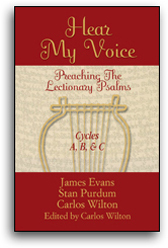
Hear My Voice
Preaching The Lectionary Psalms for Cycles A, B, C
Object:
Like last week's selection from the opening portion of this same psalm, today's selection celebrates the joy that comes of following God's Law, the Torah. As is usually the case with psalm selections in the lectionary, it amplifies the First Lesson from the Hebrew Scriptures -- which this week happens to be Leviticus 19:1-2, 9-18.

Reading through verses 9-18 of the Leviticus passage, we quickly discover that following God's Law transcends mere legalism: at the root of each of these commandments is a deep and abiding ethical concern for the well-being of others. The command to leave something in the field for the gleaners (Leviticus 19:9-10) honors the needs of the poor. The prohibition against stealing has a human face: "You shall not defraud your neighbor" (v. 13a). "You shall not keep the wages of a laborer until morning" (v. 13b) is among the earliest examples of fair-labor legislation -- the workers, after all, need their salaries if they are to feed their families. There is concern for the disabled (v. 14), and an admonition to treat everyone equally: "You shall not be partial to the poor or defer to the great" (v. 15). Ultimately, there comes a prohibition against hate itself (v. 17), followed by the greatest commandment of all: "you shall love your neighbor as yourself" (v. 18).
"Give me understanding," pleads the psalmist, "that I may keep your law and observe it with my whole heart" (Psalm 119:34). Perhaps the most important aspect of this understanding is the discovery that God's Law is about much more than statutes and regulations and ordinances and codicils. With love at its very heart, it is the concrete manifestation of the Lord's desire that we live in harmony with others, and even with ourselves. The law the psalmist begs to understand has, in the very deepest sense, a human face. "Turn my eyes from looking at vanities," he pleads; "give me life in your ways" (v. 37). Far from being a dead letter, the law is life-giving.
Such a view is expressed by hymn-writer Thomas Troeger, in the following stanza:
We are not free when we're confined
To every wish that sweeps the mind
But free when freely we accept
The sacred bounds that must be kept.
("God Marked a Line and Told the Sea," Oxford University Press, 1989)
-- C. W.
Reading through verses 9-18 of the Leviticus passage, we quickly discover that following God's Law transcends mere legalism: at the root of each of these commandments is a deep and abiding ethical concern for the well-being of others. The command to leave something in the field for the gleaners (Leviticus 19:9-10) honors the needs of the poor. The prohibition against stealing has a human face: "You shall not defraud your neighbor" (v. 13a). "You shall not keep the wages of a laborer until morning" (v. 13b) is among the earliest examples of fair-labor legislation -- the workers, after all, need their salaries if they are to feed their families. There is concern for the disabled (v. 14), and an admonition to treat everyone equally: "You shall not be partial to the poor or defer to the great" (v. 15). Ultimately, there comes a prohibition against hate itself (v. 17), followed by the greatest commandment of all: "you shall love your neighbor as yourself" (v. 18).
"Give me understanding," pleads the psalmist, "that I may keep your law and observe it with my whole heart" (Psalm 119:34). Perhaps the most important aspect of this understanding is the discovery that God's Law is about much more than statutes and regulations and ordinances and codicils. With love at its very heart, it is the concrete manifestation of the Lord's desire that we live in harmony with others, and even with ourselves. The law the psalmist begs to understand has, in the very deepest sense, a human face. "Turn my eyes from looking at vanities," he pleads; "give me life in your ways" (v. 37). Far from being a dead letter, the law is life-giving.
Such a view is expressed by hymn-writer Thomas Troeger, in the following stanza:
We are not free when we're confined
To every wish that sweeps the mind
But free when freely we accept
The sacred bounds that must be kept.
("God Marked a Line and Told the Sea," Oxford University Press, 1989)
-- C. W.