Epiphany 3 / Ordinary Time 3
Devotional
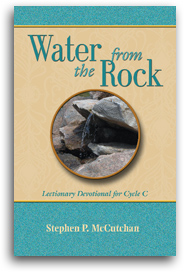
Water From the Rock
Lectionary Devotional for Cycle C
Let the words of my mouth and the meditation of my heart be acceptable to you, O Lord, my rock and my redeemer.
-- Psalm 19:14
Psalm 19 could serve as a foundation for Paul's declaration in Romans 1:20: "Ever since the creation of the world his eternal power and divine nature, invisible though they are, have been understood and seen through the things he has made." The psalmist, too, believes that the heavens and the firmament declare the glory of God to the ends of the earth (vv. 1-4). As an example, he gives the strong and steady course of the sun that evokes awe in the observer (vv. 5-6). In this sense, recalcitrant members are right when they suggest that communing with nature can inspire them. The experience of such awe evoked by nature stimulates in such people the desire to respond. But nature, no matter how inspiring, gives no instruction.
The law of the Lord is God's gift that informs us, in a way that nature cannot, of how we can respond to this mysterious power that orders our universe. The law revives the soul, makes the simple wise, rejoices the heart, and so on (vv. 7-10). It enables life to have direction and purpose in relation to one's creator. Yet, the law also makes us aware of our inadequacies and makes us even more aware of how dependent we are on God to liberate us from sin (vv. 11-13). This, too, was Paul's message in Romans 1.
Only as both rock and redeemer can the words of our mouths and the meditations of our hearts be found acceptable to God (v. 14). The rock alone becomes a harsh judgment. The redeemer alone can easily slip into cheap grace. It is the balance of experiencing God as one who expects something of us and provides us redeeming possibilities when we fail that enables us to be fully open to the goodness of God's gift of life.
-- Psalm 19:14
Psalm 19 could serve as a foundation for Paul's declaration in Romans 1:20: "Ever since the creation of the world his eternal power and divine nature, invisible though they are, have been understood and seen through the things he has made." The psalmist, too, believes that the heavens and the firmament declare the glory of God to the ends of the earth (vv. 1-4). As an example, he gives the strong and steady course of the sun that evokes awe in the observer (vv. 5-6). In this sense, recalcitrant members are right when they suggest that communing with nature can inspire them. The experience of such awe evoked by nature stimulates in such people the desire to respond. But nature, no matter how inspiring, gives no instruction.
The law of the Lord is God's gift that informs us, in a way that nature cannot, of how we can respond to this mysterious power that orders our universe. The law revives the soul, makes the simple wise, rejoices the heart, and so on (vv. 7-10). It enables life to have direction and purpose in relation to one's creator. Yet, the law also makes us aware of our inadequacies and makes us even more aware of how dependent we are on God to liberate us from sin (vv. 11-13). This, too, was Paul's message in Romans 1.
Only as both rock and redeemer can the words of our mouths and the meditations of our hearts be found acceptable to God (v. 14). The rock alone becomes a harsh judgment. The redeemer alone can easily slip into cheap grace. It is the balance of experiencing God as one who expects something of us and provides us redeeming possibilities when we fail that enables us to be fully open to the goodness of God's gift of life.