Enough For All
Sermon
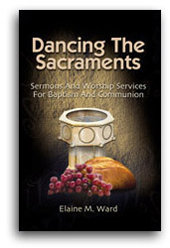
Dancing The Sacraments
Sermons And Worship Services For Baptism And Communion
(Place a sheaf of wheat and a small bunch of purple grapes in a basket on the altar to represent the union of the "bread of heaven, the gift of earth.")
Call To Worship:
Jesus said, "Take and eat." All who are hungry, come, let us worship our compassionate Lord.
Hymn: "Sing Praise To God Who Reigns Above"
(words: Johann J. Schutz; music: Bohemian Brethren's Kirchen--gesange)
Children's Time:

This is a true story. It happened at a children's time in the worship service when the children were gathered around the altar and the minister in her white robe told them the story of Jesus feeding the people with only two fish and five loaves of bread that a boy shared with Jesus. When she finished, she asked one of the children to pass out the cookies she had brought to share with the children. That day there were more children than usual and the boy quickly saw that there would not be enough for all. He broke them to share with all of the children, and when all of the pieces of cookies were given out the boy stared into the basket. It was empty. There would be no cookie for him that day, but the other children saw as well and one by one they broke off a piece of their cookie to share with the boy. Now there was enough for all.
Talk Together:
What does the story say to you? What do you like to share? What is the best gift God shares with you? (Distribute the cookies and dismiss the children with a brief prayer of thanksgiving.)
Prayer Of Confession:
Forgive us, Lord, for our lack of trust in your feedings and for our divisions and greed for material bread. Help us remember that all that we own we owe, and that all of creation is one. Amen.
Words Of Assurance:
The rain falls on the just and the unjust. Our God is a loving and forgiving God. You are forgiven. Amen.
Psalter Reading: Psalm 78:3--5
Old Testament: Proverbs 22:1--9
Epistle: 2 Corinthians 9:7--15
New Testament: Mark 6:30--44
Sermon:
"In those days when there was again a great crowd without anything to eat...."
A weary mother in an occupied country gathered sticks to build a fire and slowly stooped to blow a few flames, hoping they would ignite. Then she placed the food within the tin can on the wood. Immediately a soldier stomped on the small flame, extinguishing the fire. With disgust he spit upon the ground at the woman's feet and walked away. As soon as he was out of sight, she again wearily gathered the wood into a pile. No sooner had she done this than the soldier returned, scattering the wood, shouting sullen oaths. "What are you doing, woman?" he screamed with a curse. To which she quietly replied, "Would you not have me feed my children?"
In those days ... when the people were again without anything to eat, God asked, "Would you not have me feed my children?" and sent Joseph to Egypt to feed the people.
In those days ... when there was again a great crowd without anything to eat, God asked, "Would you not have me feed my children?" and told Moses to feed the people with God's manna in the wilderness.
In those days ... when there was again a great crowd without anything to eat, God asked, "Would you not have me feed my children?" and sent into the hungry world the Bread of Life. And Jesus called his disciples and said to them, "I have compassion."
The Word of God, the Incarnation of God, knew hunger. The crowd had been with him for three days with nothing to eat. Three days! No food. No work. After three days they wondered if there would be any work when they returned home.
We begin to wonder if Mark is saying something more here than we hear on the surface. What is at stake here? Have you ever gone three days without anything to eat? Or, is Mark speaking about something more? I think I know what he means, for I have lived with a hunger, a longing, a seeking, that is only fed now and then. I believe all of us know a hunger for "something more," feeling a craving for something that outlasts grief and strife, to be related to that Something More. Our quest for meaning is our longing for God.
When C. S. Lewis became a sudden Christian, his conversion brought him joy and deep desire for what he called the "real thing," something more, the "better country." He described it as intense desire and wrote of looking at the far--off green hills seen from his nursery window that taught him longing and joy.
Jesus saw "something more." He saw an alternate world, and Mark, through his Gospel, brought that world into being in and through Christ, the world of the Spirit.
The crowd must have found "something more" to have stayed three days without food. Saint Augustine wrote of his longing, his restlessness, his desire for another world: "Thou hast made us for thyself and our heart is restless until it finds its rest in thee."
In the first story of the feeding (Mark 6:30--44) the crowd are like sheep without a shepherd, wandering about without pasture or protection. Sometimes we identify with that. Where is our pasture, our protection? Who is our shepherd? Who or what feeds us?
Jesus presented the problem to his disciples. They gave him a practical solution and he replied, "You give them something to eat." But the disciples were hungry, too. This was no time for utopian idealism, so they said, "Shall we go and buy 200 denari worth of bread and give it to them to eat?" Be practical, Jesus. This is eight months' pay!
Many of us have had to choose between utopian idealism and feeding our family. During the Cold War those working in nuclear plants faced this choice. Or, sometimes the big decision is to decide for what we are hungry. Only if we name our need can we decide where we will seek our bread.
Jesus, however, did not send his disciples anywhere. He asked, "What do you have?" Right where you are, what do you have? This time they did not argue or question. They sought among the people right where they were and found five loaves and two fish.
Five plus two is seven, and seven is a special number. Something is afoot. But with that little food surely the solution is for the crowd to go home. That, however, is not Jesus' solution!
He ordered the crowd to sit down, took the food, blessed it, divided it, and distributed it. And the crowd had more than enough for all. So much that twelve baskets were left over.
Is it possible that Jesus is suggesting that we too can use what we have to feed others, because it is God who blesses the bread, who says, "You give them something to eat." Right where you are. In the story in Mark 8, again the disciples did not understand. "How can we feed these people with bread here in the desert?"
The disciples were concerned, perplexed. I can see Peter and James frowning, scratching their heads, perhaps thinking, "Here we go again! Jesus and his impossible expectations! This is the desert. There is no bread!"
Then Jesus asked them, "How many loaves do you have?" Ah! At last he is being practical! "Seven," they replied.
Now, facing reality, will he finally send them home?
Jesus ordered the crowd to sit down on the ground, took the seven loaves, and after giving thanks, broke them, gave them to the disciples to distribute. The hungry crowd ate at Jesus' feast and were filled. James and Peter each carried one of the twelve baskets, gathering the leftover broken pieces. There was enough for all.
The pastor, administering holy communion, looked down at the lad to whom he had already served. Not to embarrass the lad, however, the sacrament was repeated, but at the close of the worship service he called the boy to him. "I notice you took communion twice this morning. I would like to tell you a story: A woman had twin babies whom the doctor said should be placed in the sunshine for one hour each day. The mother did as the doctor advised. She placed the infant boy in the garden from noon until 1:00 p.m. and the infant girl from 1:00 until 2:00 p.m. When the doctor asked her why, she replied, 'I want each of them to get the full benefit of the sun.' " The pastor smiled at the boy and said, "Think about it. Perhaps once is enough for all."
We are hungry for so many things, for bread at God's banquet, for something more, and Jesus has compassion, and asks us, "How many loaves do you have?"
When we have eaten and are filled, we gather the leftovers and there is enough for all when we trust in the God of love. Both of the stories of feeding say, "There is enough for all." Amen.
Sacrament Of Holy Communion:
Come, eat, there is enough for all.
Hymn: "For The Bread Which You Have Broken"
(words: Louis F. Benson; music: V. Earle Copes)
Prayers Of The People
Pastoral Prayer:
Homeless, his shelter was a stable,
His crib a manger stall,
God's message to the waiting world,
"There is enough for all.
There is enough for all."
Hungry, the crowds pressed ever closer,
Responding to the call,
While Jesus taught his doubting friends,
"There is enough for all.
There is enough for all."
Fearful, we see the teeming masses
And ask what will befall
Our mother earth? Will it be true
There is enough for all?
And once again Christ
Feeds us with his words,
"There is enough for all!" Amen.
The Lord's Prayer
Offering
Doxology
Hymn Of Commitment: "Now The Silence"
(words: Jaroslav J. Vajda; music: Carl F. Schalk)
Benediction:
Go now in the name of God who gifts us with bread and blessing enough for all, through Jesus our Christ who is that spiritual bread and the Holy Spirit who enables us to share it with others. Amen.
Call To Worship:
Jesus said, "Take and eat." All who are hungry, come, let us worship our compassionate Lord.
Hymn: "Sing Praise To God Who Reigns Above"
(words: Johann J. Schutz; music: Bohemian Brethren's Kirchen--gesange)
Children's Time:
This is a true story. It happened at a children's time in the worship service when the children were gathered around the altar and the minister in her white robe told them the story of Jesus feeding the people with only two fish and five loaves of bread that a boy shared with Jesus. When she finished, she asked one of the children to pass out the cookies she had brought to share with the children. That day there were more children than usual and the boy quickly saw that there would not be enough for all. He broke them to share with all of the children, and when all of the pieces of cookies were given out the boy stared into the basket. It was empty. There would be no cookie for him that day, but the other children saw as well and one by one they broke off a piece of their cookie to share with the boy. Now there was enough for all.
Talk Together:
What does the story say to you? What do you like to share? What is the best gift God shares with you? (Distribute the cookies and dismiss the children with a brief prayer of thanksgiving.)
Prayer Of Confession:
Forgive us, Lord, for our lack of trust in your feedings and for our divisions and greed for material bread. Help us remember that all that we own we owe, and that all of creation is one. Amen.
Words Of Assurance:
The rain falls on the just and the unjust. Our God is a loving and forgiving God. You are forgiven. Amen.
Psalter Reading: Psalm 78:3--5
Old Testament: Proverbs 22:1--9
Epistle: 2 Corinthians 9:7--15
New Testament: Mark 6:30--44
Sermon:
"In those days when there was again a great crowd without anything to eat...."
A weary mother in an occupied country gathered sticks to build a fire and slowly stooped to blow a few flames, hoping they would ignite. Then she placed the food within the tin can on the wood. Immediately a soldier stomped on the small flame, extinguishing the fire. With disgust he spit upon the ground at the woman's feet and walked away. As soon as he was out of sight, she again wearily gathered the wood into a pile. No sooner had she done this than the soldier returned, scattering the wood, shouting sullen oaths. "What are you doing, woman?" he screamed with a curse. To which she quietly replied, "Would you not have me feed my children?"
In those days ... when the people were again without anything to eat, God asked, "Would you not have me feed my children?" and sent Joseph to Egypt to feed the people.
In those days ... when there was again a great crowd without anything to eat, God asked, "Would you not have me feed my children?" and told Moses to feed the people with God's manna in the wilderness.
In those days ... when there was again a great crowd without anything to eat, God asked, "Would you not have me feed my children?" and sent into the hungry world the Bread of Life. And Jesus called his disciples and said to them, "I have compassion."
The Word of God, the Incarnation of God, knew hunger. The crowd had been with him for three days with nothing to eat. Three days! No food. No work. After three days they wondered if there would be any work when they returned home.
We begin to wonder if Mark is saying something more here than we hear on the surface. What is at stake here? Have you ever gone three days without anything to eat? Or, is Mark speaking about something more? I think I know what he means, for I have lived with a hunger, a longing, a seeking, that is only fed now and then. I believe all of us know a hunger for "something more," feeling a craving for something that outlasts grief and strife, to be related to that Something More. Our quest for meaning is our longing for God.
When C. S. Lewis became a sudden Christian, his conversion brought him joy and deep desire for what he called the "real thing," something more, the "better country." He described it as intense desire and wrote of looking at the far--off green hills seen from his nursery window that taught him longing and joy.
Jesus saw "something more." He saw an alternate world, and Mark, through his Gospel, brought that world into being in and through Christ, the world of the Spirit.
The crowd must have found "something more" to have stayed three days without food. Saint Augustine wrote of his longing, his restlessness, his desire for another world: "Thou hast made us for thyself and our heart is restless until it finds its rest in thee."
In the first story of the feeding (Mark 6:30--44) the crowd are like sheep without a shepherd, wandering about without pasture or protection. Sometimes we identify with that. Where is our pasture, our protection? Who is our shepherd? Who or what feeds us?
Jesus presented the problem to his disciples. They gave him a practical solution and he replied, "You give them something to eat." But the disciples were hungry, too. This was no time for utopian idealism, so they said, "Shall we go and buy 200 denari worth of bread and give it to them to eat?" Be practical, Jesus. This is eight months' pay!
Many of us have had to choose between utopian idealism and feeding our family. During the Cold War those working in nuclear plants faced this choice. Or, sometimes the big decision is to decide for what we are hungry. Only if we name our need can we decide where we will seek our bread.
Jesus, however, did not send his disciples anywhere. He asked, "What do you have?" Right where you are, what do you have? This time they did not argue or question. They sought among the people right where they were and found five loaves and two fish.
Five plus two is seven, and seven is a special number. Something is afoot. But with that little food surely the solution is for the crowd to go home. That, however, is not Jesus' solution!
He ordered the crowd to sit down, took the food, blessed it, divided it, and distributed it. And the crowd had more than enough for all. So much that twelve baskets were left over.
Is it possible that Jesus is suggesting that we too can use what we have to feed others, because it is God who blesses the bread, who says, "You give them something to eat." Right where you are. In the story in Mark 8, again the disciples did not understand. "How can we feed these people with bread here in the desert?"
The disciples were concerned, perplexed. I can see Peter and James frowning, scratching their heads, perhaps thinking, "Here we go again! Jesus and his impossible expectations! This is the desert. There is no bread!"
Then Jesus asked them, "How many loaves do you have?" Ah! At last he is being practical! "Seven," they replied.
Now, facing reality, will he finally send them home?
Jesus ordered the crowd to sit down on the ground, took the seven loaves, and after giving thanks, broke them, gave them to the disciples to distribute. The hungry crowd ate at Jesus' feast and were filled. James and Peter each carried one of the twelve baskets, gathering the leftover broken pieces. There was enough for all.
The pastor, administering holy communion, looked down at the lad to whom he had already served. Not to embarrass the lad, however, the sacrament was repeated, but at the close of the worship service he called the boy to him. "I notice you took communion twice this morning. I would like to tell you a story: A woman had twin babies whom the doctor said should be placed in the sunshine for one hour each day. The mother did as the doctor advised. She placed the infant boy in the garden from noon until 1:00 p.m. and the infant girl from 1:00 until 2:00 p.m. When the doctor asked her why, she replied, 'I want each of them to get the full benefit of the sun.' " The pastor smiled at the boy and said, "Think about it. Perhaps once is enough for all."
We are hungry for so many things, for bread at God's banquet, for something more, and Jesus has compassion, and asks us, "How many loaves do you have?"
When we have eaten and are filled, we gather the leftovers and there is enough for all when we trust in the God of love. Both of the stories of feeding say, "There is enough for all." Amen.
Sacrament Of Holy Communion:
Come, eat, there is enough for all.
Hymn: "For The Bread Which You Have Broken"
(words: Louis F. Benson; music: V. Earle Copes)
Prayers Of The People
Pastoral Prayer:
Homeless, his shelter was a stable,
His crib a manger stall,
God's message to the waiting world,
"There is enough for all.
There is enough for all."
Hungry, the crowds pressed ever closer,
Responding to the call,
While Jesus taught his doubting friends,
"There is enough for all.
There is enough for all."
Fearful, we see the teeming masses
And ask what will befall
Our mother earth? Will it be true
There is enough for all?
And once again Christ
Feeds us with his words,
"There is enough for all!" Amen.
The Lord's Prayer
Offering
Doxology
Hymn Of Commitment: "Now The Silence"
(words: Jaroslav J. Vajda; music: Carl F. Schalk)
Benediction:
Go now in the name of God who gifts us with bread and blessing enough for all, through Jesus our Christ who is that spiritual bread and the Holy Spirit who enables us to share it with others. Amen.