Easter 2
Devotional
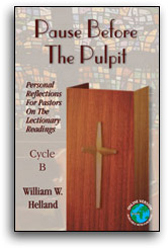
Pause Before The Pulpit
Personal Reflections For Pastors On The Lectionary Readings
John 20:19-31
We minister to people who have been heavily influenced by a faithless world, which says, "Seeing is believing." Oh how often I have wished that Jesus would show up, whether during a sermon, a Bible study, or while witnessing to a skeptic. But he doesn't, for it isn't necessary. Weak is the faith of those who always need something tangible to see or touch before they will believe.

Jesus made a powerful case for the value and importance of God's Word when he said, Blessed are those who have not seen and yet have come to believe. Our calling is not to give people things to see, so they might believe, but to clearly proclaim the good news of Jesus Christ so that those who will, might believe.
The issue being doubted in our text was the resurrection: Thomas refused to believe it until he saw Jesus for himself. I'm sure it was disappointing and frustrating for the other disciples that Thomas would not take their word for it. Why would they make up a story like that? Did he really think they were pulling his leg?
Why do people doubt what we tell them? Do they really think that we, or someone who has gone before us, made all this up about Jesus' death and resurrection? Why don't they trust us? Do they really think we're pulling their leg for some personal gain?
People doubt for many reasons. Perhaps it might be because what we are telling them is such good news they can't believe it. That might have been Thomas' reason for doubting. He no doubt loved his Lord greatly and grieved as much as any of the disciples when Jesus died. But being somewhat of a pessimist, he would be slower to embrace good news.
Other people doubt because they are logical thinkers. If something is outside the laws of nature and science, then it is not to be believed, according to them. Others doubt, not because they don't want to believe, but because they have weighed the pros and cons of believing a given thing, and the negatives won out. For example, if believing in the death and resurrection of Christ means having to acknowledge one's sin and need for Christ's forgiveness, then they would rather doubt all of it so they don't have to deal with their sin. These doubters, and others like them, are what we are up against when proclaiming the good news of Jesus Christ. It is not always fun, or easy, to share what we fully believe is good news. The disciples experienced that with Thomas.
But there are great rewards for believing in Jesus! First of all, Jesus said, Blessed are those who have ... come to believe. What are the blessings associated with belief in the resurrection? The list could be long, but the main ones are: the forgiveness of sins, a guilt-free conscience, a personal and intimate relationship with God, and the hope of eternal life. Those blessings far outweigh any advantages to not believing (if there are any).
In addition to the blessings, John made an editorial comment at the end of this text which reads: these are written so that ... through believing you may have life in his name. John saw the value and importance of the word in regard to belief and salvation. He didn't draw pictures or create statues for people to look at and worship, nor did he make little crosses that people could carry in their pockets to help them believe. Don't get me wrong, these all have their place to help us visualize the word which they represent. However, the primary means of grace is the Word of God, as compiled in the Bible, and it is only through believing in what has been written that we will have life.
Unfortunately, there will always be those who doubt this and therefore will not believe. We are not responsible for them. What we are responsible for, is to hold up God's Word as the only true means by which people can come to faith in Christ for life.
A Pastor's Prayer:
Dear Lord,
Thank you for your word that tells us everything we need to know for salvation and eternal life. Thank you for making it so simple that even a child can believe and be saved. Please forgive me for any time I have complicated the basic gospel message with my doubts and faulty human logic. Thank you for the gift of life! Amen.
1 John 1:1--2:2
I've heard it said that pastors often have favorite themes that they like to preach on. This is certainly true of John when it comes to his writing. The opening lines to this epistle have a familiar ring to them as we think back to the opening lines of his gospel. There are also familiar themes that show up through the text, such as: the word, life, light, darkness, sin, and so on. John did not write on these themes simply because they were his favorites, though. No doubt the Holy Spirit was laying these issues heavily on his heart to share with his readers, for they are extremely important for all of us.
Notice what it was that John declared to his readers: We declare to you what was from the beginning, what we have heard, what we have seen with our eyes, what we have looked at and touched with our hands, concerning the word of life. John declared that which was real and what he and others had experienced.
In our preaching, we ought to declare that which is real and that which we have experienced personally. If we only share nice, emotional stories; or our philosophies on life and spirituality; or the stories from the lives of others, people will not encounter the true and powerful Word of God which changes lives.
Notice that John declared these truths so that you also may have fellowship with us. Why do you declare the things you do? Is it because that is what is expected of you? Do you prepare for your weekly sermon thinking, "Well, I suppose I better come up with something to share this week." Or do you, like John, prepare and declare the Word of God so that others might hopefully have fellowship with us in God's kingdom? The attitude with which we go into our sermon preparation will often be reflected in our sermon. Even if we can fake it and give the impression that we really enjoy preaching, yet have no real vision for why we are doing it, we will probably fail to communicate God's Word in a way that allows the Holy Spirit to speak and change hearts and lives.
A pastor once told me that he never prepared for a sermon other than to read through the text early in the week and pray and reflect on it all week. Then on Sunday he would get in the pulpit and start preaching, believing the Holy Spirit would give him the words to say. If he had been a seasoned, disciplined preacher, I would have felt better about his style, but he wasn't. In fact, he was a poor speaker. He believed that whatever he said was from the Holy Spirit. I believe that is a dangerous way to think about preaching, for it can be an excuse for sloppy and careless sermon preparation and preaching. Without a doubt, the Holy Spirit helps us preach, but he doesn't take up residency in the pulpit only. He also resides in our study and desires to help us prepare a well-thought-out and prayed over sermon that will declare the truths of God in a way that is easily understood by all who listen.
There is so much in this text that we could meditate on, but for the sake of space, I will draw your attention to one last point in verse 4: We are writing these things so that our (your) joy may be complete. Does the reading of God's Word give you joy? That is God's intent. When it doesn't, it is probably due to sin, and John devoted the rest of the text to that issue. You see, from the very beginning God desired that his words to humanity would bring joy! It grieved the heart of God greatly when Adam and Eve hid from him when he spoke to them. That had never been an issue before, but when sin came into the garden, they became afraid of his voice and defensive over his words.
When we become afraid of God's "voice" and defensive when reading his Word, we have a sin problem; and it needs to be dealt with if we want to effectively declare his Word. I pray that you find great joy in his Word today! And keep this in mind when preaching: Not everyone is going to receive God's Word with joy. Only those who have sincerely confessed their sins and are living in grace are going to receive the truths of God with joy.
A Pastor's Prayer:
Dear Lord,
Please help me to prepare my sermons for the right reasons, and to do it with much care and prayer. Please forgive me for my sins and restore to me the joy of your salvation. I want to proclaim your truths from a heart that is clean, and do it in such a way that many are drawn into fellowship with us. Thank you. Amen.
We minister to people who have been heavily influenced by a faithless world, which says, "Seeing is believing." Oh how often I have wished that Jesus would show up, whether during a sermon, a Bible study, or while witnessing to a skeptic. But he doesn't, for it isn't necessary. Weak is the faith of those who always need something tangible to see or touch before they will believe.
Jesus made a powerful case for the value and importance of God's Word when he said, Blessed are those who have not seen and yet have come to believe. Our calling is not to give people things to see, so they might believe, but to clearly proclaim the good news of Jesus Christ so that those who will, might believe.
The issue being doubted in our text was the resurrection: Thomas refused to believe it until he saw Jesus for himself. I'm sure it was disappointing and frustrating for the other disciples that Thomas would not take their word for it. Why would they make up a story like that? Did he really think they were pulling his leg?
Why do people doubt what we tell them? Do they really think that we, or someone who has gone before us, made all this up about Jesus' death and resurrection? Why don't they trust us? Do they really think we're pulling their leg for some personal gain?
People doubt for many reasons. Perhaps it might be because what we are telling them is such good news they can't believe it. That might have been Thomas' reason for doubting. He no doubt loved his Lord greatly and grieved as much as any of the disciples when Jesus died. But being somewhat of a pessimist, he would be slower to embrace good news.
Other people doubt because they are logical thinkers. If something is outside the laws of nature and science, then it is not to be believed, according to them. Others doubt, not because they don't want to believe, but because they have weighed the pros and cons of believing a given thing, and the negatives won out. For example, if believing in the death and resurrection of Christ means having to acknowledge one's sin and need for Christ's forgiveness, then they would rather doubt all of it so they don't have to deal with their sin. These doubters, and others like them, are what we are up against when proclaiming the good news of Jesus Christ. It is not always fun, or easy, to share what we fully believe is good news. The disciples experienced that with Thomas.
But there are great rewards for believing in Jesus! First of all, Jesus said, Blessed are those who have ... come to believe. What are the blessings associated with belief in the resurrection? The list could be long, but the main ones are: the forgiveness of sins, a guilt-free conscience, a personal and intimate relationship with God, and the hope of eternal life. Those blessings far outweigh any advantages to not believing (if there are any).
In addition to the blessings, John made an editorial comment at the end of this text which reads: these are written so that ... through believing you may have life in his name. John saw the value and importance of the word in regard to belief and salvation. He didn't draw pictures or create statues for people to look at and worship, nor did he make little crosses that people could carry in their pockets to help them believe. Don't get me wrong, these all have their place to help us visualize the word which they represent. However, the primary means of grace is the Word of God, as compiled in the Bible, and it is only through believing in what has been written that we will have life.
Unfortunately, there will always be those who doubt this and therefore will not believe. We are not responsible for them. What we are responsible for, is to hold up God's Word as the only true means by which people can come to faith in Christ for life.
A Pastor's Prayer:
Dear Lord,
Thank you for your word that tells us everything we need to know for salvation and eternal life. Thank you for making it so simple that even a child can believe and be saved. Please forgive me for any time I have complicated the basic gospel message with my doubts and faulty human logic. Thank you for the gift of life! Amen.
1 John 1:1--2:2
I've heard it said that pastors often have favorite themes that they like to preach on. This is certainly true of John when it comes to his writing. The opening lines to this epistle have a familiar ring to them as we think back to the opening lines of his gospel. There are also familiar themes that show up through the text, such as: the word, life, light, darkness, sin, and so on. John did not write on these themes simply because they were his favorites, though. No doubt the Holy Spirit was laying these issues heavily on his heart to share with his readers, for they are extremely important for all of us.
Notice what it was that John declared to his readers: We declare to you what was from the beginning, what we have heard, what we have seen with our eyes, what we have looked at and touched with our hands, concerning the word of life. John declared that which was real and what he and others had experienced.
In our preaching, we ought to declare that which is real and that which we have experienced personally. If we only share nice, emotional stories; or our philosophies on life and spirituality; or the stories from the lives of others, people will not encounter the true and powerful Word of God which changes lives.
Notice that John declared these truths so that you also may have fellowship with us. Why do you declare the things you do? Is it because that is what is expected of you? Do you prepare for your weekly sermon thinking, "Well, I suppose I better come up with something to share this week." Or do you, like John, prepare and declare the Word of God so that others might hopefully have fellowship with us in God's kingdom? The attitude with which we go into our sermon preparation will often be reflected in our sermon. Even if we can fake it and give the impression that we really enjoy preaching, yet have no real vision for why we are doing it, we will probably fail to communicate God's Word in a way that allows the Holy Spirit to speak and change hearts and lives.
A pastor once told me that he never prepared for a sermon other than to read through the text early in the week and pray and reflect on it all week. Then on Sunday he would get in the pulpit and start preaching, believing the Holy Spirit would give him the words to say. If he had been a seasoned, disciplined preacher, I would have felt better about his style, but he wasn't. In fact, he was a poor speaker. He believed that whatever he said was from the Holy Spirit. I believe that is a dangerous way to think about preaching, for it can be an excuse for sloppy and careless sermon preparation and preaching. Without a doubt, the Holy Spirit helps us preach, but he doesn't take up residency in the pulpit only. He also resides in our study and desires to help us prepare a well-thought-out and prayed over sermon that will declare the truths of God in a way that is easily understood by all who listen.
There is so much in this text that we could meditate on, but for the sake of space, I will draw your attention to one last point in verse 4: We are writing these things so that our (your) joy may be complete. Does the reading of God's Word give you joy? That is God's intent. When it doesn't, it is probably due to sin, and John devoted the rest of the text to that issue. You see, from the very beginning God desired that his words to humanity would bring joy! It grieved the heart of God greatly when Adam and Eve hid from him when he spoke to them. That had never been an issue before, but when sin came into the garden, they became afraid of his voice and defensive over his words.
When we become afraid of God's "voice" and defensive when reading his Word, we have a sin problem; and it needs to be dealt with if we want to effectively declare his Word. I pray that you find great joy in his Word today! And keep this in mind when preaching: Not everyone is going to receive God's Word with joy. Only those who have sincerely confessed their sins and are living in grace are going to receive the truths of God with joy.
A Pastor's Prayer:
Dear Lord,
Please help me to prepare my sermons for the right reasons, and to do it with much care and prayer. Please forgive me for my sins and restore to me the joy of your salvation. I want to proclaim your truths from a heart that is clean, and do it in such a way that many are drawn into fellowship with us. Thank you. Amen.