In Dulci Jubilo
Sermon
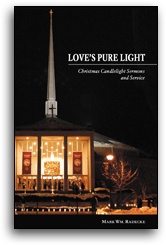
Love's Pure Light
Christmas Candlelight Sermons and Service
Year after year, we are drawn to this night. This night with its carols and candlelight, inhaling an atmosphere of poinsettia and pine, and exhaling the promise of peace. What is it about this night that so captivates our souls, I wonder? There are, I suppose, as many answers as there are people in this room.
Some are here because they are believers, faithful followers of the Christ. You are here to celebrate the nativity of your Lord. In the name of the Christ you worship and adore, I bid you a joyful welcome.

Some are here because they believed once and wonder what it would be like to believe again. You come with the remembrance of love and peace and shared hopes over many years now gathered into one great longing, a longing to be with God, to become whole. It is a longing that whatever emptiness you now know might at last be filled. In the name of the Christ your soul longs for, I bid you a joyful welcome.
Some are here because, although they neither believe nor hope to believe, still they respect the traditions of this university and the faith of its founders. Some are here in honor of the wishes of visiting family members and friends. You come because you would not, by your absence, spoil the Christmas of those you love. In the name of the Christ, the God of your fathers and mothers, I bid you a joyful welcome.
"For behold, I bring you good news of a great joy which shall be to all the people."
Good news of a great joy. The angel's startling announcement that night so long ago begs the question we must ask this night: Given the current world situation, is joy a genuine possibility -- is joy a viable option? Or are we merely whistling through the graveyard, distracting ourselves in the bleak midwinter by what we call "rejoicing"?
For the umpteenth time in the course of human history, someone has scratched a line in the sands of the Middle East and dared someone else to step across it. Another day, another deadline, and tens of thousands of lives of ordinary people perch precariously in the balance. International terrorists plot and scheme, and common citizens, learning to live at perpetual level orange or yellow, are told to lead normal lives while expecting "spectacular attacks."
Add to that
* recent revelations regarding "creative accounting practices" in once-reputable companies;
* job loss and unemployment;
* an uncertain economy at home and entire systems based on exploitation and corruption globally; and
* the scandalous datum that more than 41 million Americans lack even the most basic form of health insurance.
One then begins to wonder: Is joy possible in times such as these? Is it morally responsible to rejoice? Is it spiritually appropriate (or as we used to say, is it meet, right, and salutary) to lift our hearts in joyful song in such a time as this?
Well, what sort of world was it when the Christ Child was born in Bethlehem?
* It was a world that knew both the terrorist tactics of a party of religious insurgents known as "Zealots," and the brutal counter-terrorism practices of the Roman empire.
* It was a world in whose marketplaces weights and measures were routinely shaved in the merchants' favor.
* It was a world in which the prosperity of the rich was maintained by oppressing the poor.
* It was a world, in short, with more than a few striking similarities to our own.
Into just such a world the Baby Jesus was born, the news of his birth announced not on Wall Street or Madison Avenue, but in the middle of a sheep field. The angel spoke not to politicians and CEOs, but to certain poor shepherds. The angel's message was one of great joy, for all the people.
The gentle poetry of Luke's nativity narrative is so familiar to us that we run the risk of missing its truly revolutionary message: Joy is not contingent upon the circumstances of our lives. It is not derived from the world being more or less as we would like it to be. Joy comes to us where we are and as we are because God comes to us, where we are and as we are -- as a babe, wrapped in swaddling cloths and lying in a manger: vulnerable, poor, and weak. The son of peasant parents born in a conquered country occupied by foreign soldiers and governed by low-level bureaucrats ineligible for the plum assignments at such Mediterranean islands as Cyprus and Corsica. (You think Rome sent the valedictorians from its honors program to govern first-century Palestine? I don't think so!)
That's precisely where God chose to inaugurate the gentle reign of the Son of God: In a no-account, backwater burg called "Bethlehem" that would make Selinsgrove's strip look like Man-hattan's 5th Avenue or the Mall of America. That's where the angels tell the shepherds they will find the one whose birth is good news of a great joy for all the people! Birthed in a stable and cradled in a feed trough. Rough, ruddy, and humble -- the second person of the Holy Trinity comes to the world in a way that only the mirthful mind of God could imagine, and his coming heralds the dawning of God's new day -- one of whose hallmarks will be great joy.
One of my favorite cartoons appeared in the New Yorker a few years back. It showed a group of people on a mountaintop staring at the heavens, scanning the skies for UFOs. Off in the corner, a small child is smiling at a little alien inside a miniature flying saucer hovering about at her knees. People search the world for joy, oh yes. The problem is that too often, we are looking in the wrong places. One student of human nature has made this observation:
In youth we are looking forward to things that are to come; in old age we are looking backward to things that are past; in adulthood, although we appear indeed to be more occupied with things that are present, yet even that is too often absorbed in vague determinations to be vastly happy on some future day.1
Listen: You know that the world is unlikely ever to be exactly as we would have it. Our lives are unlikely ever to be precisely as we would like them. Those things, however, are not preconditions for the advent of our God. The Christ Child was not born in some utopian moment of universal peace. The angel did not appear only to those shepherds who had cleaned up their act (to say nothing of cleaning off their sandals). God came to them where they were and as they were, and God comes to us where we are and as we are. That is why the birth of this child is good news of a great joy for all the people. That is our warrant, our permission, our mandate to rejoice this blessed night and this holy season. Our rejoicing proclaims our conviction that God will triumph over every evil power that degrades and dehumanizes, and is doing so even now.
This is, quite frankly, a more difficult concept for us to grasp than it is for those who struggle every day to keep the household alive against the threat of hunger, disease, accidents, and violence. We truly believe that we can alter the contours of our lives in such a way that joy will be a natural by-product of professional success, academic achievement, or accumulated wealth. The poor harbor no such delusions. Just so, theirs is a joy that will remain unavailable to us so long as we believe that joy is contingent upon things going well.
Commenting on his years working with the poor in El Salvador, Dean Brackley, a Jesuit priest, made this observation:
The smile that seems to have no foundation in the facts is not phony; the spirit of fiesta is not an escape but a recognition that something else is going on in the world besides injustice and destruction. The poor smile because they suspect that this something is more powerful than the injustice. When they insist on sharing their tortilla with a visiting gringo, we recognize there is something going on in the world that is more wonderful than we dared to imagine ... The poor usher us into the heart of reality.2
There's something going on in the world -- something more powerful than terrorism and a sour economy. The Christmas story reminds us that it is the common folk who are at the center of things. It is the powerful in Rome and Washington and Baghdad who are on the fringe.
Mary knew this instinctively when the angel Gabriel told her she would be the Mother of our Lord. "My soul now magnifies the Lord," she said. "And my spirit rejoices in God my Savior." Why? "He has cast down the mighty from their thrones, and has lifted up the lowly. He has filled the hungry with good things, and the rich he has sent away empty."
God will show mercy to the poor by working justice among the powerful. This will be a font of blessing for both poor and powerful. The sleeping babe in Mary's lap has come to unbind our chains, to open our prison, to cancel our debt, to give us
A garland instead of ashes,
The oil of gladness instead of mourning,
The garment of praise instead of a spirit of despair.
-- Isaiah 61:3
Joy is not merely an option, one choice among many. Joy -- deep and resonant -- tempered by the fires of suffering and sorrow -- flows freely from our recognition that God is up to something -- something more wonderful than we had dared to imagine. That something took on human flesh and blood in a Bethlehem stall so many years ago. It is incarnated again this night, and every time we manifest in our lives the liberating power of God's love -- a love whose embodiment is good news of a great joy for all the people.
____________
1. Charles Caleb Colton (1780-1832), Lacon Or Many Things In Few Words, Addressed To Those Who Think, Vol. 1 (London: Kessinger, 1825), p. 90.
2. Dean Brackley, S. J., "Meeting the Victims, Falling in Love," Salvanet (January/February 2000), p. 6; also hyperlink http://www.crispaz.org/news/snet/2000/0100.pdf accessed July 2, 2007.
Some are here because they are believers, faithful followers of the Christ. You are here to celebrate the nativity of your Lord. In the name of the Christ you worship and adore, I bid you a joyful welcome.
Some are here because they believed once and wonder what it would be like to believe again. You come with the remembrance of love and peace and shared hopes over many years now gathered into one great longing, a longing to be with God, to become whole. It is a longing that whatever emptiness you now know might at last be filled. In the name of the Christ your soul longs for, I bid you a joyful welcome.
Some are here because, although they neither believe nor hope to believe, still they respect the traditions of this university and the faith of its founders. Some are here in honor of the wishes of visiting family members and friends. You come because you would not, by your absence, spoil the Christmas of those you love. In the name of the Christ, the God of your fathers and mothers, I bid you a joyful welcome.
"For behold, I bring you good news of a great joy which shall be to all the people."
Good news of a great joy. The angel's startling announcement that night so long ago begs the question we must ask this night: Given the current world situation, is joy a genuine possibility -- is joy a viable option? Or are we merely whistling through the graveyard, distracting ourselves in the bleak midwinter by what we call "rejoicing"?
For the umpteenth time in the course of human history, someone has scratched a line in the sands of the Middle East and dared someone else to step across it. Another day, another deadline, and tens of thousands of lives of ordinary people perch precariously in the balance. International terrorists plot and scheme, and common citizens, learning to live at perpetual level orange or yellow, are told to lead normal lives while expecting "spectacular attacks."
Add to that
* recent revelations regarding "creative accounting practices" in once-reputable companies;
* job loss and unemployment;
* an uncertain economy at home and entire systems based on exploitation and corruption globally; and
* the scandalous datum that more than 41 million Americans lack even the most basic form of health insurance.
One then begins to wonder: Is joy possible in times such as these? Is it morally responsible to rejoice? Is it spiritually appropriate (or as we used to say, is it meet, right, and salutary) to lift our hearts in joyful song in such a time as this?
Well, what sort of world was it when the Christ Child was born in Bethlehem?
* It was a world that knew both the terrorist tactics of a party of religious insurgents known as "Zealots," and the brutal counter-terrorism practices of the Roman empire.
* It was a world in whose marketplaces weights and measures were routinely shaved in the merchants' favor.
* It was a world in which the prosperity of the rich was maintained by oppressing the poor.
* It was a world, in short, with more than a few striking similarities to our own.
Into just such a world the Baby Jesus was born, the news of his birth announced not on Wall Street or Madison Avenue, but in the middle of a sheep field. The angel spoke not to politicians and CEOs, but to certain poor shepherds. The angel's message was one of great joy, for all the people.
The gentle poetry of Luke's nativity narrative is so familiar to us that we run the risk of missing its truly revolutionary message: Joy is not contingent upon the circumstances of our lives. It is not derived from the world being more or less as we would like it to be. Joy comes to us where we are and as we are because God comes to us, where we are and as we are -- as a babe, wrapped in swaddling cloths and lying in a manger: vulnerable, poor, and weak. The son of peasant parents born in a conquered country occupied by foreign soldiers and governed by low-level bureaucrats ineligible for the plum assignments at such Mediterranean islands as Cyprus and Corsica. (You think Rome sent the valedictorians from its honors program to govern first-century Palestine? I don't think so!)
That's precisely where God chose to inaugurate the gentle reign of the Son of God: In a no-account, backwater burg called "Bethlehem" that would make Selinsgrove's strip look like Man-hattan's 5th Avenue or the Mall of America. That's where the angels tell the shepherds they will find the one whose birth is good news of a great joy for all the people! Birthed in a stable and cradled in a feed trough. Rough, ruddy, and humble -- the second person of the Holy Trinity comes to the world in a way that only the mirthful mind of God could imagine, and his coming heralds the dawning of God's new day -- one of whose hallmarks will be great joy.
One of my favorite cartoons appeared in the New Yorker a few years back. It showed a group of people on a mountaintop staring at the heavens, scanning the skies for UFOs. Off in the corner, a small child is smiling at a little alien inside a miniature flying saucer hovering about at her knees. People search the world for joy, oh yes. The problem is that too often, we are looking in the wrong places. One student of human nature has made this observation:
In youth we are looking forward to things that are to come; in old age we are looking backward to things that are past; in adulthood, although we appear indeed to be more occupied with things that are present, yet even that is too often absorbed in vague determinations to be vastly happy on some future day.1
Listen: You know that the world is unlikely ever to be exactly as we would have it. Our lives are unlikely ever to be precisely as we would like them. Those things, however, are not preconditions for the advent of our God. The Christ Child was not born in some utopian moment of universal peace. The angel did not appear only to those shepherds who had cleaned up their act (to say nothing of cleaning off their sandals). God came to them where they were and as they were, and God comes to us where we are and as we are. That is why the birth of this child is good news of a great joy for all the people. That is our warrant, our permission, our mandate to rejoice this blessed night and this holy season. Our rejoicing proclaims our conviction that God will triumph over every evil power that degrades and dehumanizes, and is doing so even now.
This is, quite frankly, a more difficult concept for us to grasp than it is for those who struggle every day to keep the household alive against the threat of hunger, disease, accidents, and violence. We truly believe that we can alter the contours of our lives in such a way that joy will be a natural by-product of professional success, academic achievement, or accumulated wealth. The poor harbor no such delusions. Just so, theirs is a joy that will remain unavailable to us so long as we believe that joy is contingent upon things going well.
Commenting on his years working with the poor in El Salvador, Dean Brackley, a Jesuit priest, made this observation:
The smile that seems to have no foundation in the facts is not phony; the spirit of fiesta is not an escape but a recognition that something else is going on in the world besides injustice and destruction. The poor smile because they suspect that this something is more powerful than the injustice. When they insist on sharing their tortilla with a visiting gringo, we recognize there is something going on in the world that is more wonderful than we dared to imagine ... The poor usher us into the heart of reality.2
There's something going on in the world -- something more powerful than terrorism and a sour economy. The Christmas story reminds us that it is the common folk who are at the center of things. It is the powerful in Rome and Washington and Baghdad who are on the fringe.
Mary knew this instinctively when the angel Gabriel told her she would be the Mother of our Lord. "My soul now magnifies the Lord," she said. "And my spirit rejoices in God my Savior." Why? "He has cast down the mighty from their thrones, and has lifted up the lowly. He has filled the hungry with good things, and the rich he has sent away empty."
God will show mercy to the poor by working justice among the powerful. This will be a font of blessing for both poor and powerful. The sleeping babe in Mary's lap has come to unbind our chains, to open our prison, to cancel our debt, to give us
A garland instead of ashes,
The oil of gladness instead of mourning,
The garment of praise instead of a spirit of despair.
-- Isaiah 61:3
Joy is not merely an option, one choice among many. Joy -- deep and resonant -- tempered by the fires of suffering and sorrow -- flows freely from our recognition that God is up to something -- something more wonderful than we had dared to imagine. That something took on human flesh and blood in a Bethlehem stall so many years ago. It is incarnated again this night, and every time we manifest in our lives the liberating power of God's love -- a love whose embodiment is good news of a great joy for all the people.
____________
1. Charles Caleb Colton (1780-1832), Lacon Or Many Things In Few Words, Addressed To Those Who Think, Vol. 1 (London: Kessinger, 1825), p. 90.
2. Dean Brackley, S. J., "Meeting the Victims, Falling in Love," Salvanet (January/February 2000), p. 6; also hyperlink http://www.crispaz.org/news/snet/2000/0100.pdf accessed July 2, 2007.