Double Or Nothing
Sermon
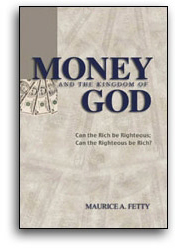
MONEY AND THE KINGDOM OF GOD
Can The Rich Be Righteous; Can The Righteous Be Rich?
The financial and investment community was uneasy as the ominous day, October 19, 1988, approached. Remembering the great crash of Black Monday, October 19, 1987, many investors were fearful of another massive drop in the stock market. Indeed, for a while on that day, a significant drop did occur only to be corrected by a late afternoon rally. Stockbrokers and investors alike breathed a sigh of relief once that day passed.

How much did you lose in the Great Crash of 1987? Twenty percent? Forty percent? Fifty percent? That crash sent a jolt through the financial world which put thousands of yuppies out of a job, closed many pricey, trendy restaurants, and deflated the real estate market even in the best of neighborhoods.
How have you been handling your investments for the future since the Great Crash? Are you in tax--free municipal bonds or in mutual bonds? Are you in real estate or corporate bonds? Are you in stocks both foreign and domestic or have you invested in money--market funds or certificates of deposit? Have you, like thousands, invested in mutual funds to enjoy significant gains in the soaring bull market?
However, if you like the risk, adventure, and drama, you might want to try your hand at the futures market. At a wedding reception I talked with the father of the bride who had made his living in the futures market, trading commodities. He had retired twice, but got back in each time because he liked it so much. "I've lost some money," he said, "but fortunately I've made a lot. It's really exciting."
One major segment of the futures market is grain futures. It works something like this. You can invest your money now to buy the option to buy a farmer's grain in advance, gambling on the chance that its price will increase by the time it is harvested and you can sell at a profit. You not only can buy a farmer's crop, you can buy a whole trainload of corn or soybeans.
There is a high risk in the futures market. Not only is there high risk in price fluctuation, there is high risk in timing. For example, most people who deal in futures would have no way whatever to handle a trainload of soybeans. But if they didn't sell their trainload of soybeans at the right time, they are likely to receive a knock on the door and a question, "Where would you like us to put your trainload of soybeans?" Of course, this is only theoretical because you would have sold them at a loss or profit before taking the delivery.
Most of us do not play the futures game. It is too risky and specialized. Nevertheless, we all are involved in a similar kind of futures market called life. And the truth is, at the end of the season, we will get a trainload of something or other at our door. It's a law of life. You get a return on your investment. And the kind of return you get depends on the kind of investment you make. Sometimes it's double or nothing.
Jesus' story of the five, two, and one talent persons is one of his many stories about money and its use. It is a story about investing for the future and return on the dollar. It is a lesson about the use of our present capabilities and monies to ensure a productive tomorrow. It is about people who are lively and risky and adventuresome as opposed to those who are fearful, defensive, and self--righteous. And the stakes are high because often it's a case of double or nothing.
I.
Note first the risk--takers. They double their money, and then are entrusted with more.
The word "talent" first referred to a measure of weight and later designated a monetary unit of the highest denomination, which today would be worth, adjusted for inflation, about $2.5 million. Thus in Jesus' story one person is given $2.5 million, another $1 million, and the last $500,000. Each person is given the amount the Lord thinks he can handle. He does not overburden his servants, but gives to each according to his ability. The Lord then leaves and asks the servants to do as well as they can with the money entrusted to them.
When the Lord returns, the man given $2.5 million has made another $2.5 million to turn back a total of $5 million. The man given $1 million has doubled his money to $2 million. The Lord is overjoyed at how well they have done in their investing. They have been prompt, devoted, and faithful. They have been adventurous and resourceful. They have taken a chance on the future and had won. Consequently, they are invited into the joy of the Lord and are given even more to invest.
The amazing thing is that the law of the harvest is built into the universe. God is invested in growth. The natural world, despite our destructiveness and misuse, produces in multiples of the seed it sows. God is not interested in a world running down with less and less life. Rather, he is interested in a world which grows and expands and becomes more and more productive. God is not interested in failure any more than we are. God is invested in salvation, which means wholeness, completeness, and breadth of life.
God has no interest in hunger and malnutrition and homeless--ness. Instead he has made the world so productive and bountiful there is more than enough for all if we will invest it wisely and share it generously. God is not interested in a world and universe that ends up in red ink. God, like any wise investor, is interested in making a "profit."
If that is true of God's world, it is true of his church. What is the waiting church to do until the end of history and the Lord's return? It is to invest wisely for the future. It is to take its gifts and money and invest them as good stewards or managers of what God has given. Very often it is a matter of double or nothing.
II.
But there is more to this matter of investing. If the word "talent" originally meant measure or weight and then money, in the Middle Ages it began to represent abilities and natural endowments as well as special gifts of the spirit given to individuals for the good of the church.
How many talents have you been given? Five? Ten? Two? One? The various gifts and abilities we possess must be used not just for ourselves and our private paradises. Rather, they are to be invested for the sake of the Lord's Church.
Do we have the ability to sing? Then let us join the choir or music program. Are we a good teacher or organizer? Then why not put those gifts to use? Do we have the ability to raise money? Then why not use that skill for the Lord's cause? Are we able to cook or make visits to shut--ins or assist people in trouble or develop a task force to meet a special need? Then we are asked by the Lord of the universe to invest unselfishly with the gifts we have been given for the future of the church.
The glory days of the '50s and '60s were "bull market" times for mainline churches. It was relatively easy to "make money" on investments in those days. But these are "bear market" days for mainline churches. Consequently, we need the successful, risk--taking, courageous, wise, incisive, intelligent, five and two talent types to give leadership and to "make money" in these times.
We need the several--talent person and the one--talent person to step forward in leadership. We need people who will risk their many abilities and their God--given gifts, their unusual and usual skills to invest, to take a risk, to earn a return for the church.
We need people to come out of withdrawal, to come back from bitterness and disenchantment, to come from anger with forgiveness, to come out of the spectator bleachers into the playing field. We need our top--talent and our one--talent person to invest in the future, and like the Lord's servants, "double our money."
One longtime member told me this church is like a sixteen--cylinder Dusenberg. Once you get all sixteen cylinders fired up and working together, there is nothing that can stop it. I think he is right. The talent and ability represented in the church is most impressive. What we need to do is to fire it up and get it running harmoniously. When we do, there will not be much that can stop it.
III.
Well, how are we investing for the future, especially for our children? What kind of seed money are we planting for their spiritual and moral education?
One seed we have planted in our children's minds is the importance of education. As a nation we have made it illegal to leave school before age sixteen. In this great land of freedom there is one freedom our law will not allow - the freedom to be uneducated. We do not allow that freedom because we feel it would threaten our democracy too seriously. Democracy depends upon an enlightened and conscientious populace. Tyrants reign on a foundation of ignorance. Dictators enforce their wills on those whose minds are too clouded to determine their own will. Totalitarian ideologies abound where the populace has rejected its responsibility for careful thinking. As a nation, we have rightly sown the seed of education.
But then we must ask, how about the seed of religious education? It is at this point Americans and many Christians begin to shuffle their feet and clear their throats to introduce a strange logic.
Surprisingly, many Christians who are very well educated in our nation's colleges and universities have little concern for religious education. If you were to ask them if they wanted their children to be good Christians and to share values and experiences similar to their own, most would answer, "Yes." Nevertheless, somewhere between the wish and the performance, there is a breakdown.
Some people seem to think their children will learn the Christian faith and moral principles by osmosis or mental telepathy. They have them in church on an irregular basis, hold the church in low esteem, and talk little of God or Christ except to swear. They pray little and read the Bible almost never. And yet, these same people seem to believe they are producing strong Christians and stalwart citizens.
At a time when many observers believe we have a bankruptcy of values, and at a time when most institutions have given up concern over values, people continue to snub their nose at the one value--producing institution in the land - the church.
If we want our children to be skiers, we pay the money for equipment and see that they get to the slopes. If we want them to be athletes or musicians or scholars, we pay the money, invest the time, and support the activities which will aid them toward the goal. We are smart enough to know that in these areas we reap what we sow.
But when it comes to church, a strange psychology sets in. If we want to become good Christians, we seem to think they will become so without time, money, or effort.
Some people are so caught up in the orgy of selfishness they make no sensible provision for the faith of the coming generation. They not only are sowing bad seed, some are hoarding all the seed to themselves, too selfish and lazy to be concerned about anyone but themselves. They are burying their talent, the moral and spiritual seeds that should be sown in young, fertile hearts and minds in the children entrusted to this family of faith, our Church.
Let us be warned about that kind of futures investing. Keep sowing that kind of seed and we'll continue to reap a whirlwind harvest of shallow secularism and subsequent nihilism and then totalitarianism. Let the Church and America be warned. You will reap what you sow. Invest in God--ignoring lifestyles and eventually we will have a trainload of Godless behavior in our front yard. It's double or nothing.
IV.
If this famous parable praises the wise investors, it severely judges the fearful, foolish would--be investors.
If the wise investors took their respective five and two talents to double their Lord's money before his return, the foolish man took his one talent and buried it in the backyard. He didn't even bank it to earn minimal interest in an insured passbook savings account. And it is toward the one--talent man that the thrust of this parable is directed. The one--talent man even blamed God for his insolence and laziness, for his timidity and lack of courage. But God held him accountable. He ended up with nothing.
Will we be a five--and--two--talent church, doubling our investment for the future? Or will we be a one--talent church buried in nostalgia, inflexibility, and fear? Will ours be a backyard burial or a frontline investment in the future? The choice is ours. It's double or nothing.
Prayer
Almighty God, divine energy and power behind all that is to be, by your wisdom you designed the universe, galaxy upon galaxy, and by your intensive love you shaped humanity in your image to reflect your glory and to do your will in the world. We give thanks and praise for all your created wonders and adore you for making us participants in thought and creativity.
We are especially grateful for abundant harvests. How can we thank you enough for the miracle of seed bearing seed, multiplying itself into an apple tree which produces even more trees to bless us with food and drink and to pleasure the eye with beauty and the sense of touch with pleasant texture? All the created world is complex beyond imagining, and yet it is balanced, beautiful, and bountiful. We praise you, Almighty God, for these blessings.
In your holy presence it is for us to confess our sometimes wanton destruction of your natural world and to acknowledge our frequent abuse of the environment. In air and sea and land we have, as humankind, left a trail of pollution and desecration. Forgive us these wrongs, and help all peoples of the world to be responsible in their use of natural resources.
We especially pray for our families. Some are angry and contentious, distraught with festering hostilities and unresolved anger. Bring forgiveness and peace, O God. Some families are destitute with no work or income. Help them to find employment and sustenance. Some families mourn the loss of husband or wife, mother or father, grandmother or grandfather. Bring comfort and peace to them and reassure us all of your grand harvest home in your kingdom which has no end.
For all those who on this day suffer from want and hunger, for refugees far from home and destitute in this world's goods, for the ill, the persecuted, and the troubled in every land, we pray your blessing of healing and strength. Let it be so, O God. Through Jesus Christ our Lord. Amen.
How much did you lose in the Great Crash of 1987? Twenty percent? Forty percent? Fifty percent? That crash sent a jolt through the financial world which put thousands of yuppies out of a job, closed many pricey, trendy restaurants, and deflated the real estate market even in the best of neighborhoods.
How have you been handling your investments for the future since the Great Crash? Are you in tax--free municipal bonds or in mutual bonds? Are you in real estate or corporate bonds? Are you in stocks both foreign and domestic or have you invested in money--market funds or certificates of deposit? Have you, like thousands, invested in mutual funds to enjoy significant gains in the soaring bull market?
However, if you like the risk, adventure, and drama, you might want to try your hand at the futures market. At a wedding reception I talked with the father of the bride who had made his living in the futures market, trading commodities. He had retired twice, but got back in each time because he liked it so much. "I've lost some money," he said, "but fortunately I've made a lot. It's really exciting."
One major segment of the futures market is grain futures. It works something like this. You can invest your money now to buy the option to buy a farmer's grain in advance, gambling on the chance that its price will increase by the time it is harvested and you can sell at a profit. You not only can buy a farmer's crop, you can buy a whole trainload of corn or soybeans.
There is a high risk in the futures market. Not only is there high risk in price fluctuation, there is high risk in timing. For example, most people who deal in futures would have no way whatever to handle a trainload of soybeans. But if they didn't sell their trainload of soybeans at the right time, they are likely to receive a knock on the door and a question, "Where would you like us to put your trainload of soybeans?" Of course, this is only theoretical because you would have sold them at a loss or profit before taking the delivery.
Most of us do not play the futures game. It is too risky and specialized. Nevertheless, we all are involved in a similar kind of futures market called life. And the truth is, at the end of the season, we will get a trainload of something or other at our door. It's a law of life. You get a return on your investment. And the kind of return you get depends on the kind of investment you make. Sometimes it's double or nothing.
Jesus' story of the five, two, and one talent persons is one of his many stories about money and its use. It is a story about investing for the future and return on the dollar. It is a lesson about the use of our present capabilities and monies to ensure a productive tomorrow. It is about people who are lively and risky and adventuresome as opposed to those who are fearful, defensive, and self--righteous. And the stakes are high because often it's a case of double or nothing.
I.
Note first the risk--takers. They double their money, and then are entrusted with more.
The word "talent" first referred to a measure of weight and later designated a monetary unit of the highest denomination, which today would be worth, adjusted for inflation, about $2.5 million. Thus in Jesus' story one person is given $2.5 million, another $1 million, and the last $500,000. Each person is given the amount the Lord thinks he can handle. He does not overburden his servants, but gives to each according to his ability. The Lord then leaves and asks the servants to do as well as they can with the money entrusted to them.
When the Lord returns, the man given $2.5 million has made another $2.5 million to turn back a total of $5 million. The man given $1 million has doubled his money to $2 million. The Lord is overjoyed at how well they have done in their investing. They have been prompt, devoted, and faithful. They have been adventurous and resourceful. They have taken a chance on the future and had won. Consequently, they are invited into the joy of the Lord and are given even more to invest.
The amazing thing is that the law of the harvest is built into the universe. God is invested in growth. The natural world, despite our destructiveness and misuse, produces in multiples of the seed it sows. God is not interested in a world running down with less and less life. Rather, he is interested in a world which grows and expands and becomes more and more productive. God is not interested in failure any more than we are. God is invested in salvation, which means wholeness, completeness, and breadth of life.
God has no interest in hunger and malnutrition and homeless--ness. Instead he has made the world so productive and bountiful there is more than enough for all if we will invest it wisely and share it generously. God is not interested in a world and universe that ends up in red ink. God, like any wise investor, is interested in making a "profit."
If that is true of God's world, it is true of his church. What is the waiting church to do until the end of history and the Lord's return? It is to invest wisely for the future. It is to take its gifts and money and invest them as good stewards or managers of what God has given. Very often it is a matter of double or nothing.
II.
But there is more to this matter of investing. If the word "talent" originally meant measure or weight and then money, in the Middle Ages it began to represent abilities and natural endowments as well as special gifts of the spirit given to individuals for the good of the church.
How many talents have you been given? Five? Ten? Two? One? The various gifts and abilities we possess must be used not just for ourselves and our private paradises. Rather, they are to be invested for the sake of the Lord's Church.
Do we have the ability to sing? Then let us join the choir or music program. Are we a good teacher or organizer? Then why not put those gifts to use? Do we have the ability to raise money? Then why not use that skill for the Lord's cause? Are we able to cook or make visits to shut--ins or assist people in trouble or develop a task force to meet a special need? Then we are asked by the Lord of the universe to invest unselfishly with the gifts we have been given for the future of the church.
The glory days of the '50s and '60s were "bull market" times for mainline churches. It was relatively easy to "make money" on investments in those days. But these are "bear market" days for mainline churches. Consequently, we need the successful, risk--taking, courageous, wise, incisive, intelligent, five and two talent types to give leadership and to "make money" in these times.
We need the several--talent person and the one--talent person to step forward in leadership. We need people who will risk their many abilities and their God--given gifts, their unusual and usual skills to invest, to take a risk, to earn a return for the church.
We need people to come out of withdrawal, to come back from bitterness and disenchantment, to come from anger with forgiveness, to come out of the spectator bleachers into the playing field. We need our top--talent and our one--talent person to invest in the future, and like the Lord's servants, "double our money."
One longtime member told me this church is like a sixteen--cylinder Dusenberg. Once you get all sixteen cylinders fired up and working together, there is nothing that can stop it. I think he is right. The talent and ability represented in the church is most impressive. What we need to do is to fire it up and get it running harmoniously. When we do, there will not be much that can stop it.
III.
Well, how are we investing for the future, especially for our children? What kind of seed money are we planting for their spiritual and moral education?
One seed we have planted in our children's minds is the importance of education. As a nation we have made it illegal to leave school before age sixteen. In this great land of freedom there is one freedom our law will not allow - the freedom to be uneducated. We do not allow that freedom because we feel it would threaten our democracy too seriously. Democracy depends upon an enlightened and conscientious populace. Tyrants reign on a foundation of ignorance. Dictators enforce their wills on those whose minds are too clouded to determine their own will. Totalitarian ideologies abound where the populace has rejected its responsibility for careful thinking. As a nation, we have rightly sown the seed of education.
But then we must ask, how about the seed of religious education? It is at this point Americans and many Christians begin to shuffle their feet and clear their throats to introduce a strange logic.
Surprisingly, many Christians who are very well educated in our nation's colleges and universities have little concern for religious education. If you were to ask them if they wanted their children to be good Christians and to share values and experiences similar to their own, most would answer, "Yes." Nevertheless, somewhere between the wish and the performance, there is a breakdown.
Some people seem to think their children will learn the Christian faith and moral principles by osmosis or mental telepathy. They have them in church on an irregular basis, hold the church in low esteem, and talk little of God or Christ except to swear. They pray little and read the Bible almost never. And yet, these same people seem to believe they are producing strong Christians and stalwart citizens.
At a time when many observers believe we have a bankruptcy of values, and at a time when most institutions have given up concern over values, people continue to snub their nose at the one value--producing institution in the land - the church.
If we want our children to be skiers, we pay the money for equipment and see that they get to the slopes. If we want them to be athletes or musicians or scholars, we pay the money, invest the time, and support the activities which will aid them toward the goal. We are smart enough to know that in these areas we reap what we sow.
But when it comes to church, a strange psychology sets in. If we want to become good Christians, we seem to think they will become so without time, money, or effort.
Some people are so caught up in the orgy of selfishness they make no sensible provision for the faith of the coming generation. They not only are sowing bad seed, some are hoarding all the seed to themselves, too selfish and lazy to be concerned about anyone but themselves. They are burying their talent, the moral and spiritual seeds that should be sown in young, fertile hearts and minds in the children entrusted to this family of faith, our Church.
Let us be warned about that kind of futures investing. Keep sowing that kind of seed and we'll continue to reap a whirlwind harvest of shallow secularism and subsequent nihilism and then totalitarianism. Let the Church and America be warned. You will reap what you sow. Invest in God--ignoring lifestyles and eventually we will have a trainload of Godless behavior in our front yard. It's double or nothing.
IV.
If this famous parable praises the wise investors, it severely judges the fearful, foolish would--be investors.
If the wise investors took their respective five and two talents to double their Lord's money before his return, the foolish man took his one talent and buried it in the backyard. He didn't even bank it to earn minimal interest in an insured passbook savings account. And it is toward the one--talent man that the thrust of this parable is directed. The one--talent man even blamed God for his insolence and laziness, for his timidity and lack of courage. But God held him accountable. He ended up with nothing.
Will we be a five--and--two--talent church, doubling our investment for the future? Or will we be a one--talent church buried in nostalgia, inflexibility, and fear? Will ours be a backyard burial or a frontline investment in the future? The choice is ours. It's double or nothing.
Prayer
Almighty God, divine energy and power behind all that is to be, by your wisdom you designed the universe, galaxy upon galaxy, and by your intensive love you shaped humanity in your image to reflect your glory and to do your will in the world. We give thanks and praise for all your created wonders and adore you for making us participants in thought and creativity.
We are especially grateful for abundant harvests. How can we thank you enough for the miracle of seed bearing seed, multiplying itself into an apple tree which produces even more trees to bless us with food and drink and to pleasure the eye with beauty and the sense of touch with pleasant texture? All the created world is complex beyond imagining, and yet it is balanced, beautiful, and bountiful. We praise you, Almighty God, for these blessings.
In your holy presence it is for us to confess our sometimes wanton destruction of your natural world and to acknowledge our frequent abuse of the environment. In air and sea and land we have, as humankind, left a trail of pollution and desecration. Forgive us these wrongs, and help all peoples of the world to be responsible in their use of natural resources.
We especially pray for our families. Some are angry and contentious, distraught with festering hostilities and unresolved anger. Bring forgiveness and peace, O God. Some families are destitute with no work or income. Help them to find employment and sustenance. Some families mourn the loss of husband or wife, mother or father, grandmother or grandfather. Bring comfort and peace to them and reassure us all of your grand harvest home in your kingdom which has no end.
For all those who on this day suffer from want and hunger, for refugees far from home and destitute in this world's goods, for the ill, the persecuted, and the troubled in every land, we pray your blessing of healing and strength. Let it be so, O God. Through Jesus Christ our Lord. Amen.