Clean Hearts And Renewed Spirits
Adult study
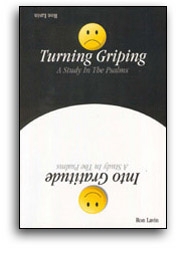
Turning Griping Into Gratitude
A Study In The Psalms
Object:
Create in me a clean heart, O God, and put a new and right spirit within me.
-- Psalm 51:10, NRSV
* * *
Why not memorize Psalm 51:10 and repeat it each day this week? This verse shows us how to deal with the enemies in our own hearts and minds. Often, we are our own worse enemy. Unclean hearts and wrong spirits can bog us down in the mire of soul despair. That is why we need this verse about clean hearts and renewed spirits.

There is an extreme potential in each of us for both evil and good. Both sides of human nature are revealed in this great psalm verse. David, the psalmist, had fallen into the pit of despair because he followed his lower nature. He also rose to great heights of spirituality when he followed his higher nature. As a human being made in the image of God, David returned to the Lord and was restored.
Unclean Hearts And Wrong Spirits
An anonymous poet described our two natures like this:
Two Natures
Within this earthly temple there's a crowd
There is one of us that's humble; one that's proud.
There is one that is sorry for his sins
One that unrepentant, sits and grins.
From much corroding care I would be free,
If I could just discover which is me.
They are both me. The struggle within is a struggle between these two forces. We see these forces at work in David, the psalmist. We see them in ourselves as well.
We were created "a little lower than the angels," but sometimes we act like little devils. There are two sides to each of us. The question is not "Are we bad or good?" We are both. The question is "Which one of these forces will win out?"
Another anonymous poet described the plight of being caught between the forces of evil and good like this:
There is so much bad in the best of us
And so much good in the worst of us
That it hardly behooves any of us
To talk about the rest of us.
We will look at the both sides of our human nature as we examine Psalm 51. "Create in me a clean heart, O God, and put a new and right spirit within me" (Psalm 51:10).
"Create in me a clean heart, O God ..." the psalmist writes. What does it mean that God gives us clean hearts? The first thing we must do is to acknowledge that our hearts are unclean.
The heart, with its pumping of blood to all parts of the body, is basic for life. Heart trouble means trouble in all parts of the body. When the veins get all clogged up, the whole body suffers. Someone recently told me, "I just had triple bypass surgery. Now I feel like a new man."
It is the clogging up of our spiritual side which the ancient psalmist has in mind when he pleads with God to give him a clean heart. Psalm 51 lists three ways that our spiritual hearts get clogged up.
First, transgressions clog up the spiritual heart. Transgression is a matter of conscious rebellion. "Have mercy on me, O God, according to your steadfast love; according to your abundant mercy blot out my transgressions," the psalmist writes (51:1).
The origin of this psalm is revealing. David, the King of Israel, committed adultery with a beautiful woman named Bathsheba. He saw her bathing on her balcony one day and he lusted after her. He was a man of power. He knew that it was wrong to lust after another man's wife, but he proceeded with the affair, driven by his will to have this woman, whatever the cost. When Bathsheba got pregnant, David tried to cover his transgression by sending her husband Uriah, one of David's warriors, to the front lines. David's rebellious attitude cost Uriah his life.
The prophet Nathan appeared before David one day and asked the pointed question, "How would you judge a man who was wealthy and powerful who stole from a man who was weak and needy?" David, the King, who frequently had to make judgments about people's behavior, said that the man should be punished severely. Nathan, the prophet, responded, "You are the man."
Psalm 51 is David's response to having his transgression revealed. "Blot out my transgressions ..." (51:1), he wrote. "Create in me a clean heart, O God" (51:10). You can feel the passion and the drama of repentance and forgiveness in the Psalm. Transgressions separated David from his source of power. He was revived, restored, and reinstated.
We too transgress. We know something is wrong, yet we proceed with it, not realizing the consequences of our actions. Is it possible to be restored? Yes, but we, like David, must repent. When we do, God casts our sins from us.
As Psalm 103:12 says, "As far as the east is from the west, so far he removes our transgressions from us."
Unclean hearts are filled with transgressions, willful disobedience. Unclean hearts are also filled with iniquities.
Second, iniquities clog up the spiritual heart. David wrote, "Wash me thoroughly from my iniquity ..." (Psalm 51:2).
Iniquity means error, or straying from God's ways, as David strayed when he followed his lust instead of his God. Right from the beginning of time, we see the tendency to stray from God's ways. The story of Adam and Eve not only illustrates how we go in erroneous ways, it also shows how we try to cover up for what we do, refusing to acknowledge that we have done wrong.
God said to Adam, "You may eat of all of the trees of this garden, except this one tree." The one thing forbidden is the one thing desired most of all. Eve tempts Adam to eat of the forbidden fruit. Adam relents and does what he knows is against God's will, making a major error of judgment. Then he compounds the error by trying to cover it up and blaming Eve.
God finds Adam hiding behind a bush. "What have you done?" God asks. "It wasn't me. Eve made me do it." When Eve is confronted, she blames the snake. "He made me do it," she says. We have here the classic game of "P.T.B.," "Passing the buck."
This game of "P.T.B." is played in homes and offices, between children and their parents and between friends. It results in compounding the original error by refusing to acknowledge that we have done wrong. Iniquity compounded by iniquity clogs things up in human relationships. Refusing to take responsibility for the error of our ways means that we do not have clean hearts.
When Nathan said to David, "Thou art the man," David repented. Many today, following the example of Adam, say, "Not me. Someone else made me do it. It was the fault of my parents and the way they raised me. I am not guilty. Someone else is to blame." David, setting a pattern of health said, "Wash me thoroughly from my iniquity and cleanse me from my sin" (51:2).
The third way this psalm describes an unclean heart is sin. "Cleanse me from my sin," David wrote (Psalm 51:2). Sin is our self-centered tendency to miss the mark. It means that we cannot see beyond our own little world. In theology, the German word umvelt is used to describe this condition. It means that I don't see the big picture because I am all caught up in my little world.
A psychiatrist wrote in his journal about a patient named Edith, that there was little hope of helping her. Here is what he said: "Edith is bound on the east and west, the north and the south by Edith."
Edith is not the only one who has this problem. We all have it! Psalm 51 shows us the way out of the dilemma of being bound on every side by ourselves. There is a war going on in every one of us -- a war between evil and good. The way out of the dilemma called sin is repentance, turning from self to God.
One part of me says, "I did not do it. Don't blame me." That is the part which is called original sin. By nature I am sinful and self-centered. That is what Psalm 51:5 means when it says, "In sin did my mother conceive me." If that tendency is not overcome, I come out a loser and find only misery and death.
But there is hope. God also placed a bit of himself in me. That part says, "Confess your sin and return to God." David chose the better part and said, "Create in me a clean heart, O God...." Thus David's spirit was renewed. We, too, can have renewed spirits by choosing the better part.
Clean Hearts And Renewed Spirits
David said, "Create in me a clean heart, O God, and put a new and right spirit within me" (Psalm 51:10). How can I have a new and right spirit? By repentance and return.
Repentance means turning back to God when we have gone astray. Repentance results in revival of our flagging spirits, restoration of the joy that has been missing, and reinstatement of our relationship with our God. I especially like the Brandt paraphrase of Psalm 51:10-12.
Revive my flagging spirit, O God
Restore to me the joy and assurance of a right
relationship with You.
Reinstate me in Your purposes, and help me to
avoid the snares and pitfalls along the way.20
Consider the three words, revive, restore and reinstate, and behold what happens when God gives clean hearts and renewed spirits as we turn back to him with repentance.
Let me describe this journey back to God in story form. It is one thing to hear the truth of God, another to feel the truth of it. Sometimes we feel it better when we hear it in story form. This is the true story of Jay Dull.
In 1961, Jay Dull murdered a taxicab driver in Muncie, Indiana. Jay and his friend, Walter, had taken the taxicab driver out into the country to rob him. When the cab driver lunged for the gun, it went off and shot him. Jay and his friend, Walt, jumped in the cab and drove back to town, leaving the cabdriver in the country where he froze to death. It is plain to see that the lower natures of Jay Dull and Walt were at work in the robbery and the murder. It got worse.
At his trial, Jay was asked the question, "Aren't you sorry for what you did?" The belligerent, arrogant criminal responded, "Hell, no. Given the same circumstances, I'd do it again." Jay Dull was convicted of murder and assigned to the electric chair. He ordered his last meal, had his head and leg shaved, and came within twelve hours of being electrocuted. A stay of execution from the governor of Indiana, in response to the pleas from Jay's mother, saved his life physically, but from a spiritual point of view, Jay seemed like a hopeless case.
I met Jay in the county jail in Muncie in 1962. One of his relatives was a member of Holy Trinity Church where I was the pastor. "Will you go see him?" his relative asked. Reluctantly I went, but frankly I thought that a pastoral call was useless. When Jay told me that he had turned his life over to Christ, I thought at first that it was what is called "jail-house religion," saying that you are sorry in order to avoid the consequences of evil actions. After visiting Jay over a period of several months, I became convinced that Jay was sincere in his repentance.
It was my pleasure to see this murderer turn his life over to the Savior. "I deserve this punishment," Jay said, "but I need to be made right with God." I heard Jay's confession, instructed him in the Christian faith, and confirmed him in the Muncie jail in 1963. Jay's higher nature responded to the gospel that Christ had died for him and for his forgiveness.
Most of us have not gone to the extremes of adultery like King David or murder like Jay Dull, but we have the same potential for evil that they had. We also have the same potential to turn back to God, because God has placed a bit of himself in all of us. It is called "the image of God." There is something in us onto which God latches. In theology this is called the anknugfunktspunkt, the buttoning-on point. God placed something of himself in each of us so that, like a button and a buttonhole, we fit together with God when we return to him. When that happens, God revives us, restores us, and reinstates us.
First, God revives us. All of us get tired and discouraged. It is very encouraging to hear that God revives our flagging spirits.
Our spirits can be revived. Jesus says, "Come unto me all you who labor and are heavy laden and I will give you rest" (Matthew 11:28). When burdened down with problems and sins, we can be revived. That is why we have a Savior who loves us.
Second, our spirits can be restored. Jeremiah, the prophet, wrote, "Return O faithless children. I will heal your faithlessness" (Jeremiah 3:22). Let me paraphrase the message of God's prophet: "If you return, I will restore you" (Jeremiah 4:1). We can be restored because we have a Savior who has mercy on us.
Third, we can be reinstated to the status of God's children, seeking to do God's will and following his purposes. We can be reinstated because we have a Savior who died for us.
After being away from God all of her life, a new Christian recently told me, "This church has made all the difference in the world for my life. I am a new person. I was judgmental and resentful. Life looks very different now. For the first time in my life, I feel that I am not alone. God is on my side. God was there all along, I just did not see it before."
It is my privilege as a pastor to see the worst and the best in people. Pastors see both the selfish and greedy side when people reveal their sins in confession or when relatives fight with one another over who will inherit what at the time of a death. We also see the best in some people as they turn back to God and have their spirits renewed. That is one of the reasons I like the anonymous poem about the two sides of human nature so much.
There is so much bad in the best of us
And so much good in the worse of us
That it hardly behooves any of us
To talk about the rest of us.
Questions For Meditation
Or Group Discussion
1. Describe the two-sided nature of human beings.
2. Transgressions are:
3. Iniquities are:
4. Sin is:
5. What revives us, restores us, and reinstates us?
_________
20. Leslie Brandt, Psalms Now (St. Louis: Concordia, 1973), p. 82.
-- Psalm 51:10, NRSV
* * *
Why not memorize Psalm 51:10 and repeat it each day this week? This verse shows us how to deal with the enemies in our own hearts and minds. Often, we are our own worse enemy. Unclean hearts and wrong spirits can bog us down in the mire of soul despair. That is why we need this verse about clean hearts and renewed spirits.
There is an extreme potential in each of us for both evil and good. Both sides of human nature are revealed in this great psalm verse. David, the psalmist, had fallen into the pit of despair because he followed his lower nature. He also rose to great heights of spirituality when he followed his higher nature. As a human being made in the image of God, David returned to the Lord and was restored.
Unclean Hearts And Wrong Spirits
An anonymous poet described our two natures like this:
Two Natures
Within this earthly temple there's a crowd
There is one of us that's humble; one that's proud.
There is one that is sorry for his sins
One that unrepentant, sits and grins.
From much corroding care I would be free,
If I could just discover which is me.
They are both me. The struggle within is a struggle between these two forces. We see these forces at work in David, the psalmist. We see them in ourselves as well.
We were created "a little lower than the angels," but sometimes we act like little devils. There are two sides to each of us. The question is not "Are we bad or good?" We are both. The question is "Which one of these forces will win out?"
Another anonymous poet described the plight of being caught between the forces of evil and good like this:
There is so much bad in the best of us
And so much good in the worst of us
That it hardly behooves any of us
To talk about the rest of us.
We will look at the both sides of our human nature as we examine Psalm 51. "Create in me a clean heart, O God, and put a new and right spirit within me" (Psalm 51:10).
"Create in me a clean heart, O God ..." the psalmist writes. What does it mean that God gives us clean hearts? The first thing we must do is to acknowledge that our hearts are unclean.
The heart, with its pumping of blood to all parts of the body, is basic for life. Heart trouble means trouble in all parts of the body. When the veins get all clogged up, the whole body suffers. Someone recently told me, "I just had triple bypass surgery. Now I feel like a new man."
It is the clogging up of our spiritual side which the ancient psalmist has in mind when he pleads with God to give him a clean heart. Psalm 51 lists three ways that our spiritual hearts get clogged up.
First, transgressions clog up the spiritual heart. Transgression is a matter of conscious rebellion. "Have mercy on me, O God, according to your steadfast love; according to your abundant mercy blot out my transgressions," the psalmist writes (51:1).
The origin of this psalm is revealing. David, the King of Israel, committed adultery with a beautiful woman named Bathsheba. He saw her bathing on her balcony one day and he lusted after her. He was a man of power. He knew that it was wrong to lust after another man's wife, but he proceeded with the affair, driven by his will to have this woman, whatever the cost. When Bathsheba got pregnant, David tried to cover his transgression by sending her husband Uriah, one of David's warriors, to the front lines. David's rebellious attitude cost Uriah his life.
The prophet Nathan appeared before David one day and asked the pointed question, "How would you judge a man who was wealthy and powerful who stole from a man who was weak and needy?" David, the King, who frequently had to make judgments about people's behavior, said that the man should be punished severely. Nathan, the prophet, responded, "You are the man."
Psalm 51 is David's response to having his transgression revealed. "Blot out my transgressions ..." (51:1), he wrote. "Create in me a clean heart, O God" (51:10). You can feel the passion and the drama of repentance and forgiveness in the Psalm. Transgressions separated David from his source of power. He was revived, restored, and reinstated.
We too transgress. We know something is wrong, yet we proceed with it, not realizing the consequences of our actions. Is it possible to be restored? Yes, but we, like David, must repent. When we do, God casts our sins from us.
As Psalm 103:12 says, "As far as the east is from the west, so far he removes our transgressions from us."
Unclean hearts are filled with transgressions, willful disobedience. Unclean hearts are also filled with iniquities.
Second, iniquities clog up the spiritual heart. David wrote, "Wash me thoroughly from my iniquity ..." (Psalm 51:2).
Iniquity means error, or straying from God's ways, as David strayed when he followed his lust instead of his God. Right from the beginning of time, we see the tendency to stray from God's ways. The story of Adam and Eve not only illustrates how we go in erroneous ways, it also shows how we try to cover up for what we do, refusing to acknowledge that we have done wrong.
God said to Adam, "You may eat of all of the trees of this garden, except this one tree." The one thing forbidden is the one thing desired most of all. Eve tempts Adam to eat of the forbidden fruit. Adam relents and does what he knows is against God's will, making a major error of judgment. Then he compounds the error by trying to cover it up and blaming Eve.
God finds Adam hiding behind a bush. "What have you done?" God asks. "It wasn't me. Eve made me do it." When Eve is confronted, she blames the snake. "He made me do it," she says. We have here the classic game of "P.T.B.," "Passing the buck."
This game of "P.T.B." is played in homes and offices, between children and their parents and between friends. It results in compounding the original error by refusing to acknowledge that we have done wrong. Iniquity compounded by iniquity clogs things up in human relationships. Refusing to take responsibility for the error of our ways means that we do not have clean hearts.
When Nathan said to David, "Thou art the man," David repented. Many today, following the example of Adam, say, "Not me. Someone else made me do it. It was the fault of my parents and the way they raised me. I am not guilty. Someone else is to blame." David, setting a pattern of health said, "Wash me thoroughly from my iniquity and cleanse me from my sin" (51:2).
The third way this psalm describes an unclean heart is sin. "Cleanse me from my sin," David wrote (Psalm 51:2). Sin is our self-centered tendency to miss the mark. It means that we cannot see beyond our own little world. In theology, the German word umvelt is used to describe this condition. It means that I don't see the big picture because I am all caught up in my little world.
A psychiatrist wrote in his journal about a patient named Edith, that there was little hope of helping her. Here is what he said: "Edith is bound on the east and west, the north and the south by Edith."
Edith is not the only one who has this problem. We all have it! Psalm 51 shows us the way out of the dilemma of being bound on every side by ourselves. There is a war going on in every one of us -- a war between evil and good. The way out of the dilemma called sin is repentance, turning from self to God.
One part of me says, "I did not do it. Don't blame me." That is the part which is called original sin. By nature I am sinful and self-centered. That is what Psalm 51:5 means when it says, "In sin did my mother conceive me." If that tendency is not overcome, I come out a loser and find only misery and death.
But there is hope. God also placed a bit of himself in me. That part says, "Confess your sin and return to God." David chose the better part and said, "Create in me a clean heart, O God...." Thus David's spirit was renewed. We, too, can have renewed spirits by choosing the better part.
Clean Hearts And Renewed Spirits
David said, "Create in me a clean heart, O God, and put a new and right spirit within me" (Psalm 51:10). How can I have a new and right spirit? By repentance and return.
Repentance means turning back to God when we have gone astray. Repentance results in revival of our flagging spirits, restoration of the joy that has been missing, and reinstatement of our relationship with our God. I especially like the Brandt paraphrase of Psalm 51:10-12.
Revive my flagging spirit, O God
Restore to me the joy and assurance of a right
relationship with You.
Reinstate me in Your purposes, and help me to
avoid the snares and pitfalls along the way.20
Consider the three words, revive, restore and reinstate, and behold what happens when God gives clean hearts and renewed spirits as we turn back to him with repentance.
Let me describe this journey back to God in story form. It is one thing to hear the truth of God, another to feel the truth of it. Sometimes we feel it better when we hear it in story form. This is the true story of Jay Dull.
In 1961, Jay Dull murdered a taxicab driver in Muncie, Indiana. Jay and his friend, Walter, had taken the taxicab driver out into the country to rob him. When the cab driver lunged for the gun, it went off and shot him. Jay and his friend, Walt, jumped in the cab and drove back to town, leaving the cabdriver in the country where he froze to death. It is plain to see that the lower natures of Jay Dull and Walt were at work in the robbery and the murder. It got worse.
At his trial, Jay was asked the question, "Aren't you sorry for what you did?" The belligerent, arrogant criminal responded, "Hell, no. Given the same circumstances, I'd do it again." Jay Dull was convicted of murder and assigned to the electric chair. He ordered his last meal, had his head and leg shaved, and came within twelve hours of being electrocuted. A stay of execution from the governor of Indiana, in response to the pleas from Jay's mother, saved his life physically, but from a spiritual point of view, Jay seemed like a hopeless case.
I met Jay in the county jail in Muncie in 1962. One of his relatives was a member of Holy Trinity Church where I was the pastor. "Will you go see him?" his relative asked. Reluctantly I went, but frankly I thought that a pastoral call was useless. When Jay told me that he had turned his life over to Christ, I thought at first that it was what is called "jail-house religion," saying that you are sorry in order to avoid the consequences of evil actions. After visiting Jay over a period of several months, I became convinced that Jay was sincere in his repentance.
It was my pleasure to see this murderer turn his life over to the Savior. "I deserve this punishment," Jay said, "but I need to be made right with God." I heard Jay's confession, instructed him in the Christian faith, and confirmed him in the Muncie jail in 1963. Jay's higher nature responded to the gospel that Christ had died for him and for his forgiveness.
Most of us have not gone to the extremes of adultery like King David or murder like Jay Dull, but we have the same potential for evil that they had. We also have the same potential to turn back to God, because God has placed a bit of himself in all of us. It is called "the image of God." There is something in us onto which God latches. In theology this is called the anknugfunktspunkt, the buttoning-on point. God placed something of himself in each of us so that, like a button and a buttonhole, we fit together with God when we return to him. When that happens, God revives us, restores us, and reinstates us.
First, God revives us. All of us get tired and discouraged. It is very encouraging to hear that God revives our flagging spirits.
Our spirits can be revived. Jesus says, "Come unto me all you who labor and are heavy laden and I will give you rest" (Matthew 11:28). When burdened down with problems and sins, we can be revived. That is why we have a Savior who loves us.
Second, our spirits can be restored. Jeremiah, the prophet, wrote, "Return O faithless children. I will heal your faithlessness" (Jeremiah 3:22). Let me paraphrase the message of God's prophet: "If you return, I will restore you" (Jeremiah 4:1). We can be restored because we have a Savior who has mercy on us.
Third, we can be reinstated to the status of God's children, seeking to do God's will and following his purposes. We can be reinstated because we have a Savior who died for us.
After being away from God all of her life, a new Christian recently told me, "This church has made all the difference in the world for my life. I am a new person. I was judgmental and resentful. Life looks very different now. For the first time in my life, I feel that I am not alone. God is on my side. God was there all along, I just did not see it before."
It is my privilege as a pastor to see the worst and the best in people. Pastors see both the selfish and greedy side when people reveal their sins in confession or when relatives fight with one another over who will inherit what at the time of a death. We also see the best in some people as they turn back to God and have their spirits renewed. That is one of the reasons I like the anonymous poem about the two sides of human nature so much.
There is so much bad in the best of us
And so much good in the worse of us
That it hardly behooves any of us
To talk about the rest of us.
Questions For Meditation
Or Group Discussion
1. Describe the two-sided nature of human beings.
2. Transgressions are:
3. Iniquities are:
4. Sin is:
5. What revives us, restores us, and reinstates us?
_________
20. Leslie Brandt, Psalms Now (St. Louis: Concordia, 1973), p. 82.