Christmas Day
Preaching
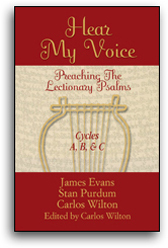
Hear My Voice
Preaching The Lectionary Psalms for Cycles A, B, C
Object:
(Occurs in all three cycles of the lectionary; see also Christmas, Cycle A, and Easter 6, Cycle B, for alternative approaches.)
Like Psalm 96 (see Christmas Eve), Psalm 98 is a psalm proclaiming the glory of Israel's God. Verses 7 and 8 speak of the whole orchestra of nature chiming in to praise God, including "the world and those who live in it."

Perhaps it is not too much of a stretch to go on from there to talk about the birth of Christ in a stable for animals, as an indication of his lordship over them as well. Actually, during Advent last year, a young man in my congregation asked me, "Do dogs go to heaven?"
We who have been around animals readily understand how attached we can become to them, and in the case of a faithful pet, we'd like to believe that there is some kind of happy afterlife for them. But since they are not reasoning creatures, and, as far as we know, can't make the kinds of decisions about right or wrong that humans can, we may conclude that, while for us there is a world to come, there is not one for animals.
Nonetheless, it seems that Christmas and animals go together. On the secular side, we have Dasher and Dancer and the rest of the reindeer cohorts. But, even the more serious side of Christmas has some critters. "Silent Night," for example, never would have been written, we're told, had mice not eaten the bellows of a church organ, forcing the composition of a simple carol that could be accompanied by guitar. Most of all, we've got Jesus born in a stable -- presumably in the presence of animals -- so we can assume that all of that means something.
Certainly, it can be a reminder that all life is interconnected. We get jolted by that sometimes when we change the balance of nature by eliminating all the natural predators in an area. Pretty soon, we find ourselves overrun by rabbits or other creatures that are normally part of the food chain for other animals.
Yet in other ways, animals are part of the richness of our lives. Several years ago, I took a church youth group to a nursing home at Christmas time. That year, in addition to singing Christmas carols and passing out little remembrances, we had the children bring their pets along. We had a dog, a couple of cats, and even a mouse. As we went from room to room, the residents wanted to pet and hold the animals. Even some of the people who were unable to talk and seemed deep in senility responded to the animals.
Maybe the animals were there that first Christmas to remind us that God's love doesn't come only in big dramatic gestures like unique stars in the sky. Maybe God's love comes, sometimes, through the faithful companionship of God's other creatures. There are many people whose lives would be sadder and darker without a pet for companionship, or whose lives would be less open without an animal to care for.
Animals also challenge us to be better than we are. How much we all would improve if we lived as the kind of people our dogs seem to think we are!
That the seas should roar, the floods clap their hands, and the hills sing is poetic imagery to be sure, but the words remind us that the whole world has a stake in the redemption of creation.
-- S. P.
Like Psalm 96 (see Christmas Eve), Psalm 98 is a psalm proclaiming the glory of Israel's God. Verses 7 and 8 speak of the whole orchestra of nature chiming in to praise God, including "the world and those who live in it."
Perhaps it is not too much of a stretch to go on from there to talk about the birth of Christ in a stable for animals, as an indication of his lordship over them as well. Actually, during Advent last year, a young man in my congregation asked me, "Do dogs go to heaven?"
We who have been around animals readily understand how attached we can become to them, and in the case of a faithful pet, we'd like to believe that there is some kind of happy afterlife for them. But since they are not reasoning creatures, and, as far as we know, can't make the kinds of decisions about right or wrong that humans can, we may conclude that, while for us there is a world to come, there is not one for animals.
Nonetheless, it seems that Christmas and animals go together. On the secular side, we have Dasher and Dancer and the rest of the reindeer cohorts. But, even the more serious side of Christmas has some critters. "Silent Night," for example, never would have been written, we're told, had mice not eaten the bellows of a church organ, forcing the composition of a simple carol that could be accompanied by guitar. Most of all, we've got Jesus born in a stable -- presumably in the presence of animals -- so we can assume that all of that means something.
Certainly, it can be a reminder that all life is interconnected. We get jolted by that sometimes when we change the balance of nature by eliminating all the natural predators in an area. Pretty soon, we find ourselves overrun by rabbits or other creatures that are normally part of the food chain for other animals.
Yet in other ways, animals are part of the richness of our lives. Several years ago, I took a church youth group to a nursing home at Christmas time. That year, in addition to singing Christmas carols and passing out little remembrances, we had the children bring their pets along. We had a dog, a couple of cats, and even a mouse. As we went from room to room, the residents wanted to pet and hold the animals. Even some of the people who were unable to talk and seemed deep in senility responded to the animals.
Maybe the animals were there that first Christmas to remind us that God's love doesn't come only in big dramatic gestures like unique stars in the sky. Maybe God's love comes, sometimes, through the faithful companionship of God's other creatures. There are many people whose lives would be sadder and darker without a pet for companionship, or whose lives would be less open without an animal to care for.
Animals also challenge us to be better than we are. How much we all would improve if we lived as the kind of people our dogs seem to think we are!
That the seas should roar, the floods clap their hands, and the hills sing is poetic imagery to be sure, but the words remind us that the whole world has a stake in the redemption of creation.
-- S. P.