Caught By The Hook
Sermon
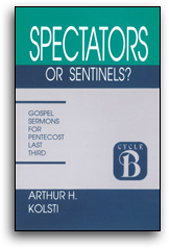
SPECTATORS OR SENTINELS?
Sermons For Pentecost (Last Third)
This is Reformation Sunday and it is fitting that we start with a quote from Martin Luther. Here it is. "When God builds a church the Devil builds the chapel." Take these words and let them just hang over this sermon. Their appropriateness will become apparent.
We look in on the scene John has placed before us. Jesus is speaking to some Jews who had responded to his words and become believers. Some commentators discount this identity of the hearers as faulty. We will understand why later. John's gospel abounds in ironic twists, and we are dealing with one of them.

Jesus makes a promise to these new followers. "If you continue in my word, you are truly my disciples; and you will know the truth, and the truth will make you free." His very use of language should have caught their attention and triggered some serious listening and questions. A favorite word of the fourth gospel crops up here, the command, "abide." It is translated in several ways as abide, dwell, continue, remain, but none of these exhausts the mystery surrounding the word. How on earth does a word take up residence in an individual or a community or vice-versa? This is a strange idiom. You would think the hearers would have a few questions.
But no, it is the buzz word, freedom, that gets their attention and raises their hackles. "We are descendants of Abraham and have never been slaves to anyone. What do you mean by saying, 'You will be made free?' "Wow, are they defensive. They make no mention of those historic times when they were in bondage to Egyptians, Babylonians and Syrians. A lot of ego and self-delusion surfaces in this reply to Jesus.
They are huffy like the very proper lady from Boston when someone asked if she were born again. She replied, "If you have been born once in Boston there is absolutely no need to be born again anywhere else." I guess any of us can fall into the trap of believing that our origins, family heritage, cultural traditions and way of doing things is the final and definitive word. Jesus was up against such a mind set. There was no openness to any other word to say nothing of the Word from beyond. Jesus called this servitude to sin. The Devil was at work.
For some strange reason the lectionary assignment for today cuts off at verse 36. Essential to the whole episode is the reply of Jesus in verse 37. "I know that you are descendants of Abraham; yet you look for an opportunity to kill me, because there is no place in you for my word." Remember, these are believers who misunderstand and argue with Jesus. They are nice religious people. We would certainly not expect them to harbor anti-Jesus sentiments, especially violent ones. That is why many commentators call their identity an editorial error. Believers, they reason, simply would not harbor such extreme animosity toward Jesus. Why not? Do our religious traditions and sentiments produce immunity to sin? I think Luther would understand what is going on here. "When God builds a church, the Devil builds the chapel."
Recently the news featured the story of a minister whose wife contracted the HIV virus through a blood transfusion. His pastorate was terminated by his church. Five other churches excluded him from consideration as a pastoral candidate. The pastor who currently chairs the Inter Faith Commission on AIDS was asked in a television interview, "Is this the Christian thing to do?" He replied, "Those who live by fear can do horrible things in the name of religion."
There was a lot of fear circulating around Jesus. His opponents feared his challenges to the tradition hardened dogmas that fragmented community and the judgmental litmus tests set down by the prevailing piety. His own disciples feared public intimidation and at the end all ran for cover. I do not blame them, I run scared a lot of the time.
There was a lot of fear circulating inside and outside the community gathered around the Apostle John. John's community was breaking down barriers that tradition had sanctioned for centuries. Women, for example, who were excluded from public roles in Jerusalem in the time of Jesus were serving on equal footing with men in the Johanine community. The heroines of the fourth gospel shine out at us. There is the Samaritan woman who became a city missionary. There is Martha whose pivotal confession of faith rings out in the fourth gospel as Peter's does in the other gospels. There is Mary Magdalene to whom the risen Lord first appeared and whom he commissioned as an apostle to the apostles. Think of the controversies over gender roles and ethnic differences all this must have triggered in the wider community.
There is evidence that leaders of the church in Jerusalem were themselves a bit uncomfortable with this maverick community under John's leadership. If even they were a bit uncomfortable, think how upset the enemies of the Jesus movement must have been. John's congregations were opening doors closed for centuries and opening them in the name of him who proclaimed, "I am the door of the sheep." Read that great 10th chapter, the Shepherd chapter, and in the background you will hear the noise of doors slamming shut in anger and doors opening up in the name of an inclusive love. John's community was facing tremendous public intimidation. They were in a cauldron boiling over with acrimony and opposition. Paul Minear titled a recent book of his on the fourth gospel as The Martyr's Gospel.
We know also that within the institutions of Jerusalem there were Jews who were secret believers, crypto-Christians who personally believed in Jesus but feared public intimidation. Two of them show up in the gospel of John. One is Nicodemus who comes to Jesus at night. The other is Joseph of Arimathea who comes forward at the end to claim the body of Jesus. Both he and Nicodemus at great personal risk arrange the burial of Jesus.
Could this conversation of Jesus with believers that we have been listening to be directed by John to secret Christians? That believers should want to kill Jesus is an ironic twist, but this gospel is full of ironic twists. Does John here engage in a bit of shock treatment? Do we encounter in this conversation an unexpected giant hook reaching out to shock us, impale us, push us into some sort of soul searching? "You desire to kill me." This is extreme language. But John uses extreme language. Recall how he described the intimacy of disciple and risen Lord as "eating the flesh of the Son of Man and drinking his blood." In our lesson Jesus talks with believers who do not hear him all the way. They are excluding him. Could they indeed be doing in one way what those who placed him on the cross did in their way?
Some years later an unknown Christian prophet, probably a member of the Johanine community in Ephesus, would circulate among the churches a tract that we know as the book of Revelation. There is an unforgettable scene in that book where a lukewarm community of believers exclude the Risen One from their midst because they exempt themselves from anything the Lord has to offer. Like the secret disciples of another day and the silent ones of any day, they are playing it safe. How often have we heard those words of the Risen Christ to the Christians hiding inside their church in Laodicea, doing their private Jesus thing, while in the public sphere cold winds blew. "Listen! I am standing at the door knocking; if you hear my voice and open the door, I will come in to you and eat with you."
The lines of the spiritual ask, "Were you there when they crucified my Lord." No, none of us was there physically. I cannot talk for you, but I can talk for myself. My kind of fear and timidity was there in Peter who denied him and the disciples who deserted him. My kind of wavering and indecisiveness was there. My kind of fear and meanness was there. My kind of sin was there. You answer the question for yourself.
So, John has caught us all on his hook. But not to make us squirm. He wants us to say, "No, we do not want to be believers like that." John wants us to let the living Lord liberate us from the fears that hold us back, the pride that gets in the way, the old biases that close our minds. The promise stands and rings out, "If you continue in my word, you are truly my disciples; and you will know the truth, and the truth will make you free."
This is Reformation Sunday. Some have questioned whether we should continue to observe it in our churches. Certainly not if we use the occasion to exalt our particular tradition. To do that would be to build monuments to the reformers while denying their spirit. If we use the occasion to point to the mysterious ever-creating Word from beyond, the Word addressed to us in and through the crucified and risen Lord then we are true to our tradition and rightly using it not as a badge of merit, but as a spur in the present. There is a Latin phrase that sums up the driving force of our tradition as handed down by the continental reformers, "Ecclesia reformata sed semper reformanda," the church reformed but ever reforming. That same spirit is picked up in the Pilgrim/Puritan tradition in the words of Pastor John Robinson as he bade farewell to the departing Pilgrims in Leyden. "I am persuaded that God has more thought and light to break forth from his holy Word." There it is: ever reforming, ever abiding in the creative Word from beyond, ever seeking to grow into that word that it may grow into us, ever waiting for new and liberating light to break forth in timely ways out of the timeless truth of the ever-creating God who is greater than we can ever know.
We look in on the scene John has placed before us. Jesus is speaking to some Jews who had responded to his words and become believers. Some commentators discount this identity of the hearers as faulty. We will understand why later. John's gospel abounds in ironic twists, and we are dealing with one of them.
Jesus makes a promise to these new followers. "If you continue in my word, you are truly my disciples; and you will know the truth, and the truth will make you free." His very use of language should have caught their attention and triggered some serious listening and questions. A favorite word of the fourth gospel crops up here, the command, "abide." It is translated in several ways as abide, dwell, continue, remain, but none of these exhausts the mystery surrounding the word. How on earth does a word take up residence in an individual or a community or vice-versa? This is a strange idiom. You would think the hearers would have a few questions.
But no, it is the buzz word, freedom, that gets their attention and raises their hackles. "We are descendants of Abraham and have never been slaves to anyone. What do you mean by saying, 'You will be made free?' "Wow, are they defensive. They make no mention of those historic times when they were in bondage to Egyptians, Babylonians and Syrians. A lot of ego and self-delusion surfaces in this reply to Jesus.
They are huffy like the very proper lady from Boston when someone asked if she were born again. She replied, "If you have been born once in Boston there is absolutely no need to be born again anywhere else." I guess any of us can fall into the trap of believing that our origins, family heritage, cultural traditions and way of doing things is the final and definitive word. Jesus was up against such a mind set. There was no openness to any other word to say nothing of the Word from beyond. Jesus called this servitude to sin. The Devil was at work.
For some strange reason the lectionary assignment for today cuts off at verse 36. Essential to the whole episode is the reply of Jesus in verse 37. "I know that you are descendants of Abraham; yet you look for an opportunity to kill me, because there is no place in you for my word." Remember, these are believers who misunderstand and argue with Jesus. They are nice religious people. We would certainly not expect them to harbor anti-Jesus sentiments, especially violent ones. That is why many commentators call their identity an editorial error. Believers, they reason, simply would not harbor such extreme animosity toward Jesus. Why not? Do our religious traditions and sentiments produce immunity to sin? I think Luther would understand what is going on here. "When God builds a church, the Devil builds the chapel."
Recently the news featured the story of a minister whose wife contracted the HIV virus through a blood transfusion. His pastorate was terminated by his church. Five other churches excluded him from consideration as a pastoral candidate. The pastor who currently chairs the Inter Faith Commission on AIDS was asked in a television interview, "Is this the Christian thing to do?" He replied, "Those who live by fear can do horrible things in the name of religion."
There was a lot of fear circulating around Jesus. His opponents feared his challenges to the tradition hardened dogmas that fragmented community and the judgmental litmus tests set down by the prevailing piety. His own disciples feared public intimidation and at the end all ran for cover. I do not blame them, I run scared a lot of the time.
There was a lot of fear circulating inside and outside the community gathered around the Apostle John. John's community was breaking down barriers that tradition had sanctioned for centuries. Women, for example, who were excluded from public roles in Jerusalem in the time of Jesus were serving on equal footing with men in the Johanine community. The heroines of the fourth gospel shine out at us. There is the Samaritan woman who became a city missionary. There is Martha whose pivotal confession of faith rings out in the fourth gospel as Peter's does in the other gospels. There is Mary Magdalene to whom the risen Lord first appeared and whom he commissioned as an apostle to the apostles. Think of the controversies over gender roles and ethnic differences all this must have triggered in the wider community.
There is evidence that leaders of the church in Jerusalem were themselves a bit uncomfortable with this maverick community under John's leadership. If even they were a bit uncomfortable, think how upset the enemies of the Jesus movement must have been. John's congregations were opening doors closed for centuries and opening them in the name of him who proclaimed, "I am the door of the sheep." Read that great 10th chapter, the Shepherd chapter, and in the background you will hear the noise of doors slamming shut in anger and doors opening up in the name of an inclusive love. John's community was facing tremendous public intimidation. They were in a cauldron boiling over with acrimony and opposition. Paul Minear titled a recent book of his on the fourth gospel as The Martyr's Gospel.
We know also that within the institutions of Jerusalem there were Jews who were secret believers, crypto-Christians who personally believed in Jesus but feared public intimidation. Two of them show up in the gospel of John. One is Nicodemus who comes to Jesus at night. The other is Joseph of Arimathea who comes forward at the end to claim the body of Jesus. Both he and Nicodemus at great personal risk arrange the burial of Jesus.
Could this conversation of Jesus with believers that we have been listening to be directed by John to secret Christians? That believers should want to kill Jesus is an ironic twist, but this gospel is full of ironic twists. Does John here engage in a bit of shock treatment? Do we encounter in this conversation an unexpected giant hook reaching out to shock us, impale us, push us into some sort of soul searching? "You desire to kill me." This is extreme language. But John uses extreme language. Recall how he described the intimacy of disciple and risen Lord as "eating the flesh of the Son of Man and drinking his blood." In our lesson Jesus talks with believers who do not hear him all the way. They are excluding him. Could they indeed be doing in one way what those who placed him on the cross did in their way?
Some years later an unknown Christian prophet, probably a member of the Johanine community in Ephesus, would circulate among the churches a tract that we know as the book of Revelation. There is an unforgettable scene in that book where a lukewarm community of believers exclude the Risen One from their midst because they exempt themselves from anything the Lord has to offer. Like the secret disciples of another day and the silent ones of any day, they are playing it safe. How often have we heard those words of the Risen Christ to the Christians hiding inside their church in Laodicea, doing their private Jesus thing, while in the public sphere cold winds blew. "Listen! I am standing at the door knocking; if you hear my voice and open the door, I will come in to you and eat with you."
The lines of the spiritual ask, "Were you there when they crucified my Lord." No, none of us was there physically. I cannot talk for you, but I can talk for myself. My kind of fear and timidity was there in Peter who denied him and the disciples who deserted him. My kind of wavering and indecisiveness was there. My kind of fear and meanness was there. My kind of sin was there. You answer the question for yourself.
So, John has caught us all on his hook. But not to make us squirm. He wants us to say, "No, we do not want to be believers like that." John wants us to let the living Lord liberate us from the fears that hold us back, the pride that gets in the way, the old biases that close our minds. The promise stands and rings out, "If you continue in my word, you are truly my disciples; and you will know the truth, and the truth will make you free."
This is Reformation Sunday. Some have questioned whether we should continue to observe it in our churches. Certainly not if we use the occasion to exalt our particular tradition. To do that would be to build monuments to the reformers while denying their spirit. If we use the occasion to point to the mysterious ever-creating Word from beyond, the Word addressed to us in and through the crucified and risen Lord then we are true to our tradition and rightly using it not as a badge of merit, but as a spur in the present. There is a Latin phrase that sums up the driving force of our tradition as handed down by the continental reformers, "Ecclesia reformata sed semper reformanda," the church reformed but ever reforming. That same spirit is picked up in the Pilgrim/Puritan tradition in the words of Pastor John Robinson as he bade farewell to the departing Pilgrims in Leyden. "I am persuaded that God has more thought and light to break forth from his holy Word." There it is: ever reforming, ever abiding in the creative Word from beyond, ever seeking to grow into that word that it may grow into us, ever waiting for new and liberating light to break forth in timely ways out of the timeless truth of the ever-creating God who is greater than we can ever know.