Abraham And Moses Run For President
Adult study
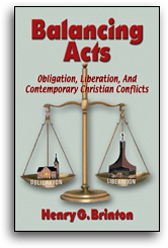
Balancing Acts
Obligation, Liberation, And Contemporary Christian Conflicts
George W. Bush is Abraham. Bill Clinton is Moses. Peel back the party affiliations, and you discover that these two presidents of the United States have strong ties to a patriarch and a prophet. Clinton has a faith that focuses on liberation, while Bush tends to stress religious obligation. In their words and deeds on the campaign trail and in the White House, they reveal allegiance to two distinctive models of religious leadership that have roots in the deepest strata of Hebrew history.

But perhaps it is premature to jump immediately to the conclusion that Bush and Clinton are religious leaders, even though both men speak openly and often about their Christian faith. Better to go back a few years, to an earlier election cycle in which two ordained ministers made a run for the White House. The year was 1988, and Jesse Jackson and Pat Robertson were racing full speed along the presidential campaign trail. Both were Baptists, and while they might have shared some foundational Christian beliefs, their political views were wildly divergent.
Marion "Pat" Robertson was a conservative who was expected to continue the "Reagan Revolution" with strong views on issues such as abortion, school prayer, and pornography. He yielded his Southern Baptist ministry credentials in an effort to separate his religious vocation from his candidacy, but some questioned his dedication to the separation of church and state. While a minister, Robertson said he believed that only devout Christians and Jews were qualified to govern.
Such stands led some evangelical Christians to call Robertson "God's candidate for the presidency of the United States." But it was not only evangelicals that were lining up behind him: The Robertson campaign was staffed by Christians of all kinds, including Roman Catholics and mainstream Protestants. His message seemed to resonate with people who felt afflicted by "secular humanism" and were anxious for a national move toward Judeo-Christian values.
On the other hand, Jesse Jackson was a liberal who was highly critical of the Reagan administration. His support seemed to be coming from groups which felt powerless at the time, both his multi-racial Rainbow Coalition that emerged during the 1984 campaign, and groups of farmers, Vietnam veterans, and blue-collar workers. Unlike Robertson, Jackson held on to his Baptist ministry credentials and managed to avoid becoming embroiled in the church-state debate. Perhaps his racial-ethnic background provided him with some protection, since in the African-American community it is not uncommon for ministers to be leaders in both religious and political spheres.
Jackson believed that he was set aside by God for a purpose, according to an article by Gail Sheehy in the January 1988 Vanity Fair, and he had a dream while in high school in which he was leading his people across a river. Apparently, this revealed to him that he was a born leader, one who could go on to assist Martin Luther King, Jr., confront Mikhail Gorbachev on the question of Soviet Jewry, challenge Daniel Ortega to reopen the Nicaraguan press, and, of course, run for president of the United States. "From the outhouse to the statehouse to the courthouse to the White House," was his vision, as preached to the congregation of New Bethel Baptist Church in Detroit in the summer of 1987. Jesse Jackson was a man who dreamed of leading his people, and not just the Rainbow Coalition but all the people of the United States.
Pat Robertson and Jesse Jackson: Two committed Christians with wildly different political visions. One is a conservative, one is a liberal ... one is devoted to traditional societal structures, one is devoted to the underclass ... one believes that only the devout should govern, the other believes that he has been called to lead his people across the river. All of which raises the question: Are they merely different kinds of politicians, or are they actually different kinds of Christians?
The distinctions between Pat Robertson and Jesse Jackson go beneath their political positions to their basic religious orientations. Put quite simply, one focuses on covenant, while the other orients himself toward exodus. Pat Robertson has a view of life and faith that centers on an agreement with God, a covenant, while Jesse Jackson bases his convictions on God's liberating work, seen most clearly in the exodus. Believers such as Robertson tend to focus on the obligations of religious life, and they appreciate moral clarity, while Christians such as Jackson see religion as a liberation movement and tend to stress God's love for the oppressed of the earth.
Of course, neither of these orientations is uniquely Christian. Both are based in the Hebrew Scriptures and are central to Jewish thought as well. In the book of Genesis, God makes a covenant with Abraham, the great patriarch of the Israelites. God says, "I am God Almighty; walk before me, and be blameless. And I will make my covenant between me and you, and will make you exceedingly numerous" (Genesis 17:1-2). God makes a deal with Abraham: He says "walk before me, and be blameless," and I will do wonderful things for you. In exchange for Abraham's devotion, God promises to multiply Abraham, to make him exceedingly fruitful, to establish him as the father of a multitude of nations, with kings and a land that his family could call its own.
This is covenant in its classic sense: A term of relationship between a superior and an inferior party, with the superior party -- in this case God -- establishing the bond and setting the terms. Throughout the Hebrew Scriptures, God renews this covenant with the people of Israel over and over, and the deal is always basically the same: You shall be my people and I will be your God.
The other focal point presented in the Bible is the exodus, the mighty act in which God liberates his people from slavery in Egypt. Knowing that the Hebrews have suffered, God comes down "to deliver them from the Egyptians, and to bring them up out of that land to a good and broad land, a land flowing with milk and honey" (Exodus 3:8). Moses is appointed to lead God's people out, and he does so, through the Red Sea and on toward the promised land. Throughout Jewish and Christian history, this event has been considered crucial to the life of faith, for it demonstrates God's solidarity with the oppressed, and his desire to liberate people from physical and spiritual bondage.
Clearly, Pat Robertson is a kind of Abraham, in covenantal relationship with God and hoping to govern along with other people of the covenant -- devout Christians and Jews. Jesse Jackson sees himself as a Moses, repeating the exodus as he leads his followers over the river and into the promised land. It is their orientation to one or the other of these foci, covenant or exodus, that governs their religious attitudes, and to some extent, their politics. It is not too much of a stretch to say that in 1988, Abraham and Moses ran for president.
Of course, Pat Robertson and Jesse Jackson are not the only politicians to embrace these orientations. In each election cycle, conservatives emulate the covenant-making character of Abraham, as they focus on the obligations of religious life and show an appreciation for moral clarity. Liberals continue to march behind Moses, as they embrace religion as a liberation movement and stress God's love for the oppressed of the earth. Obligation versus liberation, and clarity versus charity -- these distinctive approaches continue to define the theological battle lines in church and society today.
Consider the positions of Bill Clinton, the Moses character of the 1990s. As president, he met regularly with ministers, claimed a relationship with Christ, and not only read the scriptures but quoted them from memory. In November 1995, he wept when Bishop Nathaniel Linsey of the Christian Methodist Episcopal Church and fourteen other clergy laid hands on him and asked God to "make the president strong for the task" of protecting society's most vulnerable. But in conservative circles there was always a great deal of consternation about Clinton's Christianity -- especially his Baptist affiliation. The Southern Baptist Convention rejected Clinton's policies on moral issues, and passed a resolution that said "we separate ourselves" from the president's "acts and positions" supporting abortion rights, abortion funding, homosexuals in the military, and homosexual rights.
Conservatives wanted the president to provide moral clarity, but Clinton focused instead on Christian charity -- using his office to help persons in need. Seminary professor, Wayne Ward, a former pastor to Clinton, said to Christian American magazine in March 1993, "Despite differences of opinion people may have with Bill, he is a disciple of Jesus Christ and sees the political profession as a way to fulfill his strong calling from God to help people." His policies were oriented more toward liberation than toward obligation, motivating him to work to protect freedoms such as gay rights and abortion rights. He would fall under the "Soft America" category defined by political analyst Michael Barone in his book, Hard America, Soft America -- "Soft America" being a movement marked by progressive values, filled with government regulation and social safety nets.
In a sermon delivered on November 22, 1992, Jesse Jackson hailed Clinton's election as "the dawn of a new day," and announced that "God has raised up a leader from amongst the common people." Referring to the Ten Commandments, Jackson said that God gave Moses a "ten-point urban policy plan," and suggested that such ethical principles should guide ordinary Americans as they seek to fulfill their part of the Clinton agenda. For some, Bill Clinton served as a kind of Moses, a leader raised up by God to liberate the oppressed and create a better society. "Political involvement dictated by faith is not the exclusive province of the right wing," said Clinton at a Sunday service at New York's Riverside Church during the 2004 presidential campaign. The September 4, 2004, Washington Post reported that Riverside became the mother ship of "Mobilization 2004" and "Let Justice Roll," nationwide efforts to place "prophetic justice principles" in front of voters and candidates.
Replacing Clinton was George W. Bush, an Abraham for the new millennium. From the very start, he was pro-life and pro-traditional-family, and brought a focus on moral clarity that his predecessor could never provide (especially in light of the Monica Lewinsky scandal). "I rely upon my faith as an anchor, as a home, as a spiritual home that is very comforting," Bush told Crosswalk.com during the 2000 campaign. "I find great comfort in the Bible and in prayer." This attitude of intense devotion began for Bush in 1986, around his fortieth birthday, when he quit drinking and entered into a deeper relationship with God. Although he never went into a substance abuse program such as Alcoholics Anonymous, he indicated to The Washington Post in July 1999 that he was guided by the broader AA philosophy of placing one's faith in God. "If you change your heart, you can change your behavior," Bush said.
Changing hearts and changing behavior: This emphasis reveals a covenantal orientation, and lies at the heart of Bush's commitment to "compassionate conservatism," an agenda that is based on the belief that the greatest hope for the poor is found not in reform but in redemption. In every instance where Bush's administration sees a responsibility to help people, Bush has promised to look first to faith-based organizations, charities, and community groups that have shown their ability to save and change lives. Marvin Olasky, the Texas professor and Bush ally who coined the phrase "compassionate conservatism," believes that poverty is not caused by a lack of money, but by a lack of moral values on behalf of the poor.
"I understand the power of faith," said Bush to the volunteers in a Cleveland church in May 2001, "that faith can change lives." Along with Olasky, he believes that helping people with the greatest need is best done through some type of religious transformation -- a conviction he first acted upon as Governor of Texas, when he allowed proselytizing Christian organizations to offer state-funded social programs, including a ministry-run prison program. George W. Bush is clearly an Abraham character who uses his position as president to remind people of the importance of religious obligation and moral clarity. Bush has "proven himself," said the Reverend Lou Sheldon of the "Traditional Values Coalition" to the September 4, 2004, Washington Post. "He supports a constitutional amendment [banning gay marriage]. He signed a law banning partial-birth abortion. He supports abstinence education." Bush won his second term in part because of "values voters" -- religious conservatives who oppose gay marriage and abortion. Exit polling on Election Day 2004 revealed that 22 percent of voters identified "moral values" as the primary factor in their vote, and they favored Bush by a ratio of 4 to 1. Bush fits the "Hard America" definition provided by Michael Barone -- an America marked by competition, accountability, and very little coddling.
Moses and Abraham. Clinton and Bush. Neither should be thought of as a superior religious leader -- only different. In fact, the dual influences of Moses and Abraham are found throughout the Bible to have separate but equally valuable contributions to make, and the themes of exodus and covenant reveal themselves again and again over the course of the ministry of Jesus Christ. In a story found in the Gospel of Matthew, Jesus encounters a Canaanite women, a person who is clearly not a participant in God's covenant with the Israelites. At first, Jesus does not want to deal with her, since he feels that he was sent "only to the lost sheep of the house of Israel" (Matthew 15:24). But she persists in asking for his help, believing strongly that Jesus the Messiah could liberate her daughter from the grip of a demon. Finally Jesus, impressed by the woman's great faith, grants her wish and heals her daughter. This reveals the theme of exodus, with God acting to liberate all types of people from physical and spiritual bondage.
But covenant is also present in the ministry of Christ, most notably in the words of Jesus at the Last Supper, "This cup is the new covenant in my blood. Do this, as often as you drink it, in remembrance of me" (1 Corinthians 11:25). Then, in the anonymous Letter to the Hebrews, Jesus Christ is described as "the mediator of a better covenant" (Hebrews 8:6). Clearly, the early Christians saw themselves as people of covenant right along with the ancient Israelites. Both exodus and covenant, personified by the characters Moses and Abraham, have been carried by Christians and Jews into the present.
The challenge for American leaders and citizens is to strike a healthy balance between covenant and exodus, for both are integral parts of an authentic, deep, and lively religious faith. We run into trouble when we give priority to covenant, and in so doing downplay God's powerful work of liberation. At the same time, it is wrong to focus only on exodus, and in the process forget some of the obligations of covenant. A mature faith sees value in both obligation and liberation, and it embraces the importance of both moral clarity and heartfelt charity. Both Moses and Abraham understood this, and displayed it in their own life stories. Moses was not only the liberator of his people, but also the law-giver (Exodus chs. 19-24). And, Abraham not only made a covenant with God, but walked in faith into an unknown future, which had the effect of elevating belief in the Lord above works of the law (Romans ch. 4).
Our political leaders have a sense of this as well, despite their tendency to lean toward one extreme or the other. "I don't think I could do my job as president," Bill Clinton said in a March 1994 ABC interview, sounding a lot like Abraham, "much less continue to try to grow as a person in the absence of my faith in God and my attempt to learn more about what it should be and grow." And George W. Bush expressed a Moses-like concern for helping the oppressed when he praised a group of Catholic volunteers in May 2001, saying, "God has a special concern for the poor. For some people, Jesus' admonition to care for the least of these is an admirable moral teaching. For the folks at this center, and centers like it all around America, it's a way of life."
Somewhere, between extreme devotion to either covenant or exodus, there is a healthy balance to be found. In fact, by holding the two in creative tension, leaders and citizens can benefit from the best of both concepts: The liberation, charity, and solidarity of the exodus ... plus the moral strength, clarity, and promise of the covenant. Belief in covenant and exodus is powerful when the two are held together, but problems can arise when one is given priority over the other. Witness the moral blindness of Bill Clinton in the Monica Lewinsky affair, and the lack of Christian charity shown by George W. Bush in his pattern of tax cuts that disproportionately favor the rich.
The challenge for church leaders is to focus on issues of obligation and liberation without being seen as pushing a partisan political agenda, or supporting a particular candidate. In July of 2004, the General Assembly of the Presbyterian Church (USA) did something I found troubling -- it issued a resolution condemning the invasion of Iraq as "unwise, immoral, and illegal." In this case, it wasn't the assembly's weighing in on a public issue that bothered me, since it does so almost every year. Nor was it the church's stand against the war -- I had questioned the invasion myself.
What took me aback was the stridency of the language. As soon as I heard it, I had the feeling it would cause problems in the pews. It didn't seem like the kind of statement that would inspire constructive conversation about a complex and controversial issue, or encourage dialogue about the competing claims of obligation and liberation, covenant and exodus.
While people certainly come to church to receive clear moral guidance, I am aware that they also come to engage in dialogue about difficult questions, and to find something that isn't readily available in the larger society -- a place where disagreement is handled gracefully and respectfully by people of shared religious values. Because this resolution stressed one point of view, I feared it would have a polarizing effect. It was a divider, not a uniter.
Sure enough, within a day of the resolution, I began to hear complaints from church members, especially active-duty or retired members of the armed forces. To them, the assembly's action had drawn a line in the sand. Some supporters of the war even began to talk about leaving the church. "If the line is drawn as a result of the convictions of the majority, then okay," observed my parishioner, Mike Nelson, a career Air Force officer, fighter pilot, and Vietnam combat veteran. But Mike said he doubted that the assembly was speaking for the majority of Presbyterians.
Although I had been encouraging people to ask questions about the wisdom of the invasion since before American forces entered Iraq, I objected to this resolution because it did nothing to help my church members figure out what it means to be a follower of Christ in a time of war. It gave them no opening to discuss their concerns and wrestle with the conflicting feelings that arise at such a time. I knew that some members supported the war because they believed that the invasion was an effort to liberate the oppressed Iraqi people. Others opposed the military campaign because they could not reconcile it with their Christian obligation to practice nonviolence. But the Presbyterian pronouncement that the war was "unwise, immoral, and illegal" did nothing to encourage conversation about these issues or invite church members to perform a balancing act between various points of view. Parishioners are never helped by resolutions that force people to be either insiders or outsiders, driven even further apart in a society that's already politically polarized.
Lately, I see this happening again and again, whether the issue is war in Iraq, homosexuality, abortion, stem-cell research, or the Israeli-Palestinian conflict. Although Presbyterians enjoy freedom of conscience and aren't bound by these resolutions, many people object to having their donations used by a national body to send messages that don't represent their individual or congregational views. At the same time, people are struggling with these difficult issues, and they are looking for the church to teach, inform, and inspire them -- to lead them with its pronouncements, instead of driving them away. So there's a tension between the perspective of the individual and the view of the church. This can be healthy and creative, but only when church pronouncements are firmly grounded in the Bible and theology, and are seen as being fair and nonpartisan.
This is, of course, easier said than done. Part of the problem with church pronouncements is that they are often too hastily made. My colleague, Susan Andrews, pastor of Bradley Hills Presbyterian Church in Bethesda, Maryland, and a former leader of the General Assembly, believes that pronouncements have to be carefully written and carefully studied. When this effort is made, she says, the resolutions "can help put theological and biblical foundations to what would otherwise be just political statements."
The Presbyterian Church, along with many other Christian bodies, has long believed it's important to take stands on public issues of moral concern. In 1958, the General Assembly declared that it had a responsibility "to speak on social and moral issues for the encouragement and instruction of the Church and its members." Past Presbyterian pronouncements have supported public school desegregation (1954), equal rights for women (1983), divestment in South Africa to help end apartheid (1985), a ban on land mines (1995), and reduction of greenhouse gases (1998) -- positions that were once controversial, but are now accepted by many if not most Americans.
The question, then, is not whether to speak, but how. In this regard I've learned a great deal from Gerry Creedon, pastor of St. Charles Borromeo Catholic Church in Arlington, Virginia, and chairman of the Diocesan Peace and Justice Commission. Before the outbreak of the Iraq war, he developed a one-day program for his parishioners to talk and reflect on the church's analysis of war, which he conducted on three separate occasions to groups numbering between thirty and sixty participants. He also distributed the program to seventy parishes in the diocese.
The way it worked was this: After prayer, Gerry asked the participants to offer their reasons for either supporting or opposing military action in Iraq. He then gave a presentation on Catholic teaching on war and peace, including both just-war tradition and the older tradition of nonviolence. The program ended with a clear biblical challenge to work for peace, but it took no political stand -- instead, it provided parishioners with an opportunity to engage in dialogue and listen to the voice of the Catholic tradition.
Such an approach can have great practical benefit in the life of a church, because its focus is on parishioners listening to one another instead of reacting to one another. In this case, a full analysis of the Iraq issue came out of the contributions of the participants themselves, and arguments were made for liberation and obligation in a clear and non-polarizing way.
I am convinced that dialogue is an essential part of the educational process, because it draws people into an issue in a way that the simple proclamation of traditional truths never can. It also reduces the resistance and defensiveness most people feel when presented with one side of an issue without an opportunity to reply, which often happens when a sermon is preached. "There is no easy way to respond to the remarks in a Sunday homily," says my friend Dan Napolitano, a Roman Catholic layman. "The priest has a 'bully pulpit' in every sense of the expression."
Dan has no problem with priests and ministers having political positions of their own, but he feels it's important for them to create a climate for multiple opinions and to avoid the mistake of assuming that their congregations are monolithic audiences. "Priests and ministers must preach to and lead a wildly diverse group," he says, "parishioners who are either with the NRA or ACLU, those who want the 'old days' and those who can't stand them, those who love the services and those who are ambivalent."
Diversity is a characteristic of every congregation, with fans of Bill Clinton sitting side by side with supporters of George Bush, and if we pastors don't acknowledge this and foster dialogue, we'll simply drive our parishioners further apart. In my own preaching, I try to lift up ideas and questions that will stimulate conversation, instead of shutting it down. I attempt to invite members from across the political spectrum to look at important matters along with me, and continue the conversation after the service is over. For some people, church may be the only place where this kind of discussion is possible -- and even encouraged.
Adam Hamilton, the pastor of a large Methodist congregation in Leawood, Kansas, takes the use of dialogue in preaching even further. He recommends that preachers begin their sermons on tough issues by presenting an opposing position -- and present it so powerfully that the congregation would believe that it is the preacher's own position if the sermon abruptly ended. Then, and only then, should preachers present their own positions, and they should take care to keep their arguments grounded in the Bible. As difficult as this approach may be, it creates an atmosphere of dialogue, and stands a better chance of actually changing minds than a more confrontational approach.
Of course, for every minister and every church, there will be times when they must articulate a position with absolute clarity. During the Civil Rights Era, the pastor of Fairfax Presbyterian delivered such a call for racial equality, but in most of the complex controversies we face today, there is no real benefit in rushing quickly to decide a matter with a church vote. Linda Olson Peebles, a minister at the Unitarian Universalist Church of Arlington, Virginia, believes that forcing a vote on contentious issues can make the minority feel marginalized. And when debates fixate on questions of wording and minor details, then people are pulled away, she says, from "the core faith stances that do in fact guide us."
It is a focus on these "core faith stances" that will enable churches to make their greatest contributions, and pastors can help their people to move toward Christian clarity by inviting them to engage in dialogue about the examples of Abraham and Moses in the face of a variety of contemporary issues. I am afraid that the church will continue to polarize its members if it forces them to take particular political stands, but it will draw people together if it begins to lift up current controversies -- war, abortion, homosexuality -- and discuss them in light of obligation and liberation, moral clarity and Christian charity, covenant and exodus.
These categories are helpful because they are not designed to win political arguments. Instead, they put us in touch with our core faith stances, and provide us with a clearer understanding of ourselves, the community of faith, and the larger culture. It is the interplay of obligation and liberation that helps us figure out what it means to be followers of Christ in America today, and this interplay is best experienced through dialogue with people who take their stands -- with passion, commitment, and good faith -- at various points along the spectrum that runs from Abraham to Moses.
But perhaps it is premature to jump immediately to the conclusion that Bush and Clinton are religious leaders, even though both men speak openly and often about their Christian faith. Better to go back a few years, to an earlier election cycle in which two ordained ministers made a run for the White House. The year was 1988, and Jesse Jackson and Pat Robertson were racing full speed along the presidential campaign trail. Both were Baptists, and while they might have shared some foundational Christian beliefs, their political views were wildly divergent.
Marion "Pat" Robertson was a conservative who was expected to continue the "Reagan Revolution" with strong views on issues such as abortion, school prayer, and pornography. He yielded his Southern Baptist ministry credentials in an effort to separate his religious vocation from his candidacy, but some questioned his dedication to the separation of church and state. While a minister, Robertson said he believed that only devout Christians and Jews were qualified to govern.
Such stands led some evangelical Christians to call Robertson "God's candidate for the presidency of the United States." But it was not only evangelicals that were lining up behind him: The Robertson campaign was staffed by Christians of all kinds, including Roman Catholics and mainstream Protestants. His message seemed to resonate with people who felt afflicted by "secular humanism" and were anxious for a national move toward Judeo-Christian values.
On the other hand, Jesse Jackson was a liberal who was highly critical of the Reagan administration. His support seemed to be coming from groups which felt powerless at the time, both his multi-racial Rainbow Coalition that emerged during the 1984 campaign, and groups of farmers, Vietnam veterans, and blue-collar workers. Unlike Robertson, Jackson held on to his Baptist ministry credentials and managed to avoid becoming embroiled in the church-state debate. Perhaps his racial-ethnic background provided him with some protection, since in the African-American community it is not uncommon for ministers to be leaders in both religious and political spheres.
Jackson believed that he was set aside by God for a purpose, according to an article by Gail Sheehy in the January 1988 Vanity Fair, and he had a dream while in high school in which he was leading his people across a river. Apparently, this revealed to him that he was a born leader, one who could go on to assist Martin Luther King, Jr., confront Mikhail Gorbachev on the question of Soviet Jewry, challenge Daniel Ortega to reopen the Nicaraguan press, and, of course, run for president of the United States. "From the outhouse to the statehouse to the courthouse to the White House," was his vision, as preached to the congregation of New Bethel Baptist Church in Detroit in the summer of 1987. Jesse Jackson was a man who dreamed of leading his people, and not just the Rainbow Coalition but all the people of the United States.
Pat Robertson and Jesse Jackson: Two committed Christians with wildly different political visions. One is a conservative, one is a liberal ... one is devoted to traditional societal structures, one is devoted to the underclass ... one believes that only the devout should govern, the other believes that he has been called to lead his people across the river. All of which raises the question: Are they merely different kinds of politicians, or are they actually different kinds of Christians?
The distinctions between Pat Robertson and Jesse Jackson go beneath their political positions to their basic religious orientations. Put quite simply, one focuses on covenant, while the other orients himself toward exodus. Pat Robertson has a view of life and faith that centers on an agreement with God, a covenant, while Jesse Jackson bases his convictions on God's liberating work, seen most clearly in the exodus. Believers such as Robertson tend to focus on the obligations of religious life, and they appreciate moral clarity, while Christians such as Jackson see religion as a liberation movement and tend to stress God's love for the oppressed of the earth.
Of course, neither of these orientations is uniquely Christian. Both are based in the Hebrew Scriptures and are central to Jewish thought as well. In the book of Genesis, God makes a covenant with Abraham, the great patriarch of the Israelites. God says, "I am God Almighty; walk before me, and be blameless. And I will make my covenant between me and you, and will make you exceedingly numerous" (Genesis 17:1-2). God makes a deal with Abraham: He says "walk before me, and be blameless," and I will do wonderful things for you. In exchange for Abraham's devotion, God promises to multiply Abraham, to make him exceedingly fruitful, to establish him as the father of a multitude of nations, with kings and a land that his family could call its own.
This is covenant in its classic sense: A term of relationship between a superior and an inferior party, with the superior party -- in this case God -- establishing the bond and setting the terms. Throughout the Hebrew Scriptures, God renews this covenant with the people of Israel over and over, and the deal is always basically the same: You shall be my people and I will be your God.
The other focal point presented in the Bible is the exodus, the mighty act in which God liberates his people from slavery in Egypt. Knowing that the Hebrews have suffered, God comes down "to deliver them from the Egyptians, and to bring them up out of that land to a good and broad land, a land flowing with milk and honey" (Exodus 3:8). Moses is appointed to lead God's people out, and he does so, through the Red Sea and on toward the promised land. Throughout Jewish and Christian history, this event has been considered crucial to the life of faith, for it demonstrates God's solidarity with the oppressed, and his desire to liberate people from physical and spiritual bondage.
Clearly, Pat Robertson is a kind of Abraham, in covenantal relationship with God and hoping to govern along with other people of the covenant -- devout Christians and Jews. Jesse Jackson sees himself as a Moses, repeating the exodus as he leads his followers over the river and into the promised land. It is their orientation to one or the other of these foci, covenant or exodus, that governs their religious attitudes, and to some extent, their politics. It is not too much of a stretch to say that in 1988, Abraham and Moses ran for president.
Of course, Pat Robertson and Jesse Jackson are not the only politicians to embrace these orientations. In each election cycle, conservatives emulate the covenant-making character of Abraham, as they focus on the obligations of religious life and show an appreciation for moral clarity. Liberals continue to march behind Moses, as they embrace religion as a liberation movement and stress God's love for the oppressed of the earth. Obligation versus liberation, and clarity versus charity -- these distinctive approaches continue to define the theological battle lines in church and society today.
Consider the positions of Bill Clinton, the Moses character of the 1990s. As president, he met regularly with ministers, claimed a relationship with Christ, and not only read the scriptures but quoted them from memory. In November 1995, he wept when Bishop Nathaniel Linsey of the Christian Methodist Episcopal Church and fourteen other clergy laid hands on him and asked God to "make the president strong for the task" of protecting society's most vulnerable. But in conservative circles there was always a great deal of consternation about Clinton's Christianity -- especially his Baptist affiliation. The Southern Baptist Convention rejected Clinton's policies on moral issues, and passed a resolution that said "we separate ourselves" from the president's "acts and positions" supporting abortion rights, abortion funding, homosexuals in the military, and homosexual rights.
Conservatives wanted the president to provide moral clarity, but Clinton focused instead on Christian charity -- using his office to help persons in need. Seminary professor, Wayne Ward, a former pastor to Clinton, said to Christian American magazine in March 1993, "Despite differences of opinion people may have with Bill, he is a disciple of Jesus Christ and sees the political profession as a way to fulfill his strong calling from God to help people." His policies were oriented more toward liberation than toward obligation, motivating him to work to protect freedoms such as gay rights and abortion rights. He would fall under the "Soft America" category defined by political analyst Michael Barone in his book, Hard America, Soft America -- "Soft America" being a movement marked by progressive values, filled with government regulation and social safety nets.
In a sermon delivered on November 22, 1992, Jesse Jackson hailed Clinton's election as "the dawn of a new day," and announced that "God has raised up a leader from amongst the common people." Referring to the Ten Commandments, Jackson said that God gave Moses a "ten-point urban policy plan," and suggested that such ethical principles should guide ordinary Americans as they seek to fulfill their part of the Clinton agenda. For some, Bill Clinton served as a kind of Moses, a leader raised up by God to liberate the oppressed and create a better society. "Political involvement dictated by faith is not the exclusive province of the right wing," said Clinton at a Sunday service at New York's Riverside Church during the 2004 presidential campaign. The September 4, 2004, Washington Post reported that Riverside became the mother ship of "Mobilization 2004" and "Let Justice Roll," nationwide efforts to place "prophetic justice principles" in front of voters and candidates.
Replacing Clinton was George W. Bush, an Abraham for the new millennium. From the very start, he was pro-life and pro-traditional-family, and brought a focus on moral clarity that his predecessor could never provide (especially in light of the Monica Lewinsky scandal). "I rely upon my faith as an anchor, as a home, as a spiritual home that is very comforting," Bush told Crosswalk.com during the 2000 campaign. "I find great comfort in the Bible and in prayer." This attitude of intense devotion began for Bush in 1986, around his fortieth birthday, when he quit drinking and entered into a deeper relationship with God. Although he never went into a substance abuse program such as Alcoholics Anonymous, he indicated to The Washington Post in July 1999 that he was guided by the broader AA philosophy of placing one's faith in God. "If you change your heart, you can change your behavior," Bush said.
Changing hearts and changing behavior: This emphasis reveals a covenantal orientation, and lies at the heart of Bush's commitment to "compassionate conservatism," an agenda that is based on the belief that the greatest hope for the poor is found not in reform but in redemption. In every instance where Bush's administration sees a responsibility to help people, Bush has promised to look first to faith-based organizations, charities, and community groups that have shown their ability to save and change lives. Marvin Olasky, the Texas professor and Bush ally who coined the phrase "compassionate conservatism," believes that poverty is not caused by a lack of money, but by a lack of moral values on behalf of the poor.
"I understand the power of faith," said Bush to the volunteers in a Cleveland church in May 2001, "that faith can change lives." Along with Olasky, he believes that helping people with the greatest need is best done through some type of religious transformation -- a conviction he first acted upon as Governor of Texas, when he allowed proselytizing Christian organizations to offer state-funded social programs, including a ministry-run prison program. George W. Bush is clearly an Abraham character who uses his position as president to remind people of the importance of religious obligation and moral clarity. Bush has "proven himself," said the Reverend Lou Sheldon of the "Traditional Values Coalition" to the September 4, 2004, Washington Post. "He supports a constitutional amendment [banning gay marriage]. He signed a law banning partial-birth abortion. He supports abstinence education." Bush won his second term in part because of "values voters" -- religious conservatives who oppose gay marriage and abortion. Exit polling on Election Day 2004 revealed that 22 percent of voters identified "moral values" as the primary factor in their vote, and they favored Bush by a ratio of 4 to 1. Bush fits the "Hard America" definition provided by Michael Barone -- an America marked by competition, accountability, and very little coddling.
Moses and Abraham. Clinton and Bush. Neither should be thought of as a superior religious leader -- only different. In fact, the dual influences of Moses and Abraham are found throughout the Bible to have separate but equally valuable contributions to make, and the themes of exodus and covenant reveal themselves again and again over the course of the ministry of Jesus Christ. In a story found in the Gospel of Matthew, Jesus encounters a Canaanite women, a person who is clearly not a participant in God's covenant with the Israelites. At first, Jesus does not want to deal with her, since he feels that he was sent "only to the lost sheep of the house of Israel" (Matthew 15:24). But she persists in asking for his help, believing strongly that Jesus the Messiah could liberate her daughter from the grip of a demon. Finally Jesus, impressed by the woman's great faith, grants her wish and heals her daughter. This reveals the theme of exodus, with God acting to liberate all types of people from physical and spiritual bondage.
But covenant is also present in the ministry of Christ, most notably in the words of Jesus at the Last Supper, "This cup is the new covenant in my blood. Do this, as often as you drink it, in remembrance of me" (1 Corinthians 11:25). Then, in the anonymous Letter to the Hebrews, Jesus Christ is described as "the mediator of a better covenant" (Hebrews 8:6). Clearly, the early Christians saw themselves as people of covenant right along with the ancient Israelites. Both exodus and covenant, personified by the characters Moses and Abraham, have been carried by Christians and Jews into the present.
The challenge for American leaders and citizens is to strike a healthy balance between covenant and exodus, for both are integral parts of an authentic, deep, and lively religious faith. We run into trouble when we give priority to covenant, and in so doing downplay God's powerful work of liberation. At the same time, it is wrong to focus only on exodus, and in the process forget some of the obligations of covenant. A mature faith sees value in both obligation and liberation, and it embraces the importance of both moral clarity and heartfelt charity. Both Moses and Abraham understood this, and displayed it in their own life stories. Moses was not only the liberator of his people, but also the law-giver (Exodus chs. 19-24). And, Abraham not only made a covenant with God, but walked in faith into an unknown future, which had the effect of elevating belief in the Lord above works of the law (Romans ch. 4).
Our political leaders have a sense of this as well, despite their tendency to lean toward one extreme or the other. "I don't think I could do my job as president," Bill Clinton said in a March 1994 ABC interview, sounding a lot like Abraham, "much less continue to try to grow as a person in the absence of my faith in God and my attempt to learn more about what it should be and grow." And George W. Bush expressed a Moses-like concern for helping the oppressed when he praised a group of Catholic volunteers in May 2001, saying, "God has a special concern for the poor. For some people, Jesus' admonition to care for the least of these is an admirable moral teaching. For the folks at this center, and centers like it all around America, it's a way of life."
Somewhere, between extreme devotion to either covenant or exodus, there is a healthy balance to be found. In fact, by holding the two in creative tension, leaders and citizens can benefit from the best of both concepts: The liberation, charity, and solidarity of the exodus ... plus the moral strength, clarity, and promise of the covenant. Belief in covenant and exodus is powerful when the two are held together, but problems can arise when one is given priority over the other. Witness the moral blindness of Bill Clinton in the Monica Lewinsky affair, and the lack of Christian charity shown by George W. Bush in his pattern of tax cuts that disproportionately favor the rich.
The challenge for church leaders is to focus on issues of obligation and liberation without being seen as pushing a partisan political agenda, or supporting a particular candidate. In July of 2004, the General Assembly of the Presbyterian Church (USA) did something I found troubling -- it issued a resolution condemning the invasion of Iraq as "unwise, immoral, and illegal." In this case, it wasn't the assembly's weighing in on a public issue that bothered me, since it does so almost every year. Nor was it the church's stand against the war -- I had questioned the invasion myself.
What took me aback was the stridency of the language. As soon as I heard it, I had the feeling it would cause problems in the pews. It didn't seem like the kind of statement that would inspire constructive conversation about a complex and controversial issue, or encourage dialogue about the competing claims of obligation and liberation, covenant and exodus.
While people certainly come to church to receive clear moral guidance, I am aware that they also come to engage in dialogue about difficult questions, and to find something that isn't readily available in the larger society -- a place where disagreement is handled gracefully and respectfully by people of shared religious values. Because this resolution stressed one point of view, I feared it would have a polarizing effect. It was a divider, not a uniter.
Sure enough, within a day of the resolution, I began to hear complaints from church members, especially active-duty or retired members of the armed forces. To them, the assembly's action had drawn a line in the sand. Some supporters of the war even began to talk about leaving the church. "If the line is drawn as a result of the convictions of the majority, then okay," observed my parishioner, Mike Nelson, a career Air Force officer, fighter pilot, and Vietnam combat veteran. But Mike said he doubted that the assembly was speaking for the majority of Presbyterians.
Although I had been encouraging people to ask questions about the wisdom of the invasion since before American forces entered Iraq, I objected to this resolution because it did nothing to help my church members figure out what it means to be a follower of Christ in a time of war. It gave them no opening to discuss their concerns and wrestle with the conflicting feelings that arise at such a time. I knew that some members supported the war because they believed that the invasion was an effort to liberate the oppressed Iraqi people. Others opposed the military campaign because they could not reconcile it with their Christian obligation to practice nonviolence. But the Presbyterian pronouncement that the war was "unwise, immoral, and illegal" did nothing to encourage conversation about these issues or invite church members to perform a balancing act between various points of view. Parishioners are never helped by resolutions that force people to be either insiders or outsiders, driven even further apart in a society that's already politically polarized.
Lately, I see this happening again and again, whether the issue is war in Iraq, homosexuality, abortion, stem-cell research, or the Israeli-Palestinian conflict. Although Presbyterians enjoy freedom of conscience and aren't bound by these resolutions, many people object to having their donations used by a national body to send messages that don't represent their individual or congregational views. At the same time, people are struggling with these difficult issues, and they are looking for the church to teach, inform, and inspire them -- to lead them with its pronouncements, instead of driving them away. So there's a tension between the perspective of the individual and the view of the church. This can be healthy and creative, but only when church pronouncements are firmly grounded in the Bible and theology, and are seen as being fair and nonpartisan.
This is, of course, easier said than done. Part of the problem with church pronouncements is that they are often too hastily made. My colleague, Susan Andrews, pastor of Bradley Hills Presbyterian Church in Bethesda, Maryland, and a former leader of the General Assembly, believes that pronouncements have to be carefully written and carefully studied. When this effort is made, she says, the resolutions "can help put theological and biblical foundations to what would otherwise be just political statements."
The Presbyterian Church, along with many other Christian bodies, has long believed it's important to take stands on public issues of moral concern. In 1958, the General Assembly declared that it had a responsibility "to speak on social and moral issues for the encouragement and instruction of the Church and its members." Past Presbyterian pronouncements have supported public school desegregation (1954), equal rights for women (1983), divestment in South Africa to help end apartheid (1985), a ban on land mines (1995), and reduction of greenhouse gases (1998) -- positions that were once controversial, but are now accepted by many if not most Americans.
The question, then, is not whether to speak, but how. In this regard I've learned a great deal from Gerry Creedon, pastor of St. Charles Borromeo Catholic Church in Arlington, Virginia, and chairman of the Diocesan Peace and Justice Commission. Before the outbreak of the Iraq war, he developed a one-day program for his parishioners to talk and reflect on the church's analysis of war, which he conducted on three separate occasions to groups numbering between thirty and sixty participants. He also distributed the program to seventy parishes in the diocese.
The way it worked was this: After prayer, Gerry asked the participants to offer their reasons for either supporting or opposing military action in Iraq. He then gave a presentation on Catholic teaching on war and peace, including both just-war tradition and the older tradition of nonviolence. The program ended with a clear biblical challenge to work for peace, but it took no political stand -- instead, it provided parishioners with an opportunity to engage in dialogue and listen to the voice of the Catholic tradition.
Such an approach can have great practical benefit in the life of a church, because its focus is on parishioners listening to one another instead of reacting to one another. In this case, a full analysis of the Iraq issue came out of the contributions of the participants themselves, and arguments were made for liberation and obligation in a clear and non-polarizing way.
I am convinced that dialogue is an essential part of the educational process, because it draws people into an issue in a way that the simple proclamation of traditional truths never can. It also reduces the resistance and defensiveness most people feel when presented with one side of an issue without an opportunity to reply, which often happens when a sermon is preached. "There is no easy way to respond to the remarks in a Sunday homily," says my friend Dan Napolitano, a Roman Catholic layman. "The priest has a 'bully pulpit' in every sense of the expression."
Dan has no problem with priests and ministers having political positions of their own, but he feels it's important for them to create a climate for multiple opinions and to avoid the mistake of assuming that their congregations are monolithic audiences. "Priests and ministers must preach to and lead a wildly diverse group," he says, "parishioners who are either with the NRA or ACLU, those who want the 'old days' and those who can't stand them, those who love the services and those who are ambivalent."
Diversity is a characteristic of every congregation, with fans of Bill Clinton sitting side by side with supporters of George Bush, and if we pastors don't acknowledge this and foster dialogue, we'll simply drive our parishioners further apart. In my own preaching, I try to lift up ideas and questions that will stimulate conversation, instead of shutting it down. I attempt to invite members from across the political spectrum to look at important matters along with me, and continue the conversation after the service is over. For some people, church may be the only place where this kind of discussion is possible -- and even encouraged.
Adam Hamilton, the pastor of a large Methodist congregation in Leawood, Kansas, takes the use of dialogue in preaching even further. He recommends that preachers begin their sermons on tough issues by presenting an opposing position -- and present it so powerfully that the congregation would believe that it is the preacher's own position if the sermon abruptly ended. Then, and only then, should preachers present their own positions, and they should take care to keep their arguments grounded in the Bible. As difficult as this approach may be, it creates an atmosphere of dialogue, and stands a better chance of actually changing minds than a more confrontational approach.
Of course, for every minister and every church, there will be times when they must articulate a position with absolute clarity. During the Civil Rights Era, the pastor of Fairfax Presbyterian delivered such a call for racial equality, but in most of the complex controversies we face today, there is no real benefit in rushing quickly to decide a matter with a church vote. Linda Olson Peebles, a minister at the Unitarian Universalist Church of Arlington, Virginia, believes that forcing a vote on contentious issues can make the minority feel marginalized. And when debates fixate on questions of wording and minor details, then people are pulled away, she says, from "the core faith stances that do in fact guide us."
It is a focus on these "core faith stances" that will enable churches to make their greatest contributions, and pastors can help their people to move toward Christian clarity by inviting them to engage in dialogue about the examples of Abraham and Moses in the face of a variety of contemporary issues. I am afraid that the church will continue to polarize its members if it forces them to take particular political stands, but it will draw people together if it begins to lift up current controversies -- war, abortion, homosexuality -- and discuss them in light of obligation and liberation, moral clarity and Christian charity, covenant and exodus.
These categories are helpful because they are not designed to win political arguments. Instead, they put us in touch with our core faith stances, and provide us with a clearer understanding of ourselves, the community of faith, and the larger culture. It is the interplay of obligation and liberation that helps us figure out what it means to be followers of Christ in America today, and this interplay is best experienced through dialogue with people who take their stands -- with passion, commitment, and good faith -- at various points along the spectrum that runs from Abraham to Moses.