
Epiphany 2/Ordinary Time 2
Preaching
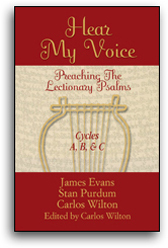
Hear My Voice
Preaching The Lectionary Psalms for Cycles A, B, C
(See Proper 4/Pentecost 2/Ordinary Time 9, Cycle B for an alternative approach; see also Proper 11/Pentecost 9/Ordinary Time 16, Cycle A for an alternative approach to vv. 1-12, 23-24.)
The psalmist raises an interesting question. He writes: "You hem me in, behind and before, and you lay your hand upon me" (v. 5). He also writes, "Where can I go from your spirit? Or where can I flee from your presence?" (v. 7).
The latter questions are rhetorical, of course. They are questions that make an assertion: There is nowhere I can go where God's Spirit is not present.
The problem this raises is the problem of free will. The psalmist's statement that God "hems me in" makes it sound as though human beings have no choice. Like a master chess player, God so maneuvers the field of choices and options that the only real option is for the writer to do what God wants.
But if that is true, then are we correct in believing we are really free to choose at all? If we are left with only one choice, as the psalmist seems to be saying, does that mean that our lives are scripted? Are we merely puppets on strings, dancing and acting according to God's predetermined dictates?
There are many who are ready to read the psalm that way, and in fact find a good bit of comfort in that sort of reading. The ambiguity and uncertainty of this world yields to the governing forces of God's infallible choices. We need only to "wait on the Lord," and enjoy the life God has crafted for us to live.
But the absence of choice removes the demand for responsibility. If we are only able to choose from among limited options that God has left for us to choose, then we are not responsible for our choices. Obviously that is not the biblical position. In every encounter with the presence of God we are, in fact, accountable for our choices.
So how are we to reconcile these seemingly contradictory ideas? How is it possible that God can "hem me in" and yet at the same time not hem me in?
One possible resolution is found in the opening verse: "You have searched me and known me."
Parents who have more than one child know all too well that trying to treat all children exactly the same is not practical. If all children in a family were exactly the same in personality and temperament, it might be possible, but that is not usually the case. Some children are extroverts, some introverts. Some respond to positive reinforcement, others only to negative reinforcement. Attentive parents must find out, usually through trial and error, what works with their child.
The same is true with God. God wants us to make good choices. God wants us to do well. But God is not going to override our freedom in order to make us what God wants us to be.
Since God knows us better than anyone, even better than we know ourselves, God is able to work in our lives and in our world in just the right way, so as to give us the best position to make the best choice. Do we always make the right choice? No. Sadly, we do not. God is always faithful to make sure the best choice is available to us in a way that is uniquely designed for us to understand it.
God "hems us in." Not in a constraint that allows no freedom, but in a carefully constructed moment of opportunity that allows us to see or hear or feel what is right. God can do this because God has searched us and known us.
-- J. E.
The psalmist raises an interesting question. He writes: "You hem me in, behind and before, and you lay your hand upon me" (v. 5). He also writes, "Where can I go from your spirit? Or where can I flee from your presence?" (v. 7).
The latter questions are rhetorical, of course. They are questions that make an assertion: There is nowhere I can go where God's Spirit is not present.
The problem this raises is the problem of free will. The psalmist's statement that God "hems me in" makes it sound as though human beings have no choice. Like a master chess player, God so maneuvers the field of choices and options that the only real option is for the writer to do what God wants.
But if that is true, then are we correct in believing we are really free to choose at all? If we are left with only one choice, as the psalmist seems to be saying, does that mean that our lives are scripted? Are we merely puppets on strings, dancing and acting according to God's predetermined dictates?
There are many who are ready to read the psalm that way, and in fact find a good bit of comfort in that sort of reading. The ambiguity and uncertainty of this world yields to the governing forces of God's infallible choices. We need only to "wait on the Lord," and enjoy the life God has crafted for us to live.
But the absence of choice removes the demand for responsibility. If we are only able to choose from among limited options that God has left for us to choose, then we are not responsible for our choices. Obviously that is not the biblical position. In every encounter with the presence of God we are, in fact, accountable for our choices.
So how are we to reconcile these seemingly contradictory ideas? How is it possible that God can "hem me in" and yet at the same time not hem me in?
One possible resolution is found in the opening verse: "You have searched me and known me."
Parents who have more than one child know all too well that trying to treat all children exactly the same is not practical. If all children in a family were exactly the same in personality and temperament, it might be possible, but that is not usually the case. Some children are extroverts, some introverts. Some respond to positive reinforcement, others only to negative reinforcement. Attentive parents must find out, usually through trial and error, what works with their child.
The same is true with God. God wants us to make good choices. God wants us to do well. But God is not going to override our freedom in order to make us what God wants us to be.
Since God knows us better than anyone, even better than we know ourselves, God is able to work in our lives and in our world in just the right way, so as to give us the best position to make the best choice. Do we always make the right choice? No. Sadly, we do not. God is always faithful to make sure the best choice is available to us in a way that is uniquely designed for us to understand it.
God "hems us in." Not in a constraint that allows no freedom, but in a carefully constructed moment of opportunity that allows us to see or hear or feel what is right. God can do this because God has searched us and known us.
-- J. E.
