

Ragman
Children's sermon
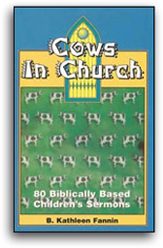
Cows In Church
80 Biblically Based Children's Sermons
Object:
A piece of cloth and a quilt block. (An entire pieced quilt would also suffice.)
"Have you ever heard the word 'remnant'? No? Well, I'd like to talk about remnants this morning. A remnant is a leftover, a scrap. A good place to find remnants is at the fabric store. Often a small piece of material, usually a yard or less, is left on the end of a bolt of cloth after the rest of the bolt has been sold. This leftover piece is called a remnant.

"Remnants are not usually big enough to be as useful as larger pieces might be, so they are often sold at a reduced price. People who need just small pieces of material for handicrafts often buy remnants. Can all of you say 'remnant'?"
"There's another word that means close to the same thing which I'm sure all of you know: 'rag.' Where do we get rags?"
"You buy them!" Having just talked about going to the remnant table at the fabric store, I should have seen this coming.
"Well, yes," I continue. "Rags can be bought. But where else might we get rags? What happens when you get a hole in your sock? Do you fix it?"
"No! It gets thrown away!"
"But if you didn't throw it away, you'd have a rag, wouldn't you? If we tear a skirt or a pair of pants, or if we get a hole in the elbow of a jacket or sweater, we might patch it. But eventually, even the patch will wear out and you will have a piece of clothing which has become a rag. What do we do with rags?"
"Use them to clean!"
"Use them to wash dishes."
"Use them to wipe your hands on when you're working on the car."
"Use them for patches."
"Well, I can see by your answers that you are all familiar with rags. A long time ago there was an occupation that we don't hear much about any more: the ragman. The ragman would go door-to-door to collect, buy, and sell rags. Pieces of worn-out material, of no use to those who gave or sold them to him, were valued by the ragman because they provided his income.
"I was going through some rags in my attic the other day, and noticed how pretty some of them were. So, I cut them into strips and sewed the strips together to make this quilt square.
"Rags and remnants are very valuable to quilters who make beautiful covers from discarded, seemingly useless bits of material. As I was piecing this square together, I realized there was another 'ragman' whom we all know -- only the rags he collected weren't material; they were people!
"You know, we are often afraid of people who are different from us. If people dress in a way that seems strange to us, we might avoid them, especially if their clothes are rags. But it may be that rags are all they can afford to wear.
"If someone has a disease we are afraid of, like AIDS, we might avoid that person too. Sometimes we avoid people with handicaps because we don't know how to act with them; we notice their handicaps and forget that they are people who have feelings, just like the rest of us.
"But there was a 'ragman' who taught us to love one another, unconditionally. He never turned away from the ragged people whom society pushed aside. He welcomed the blind, the broken, the torn, the dirty. The people whom others cast out in fear, he welcomed in love. He healed the brokenhearted, restored sight to the blind, cured lepers, and brought new wholeness to humanity. Do you know this ragman's name?
"Jesus!!"
"That's right. Jesus was the ragman. So the next time you get a hole in your sock, or tear a sleeve, or use a rag, remember a very special ragman whose love extends across the centuries to every one of us -- right here, right now, every day of our lives. We know his love every time we open our hearts to one another."
"Remnants are not usually big enough to be as useful as larger pieces might be, so they are often sold at a reduced price. People who need just small pieces of material for handicrafts often buy remnants. Can all of you say 'remnant'?"
"There's another word that means close to the same thing which I'm sure all of you know: 'rag.' Where do we get rags?"
"You buy them!" Having just talked about going to the remnant table at the fabric store, I should have seen this coming.
"Well, yes," I continue. "Rags can be bought. But where else might we get rags? What happens when you get a hole in your sock? Do you fix it?"
"No! It gets thrown away!"
"But if you didn't throw it away, you'd have a rag, wouldn't you? If we tear a skirt or a pair of pants, or if we get a hole in the elbow of a jacket or sweater, we might patch it. But eventually, even the patch will wear out and you will have a piece of clothing which has become a rag. What do we do with rags?"
"Use them to clean!"
"Use them to wash dishes."
"Use them to wipe your hands on when you're working on the car."
"Use them for patches."
"Well, I can see by your answers that you are all familiar with rags. A long time ago there was an occupation that we don't hear much about any more: the ragman. The ragman would go door-to-door to collect, buy, and sell rags. Pieces of worn-out material, of no use to those who gave or sold them to him, were valued by the ragman because they provided his income.
"I was going through some rags in my attic the other day, and noticed how pretty some of them were. So, I cut them into strips and sewed the strips together to make this quilt square.
"Rags and remnants are very valuable to quilters who make beautiful covers from discarded, seemingly useless bits of material. As I was piecing this square together, I realized there was another 'ragman' whom we all know -- only the rags he collected weren't material; they were people!
"You know, we are often afraid of people who are different from us. If people dress in a way that seems strange to us, we might avoid them, especially if their clothes are rags. But it may be that rags are all they can afford to wear.
"If someone has a disease we are afraid of, like AIDS, we might avoid that person too. Sometimes we avoid people with handicaps because we don't know how to act with them; we notice their handicaps and forget that they are people who have feelings, just like the rest of us.
"But there was a 'ragman' who taught us to love one another, unconditionally. He never turned away from the ragged people whom society pushed aside. He welcomed the blind, the broken, the torn, the dirty. The people whom others cast out in fear, he welcomed in love. He healed the brokenhearted, restored sight to the blind, cured lepers, and brought new wholeness to humanity. Do you know this ragman's name?
"Jesus!!"
"That's right. Jesus was the ragman. So the next time you get a hole in your sock, or tear a sleeve, or use a rag, remember a very special ragman whose love extends across the centuries to every one of us -- right here, right now, every day of our lives. We know his love every time we open our hearts to one another."

