Purity In An Impure Age
Preaching
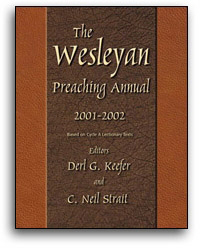
THE WESLEYAN PREACHING ANNUAL 2001--2002
Someone has said that if sin were not in the vocabulary, it would have to be invented. There has to be a way to describe the debaucherous acts of humans. Gerard Reed, in his book, C.S. Lewis and the Bright Shadow of Holiness, wrote: "In its twisted self--service, sin smears creation with its slime" (Kansas City: Beacon Hill Press of Kansas City, 1999, p. 58).

The task of ministry, especially pastoring, is to deal with the slime, the debauchery, the evils sin spawns. It seems a million miles from sinner to Christian, from evil to good, from darkness to light. Pastoring has never been easy, but it is certainly complicated by the sins of modern life.
Where does a pastor begin to make a difference? How does he/she impact the darkness? There are no easy answers. The challenge to make a difference in a culture saturated with evil and selfishness is almost overwhelming. But take courage, the early church had some of its best days in a pagan world, amidst evils and snares not unlike the present. They were outnumbered on every front, but made an impact. They were persecuted, but left a witness. It was the blood of the early Christians which fertilized the growth of Christianity in the first century.
The early church began, and grew, with basic ingredients - prayer, the Word, fellowship, service and evangelism. When you study Acts 2 and 4, it is interesting to note how God blessed these basic principles. It is a reminder for us that some things cannot be improved. Some things have an enduring quality about them which enriches life the more they are used.
The Greek word for pure is katharidzo, and it means "unmixed, unadulterated, sifted, genuine, real, with no added mixture or elements" (David Johnson, Joy Comes In The Morning, Camp Hill, Pa.: Christian Publications, 1998, p. 153). Would it be safe to say that the early Christians were genuine Jesus--people, who lived uncluttered lives and who let their lives speak of and for Jesus? Because they had so little, they depended, totally, on God.
Maybe there is a lesson here for us. We have so much, and try to fit so much into our ministry. We are in a constant rush to attend another seminar, read another book and try another idea. And this is not wrong! It is only when we add too much of them, and leave Him out, or at best, on the margins of our ministry, that creates a problem.
Maybe the lesson we need to learn from the early church is that the basics need to be firmly in place, and anything we add must be to enhance rather than to engulf, to promote, rather than diminish, to add to, rather than take from. David Johnson has reminded us that "... Kingdom living begins with an internal transformation by God's Spirit. And people of the Kingdom are not those folks who have learned about and adhered to a set of rules. It's internal. It's an issue of the heart, for from the heart flow the issues of life itself" (Ibid., p. 153).
The early church went forward on their knees, keeping their hearts tuned to the way and will of the Holy Spirit. Their strategy kept them pure in an impure world. There may be something for us in their committed walk that we need to revisit. It was an unadulterated, genuine and real life, lived in the power of the Spirit. Its purity left its mark on pagan neighbors. "And the Lord added to their number daily those who were being saved" (Acts 2:47).
C. Neil Strait
The task of ministry, especially pastoring, is to deal with the slime, the debauchery, the evils sin spawns. It seems a million miles from sinner to Christian, from evil to good, from darkness to light. Pastoring has never been easy, but it is certainly complicated by the sins of modern life.
Where does a pastor begin to make a difference? How does he/she impact the darkness? There are no easy answers. The challenge to make a difference in a culture saturated with evil and selfishness is almost overwhelming. But take courage, the early church had some of its best days in a pagan world, amidst evils and snares not unlike the present. They were outnumbered on every front, but made an impact. They were persecuted, but left a witness. It was the blood of the early Christians which fertilized the growth of Christianity in the first century.
The early church began, and grew, with basic ingredients - prayer, the Word, fellowship, service and evangelism. When you study Acts 2 and 4, it is interesting to note how God blessed these basic principles. It is a reminder for us that some things cannot be improved. Some things have an enduring quality about them which enriches life the more they are used.
The Greek word for pure is katharidzo, and it means "unmixed, unadulterated, sifted, genuine, real, with no added mixture or elements" (David Johnson, Joy Comes In The Morning, Camp Hill, Pa.: Christian Publications, 1998, p. 153). Would it be safe to say that the early Christians were genuine Jesus--people, who lived uncluttered lives and who let their lives speak of and for Jesus? Because they had so little, they depended, totally, on God.
Maybe there is a lesson here for us. We have so much, and try to fit so much into our ministry. We are in a constant rush to attend another seminar, read another book and try another idea. And this is not wrong! It is only when we add too much of them, and leave Him out, or at best, on the margins of our ministry, that creates a problem.
Maybe the lesson we need to learn from the early church is that the basics need to be firmly in place, and anything we add must be to enhance rather than to engulf, to promote, rather than diminish, to add to, rather than take from. David Johnson has reminded us that "... Kingdom living begins with an internal transformation by God's Spirit. And people of the Kingdom are not those folks who have learned about and adhered to a set of rules. It's internal. It's an issue of the heart, for from the heart flow the issues of life itself" (Ibid., p. 153).
The early church went forward on their knees, keeping their hearts tuned to the way and will of the Holy Spirit. Their strategy kept them pure in an impure world. There may be something for us in their committed walk that we need to revisit. It was an unadulterated, genuine and real life, lived in the power of the Spirit. Its purity left its mark on pagan neighbors. "And the Lord added to their number daily those who were being saved" (Acts 2:47).
C. Neil Strait