Psalm 8
Preaching
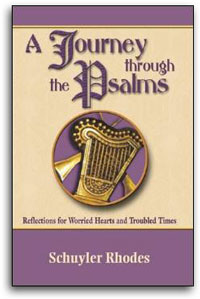
A Journey Through the Psalms: Reflections for Worried Hearts and Troubled Times
Preaching the Psalms Cycles A, B, C
Object:
Knowing one's place in the world is an important thing. Indeed, some would say that it is an essential ingredient in being a full, even sane individual. Without a place in which we belong, we are footloose, adrift, and without connection. Without a niche to call our own we become vagabonds of the spirit, always on the move, always looking for a place to land.

Human history could be described as the never-ending search for just such a place. It is an existential conundrum that finds form in this psalm as the writer ponders what it means to be "a little lower than God...." It is a statement that seems a bit arrogant, but upon examination, strikes home. After all, we have been given "dominion" over the works of God's hands. The sheep, ox, beasts of the fields; the birds and the fish of the sea; all of it is in our hands.
It is a frightful thought, for the truth is that human beings have made a complete mess of things. From the looming catastrophe of global warming to the stripping of the seas of life, our "dominion" has not worked out so well. From growing rates of extinction of a host of creatures to the mowing down of rain forests, one has to wonder if God might have made a slight error in judgment here.
Could it be that humans have only heard part of the reading of this psalm? Could it be that we have embraced the dominion part, but missed out somehow on the part where we are to be in awe of the works of God's hands?
Sure. Humans got the bigger brains, the opposable thumb, and an insatiable drive to expand and control. But did we get the part where we're supposed to love God's creation? Have we taken in the magnitude and glory of this remarkable planet? Or is that mountain in the distance just a hill to be removed so we can get at the coal?
Perhaps the time has come for a holistic embrace of what it means to be stewards of God's creation. Maybe now is a time our species might take stock of the world in which we find ourselves and claim some of that oft discussed "personal responsibility" for the shape in which we have left God's world. Could it be that, like the Holy Trinity, expressed in Creation, Word, and Spirit, our understanding of dominion needs also to be expressed in a threefold fashion?
What if dominion were just one part of a trinity of stewardship? What if there were two other components consisting of compassion and humility? Such an expression of our place in the world might bring a new balance. A holy blend of dominion, compassion, and humility could well be a new expression for how we humans could begin again -- as ones who know their place as stewards and caretakers of one of God's incredible gifts -- creation itself.
Human history could be described as the never-ending search for just such a place. It is an existential conundrum that finds form in this psalm as the writer ponders what it means to be "a little lower than God...." It is a statement that seems a bit arrogant, but upon examination, strikes home. After all, we have been given "dominion" over the works of God's hands. The sheep, ox, beasts of the fields; the birds and the fish of the sea; all of it is in our hands.
It is a frightful thought, for the truth is that human beings have made a complete mess of things. From the looming catastrophe of global warming to the stripping of the seas of life, our "dominion" has not worked out so well. From growing rates of extinction of a host of creatures to the mowing down of rain forests, one has to wonder if God might have made a slight error in judgment here.
Could it be that humans have only heard part of the reading of this psalm? Could it be that we have embraced the dominion part, but missed out somehow on the part where we are to be in awe of the works of God's hands?
Sure. Humans got the bigger brains, the opposable thumb, and an insatiable drive to expand and control. But did we get the part where we're supposed to love God's creation? Have we taken in the magnitude and glory of this remarkable planet? Or is that mountain in the distance just a hill to be removed so we can get at the coal?
Perhaps the time has come for a holistic embrace of what it means to be stewards of God's creation. Maybe now is a time our species might take stock of the world in which we find ourselves and claim some of that oft discussed "personal responsibility" for the shape in which we have left God's world. Could it be that, like the Holy Trinity, expressed in Creation, Word, and Spirit, our understanding of dominion needs also to be expressed in a threefold fashion?
What if dominion were just one part of a trinity of stewardship? What if there were two other components consisting of compassion and humility? Such an expression of our place in the world might bring a new balance. A holy blend of dominion, compassion, and humility could well be a new expression for how we humans could begin again -- as ones who know their place as stewards and caretakers of one of God's incredible gifts -- creation itself.