Proper 7
Preaching
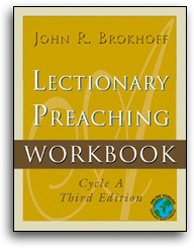
Lectionary Preaching Workbook
Cycle A, THIRD EDITION
THE LESSONS
Lesson 1: Genesis 21:8--21 (C)
Under Sarah's insistence, Abraham expels Hagar and son. The miracle baby, Isaac, arrived. Seeing her son playing with Ishmael, Abraham's son by the Egyptian Hagar, Sarah orders Abraham to get rid of the boy and his mother. Reluctantly, Abraham sends them into a wilderness with a bag of food and water. But, Yahweh came to their rescue.
Lesson 1: Jeremiah 20:10--13 (RC); Jeremiah 20:7--13 (E)
Jeremiah trusts God to deliver him from those who oppose his preaching.

Lesson 2: Romans 6:1b--11 (C); Romans 5:12--15 (RC); Romans 5:15b--19 (E)
As sin and death come through one man (Adam), life and justification come through one man (Jesus). Through one man, Adam, came sin and death; through one man, Jesus, came righteousness and life. Through one man came condemnation; through one man came justification. We sin not because Adam sinned nor because we sinned in Adam. Like Adam, we all sin with or without the law. Through Adam humanity was infected with the disease of sin; through Christ the physician we are healed of our infirmity by grace. Sin results in death, not necessarily physical death, but as separation from God. From Adam's sin we reap condemnation but from the free gift of grace in Christ we receive acquittal and life.
Gospel: Matthew 10:24--39 (C); Matthew 20:26--33 (RC); Matthew 10:(16--23) 24--33 (E)
Though the world may persecute Christ's followers, the Father knows and cares for his people. Jesus has called his disciples and sends them out to preach and heal. As he was persecuted, his disciples could expect no less. They are not to fear those who can kill only the body. It is better to fear God who can kill body and soul. In spite of their hardship, the heavenly Father knows them as intimately as knowing the number of hairs on their heads and cares for them as he cares for even "worthless" birds. As they are faithful in their witness to God, he will be faithful to them.
Psalm Of The Day
Psalm 86:1--19, 16--17 (C) - "Turn to me and be gracious to me" (v. 17).
Psalm 69:1--18 (RC, E) - "Answer me, O Lord, for thy steadfast love is good" (v. 16a).
Prayer Of The Day
"O God, our defender, storms rage about us and cause us to be afraid. Rescue your people from despair, deliver your sons and daughters from fear and preserve us from unbelief."
Hymn Of The Day
"Let Me Be Yours Forever"
THEOLOGICAL REFLECTIONS
Gospel: Matthew 10:24--39
1. Fear (vv. 26, 28, 39). According to Jesus, Christians are not to fear "them." Who are "them"? In the foregoing passage Jesus defines and describes "them" as those who persecute his followers, who in your own family betray you for being Christian, who are hated because they follow Jesus, and who are persecuted as Christians. This points to the fact that Christians live in a hostile world which does not tolerate Christian teachings and practice. The darkness hates the light. Evil is a reality and is not neutral or tolerant of an opposing force or righteousness. This raises the question why so few, if any, Christians are persecuted in America. Is America so Christian as not to oppose Christianity, or are "Christians" not that Christian to arouse hostility?
2. Limitation of evil (v. 28). The worst evil can do is to kill the body. But man is more than a body. No enemy can murder the spirit of a person. It is beyond the physical realm of man. They could crucify the body of Jesus but not his soul, which conquered the hatred that put him on the cross. Enemies could stone Stephen to death, but his spirit won out. Add to the list people like Polycarp, Joan of Arc, and William Tyndale. The one who is lord of both body and soul is God alone. Then, it would be better to fear only God.
3. A caring God (vv. 29--31). Does an infinite being of all power and glory have time and concern for the world, even for the least on earth? It seems that to say he does is incomprehensible. Jesus teaches that at the heart of the universe and at the base of our existence is a God who knows and cares about the least of his creation such as sparrows, and the number of hairs on a human head. Why is this so? It reveals the value God places upon a human. A person is of great worth, not because of any inherent goodness, but because of the value God places on each one of us.
4. Public confession (vv. 32--33). If the Christian religion is a personal religion with God through faith in Christ, can Christianity be a private affair? Can a person be baptized privately in the seclusion of his home? Why bother with joining a church and worshiping publicly? Christianity is personal but never private; it is a fellowship and not an isolated, individualistic affair. Twice Jesus refers to "before men." Who denies Christ publicly will be denied by Christ before God; who confesses him before people, Christ will confess him before God. Christianity cannot be a private, secluded affair. It is to be known, shown, and confessed for all to see and hear.
Lesson 1: Genesis 21:8--21 (C)
1. Feast (v. 8). For Isaac it was a feast; for Ishmael it was a famine. Two boys with the same father had two mothers. Sarah did not want Ishmael to share in Isaac's inheritance. She persuaded Abraham to throw Ishmael and Hagar out of the family into a wilderness. What price jealousy!
2. Cast out (v. 10). With Sarah's insistence and Yahweh's support Abraham drives out his Egyptian wife and son. How cruel and merciless! Is this the godly way of handling family problems? Banish the child? Leave home? Is there not a better way?
3. Heard (v. 17). When the food and water gave out, Hagar cries at her son's approaching death. Ishmael cries out of hunger and thirst. Nobody but God hears their cries. He comes to their rescue and promises to make Ishmael a great nation.
Lesson 1: Jeremiah 20:10--13 (RC); Jeremiah 20:7--13 (E)
1. What do you expect? (v. 7). Jeremiah claims God deceived him. Did Jeremiah expect God to give him favor with man because he accepted the call to preach? Look what his preaching got him: he is a laughingstock among his people, he is denounced by his friends, his enemies are waiting to get revenge, the people refuse to accept his messages. Answering God's call to be a faithful witness and disciple does not guarantee honor, acceptance, or well--being.
2. Driven (v. 4). Here is one who wants to quit but cannot. He decides not to preach but he finds himself driven to keep going. It is like a fire in his bones that must be expressed or explode! He is driven by an inner voice. The love of Christ, faith of God, the sense of obedience, impel, and compel one to witness regardless of popular acceptance.
3. Faith (v. 11). Faith overcomes fear. In the midst of persecution, Jeremiah puts his trust in God's deliverance from his enemies. He was sure God would vindicate him and his oppressors would be eliminated. His trust was justified, for when he was released from the dungeon, Jeremiah exulted, "Praise the Lord!" (v. 13).
Lesson 2: Romans 5:12--15 (RC); Romans 5:15b--19 (E)
1. Corporateness (v. 12). Death and life came to humankind through one man: death by Adam, life by the second Adam. This is possible because humanity is corporate; no man is an island. What good or evil is done affects the rest of the human race. It is inevitable because of the oneness of humanity. Thus, sin comes through one man, Adam, and life comes through one man, Jesus.
2. Sin (vv. 12--14). Sin - sin - transgressions - law - death: all are mentioned in this passage. Sin is the condition of rebellion and disobedience performed by Adam. Since Adam all have the same sin. It is a part of being human. Sin is a condition of human nature expressing itself in sins or transgressions in thought, word, or deed. The law exposes the sin that is in us. Even if there were no law, we may not recognize our sins, but sin would still exist, for law does not change human nature. The result of sin is death - spiritual death in terms of separation from God. To die physically is human normality; to die spiritually is to reap the consequences of sin.
3. Grace (v. 15). Life comes to humanity through one man, Jesus Christ. It is not earned as sin is, but it is a gift resulting from God's grace. Through the cross grace brings life, for life is union with God - justification, reconciliation, peace. If life comes through one man, then to believe and accept Christ is a necessity for the world to be reconciled to God and thus to be saved.
PREACHING POSSIBILITIES
Gospel: Matthew 10:24--39
1. The Conquest Of Fear. 10:26--33
Need: Fear is not easy to overcome. One can reason it through and arrive at the conclusion that there is no good reason to fear. One can argue himself into agreeing that fear is unnecessary. All the thinking and talking about the futility of fear does not take it away. It seems to rest in one's feelings that are deeper than any rational arguments. Thus, faith that deals with basic feelings is the cure for fear. We need to be reminded that the Gospel lesson deals with fear of our enemies who oppose our Christian faith.
Outline: Faith conquers fear because -
a. Faith is certain we shall overcome - v. 21.
b. Faith is in God rather than in man - v. 28.
c. Faith in God's care of us - vv. 29--31.
2. Why Are We Not Afraid? 10:26, 28, 31
Need: The Gospel for today assumes that we Christians are being persecuted for our faith. This is not the case in America as it is in some Communist and Fascist countries. Time magazine reported that 800 Latin American clergymen have been jailed, kidnapped, or killed. Is this Gospel meaningless, therefore, to American Christians? Why are we not being persecuted for our faith?
Outline: Why are we not afraid of persecution?
a. Does America not have people hostile toward Christianity?
b. Has American Christianity become innocuous and tolerant of evil?
c. Are Christians no different from non--Christians?
3. Fear That Chases Fears. 10:28
Need: Fear cannot be totally eradicated from the psyche. Fear is a part of our make--up. It is a question what or whom we fear. In this text, Jesus calls upon us to fear God and not people. When God is feared, fears of people disappear. It is said of John Knox that he so feared God that he feared no man. Jesus points out that it would be better to fear God who can kill body and soul than to fear a person who can kill only the body.
Outline: Fear God -
a. And the lesser fear of people disappears.
b. And you lose the fear of judgment for sin.
c. And you lose the fear of failure.
Lesson 1: Genesis 21:8--21 (C) (Preaching Themes)
1. Partial Parents. 21:8--11
Children have a right to equal treatment by parents. Nevertheless, at times one or both parents show partiality. Sarah is partial to Isaac as Rebekah was partial to Jacob. On Sarah's part there were jealousy and envy as she watched her son and stepson play together. The challenge for parents is to love each child equally.
2. Innocent Suffering. 21:14
As Adam listened to his wife, Abraham listened and obeyed Sarah. She asked out of pride, jealousy, and envy. And what was the result? Innocent suffering. Did Ishmael as a little boy deserve facing death in a wilderness? How did Hagar deserve her rejection? After all, Sarah suggested to Abraham that he have a son by Hagar. People innocently suffer from the sins of others. Babies suffer from drug--addicted mothers. The supreme example of innocent suffering is Jesus on the cross.
3. A Caring God. 21:15--21
When nobody else hears the cry of the needy and oppressed, God does. He heard the crying of Hagar and Ishmael. When the Israelites were slaves in Egypt, God again heard the cry of his oppressed people. We have a God who cares. Jesus was a man of compassion. He cared enough to sacrifice himself on a cross to bring us out of death to life.
Lesson 1: Jeremiah 20:10--13 (RC); Jeremiah 20:7--13 (E)
1. A Preacher's Life. 20:7--13
Need: How many lay people know what a preacher (prophet) goes through to be a faithful spokesperson for God? Jeremiah gives us a view of what goes on in a preacher's heart as he faithfully proclaims God's Word to an unsympathetic people. Occasionally, it is good for a congregation to understand the inner struggle of a preacher that it may understand and pray for him in his work as God's spokesperson.
Outline: Consider what may happen in a preacher's life.
a. A feeling of misgiving - v. 7.
b. An uncomfortable message to proclaim- v. 8.
c. A negative response - vv. 7, 10.
d. An inner compulsion to preach - v. 9.
2. If You Tell The Truth. 20:7--13
Need: If you tell the truth, like Jeremiah, you are in trouble. The truth hurts people. They will not like it. They would rather get rid of you than accept the truth which would compel them to change their ways. Yet, this is the call of a Christian - to tell the truth of God at all times.
Outline: If you tell the truth -
a. You will be unpopular - v. 7b.
b. You will have an unpleasant message - v. 8.
c. You will have opposition - v. 10.
Lesson 2: Romans 5:12--15 (RC); Romans 5:15b--19 (E)
1. It Took Only One. 5:12, 15
Need: In this pericope, Paul reminds us of the corporateness of humanity. We are as one person. What one does affects the whole. No man is an island. One lives or dies to himself. Because of this, one person's sin can pollute the whole human race. We call it "original sin." One man's death on a cross means life for all who accept him by faith. Through this sermon people should get an understanding of the reason for their sinning and should look to Jesus for deliverance.
Outline: It took only one -
a. For sin to enter the world - v. 12.
b. For sin to exit the world - v. 15.
2. Why Do Christians Die? 5:12--15
Need: Sin brings death. Christ brings life. Why then do Christians die? The answer is in the understanding of the biblical teaching of death. There is a physical and a spiritual death. Sin brings separation from God, and this is the meaning of death. Premature physical death may result from sinful living. A Christian dies physically like all people die, but a Christian never dies spiritually. Nothing can separate us from the love of God, not even physical death.
Outline: Which death will be yours?
a. Physical death is unnecessary.
1. Sin brings death.
2. Grace brings eternal life.
Lesson 1: Genesis 21:8--21 (C)
Under Sarah's insistence, Abraham expels Hagar and son. The miracle baby, Isaac, arrived. Seeing her son playing with Ishmael, Abraham's son by the Egyptian Hagar, Sarah orders Abraham to get rid of the boy and his mother. Reluctantly, Abraham sends them into a wilderness with a bag of food and water. But, Yahweh came to their rescue.
Lesson 1: Jeremiah 20:10--13 (RC); Jeremiah 20:7--13 (E)
Jeremiah trusts God to deliver him from those who oppose his preaching.
Lesson 2: Romans 6:1b--11 (C); Romans 5:12--15 (RC); Romans 5:15b--19 (E)
As sin and death come through one man (Adam), life and justification come through one man (Jesus). Through one man, Adam, came sin and death; through one man, Jesus, came righteousness and life. Through one man came condemnation; through one man came justification. We sin not because Adam sinned nor because we sinned in Adam. Like Adam, we all sin with or without the law. Through Adam humanity was infected with the disease of sin; through Christ the physician we are healed of our infirmity by grace. Sin results in death, not necessarily physical death, but as separation from God. From Adam's sin we reap condemnation but from the free gift of grace in Christ we receive acquittal and life.
Gospel: Matthew 10:24--39 (C); Matthew 20:26--33 (RC); Matthew 10:(16--23) 24--33 (E)
Though the world may persecute Christ's followers, the Father knows and cares for his people. Jesus has called his disciples and sends them out to preach and heal. As he was persecuted, his disciples could expect no less. They are not to fear those who can kill only the body. It is better to fear God who can kill body and soul. In spite of their hardship, the heavenly Father knows them as intimately as knowing the number of hairs on their heads and cares for them as he cares for even "worthless" birds. As they are faithful in their witness to God, he will be faithful to them.
Psalm Of The Day
Psalm 86:1--19, 16--17 (C) - "Turn to me and be gracious to me" (v. 17).
Psalm 69:1--18 (RC, E) - "Answer me, O Lord, for thy steadfast love is good" (v. 16a).
Prayer Of The Day
"O God, our defender, storms rage about us and cause us to be afraid. Rescue your people from despair, deliver your sons and daughters from fear and preserve us from unbelief."
Hymn Of The Day
"Let Me Be Yours Forever"
THEOLOGICAL REFLECTIONS
Gospel: Matthew 10:24--39
1. Fear (vv. 26, 28, 39). According to Jesus, Christians are not to fear "them." Who are "them"? In the foregoing passage Jesus defines and describes "them" as those who persecute his followers, who in your own family betray you for being Christian, who are hated because they follow Jesus, and who are persecuted as Christians. This points to the fact that Christians live in a hostile world which does not tolerate Christian teachings and practice. The darkness hates the light. Evil is a reality and is not neutral or tolerant of an opposing force or righteousness. This raises the question why so few, if any, Christians are persecuted in America. Is America so Christian as not to oppose Christianity, or are "Christians" not that Christian to arouse hostility?
2. Limitation of evil (v. 28). The worst evil can do is to kill the body. But man is more than a body. No enemy can murder the spirit of a person. It is beyond the physical realm of man. They could crucify the body of Jesus but not his soul, which conquered the hatred that put him on the cross. Enemies could stone Stephen to death, but his spirit won out. Add to the list people like Polycarp, Joan of Arc, and William Tyndale. The one who is lord of both body and soul is God alone. Then, it would be better to fear only God.
3. A caring God (vv. 29--31). Does an infinite being of all power and glory have time and concern for the world, even for the least on earth? It seems that to say he does is incomprehensible. Jesus teaches that at the heart of the universe and at the base of our existence is a God who knows and cares about the least of his creation such as sparrows, and the number of hairs on a human head. Why is this so? It reveals the value God places upon a human. A person is of great worth, not because of any inherent goodness, but because of the value God places on each one of us.
4. Public confession (vv. 32--33). If the Christian religion is a personal religion with God through faith in Christ, can Christianity be a private affair? Can a person be baptized privately in the seclusion of his home? Why bother with joining a church and worshiping publicly? Christianity is personal but never private; it is a fellowship and not an isolated, individualistic affair. Twice Jesus refers to "before men." Who denies Christ publicly will be denied by Christ before God; who confesses him before people, Christ will confess him before God. Christianity cannot be a private, secluded affair. It is to be known, shown, and confessed for all to see and hear.
Lesson 1: Genesis 21:8--21 (C)
1. Feast (v. 8). For Isaac it was a feast; for Ishmael it was a famine. Two boys with the same father had two mothers. Sarah did not want Ishmael to share in Isaac's inheritance. She persuaded Abraham to throw Ishmael and Hagar out of the family into a wilderness. What price jealousy!
2. Cast out (v. 10). With Sarah's insistence and Yahweh's support Abraham drives out his Egyptian wife and son. How cruel and merciless! Is this the godly way of handling family problems? Banish the child? Leave home? Is there not a better way?
3. Heard (v. 17). When the food and water gave out, Hagar cries at her son's approaching death. Ishmael cries out of hunger and thirst. Nobody but God hears their cries. He comes to their rescue and promises to make Ishmael a great nation.
Lesson 1: Jeremiah 20:10--13 (RC); Jeremiah 20:7--13 (E)
1. What do you expect? (v. 7). Jeremiah claims God deceived him. Did Jeremiah expect God to give him favor with man because he accepted the call to preach? Look what his preaching got him: he is a laughingstock among his people, he is denounced by his friends, his enemies are waiting to get revenge, the people refuse to accept his messages. Answering God's call to be a faithful witness and disciple does not guarantee honor, acceptance, or well--being.
2. Driven (v. 4). Here is one who wants to quit but cannot. He decides not to preach but he finds himself driven to keep going. It is like a fire in his bones that must be expressed or explode! He is driven by an inner voice. The love of Christ, faith of God, the sense of obedience, impel, and compel one to witness regardless of popular acceptance.
3. Faith (v. 11). Faith overcomes fear. In the midst of persecution, Jeremiah puts his trust in God's deliverance from his enemies. He was sure God would vindicate him and his oppressors would be eliminated. His trust was justified, for when he was released from the dungeon, Jeremiah exulted, "Praise the Lord!" (v. 13).
Lesson 2: Romans 5:12--15 (RC); Romans 5:15b--19 (E)
1. Corporateness (v. 12). Death and life came to humankind through one man: death by Adam, life by the second Adam. This is possible because humanity is corporate; no man is an island. What good or evil is done affects the rest of the human race. It is inevitable because of the oneness of humanity. Thus, sin comes through one man, Adam, and life comes through one man, Jesus.
2. Sin (vv. 12--14). Sin - sin - transgressions - law - death: all are mentioned in this passage. Sin is the condition of rebellion and disobedience performed by Adam. Since Adam all have the same sin. It is a part of being human. Sin is a condition of human nature expressing itself in sins or transgressions in thought, word, or deed. The law exposes the sin that is in us. Even if there were no law, we may not recognize our sins, but sin would still exist, for law does not change human nature. The result of sin is death - spiritual death in terms of separation from God. To die physically is human normality; to die spiritually is to reap the consequences of sin.
3. Grace (v. 15). Life comes to humanity through one man, Jesus Christ. It is not earned as sin is, but it is a gift resulting from God's grace. Through the cross grace brings life, for life is union with God - justification, reconciliation, peace. If life comes through one man, then to believe and accept Christ is a necessity for the world to be reconciled to God and thus to be saved.
PREACHING POSSIBILITIES
Gospel: Matthew 10:24--39
1. The Conquest Of Fear. 10:26--33
Need: Fear is not easy to overcome. One can reason it through and arrive at the conclusion that there is no good reason to fear. One can argue himself into agreeing that fear is unnecessary. All the thinking and talking about the futility of fear does not take it away. It seems to rest in one's feelings that are deeper than any rational arguments. Thus, faith that deals with basic feelings is the cure for fear. We need to be reminded that the Gospel lesson deals with fear of our enemies who oppose our Christian faith.
Outline: Faith conquers fear because -
a. Faith is certain we shall overcome - v. 21.
b. Faith is in God rather than in man - v. 28.
c. Faith in God's care of us - vv. 29--31.
2. Why Are We Not Afraid? 10:26, 28, 31
Need: The Gospel for today assumes that we Christians are being persecuted for our faith. This is not the case in America as it is in some Communist and Fascist countries. Time magazine reported that 800 Latin American clergymen have been jailed, kidnapped, or killed. Is this Gospel meaningless, therefore, to American Christians? Why are we not being persecuted for our faith?
Outline: Why are we not afraid of persecution?
a. Does America not have people hostile toward Christianity?
b. Has American Christianity become innocuous and tolerant of evil?
c. Are Christians no different from non--Christians?
3. Fear That Chases Fears. 10:28
Need: Fear cannot be totally eradicated from the psyche. Fear is a part of our make--up. It is a question what or whom we fear. In this text, Jesus calls upon us to fear God and not people. When God is feared, fears of people disappear. It is said of John Knox that he so feared God that he feared no man. Jesus points out that it would be better to fear God who can kill body and soul than to fear a person who can kill only the body.
Outline: Fear God -
a. And the lesser fear of people disappears.
b. And you lose the fear of judgment for sin.
c. And you lose the fear of failure.
Lesson 1: Genesis 21:8--21 (C) (Preaching Themes)
1. Partial Parents. 21:8--11
Children have a right to equal treatment by parents. Nevertheless, at times one or both parents show partiality. Sarah is partial to Isaac as Rebekah was partial to Jacob. On Sarah's part there were jealousy and envy as she watched her son and stepson play together. The challenge for parents is to love each child equally.
2. Innocent Suffering. 21:14
As Adam listened to his wife, Abraham listened and obeyed Sarah. She asked out of pride, jealousy, and envy. And what was the result? Innocent suffering. Did Ishmael as a little boy deserve facing death in a wilderness? How did Hagar deserve her rejection? After all, Sarah suggested to Abraham that he have a son by Hagar. People innocently suffer from the sins of others. Babies suffer from drug--addicted mothers. The supreme example of innocent suffering is Jesus on the cross.
3. A Caring God. 21:15--21
When nobody else hears the cry of the needy and oppressed, God does. He heard the crying of Hagar and Ishmael. When the Israelites were slaves in Egypt, God again heard the cry of his oppressed people. We have a God who cares. Jesus was a man of compassion. He cared enough to sacrifice himself on a cross to bring us out of death to life.
Lesson 1: Jeremiah 20:10--13 (RC); Jeremiah 20:7--13 (E)
1. A Preacher's Life. 20:7--13
Need: How many lay people know what a preacher (prophet) goes through to be a faithful spokesperson for God? Jeremiah gives us a view of what goes on in a preacher's heart as he faithfully proclaims God's Word to an unsympathetic people. Occasionally, it is good for a congregation to understand the inner struggle of a preacher that it may understand and pray for him in his work as God's spokesperson.
Outline: Consider what may happen in a preacher's life.
a. A feeling of misgiving - v. 7.
b. An uncomfortable message to proclaim- v. 8.
c. A negative response - vv. 7, 10.
d. An inner compulsion to preach - v. 9.
2. If You Tell The Truth. 20:7--13
Need: If you tell the truth, like Jeremiah, you are in trouble. The truth hurts people. They will not like it. They would rather get rid of you than accept the truth which would compel them to change their ways. Yet, this is the call of a Christian - to tell the truth of God at all times.
Outline: If you tell the truth -
a. You will be unpopular - v. 7b.
b. You will have an unpleasant message - v. 8.
c. You will have opposition - v. 10.
Lesson 2: Romans 5:12--15 (RC); Romans 5:15b--19 (E)
1. It Took Only One. 5:12, 15
Need: In this pericope, Paul reminds us of the corporateness of humanity. We are as one person. What one does affects the whole. No man is an island. One lives or dies to himself. Because of this, one person's sin can pollute the whole human race. We call it "original sin." One man's death on a cross means life for all who accept him by faith. Through this sermon people should get an understanding of the reason for their sinning and should look to Jesus for deliverance.
Outline: It took only one -
a. For sin to enter the world - v. 12.
b. For sin to exit the world - v. 15.
2. Why Do Christians Die? 5:12--15
Need: Sin brings death. Christ brings life. Why then do Christians die? The answer is in the understanding of the biblical teaching of death. There is a physical and a spiritual death. Sin brings separation from God, and this is the meaning of death. Premature physical death may result from sinful living. A Christian dies physically like all people die, but a Christian never dies spiritually. Nothing can separate us from the love of God, not even physical death.
Outline: Which death will be yours?
a. Physical death is unnecessary.
1. Sin brings death.
2. Grace brings eternal life.